
VENOSA, DIOCESE of. — City and diocese in the province of Potenza; it has an area of 587 sq. km and a population of 50,200 inhabitants, of whom 50,000 are Catholics, distributed among 10 parishes served by 28 diocesan and 11 religious priests; it has a seminary; 3 male and 6 female religious communities (Ann. Pont. 1953, p. 444).
I. HISTORY
An Apulian rather than Lucanian city, V. acquired importance after the Samnite domination. Rome established there a populous colony under Latin law (291 B.C.) and always took care that the city should be militarily impregnable, owing to its strategic position on the Via Appia and among the neighboring peoples. Although faithful to Rome during the Punic Wars and an operational stronghold after the defeat at Cannae, V. War. It was the birthplace of Q. Orazio Flacco (65–8 B.C.).The introduction of Christianity must have been encouraged both by the city’s military and civil preeminence and, after the fall of Jerusalem, by the formation of a flourishing colony of Jews, who had a permanent settlement there, as attested by the existence of their own burial area. The presence of this Jewish group suggests that a Christian community was formed at an early date, but nothing is known of its size, and even less of the time when it was raised to the status of a diocese. As for the historicity of the first commonly known bishop, named Felice, a Passio manipulated in five different redactions (BHL, 2894, 2895, and 2895 b; Anal. Boll., 1921, pp. 246, 252–59, and 270–79) offers scant grounds for belief. The martyr Felice in fact belonged to the city of Thibieuca (Proconsular Africa), whereas the homonymous bishop of Venosa may have been either a saint from another Italian city, the same African bishop, or—an even less acceptable hypothesis—an unknown local martyr, whose place of burial would not even be known. The second name in the catalogue, Filippo, consecrated, according to Ughelli (VII, p. 168), by Pope Fabiano in 238, is legendary, no less than the next, Giovanni, whom Ughelli places under Leone I (440–61), attributing to him, in imitation of that pontiff’s achievement, the merit of having halted Attila as he threatened V. Lanzoni (I, p. 299), on the other hand, assigns him to the sixteenth century, regarding him as a corruption of Bongiovanni. Asterio (or Austerio), likewise included by a Vita et translationi s. Sabini of Canosa (chap. II, BHL, 7443) among the prelates who took part in the blessing by Gelasio I of the church of S. Andrea at Barletta, is also without foundation, because in Gelasio’s time the bishop of V. was Stefano (492–502; Jaffé-Wattenbach, 653–660, 689), who appears to be the first historically known figure in the Venosan catalogue; he took part in the Roman Councils (501–504) of Pope Simmaco.
After Felice, the city’s vicissitudes and its inevitable decline as a result of the barbarian invasions left no record of bishops until 1014, when Pietro is mentioned as having been present at the consecration of the so-called Madonna della Foresta at Lavello. Occupied by the Ostrogoths (493–553) and placed under the gastaldato of Acerenza by the Lombards, V. during those centuries changed hands several times between the Byzantines and the Saracens, who razed it to the ground. Its revival began only with the Normans: Drogone, brother of Guiscardo, while Giaquinto (or Giacinto; 1053) was bishop, donated the celebrated abbey of the S.ma Trinità to Abbot Gaufrido; it was to receive the remains of most of the Altavilla family. Although struggles over the succession sometimes violently engulfed the city, V. continued to flourish, so much so that under Federico II it was a temporary seat of the empire. The advent of the Angevins marked the beginning of its definitive decline and of the succession of lordships—from the Sanseverino to the Aragonese and the Bourbons—that weighed upon the city. The series of bishops after Giaquinto is almost complete. The following may be mentioned: Costantino (or Costanzo), who in 1071 took part in the consecration of the church of Montecassino performed by Alessandro II and received various donations for the S.ma Trinità from Duke Roberto; Pietro, present at the Lateran Council of 1179 and mentioned in connection with numerous grants to the Benedictine abbey of S. Maria di Monte Albo near V.; and Bongiovanni (1501), formerly the personal physician of Alessandro VI and a generous helper during a terrible plague, whose cessation prompted the construction of the church of SS. Rocco e Sebastiano, which was given to the Capuchins.
The diocese, which included Forenza, Spinazzola, and smaller centers, has since 1818 also extended its jurisdiction over the diocese of Lavello, suppressed by Pio VII with the bull De utiliori Dominicae.
MONUMENTS. - Just outside the town, in 1853, a Jewish hypogeum dating from the 3rd–4th centuries A.D. was brought to light, excavated in volcanic tuff: it consists of a principal gallery, from which passageways and smaller recesses branch off on either side. Forty-seven inscriptions were found there, painted in red on a lime-washed surface or scratched onto the closures of the loculi, together with numerous forms. Written in Greek, Hebrew, or Latin, and not without vernacular terms, they offer invocations for peace and Jewish symbols, such as the
seven- and nine-branched menorah. More recently, near the catacomb, a smaller hypogeum rich in marble was discovered, with a Roman column at the entrance serving as an architrave; an inscription revealed the existence of a certain “Markellus,” head of the city.
Also outside the city walls is the monumental complex of the Holy Trinity, comprising two churches and the remains of the Benedictine monastery. The smaller and older church, the genuine royal chapel of the Norman county, is thought to have been built over a temple sacred to the god Hymen in the 4th century, but the little that remains of the ancient structure makes it impossible to establish its origin precisely. The building, of modest proportions, is connected with the once-powerful monastery by means of a square room, the so-called guesthouse, which its forms would suggest was transformed into a fortress when the abbey passed into the possession of the Knights of St John of Jerusalem (1292; cf. Ughelli, VII, p. 176). The entrance, at the end of the guesthouse, with its fine ogival portal, leads into a three-aisled space divided by piers and closed by a semicircular apse. The original building by Drogone, consecrated by Nicholas II in 1059, was greatly altered during the Hospitallers’ restoration work; what remain are a Norman capital used as a stoup, the so-called column of friendship, and the tomb of Alberada, first wife of Roberto il Guiscardo, the sole surviving one among the Norman tombs that received the remains of the Altavilla family. It consists of a cipollino marble sarcophagus, flanked by two small columns with elongated capitals supporting a classical entablature; related examples, certainly inspired by V., are the tomb of Bohemond at Canosa, the funerary monuments in Palermo Cathedral, and the tomb of Alfano in S. Maria in Cosmedin in Rome. Finally, the few remains of fourteenth-century wall paintings should be noted, including a Pietà attributed to R. Oderisi. The second church, larger but unfinished, was begun in the first decades of the 12th century, just beyond the apse of the smaller one. It was intended to be a great basilica with a Latin-cross plan, measuring 69 × 22.50 m, with three aisles divided by columns, a broad transept, a deep presbytery, an ambulatory, and a three-apsed outer curve. The construction, carried out with material taken from the Roman buildings of V., is inspired by certain monumental Italian and Burgundian examples, perhaps with greater eurhythmy. Remarkable are
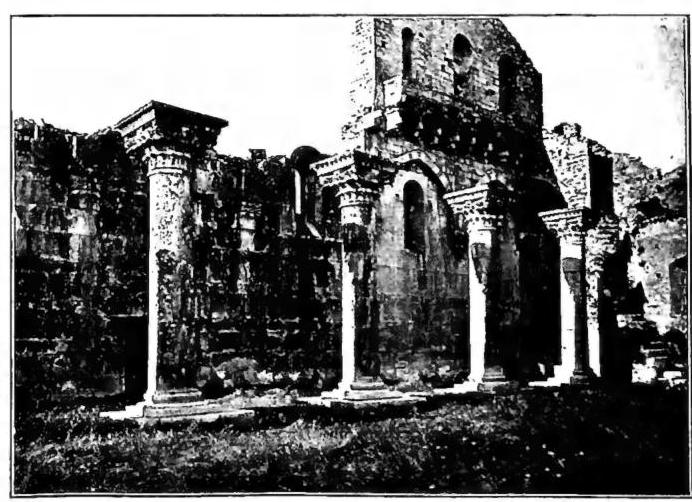
(fot. Alinari)
Of the other churches of Venosa (S. Maria della Scala, S. Biagio, S. Martino, S. Domenico, and the Purgatorio, with modest works by various artists), only the cathedral retains some interest. After the demolition of the old building, also dedicated to S. Andrea, the new church was erected through the efforts of Pirro del Balzo and consecrated in 1531. It has a fine portal by Cola di Conza (1512), a bell tower with Roman marble and inscriptions, a richly decorated Chapel of the Sacrament with a powerful marble arch (1520), and minor works. Finally, mention should be made of the medieval convent of S. Francesco, whose church retains almost nothing of the original.
BIBLI: Ughelli, VII, pp. 166-82; P. A. Corsignani, Symodus diocesana eccl. Venusinae. Historica monum. una cum episcop. catalogo, Roma 1738; Moroni, XCIII, pp. 166-74; Cappelletti, XX, pp. 493-509; O. Hirschfeld, Le catacombe degli Ebrei a V., in Bull. dell'Ist. di corrisp. archeol., 1867, pp. 148-52; A. Lavista, Notiz. stor. degli antichi e presenti tempi della città di V., Potenza 1868; P. B. Gams, Series episcop., Ratisbona 1872, p. 940; N. Albano, Cenno topogr.-stor. su V., Napoli 1879; G. Lenormant, Melfi e V., ivi 1883, p. 38 sgg.; id., La catacombe juive de V., in Revue des études juives, 6 (1883), pp. 200-207; R. Garrucci, Cimitero ebraico di V. in Puglia, in Civ. Catt., 12ª serie, 1883, I, pp. 707-20; G. Crudo, La S.ma Trinità di V. Mem. stor. e diplomatiche, Trani 1899; A. Avena, Monum. dell'Ital. merid., Roma 1902, pp. 323-35; G. Di Lorenzo, V. e la regione del Vulture (Italia artist., I, XXIV), Bergamo 1906; N. Jacobone, Venusia, Storia e topografia, Trani 1909; W. Arslan, Relaz. di una Missione artist. in Basilicata, in Campagne della Società Magna Grecia, Roma 1928, pp. 81-83; N. Jacobone, La patria di Orazio, in Japigia, 1935, pp. 307-32; Lanzoni, I, pp. 158, 285-88, 291-90, 396; R. Bordenache, Due monum. della Ital. merid., in Bull. d'Arte, 27 (1933), pp. 178-84; id., La S.ma Trinità di V., Roma 1937 (estratto da Ephemeris dacoromana); E. Lauridia, Guida di V., Melfi 1935; J. B. Frey, Corpus inscript. judaic., I, Città del Vaticano 1936, pp. 420-43; C. Valente, Riflessi della civiltà della Magna Grecia e di Roma, Roma 1938; Cottineau, II, 3328; S. Bottari, La Bourgogne et la première architecture normande en Italie méridionale et en Sicile, in Revue des arts. 3 (1953), pp. 2-12. Pasquale Testini