
VENTIMIGLIA, DIOCESI di. - It has an area of 715.50 sq. km., with 101,000 inhabitants, of whom 155 are non-Catholics. It has 82 parishes and one autonomous curé vicar; 254 churches and public oratories,
(phot. Anderson)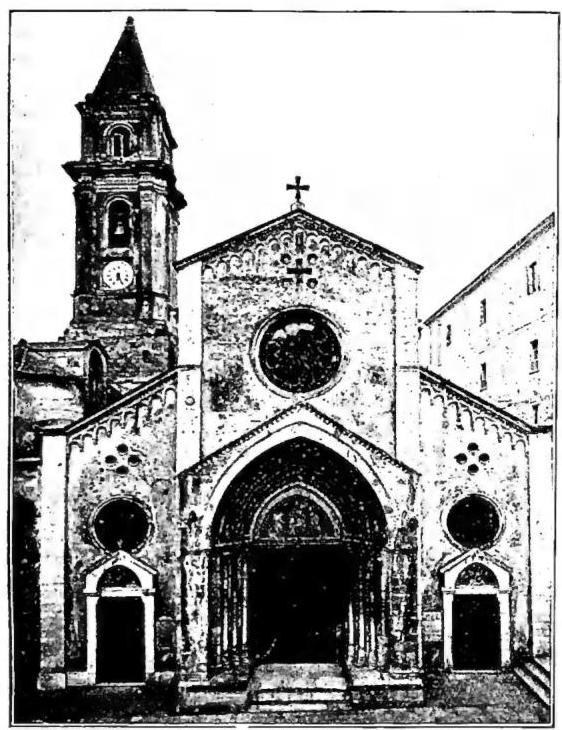
I. ORIGIN AND DEVELOPMENT OF THE DIOCESE
V. (Albium Intemelium of the Ligurians, Albium intemelium of the Romans) was one of the most flourishing municipalities of maritime Liguria and, due to its position along the Via Giulia Augusta between Italy and Gaul, was naturally open to the earliest evangelizing currents heading West. The Roman city stood in the Nervia plain, east of the present center; but with the fall of the Roman world, it was destroyed and gradually abandoned between the 5th and 8th centuries, and eventually transferred, with all its urban and ecclesiastical prerogatives, to the fortified hill west of the Roia, where it survived until the last century and where the bishop's seat is still located.The early religious events of the city remain obscure; they must have taken place in the center of the Roman city at Nervia, the seat of the first bishops and of the first, now vanished, cathedral. A local martyr of very doubtful origin and relevance is s. Secondo, ascribed to the Theban Legion, whose cult gained importance especially from the 17th century onward. The cult of s. Ampelio, located at Capo di Bordighera, is also embellished with legendary details and cannot be proven before the 12th century. The first known bishop is Giovanni, present at the Roman Council of the year 680; one must then reach 1045 to find another reliably documented bishop, Tommaso. Given the great power assumed during this period by the counts of V., independent lords of the County that extended over the entire territory of the diocese, the bishops do not appear to have ever had a significant influence on temporal power. Starting from the 12th century, the Benedictines of the abbey
of Lérins, on the Provençal coast, held extensive possessions in the diocese. When, in the 13th century, V. succumbed to Genoese conquest and the County of V. was partitioned between Genoa and Provence (Treaty of Aix of 1261), the bishop maintained his jurisdiction unaltered over the territory of various states and lordships (Genoa and Provence until 1388; then Genoa and Piedmont, in addition to the Marchesate of Dolceacqua and the Principality of Monaco); the bishop consequently found himself in an extremely delicate position, and among rival powers he long maintained the spiritual unity of the diocesan territory. The most notable repercussion of the centrifugal forces still acting within the diocese occurred during the Western Schism, when V., having remained faithful to the Roman Pope together with the parishes subject to Genoa, a rival bishopric was created at Sospello by the Avignon antipopes, which had its own bishops from 1360 to 1411 for the territory under Angevin rule. Once the unity of the diocese was restored, the bishops of V. often exercised a stabilizing and pacifying function in relations between neighboring states, not without suffering, especially in the 18th century, the consequences of the struggle between Genoa and the House of Savoy, right up to the French Revolution.
In 1802 the diocese was dismembered, with the attribution of the western half of its territory (formerly belonging to the Savoys and now passed to France) to the diocese of Nice; it was reduced to a mere 15 parishes and ran the risk of suppression; in 1806 it was also detached from the Milanese Church, of which it had remained a suffragan, and assigned to the Archdiocese of Aix. However, in 1820, with the fall of Napoleon, the diocese was reassigned to the Archdiocese of Genoa; and it was subsequently reconstituted in 1831 in a new form, with the restitution of the parishes of Val Nervia and the assignment of a large territory taken from the neighboring diocese of Albenga (Sanremo and Taggia, with the entire Argentina valley and surroundings), in compensation for the parishes lost in the West to the definitive advantage of Nice. Tenda and Briga were restored to it in 1886, having remained Italian after the annexation of Nice to France; they were detached from it once again for the benefit of Nice in 1947.
II. BISHOPS AND DISTINGUISHED FIGURES
The series of the bishops of V. is uncertain and incomplete until the 12th century, due to the general scarcity of early medieval documents: those inserted by local historians between 680 and 1045 are doubtful or apocryphal. It becomes continuous starting with Bishop Cornelius, who in 1146 intervened in the dispute between the Chapter and the monks of S. Michele. Deserving of special mention are: Benedetto Boccanegra (1382-1409), who fought strenuously to save the prestige and unity of the diocese during the Schism; the Milanese Carlo Visconti (1562-65), who participated in the Council of Trent and was one of the first bishops to establish a seminary in his diocese (1564); Msgr. Francesco Galbiati da Pontremoli (1573-1600), a disciple and confidant of Card. Borromeo, who dedicated himself to restoring the prestige of Catholicism against the Reformation, which had taken particularly firm root in the mountainous territories of the diocese; Msgr. Mauro Promontorio (1654-85), who carried out great religious activity and at the same time intervened several times in the disputes between Genoa and the Duchy of Savoy; Msgr. Domenico Clavarini (1775-97), who courageously opposed the overbearing acts of the French revolutionaries and died of grief because of them. Among the most recent ones are also mentioned Msgr. Giovanni Battista De Albertis (1831-36), Msgr. Lorenzo Battista Biale (1837-77), Msgr. Tommaso Reggio (1877-93), and Msgr. Ambrogio Daffra (1893-1932), all men of high culture and distinguished piety, who contributed to raising the fortunes of the diocese mutilated by political events and to re-establishing its religious and spiritual unity in a new form.V. also gave the Church a few blesseds in the 15th and 16th centuries: Bl. Guglielmo da V., a Franciscan, who apparently died in 1430; Bl. Serafino da Castiglione, also a Franciscan and also dead in 1430; Bl. Tommaso Stridonio, a Franciscan, who died in 1520. Also to be remembered are Fr. Agostino da V., a Capuchin, who became famous during the plague in Genoa in 1579, and finally Fr. Angelico Aprosio, an Augustinian, a 17th-century man of letters of great fame, who in 1647 founded in V. Liguria, the Biblioteca Aprosiana, still linked to his name.
III. MONUMENTS AND SANCTUARIES
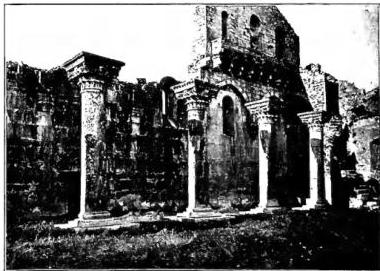
The Cathedral is of Lombard origin; the present structures date from the 11th and 12th centuries, with later modifications (it was restored externally in 1950); it stands in the center of the medieval city, together with the Baptistery (11th century) and the church of S. Michele (11th-13th centuries), a Romanesque building of great importance also for its history. The basilica of S. Siro in Sanremo (14th century, built over older Romanesque structures) has become the co-cathedral; it is the center of the new part of the diocese, detached from the bishopric of Albenga. It was formerly the seat of a "chorepiscopate," dependent on the Archbishop of Genoa, in the 6th-8th centuries, and is linked to the memories of S. Siro and S. Romolo, bishops of Genoa.Also in the newly acquired part of the diocese are the principal sanctuaries: the Basilica Sanctuary of the Sacred Heart in Bussana; the Sanctuary of the Madonna della Costa in Sanremo; the Sanctuary of N. S. della Guardia, also in Sanremo; and especially the Sanctuary of N. S. Lampedusa near Taggia, established in the 17th century following a vow made by a shipwreck survivor who arrived by sea from the island of Lampedusa. The loss of the ancient territory to the north deprived the diocese of two other highly venerated sanctuaries: N. S. del Poggio in Saorgio and N. S. del Fontan in Briga Marittima.
The convent of S. Domenico in Taggia is the major center of monastic culture, possessing a notable artistic heritage, which includes the principal works of the most distinguished Ligurian painter of the 15th century, Ludovico Brea.