
DOMENICO, saint. – Founder of the Order of Friars Preachers and of the Dominican Sisters, born in Caleruega (Spain) c. 1170.
I. YOUTH AND STUDIES
Descended from the ancient Guzman lineage, he was born to Felice and Giovanna d’Aza, who, having died at Caleruega, was buried at a l'eñafiel, and whose cult as a blessed was confirmed by Leo XII on 1 October 1824. Of his two elder brothers, Antonio, the first, was a priest and founded a hospice for the poor, while the other, Manes, entered the Dominican Order in 1215, and his cult as a blessed was confirmed by Gregory XVI on 2 June 1834.He was named D. after St. Domenico, abbot of Silos, to whose tomb his pregnant mother had gone on a devout pilgrimage. Heavenly omens are said to have preceded his birth: his mother dreamed that she was carrying in her womb a little dog with a lighted torch in its mouth, which set the whole world ablaze; and the blessed Giordano di Sassonia speaks of a star that was to appear on the child’s forehead at the moment of his Baptism. At the age of seven he was entrusted to the care of his maternal uncle, archpriest of Gumiel d'Izan; then at Palenza he devoted himself to philosophy and theology. During a time of famine, in order to aid the starving, he sold his books and all his possessions, thus setting an example to the other theologians and teachers.
II. THE REGULAR CANON
Having been ordained a priest, D. joined the canons of his diocese of Osma, who had recently been reformed into Canons Regular by Bishop Martino Bazan, and became one of the most fervent among them. Despite his youth, he was elected subprior of the Chapter.As a canon regular, D., in addition to observing the common life, devoted himself to the care of souls. Diego de Azevedo, prior of the Chapter, elected bishop of Osma in 1201, wished to have the subprior D. as his travelling companion: thus, for example, in 1204, when the bishop went to the Marches on the mission entrusted to him by King Alfonso of seeking a bride for his son Ferdinando, and probably, according to Scheeben, when the same bishop went to Rome to obtain from the Pope approval for his intention of going on missions while leaving the bishopric. When (1206) they arrived in Toulouse, they realized that their host,
like most of the people of those regions, was a heretic; by disputing with him, D. succeeded in convincing him of his error and bringing him back to the faith.
III. PREACHER AMONG THE HERETICS
In Rome Innocent III did not accept Diego’s resignation from the episcopate and ordered him to return to his diocese. At Montpellier, they met the abbot of Cîteaux, Arnaldo, together with the monks Pietro di Castelnau and Rodolfo di Fontfroide, papal legates charged with combating heresy in southern France, but discouraged by their failures. Diego did not approve of the method followed by the legates and, in order to make the preaching of the true faith more effective, proposed that they abandon all outward display and prelatical pomp, so as to imitate the apostolic way of life in everything.He added example to counsel. He sent his entire retinue back to Osma, keeping D. with him; and together with Pietro di Castelnau and Rodolfo, in the summer of 1206, they held disputations at Servian, Béziers, Carcassonne, and Montréal as simple and poor preachers. Soon abandoned by Pietro di Castelnau, Diego continued preaching with D. and Rodolfo, while also planning a foundation at Prouille. Having met twelve Cistercian abbots accompanying the abbot Arnaldo, Diego and D. instructed them on how to conduct themselves in the mission. But the impending Albigensian war prevented
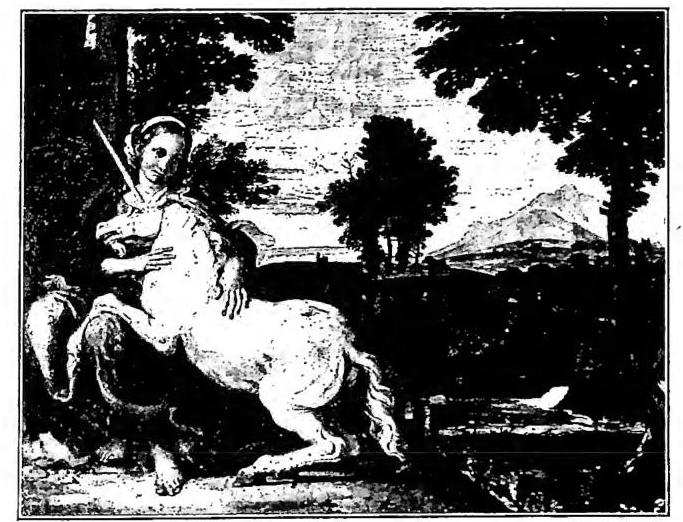
DOMENICHINO – Fresco depicting Chastity. Rome, Palazzo Farnese, Carracci Gallery.
He gave every support to the mission station at Prouille and consolidated it with fixed revenues, part of which he obtained from his benefactor, Count Simone di Montfort, commander of the army. A congregation of “converted” women had established itself at Prouille, and D. took charge of II. The sisters added to the obligations of the regular life the instruction of young girls in the faith: Prouille thus had the character of a “double” monastery. D. never tired of seeking revenues and protectors for II. During a period of difficult years and without significant external successes, D. also had the “care” of the dioceses of Tolosa, Carcassonne, and Béziers; indeed, between 1213 and 1214 he was vicar general of Carcassonne. Twice he declined the episcopal dignity that was offered to him.
IV. DIOCESAN PREACHER
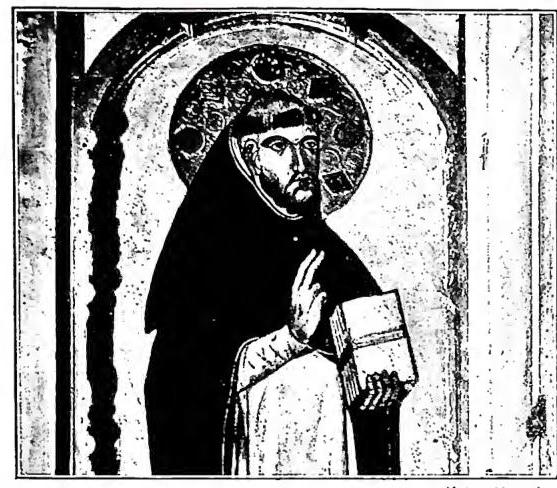
After 14 September 1213 and the capture of Toulouse, he made this city the first center of the preaching work that he supported and promoted with such zeal (1214–15), assisted by Bishop Folco. From April 1215 he began to form in the apostolic spirit the companions who joined him, and established the first convent of the Preachers. Bishop Folco appointed D. and his companions diocesan preachers and had one-sixth of all the tithes of his diocese assigned to them, in order to provide them “with books and sustenance.”DOMENICO, santo — The Saint in a fourteenth-century painting in the Church of S. D. Maggiore — Naples.
V. FONDATORE DEI FRATI PREDICATORI
Upon the election of Honorius III, D. immediately went to him to plead the cause of his Order, and on 22 Dec. 1216 the Pope, with the bull Religiosam vitam eligentibus, approved the canonical Order established at S. Romano of Toulouse, without, however, mentioning its apostolic purpose, which was instead expressed in the bull Gratiarum omnium of 21 Jan. 1217, addressed « praedicatoribus in partibus tolosanis ».Taking leave of Cardinal Ugolino, who had become his special protector, D. left Rome in Feb. 1217 to return to Toulouse, where his confrères reported to him on the instability of the political situation in southern France. In view of the uncertainty of public affairs in Toulouse, D. set about spreading the Order throughout various parts of Christendom. Accordingly, on 15 Aug. 1217 D. assigned his friars: he sent 4 to Spain, 7 to Paris, to care for souls and make contact with the university milieu, left 2 in Toulouse, and destined 2 for Prouille. With one companion he returned to Rome to settle various points of the Order’s constitutions at the Curia. Above all, he sought to obtain for his work, already spread throughout Europe, a general confirmation, which he received on 11 Feb. 1218 in a bull in which the name of the friars of the Order of Preachers appears for the first time.
In Feb. 1218 he sent his first friars to Bologna, and on the 30th of the following month he obtained for the monastery of Prouille a « privilege » identical to that previously granted to the convent of Toulouse.
Amid his many successes, D. also experienced bitter disappointments: 2 friars sent to Spain returned to him discouraged,
and those in Paris and Bologna likewise found themselves in great difficulty. Having obtained letters of recommendation, on 26 Apr. 1218 D., passing through Bologna, went to Spain. In July 1219 he proceeded to Paris, where he received Henry the Elder of Cologne into the Order; then, with Fra’ William of Monserrato, he returned to the papal Curia, which was then at Viterbo. During the journey he fell ill. At Viterbo, Rome, and then once more Viterbo, from Feb. to Apr. 1220 he dealt with several matters concerning Paris and the revision of the constitutions. It was probably in that year that he met Francis of Assisi and Raymond of Peñafort at the Roman Curia. Honorius III entrusted him with the reform of certain nuns in Rome, and at the beginning of Dec. 1219 the same Pope gave D. the church and buildings of S. Sisto to house the nuns to be reformed; the Saint’s first disciples lived there temporarily, until they obtained the church of S. Sabina.
At Bologna, in that same year, 1220, he held the general Chapter he had convoked, at which he restored the concept of poverty as he had understood it at the foundation of Toulouse in 1215, and abolished the title of abbot for superiors. The habit was reduced to a simpler form. New foundations were proposed. During the period between this Chapter and that of the following year, 1221, D. travelled through Lombardy with Fra’ Ventura of Verona, always engaged in the ministry of the divine word.
In 1221 he was in Rome to complete the reform of the nuns of S. Sisto; at Pentecost (30 May) he took part in the II General Chapter at Bologna.
Here he fell ill and, as his condition worsened, was carried into a confrère’s cell, since he had none of his own. He refused a bed, preferring a pallet. So that he might breathe purer air, at the beginning of Aug. he was carried from S. Niccolò to the shrine of S. Maria del Monte, where, having summoned his friars around him, he exhorted them one last time and wished to give them his spiritual testament. After receiving the last Sacraments, the
friars carried D. back into the city, where on Friday, 6 Aug. 1221, he passed away peacefully, promising his friars that he would be more useful to them after death than during life.
Cardinal Legate Ugolino performed the burial rite in the presence of many prelates who had gathered around him. His body was buried behind the high altar, where it remained for several years, almost forgotten. In 1233 it was solemnly translated, and several miracles took place. Following the apostolic process concerning his virtues and miracles, Gregory IX canonized the father of the Preachers at Rieti on 3 July 1234, recording this act in the bull Fons sapientiae. On 5 June 1267 the body of the holy founder was buried in the artistic shrine, still preserved today in S. Domenico.
S. D. was distinguished not only by a rare clarity of spirit, but also by a great organizational capacity, which within a few years led him to give life to an institution and a movement that exercised enormous influence on the internal and external affairs of the Church. The witnesses in the canonization process and the biographers, beginning with B. Jordan, attest to his fervor in preaching in churches, in communities, and while travelling, and in sending preachers among the faithful and unbelievers. Zeal for souls is the dominant note of the person and work of s. D. Dante weaves a sublime eulogy of him (Par., XII, 31-111).
I. Guiraud, Cartulaire de N
D. de Praeille, I-II, Paris 1907; Monumenta S. P. N. Dominici (Monum. Ord. Pred. historica, 15-16), Rome 1933-35; I. Taurisano, Fontes vitae s. D., Rome 1922. Studies: A. Mortier, Histoire des Maîtres Généraux de l'Ordre des Fr. Prêcheurs, I, Paris 1903, pp. 1-135 and 240 ff.; II, there 1905, pp. 46-61; B. Altaner, Der hl. D., Breslau 1922; Cl. Barbieri, S. D., Milan 1922; B. Jarrett, Life of st. D., London 1924;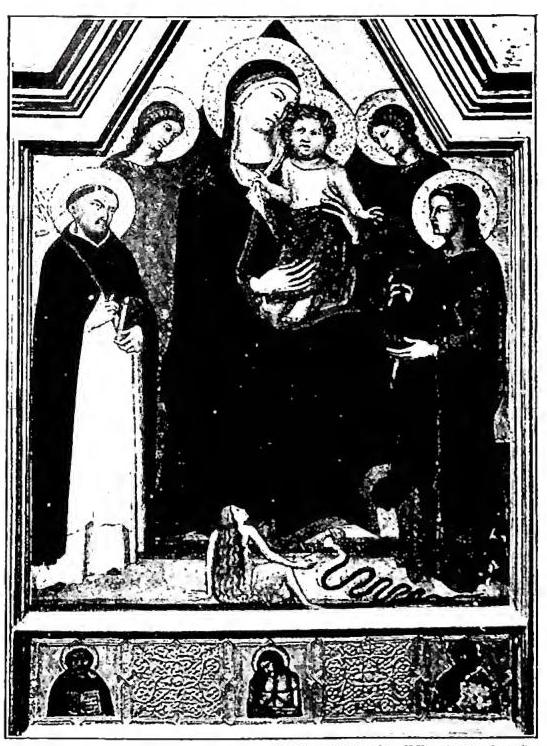
H. Scheeben, Der hl. D., Freiburg im Br. 1927; P. Mandonnet-M. H. Vicaire, S. D., 2 vols., Paris 1937; P. Getino, S. Domingo de Guzmán, Madrid 1939; M. Gillet, St D., Paris 1942; V. CAROTO, S. Domingo, Salamanca 1946; A. D'Amato-G. G. Palmieri, et al., Le reliquie di s. D., Bologna 1946; A. Walz, Compendium hist. O. P., 2nd ed., Rome 1948, pp. 1-28, 204 ff., 420, 508 ff. Angelo Walz
VI. ICONOGRAPHY
The image of the Saint, often depicted with a beard and in the habit of the Friars Preachers, is characterized by a star on his forehead, by the book, sometimes open, and by the lily. He is often accompanied by a dog carrying a lighted torch in its mouth. The dog and the star are connected with the prodigious visions of his mother and nursemaid.The earliest representations of the Saint date from the thirteenth century; examples may be found on his tomb, in the Bolognese church dedicated to him, the work of Fra Guglielmo and Nicola Pisano (1265–67), in the mosaics of the basilica of S. Marco in Venice, and finally in a panel now in Naples, in S. Domenico Maggiore. Andrea da Firenze depicted him in the frescoes of the Cappellone degli Spagnoli in S. Maria Novella in Florence, and Beato Angelico in those of the chapter house of the convent of S. Marco. His image is also extremely frequent in Renaissance sculpture, and Niccolò dell’Arca produced a realistic representation in polychrome terracotta in the church of S. Domenico in Bologna. Often represented together with the principal saints of the Dominican Order, he also appears at the foot of the Virgin’s throne in images of Our Lady of the Rosary, among which the most famous is that by Sassoferrato in S. Sabina in Rome, or in the act of witnessing the mystical marriage of s. Caterina. - Vedi tavv. CVIII-CIX.