
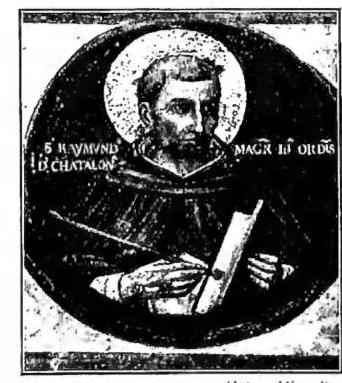
RAIMONDO DE PEÑAFORT, saint. — Dominican, born in Barcelona in 1175, died there on 6 January 1275. He studied and then taught rhetoric and logic in Barcelona. He subsequently studied at Bologna (1210–16), where he was promoted doctor of law in 1216. Returning to Barcelona at the wish of his bishop (1219) and appointed penitentiary canon and then provost of the cathedral Chapter, he entered the Dominican Order shortly thereafter (1222). He played a significant part in the foundation of the Order of Mercy, for which he compiled a large part of the Constitutions and obtained their approval (1235).
He accompanied and assisted Cardinal Giovanni di Abbeville on his legation in Spain (1229), and was subsequently commissioned by the Pope to preach in the provinces of Arles and Narbonne in support of the expedition against the Moors in Majorca. Gregory IX appointed him his confessor, chaplain, and penitentiary, and entrusted him with compiling the new authentic collection of Decretals, which was officially promulgated by him in 1234 (5 September) and presented to the Universities of Paris and Bologna (v. Corpus Iuris Canonici). During this same period, in the Pope’s name, he gave numerous responses to legal consultations, known as the Dubitalia, edited by Schulte (Die canonischen Handschriften... Prague 1868, pp. 98 ff.). He refused the archbishopric of Tarragona. Elected master general of the Order (23 May 1238), he accepted only with great reluctance; he compiled a version of the Dominican Constitutions, which remained essentially in force until the revision of 1924. In 1240 he resigned the office of master general in order to devote himself to the conversion of the Jews and Moors in Spain and Africa. Through his efforts, a school of Arabic was founded in Tunis (1250) and one of Hebrew in Murcia (the first of their kind), to prepare missionaries adequately. He insisted that s. Tommaso d'Aquino write the Summa contra Gentiles. Canonized in 1601. Feast on 23 January.
Among his works, the following should be recalled: the Summa iuris (partially preserved in the manuscript of the Vatican Library Borgh. 261), written at Bologna (1216–19), a manual of law compiled according to the order of the Decree and of the First Book of the Compilations of Decretals (ed. J. Rius, Barcelona 1945); more famous is the Summa de poenitentia, which enjoyed a wide circulation. It is an excellent guide for
(Alinari photograph)