Machine translation of the 1948–1954 Italian original. The original text is authoritative.
MAIORCA (MALLORCA), DIOCESE of. – It encompasses the island of this name and that of Cabrera in the Balearic Islands (Spain). In 1851 the see of Iviza was united to it, but was separated again in 1927. Its area is 4,306 sq. km.; the inhabitants number 327,119, all Catholics; there are 123 parishes; 386 diocesan priests; 158 religious priests; there is a conciliar seminary (of St Peter the Apostle); and 37 male and 190 female religious communities (1949). The episcopal residence is in Palma di M. It is suffragan to Valenza.
There is little information about the Christian antiquity of this region, and the origin of the diocese is shrouded in the same obscurity. It seems, however, that in the 5th century there was a bishop who, during the Vandal domination, would have been subject to the metropolitan see of Sardinia. At a Council held in Carthage in 480, a
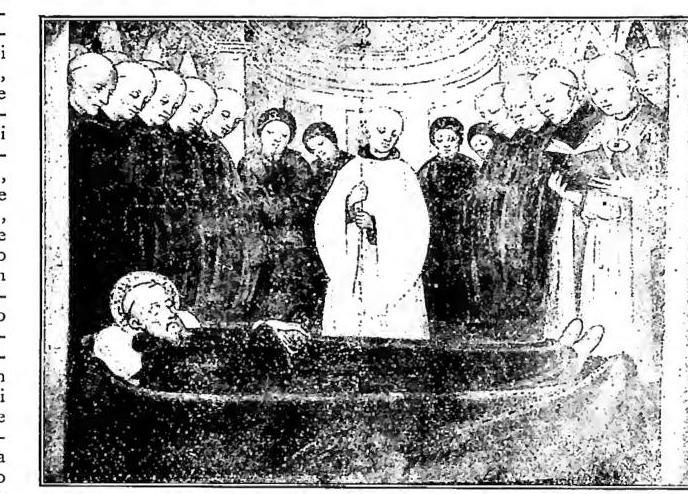
MAIOLO, saint – Esequie del Santo, Fresco by B. Lanzani (15th century) – Pavia, church of S. Salvatore.Helias de Maiorica appears. The first certain information concerning the Christianity of M. is a bull of Pope Romano (897), in which certain properties enjoyed in the Balearic Islands by the episcopal see of Gerona and its diocese are confirmed. By the middle of the 11th century, however, these islands depended on the bishop of Barcelona, as is shown by certain remarkable privileges which the prelate Guislaberto obtained from the Moorish king Mugend of Denia. Since the nearby Mediterranean coasts of Catalonia suffered greatly from the incursions of the Saracens of the Balearic Islands, the count of Barcelona, Raimondo Berengario III, wished to conquer them for the Catholic faith in 1114; but the great military expedition, during which the bishop of Barcelona, Raimondo Guillem, died, succeeded only partially; nevertheless, Pope Paschal II congratulated the count. In 1205 Innocent III promised King Pietro II of Aragon that he would establish a bishopric at M. after the king had liberated it from Muslim rule, which occurred under his son Giacomo I in 1228. Nevertheless, the diocese was not erected until 1238; its first bishop was Raimondo di Torelles, who held a Synod there in 1250 and began the Cathedral. The first prelates were directly subject to the Apostolic See, but after the province of Valenza was erected in 1492, M. was incorporated into it as a suffragan see. The Cathedral stands on the site occupied before 1229 by the Almudaina mosque, in accordance with the promise made by King Giacomo before the conquest. Its style is Lombard Gothic, with certain embellishments; its three naves are extremely graceful. It is the first Spanish cathedral in which the canons’ choir was transferred from the center to the apse and the episcopal throne restored to its original location. It is dedicated to M. S. ma Assunta.
Among the bishops are Egidio Sanchez Muñoz (antipope Clement VIII) and Rodrigo Borja, the future Alexander VI. In the diocese is the Cistercian abbey of Nuestra Señora de la Real, inaugurated in 1236 by Nunio Sana (Cottineau, II, col. 1715). The patroness of the diocese is the Immaculate Conception.
BIBL.: anon., Mallorca, in Enc. Eur. Am., XXXII, pp. 606-612; Guía de la Iglesia y de la Acción Católica Española, Madrid 1943, pp. 312-13, 332, 759-60, 775.
Giuseppe M. Pou y Marti
Cite this article
“MAIORCA (MALLORCA), DIOCESI DI.” Enciclopedia Cattolica, vol. VII (1951), p. 1110. Azione Romana digital edition, https://azioneromana.com/article/maiorca-mallorca-diocesi-di.