MAISTRE, FRANÇOIS-XAVIER de. — Savoyard writer, brother of Giuseppe, born in Chambéry on 8 November 1763 into a noble family of magistrates with legitimist traditions and deeply Catholic, died at Strelnia (near St. Petersburg) on 13 June 1852. He spent his youth partly in Savoy and partly in Piedmont. Following the invasion of the Sardinian State by the French revolutionary army, he left his homeland, as did many other officers, and settled in Russia. He fought in Georgia against the insurgent populations, took part in the 1812 campaign against Napoleon, and after the Battle of Leipzig left the military career with the rank of general. In 1813 he married Princess Sophie Zagriatsky. In 1826 he returned to Savoy, and later resided for a long time in Italy, where he lost his last two surviving children. In 1839, after a journey to France, he returned to Russia, where he died.
The variety of aspects in his works is notable, united by a common foundation of spontaneous and moving realism. *Voyage autour de ma chambre* (composed when de M. was in Turin during forty days of strict arrest and published in Lausanne in 1795) is a graceful fantasy where eighteenth-century taste is combined with Romantic inspiration, while in *Expédition nocturne autour de ma chambre* (in *Oeuvres complètes de X. de M.*, Paris 1825) the Romantic element is heightened by melancholic lyricism. *Les lépreux de la cité d’Aoste* (published with a new edition of the *Voyage* in 1811 in St. Petersburg) is inspired by a lofty Christian conception (de M. lived in Aosta from 1793 to 1797). In Russia he composed two novellas: *Les prisonniers du Caucase* and *La jeune sibérienne* (both published in the aforementioned edition of the *Oeuvres complètes de X. de M.*). The first, set in a wartime atmosphere with intensely dramatic scenes, very probably inspired Tolstoy’s *The Prisoner of the Caucasus*. The second is the plain and moving account of the true story of a Russian girl who, relying solely on her faith in God, walked from Siberia to Moscow to beg the Tsar for mercy for her innocent father. These last two works, together with fragments of three others unpublished by de M., reveal him as a great publicist, and finally as a “philosopher of Providence,” with the *Considérations sur la France* (1796), which had a European resonance.
Here was, in its entirety, the program of a non-violent monarchical restoration, and the deepening of his eschatological, historical-religious reflections: the Revolution is not an “event,” but an “epoch,” and a visible, negative sign of God’s work in the world. As long as God wills, “it guides men” (I, 4). But here there emerges, alongside Burke’s historicist doctrine and Mallet du Pan’s thesis on the “force of things,” a first germ of the Romantics’ historical pantheism, which culminates in the adoration of the divinized historical necessity. There is moreover more than a germ of “anti-liberal nationalism,” but a child of the Revolution. As early as 1795 de M. had addressed the essential themes of this, and of all his works, in the unfinished *Etude sur la souveraineté* and in the *Fragments sur la France*: here appears the first praise of the Jesuits and the exaltation of the “mission” of nations, of the “souls of peoples.”
In the troubled years between 1797 and 1802 de M. was first in Turin, then a fugitive in Venice, and finally in Sardinia, the last refuge of the Savoys, regent of the Grand Chancellery. But from 1803 to 1817 he served his King in St. Petersburg, and maintained a celebrated correspondence with the court, published between 1858 and 1860 by A. Blanc, to show that the Catholic de M. had foreseen and explained the necessity of a national policy for the House of Savoy. Important, though almost futile, was his political-religious action with Tsar Alexander I, especially in favor of the Jesuits; more effective was his religious apostolate among the aristocracy, which brought about significant conversions, including that of Mme Swetchine. In 1809 he wrote an *Essai sur le principe générateur des constitutions politiques*, and then moved from the problem of temporal sovereignty to that of spiritual sovereignty, outlining *Du Pape*, whose drafting was then spurred by the emergence of the vague interconfessional and anti-papal universalism of the Holy Alliance in 1815 (Latreille).
Returning to Piedmont, disappointed by the French Restoration and the errors of all monarchies, unable to wield true political influence, he completed his last works, *Du Pape* and the beloved *Soirées*.
As a modest ecclesiologist, for *Du Pape* he benefited from the assistance of a Lyons scholar, G. M. de Place, and detached a chapter on the Gallican Church; the *Soirées*, left unfinished, were published posthumously, and with them closes the cycle of his reflections as a “lay theologian of Providence.” As such, he prepared the Catholic revival, from the first Lamennais to Newman: the latter developed, enriching it, his concept of the dynamic-organic development of dogma. He conceded much to his adversaries, especially to the Saint-Simonians and to Comte.
Works: *Oeuvres complètes* (14 vols., Lyons 1884–87 [to which reference is made above]); *Lettres et opuscules inédits*, ed. R. de Maistre (2 vols., Paris 1851); *Mémoires politiques et correspondance diplomatique*, ed. R. de Maistre (8 vols., Paris 1858–60); *Oeuvres inédites de X. de M. Premiers essais. Fragments et correspondance*, ed. E. Réaume (Paris 1877).
The fragments that de M. never brought to completion (published posthumously in E. Réaume, *Oeuvres inédites de X. de M. Premiers essais. Fragments et correspondance*, Paris 1877) constitute a realistic portrayal of Russian society in its worldly, military, and religious aspects, which anticipates the splendid depiction in Tolstoy’s novels, especially *War and Peace*. He also wrote various poems and a free imitation of some of Krylov’s fables. He collaborated on his brother Giuseppe’s *Les soirées de St-Pétersbourg* with a vivid description of its opening. He also left some scientific memoirs in the *Bibliothèque de Genève* and communications in the Acts of the Royal Academy of Sciences of Turin.
MAIORCA, DIOCESE OF
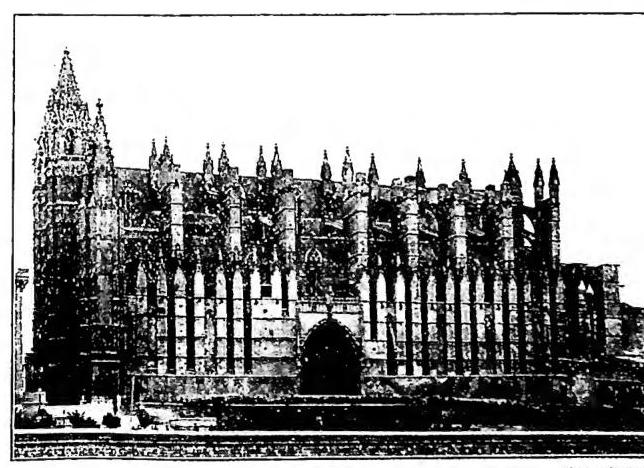
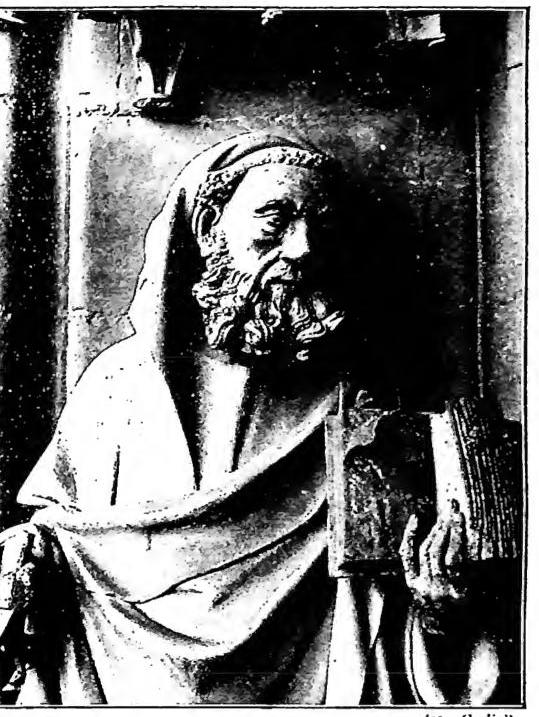
Detail of the portal known as the “del Mirador” of the Cathedral (late 14th century) — Majorca.