
GEORGIA. — Since 1936, one of the 16 federated republics constituting the U.S.S.R. Having become independent in 1918, after 1921 it formed part, as an autonomous republic, of the Transcaucasian Federation, later abolished.
CONTENTS: I. — Geography. —
II. History
III. Literature
IV. Liturgy
V. Bible Translation
VI. Art.I. GEOGRAPHY
The country, which extends entirely along the south-western slope of the Caucasus, from the Black Sea to the MiddleKura, is for the most part mountainous and difficult to traverse; on the whole, it has a temperate and healthy climate, abundant precipitation, good agricultural potential (cereals, tobacco, cotton, tea, vines, fruit trees), considerable forest resources (one-third of the territory is covered by woodland), and varied and substantial mineral wealth (copper, iron, coal, and above all manganese). Particular mention should be made of the coastal region of lower Mingrelia (to the W.), with its humid subtropical climate, unhealthy, where major land-reclamation works have recently been carried out. The population is predominantly Georgian (over two-thirds of the total), of Japhetic stock, who have always occupied a prominent position among the neighbouring Caucasian peoples, developing their own national civilization, also characterized by a flourishing literature. The most notable ethnic minorities are the Armenians (12%), Tatars (6%), and Ossetians (4.5%); the Russians number only slightly more than 100,000. Settlements are numerous (the urban population represents 29% of the total); the capital Tiflis (Tbilisi) grew from 294,000 to 519,000 inhabitants between 1926 and 1939; Kutais (Kutaisi), from 48,000 to 81,000; Batum (Batumi), the principal oil port of the U.S.S.R. (the pipeline from Baku terminates there), from 48,000 to 71,000.
In 1936 G. covered 69,300 sq km, with 3.2 million inhabitants; after the war its territory had expanded to 74,300 sq km and its population had risen to 3.6 million inhabitants (48 per sq km), as a result of the transfer, by the Russian Soviet Federative Socialist Republic, of part of the autonomous region of Karačai and of the Kabardia Balkaria Autonomous Republic (now called simply Kabardia). Within the borders of G. are found: the two autonomous republics of Abkhasia (8,696 sq km, 303,147 inhabitants; capital Sukhum) and Adjaristan (2,797 sq km, 179,946 inhabitants; capital Batum), both along the Black Sea, and the autonomous region (Oblast) of South Ossetia (3,698 sq km, 111,501 inhabitants; capital Stalinin), in the heart of the Caucasus.
II. HISTORY
G. (indigenous name Sacartvelo), bounded to the north by the Caucasus, to the west by the Black Sea, and to the south by Armenia, approaches the Caspian Sea to the east.In history the country is known under various names: Saspiria, Iberia, Gurzan, Gurgistan, Grusia. According to recent research, the Georgians are related to the peoples known as Caucasian or Asianic: Sumerians, Proto-Hittites, Hurrians, Mitanni, Subarians, and the population of Urartu. This kinship is based primarily on linguistic grounds.
In 65 B.C., following the victories of Pompey the Great, all of G. accepted the protectorate of Rome and thus became an outpost of the Empire in the struggle against Sassanid Persia.
Under Roman influence, Christianity soon began to penetrate the country. The official conversion from paganism, which consisted in the worship of the stars, fire, and trees, to the faith of Christ took place around 337 under Constantine the Great and King Mirian of eastern G. This event was the work of a captive woman whom the Georgians call St. Nino. The first missionaries were sent by the Byzantine Emperor. After some hesitation between the Armenian and Syro-Persian Churches, the Church of G. received a new hierarchical organization under King Vachtang at the end of the 5th century. At the head of the Church was placed a katholikós, who was to receive his ordination in Antioch, a practice that had completely disappeared by the 8th century. From as early as the 5th century, the Georgian Church may be considered autocephalous.
In western G., or Colchis, the penetration of the new faith dates back to the first centuries of Christianity. According to a very ancient tradition, St. Andrew the Apostle is said to have preached there. At the Ecumenical Council of Nicaea (325), two representatives of Colchis were present: Damno of Trebizond and Stratophilus of Bicvinta (Pityus of the Greeks). Toward the end of the 5th century, all western G. had embraced the Christian faith, except for Abkhasia at the eastern end of the Black Sea and Cianeti in the province of Trebizond, both of which were converted through the work of Justinian (6th century). In the 7th century there were already two ecclesiastical centers dependent on the Byzantine patriarchate: the eparchy of Fothi (ancient Phasis), with four suffragan sees, and an autonomous archbishopric of Sebastopolis in Abkhasia (Bioscuria-Sochumi). With the liberation of Colchis-Abkhasia from the political dependence of Byzantium under Leo II (746–91), King of Abkhasia, its Church too united with the autonomous Church of G. in the 9th–10th centuries.
At the end of the 4th century, eastern G. fell under the domination of the Sassanids, who vainly sought to propagate the worship of fire there. Christianity had undergone such development that at the beginning of the 6th century eastern G. alone numbered about thirty ordinary bishops.
The Christological controversies could not fail to have repercussions in G. The greatest diffusion was achieved by the Monophysite heresy, stimulated by the Henotikon (v.) of Zeno. Under Syro-Armenian influence, the Georgian Church accepted the formula of the Henotikon, but freed itself from it completely at the beginning of the 7th century through the energetic action of the katholikós Kyrion.
The first known representatives of monasticism in G. were the so-called thirteen Syrian Fathers, who arrived in Iberia around the middle of the 6th century. The most famous among them were Giovanni Sedasneli, Scio Mgvimeli, David Garegeli, Abibos Nekresseli, Iesse Tzikneli, and Anton Martmqofeli, all founders of great monasteries or illustrious bishops, missionaries, and martyrs. Around 650, eastern G. was occupied by the Arabs, who remained there until the 9th century. This was the period of the spread of the monastic state throughout G. From eastern G., or Iberia, whose capital was Mzcheta and then Tiflis (Tbilissi) from the 6th century onward, monasticism penetrated western G., especially Tao-Klargeti in the basin of the Ciorokhi, where, under the direction of the archimandrite Gregor Khanzteli, many monasteries arose in the 8th and 9th centuries, serving as centers of Christian culture and piety. Even older are the Georgian monasteries established abroad.
In Palestine there were Georgian monks or monasteries as early as the 5th century, as at Mar Saba, in the convents founded by Pietro l’Ibero (d. 488). In the 6th century, the Emperor Justinian I restored a monastery of the Iberians in Jerusalem and another of the Lazi in the desert near that city. Later, about twenty convents built in Jerusalem and its surroundings came into Georgian hands, such as that of the Holy Cross, that of St. Saviour of the Franciscans, and that of St. James of the Armenians. Georgian monks are found on Mount Sinai as early as the 6th–7th century. There they possessed three convents: Maqlovani, St. John the Evangelist, and St. George. The Georgians owned a monastery in Cyprus: Jalia. In the province of Antioch in Syria there were about ten Iberian convents: St. Simeon Stylites, St. Romanus, St. Procopius, Della Fonte, St. Barlam, Vale di Canna, St. Ezra, Calliopius, Castana, and three on Mount Olympus in Bithynia: Crania, Caverna, and SS. Cosma and Damiano; two large convents on Mount Athos: St. John the Baptist (built in 978) and Iviron (980), with about ten Metochia; and, finally, one in Constantinople. Two Georgian monasteries founded in 1861 and 1871 can still be found in that city today. On the Balkan Peninsula, near Philippopolis, the Grand Domestic of the Byzantine Empire, Gregorio Bacuriano, founded the celebrated Petrizonissa monastery (11th century), now Backovo. Most recently, a house was also established in Rome for the Georgian Fathers of Istanbul.
Under Queen Thamar (1184–1213), G. reached its political and cultural apogee, and the 12th century must be regarded as the golden age in the history of the Georgian kingdom, whose boundaries extended from the Black Sea to the Caspian Sea and from the Caucasus to Trebizond.
In the 13th century G. succumbed to the assault of the Mongols, who divided the country into two kingdoms: Eastern G. and Western G. In the 14th century the terrible Timur arrived and devastated the entire region. The general decline caused by the Mongol invasions was for a time stemmed by King George V the Magnificent (1318–46), who unified the country. The churches destroyed by Timur were rebuilt by King Alexander I (1412–42), who continued the work of George V. But the Ottoman occupation of Constantinople (1453) and Trebizond brought about the rupture of all relations between G. and the West. From that time the country, divided into three kingdoms and several autonomous feudal principalities, became a battlefield between the Turks and the Persians. The 16th and 17th centuries must be regarded as the saddest in the history of G. The king had lost all authority. The feudal lords, masters of the country, exploited the population without mercy. At this time there appeared the didi mourav (great administrator) Giorgio Saakadse, who attempted to overthrow feudalism, put an end to internal division, and concentrate all political and military power in the hands of the king. King Luarsab II did not understand him and abandoned him to the vengeance of his enemies. The astute Šab-Abas, king of Persia, taking advantage of this internal division, invaded the country, massacred nearly 100,000 Georgians there, and deported another 100,000 to Persia. The šhah then had King Luarsab II himself killed (d. in 1622), as well as Queen Kacheti-Kethevana (d. in 1624). Under King Vakhtang VI (1703–24), and especially with the accession to the throne of Theimuraz II (1733–62) and of his son Iracly II (1762–98), G. experienced better days. The feudal lords were weakened, the king’s prerogatives increased, and Iracly II was recognized as supreme head of all the political leaders who remained autonomous in the country (concession of 1790). Internal and external difficulties induced Iracly II, after seeking help in the West in vain, to conclude in 1783 a treaty of friendship and protection with the empress of Russia, Catherine II. By virtue of this treaty, Russia assumed the protectorate over G., left the internal administration of the Kingdom free, and recognized the Georgian Church’s full independence. But after the death of the Georgian king George XII (d. in 1800), Tsar Alexander I cynically violated the said treaty and proclaimed the annexation of G. to Russia (1801). The Church of G. was deprived of its autocephaly, subjected to the Russian Synod, and its head, the katholikós Antonio II, was deported to Russia in 1811. The Georgian people suffered greatly under Russian domination: confiscation of Church property, occupation of churches and monasteries, suppression of the teaching of the Georgian language in schools and abolition of the liturgy in the Georgian language in churches, destruction or spoliation of national works of art. After the collapse of the Russian Empire in 1917, G. restored its former independence on 26 May 1918. Unfortunately, power passed into the hands of the Menshevik socialist party which, heedless and ignorant of national interests, sought only to implement Marxist ideology to the detriment of the people and the Christian religion.
In 1921 G. was again attacked by Bolshevik Russia with the assistance of the Georgian Bolshevik party. The country, occupied by the Bolsheviks, was incorporated into the Soviet Union as the Autonomous Republic of Transcaucasia. The autonomous Church of G. likewise freed itself from the yoke of the Russian Synod and declared itself independent (1917), under the supreme direction of the katholikós “patriarch of all G.”
Relations between G. and the Roman Church are of very ancient origin. As early as the time of katholikós Kyrión I (beginning of the 7th century), he appealed to s. Gregorio Magno and asked him for advice on how to deal with heretics. In his polemic against the Armenian Monophysites, Kyrión relied upon the “Romans,” whose faith was for him suprema lex. In the 9th century another Georgian, s. Ilarione, visited Rome, where he remained for two years to honor the Confession of s. Pietro and the “holy Pontiffs” buried there. G., which did not take part in the iconoclastic conflict, also kept apart from the disputes of the times of Photius and Michael Cerularius. Indeed, in 1065, s. Giorgio, abbot of the Georgian monastery of Iviron on Mount Athos, solemnly defended the Roman Church and its unaltered faith in the presence of the Byzantine emperor Constantine Ducas and his clergy. It seems that in the years 1205–10 the Georgian monks of Athos conformed to the Latins even in celebrating the liturgy “in azymis.” From the 13th century onward, relations became more frequent. Honorius III (1216–27) invited King George (1212–23) to take part in the liberation of the Holy Places. Gregory IX (1227–41) sent friars minor to Queen Russudan (1223–47) and asked her to receive them well “in remissionem peccatorum.” Meanwhile the Mongols arrived and set everything to fire and sword. Russudan invoked the Pope’s help, promising him in return union with the Roman Church. In his letter of 1240 the Pontiff praised the Queen’s good disposition and urged her to recognize the Roman Church as “princeps et magistra” of all the Churches. This letter of Gregory IX is the first document to presuppose the separation of the Georgian Church from the Roman Church. Here begins the work of the missionaries in G. First came the Friars Minor, followed by the Dominicans (13th century). The Catholic mission made such progress there that in 1328 John XXII (1316–34) transferred the episcopal see of Smyrna to Tiflis, the capital of G., and by a decree of 1329 appointed the Dominican Giovanni di Firenze bishop of Tiflis. In 1349 he was succeeded by Bertrando Colleti, and the latter by Bertrando Pagessi in 1356.
Other Latin bishops known to us are: Enrico Ratz O. F. M., Leonardo di Villae O. P. (1391), Giovanni di s. Michele O. P. (1425), Alessandro O. P. (1450), Enrico Woust O. F. M. (1462), Giov. Ymink O. S. A. (1469), Alberto Engel under Alexander VI, and Giov. Schneider (1507).
Two Georgians, a metropolitan and a layman, also took part in the Council of Florence. They did not, however, sign the decree of Union. The arrival of missionaries did not cease even in the 16th century. Augustinians, Carmelites, Jesuits, and other Orders sought to bring spiritual and moral assistance to the poor country devastated by the Turks and Persians. Responding to the Georgians’ desire, Urban VIII entrusted the mission in G. to the Theatines in 1628; they remained there until 1700. The merit of these fathers toward G. is immense. Under their influence G. experienced a renewal of its religious and cultural life. The foundation of the Collegio Urbano in Rome was due in part to the prosperity of the mission in G. After the Theatines, Propaganda Fide sent the Capuchins there. Their mission, which was extraordinarily fruitful, lasted from 1661 to 1845. In that year the Capuchins were expelled by the Russians, by then masters of the Caucasus. Responsibility for the Georgian Catholics was placed in the hands of the indigenous clergy, most of whom belonged to the Georgian Congregation of the Servants of the Immaculate Conception of Istanbul.
Before the First World War, the number of Georgian Catholics amounted to 40,000, while the entire population of Soviet G. numbered approximately 3,000,000. Under the tsarist regime, Catholic G. depended upon a Catholic bishop residing in Russia. After the First World War, the Holy See sent an apostolic delegate there, but he remained only a short time in Tiflis and went to establish himself in Persia.
BIBLI: M. Brosset, Hist. de la G., 4 vols., Petersburg 1849–58; anon., Storia della G. detta della regina Maria, Tiflis 1906; F. Holladek, Zwei Grundsteine zu einer gruzianischen Staats- und Rechtsgeschichte, Leipzig 1907; M. Tamarati, Histoire du catholicisme en G., Tiflis 1908; id.,
L'Église géorgienne, Roma 1910; I. Giavachišvili, Storia del popolo georgiano (in georgiano), Tiflis 1913-14, 1928-29; P. Peeters, Histoires monastiques géorgiennes, in Annlecta Boll., 36-37 (1917-19), pp. 207 ff.; W. E. B. Allen, A History of the Georgian People, Londra 1932; I. Giavachišvili, Libro d'introduzione alla storia di Georgia, Tiflis 1937; G. Peradse, An Account of the Georgian Monks and Monasteries in Palestine, in Georgica, 1937, pp. 181-246; anon., Vita della regina Tamar, Leningrado 1938; M. Tarchnišvili, Die Entstehung und Entwicklung der kirchlichen Autohephalie G., in Kyrios, 5 (1940-41), pp. 177-93; R. Ivanizky-Inghilo, La G., Roma 1941; R. Janin, s. V. in DThC, VI, cols. 1239-89; anon., Storia della G. detta della regina Anna, Tiflis 1942.
III. LITERATURE
Georgian literature begins with the introduction of Christianity. Its oldest document is an inscription on the church of Bolnissi dating from the end of the fifth century. On the basis of the graphic, stylistic, and linguistic characteristics of these inscriptions, it must be admitted that the use of the Georgian alphabet was introduced several centuries B.C. Their theological content likewise attests a considerable development of the literary language and of ecclesiastical speech.As regards the morphological classification of Georgian texts, three forms are distinguished: khan-meti (kh, a superfluous phonetic prefix, meti), hae-meti (h, a superfluous phonetic prefix), and the normal form, in which the first two are no longer found. The oldest texts belong to the khan-meti language, which extends from its beginnings to the seventh century. The hae-meti texts are assigned to the eighth century. From the ninth century onward, the third form is used.
In terms of content, Iberian literature was exclusively ecclesiastical until the eleventh century. In the eleventh century, secular literature also began to develop. It is worth noting that, among all the Christian peoples of the medieval East, only the Georgians possess a profane literature.
In chronological order, ecclesiastical literature presents the following picture. From the fifth to the seventh century date several epigraphic inscriptions from the church of Bolnissi, the Cross of Mzkhetha, Zkissisa, etc. Many khan-meti texts of biblical, patristic, liturgical, and apocryphal content belong to the same period. The martyrdom of St. Susanik, written by the “Priest Giovanni,” dates from the fifth century. The life of the same Saint, transmitted in an Armenian recension, is merely a tendentious reworking of the Georgian text.
The martyrdom of St. Eustatius of Mzkhetha, an Arab convert, belongs to the sixth century (published in: Sitzungsberichte der preuss. Akademie der Wissenschaften, 1901, p. 875). Also dating from the sixth and seventh centuries are the sermons attributed to Giovanni Bolnissi (ed. by M. Gianavili, Tiflis 1911; M. Tarchnišvili, Zwei Lektionarfragmente, in Kyrios, 6 [1942], pp. 16-19). Several writings of the katholikós Kyrios I have survived, preserved in the Armenian book of letters (Epistolary).
For purposes of information, we recall Evagrius Ponticus, of Georgian origin according to Sozomen, and the life of Peter the Iberian, likewise preserved in an Iberian version (ed. by N. Marr, in Pravosl. Palestin. Sbornik, 16 [1896, II], pp. 1-119).
The martyrdom of the “Children of Cola” also dates from the eighth century (ed. N. Marr, in Texti i rasiskasija po armeno-gruz. filologii, 5 [1903], p. 55), as does that of St. Abo of Tiflis ([ed. Texte und Unters., new series, 13, IV], Leipzig 1905), and very probably also the historical work of Leonti Mroveli, which contains a Life of the Kings and the Conversion of Karthli (Georgia). The nucleus of the Conversion must be attributed to the deacon Grigol, who lived before the seventh century. The flourishing legend surrounding St. Nino or Nina has come down to us in several recensions.
The 9th and 12th centuries constitute the golden age of Georgian literature, which encompasses all branches of ecclesiastical science both in translation from Syriac, Armenian, Greek, and Arabic, and in the expression of its own thought. In original literature, the foremost place is occupied by ecclesiastical hymnography, preserved in a manuscript from the years 978-88, whose author is Michel Modrekili, a monk of the monastery of Oski in southwestern Georgia. In this collection, Georgian hymnographers such as Giovanni di Tibethi, Esra, another Giovanni Khurdania, Filippo, Stefano Sananaidse, David di Tibethi, and others are cited. In the 10th century, the hymnographers Giovanni Minckhi, a certain Filippo, and Giovanni Zosima on Mount Sinai also flourished. Of the following century, instead, is the life of St. Gregorio di Khanztha by the monk Giorgio Marciul (ed. of
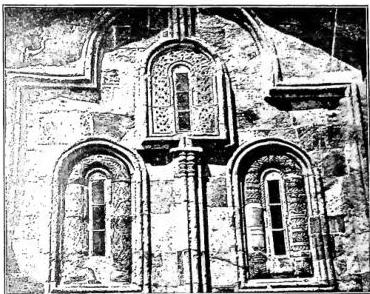
(from J. Boltrussitis, Etudes sur l'art médiéval en Géorgie et en Arménie, Paris 1878, pl. 3b)
GEORGIA - Detail of the Church of Ikorta (1172).
The greatest representatives of the golden age, which coincides with the Byzantine influence in Georgia, are the following authors: 1. Euthymius the Athonite, abbot of Iviron on Mount Athos (1006-28), son of the prince-monk John, who, with the help of the prince-monk Thornike Eristavi, victor over Bardas Skleros, founded that monastery, called Portaitissa, meaning "Madonna of the Gate." St. Euthymius translated from Greek, composed, and himself reworked about 80 writings of the most varied content, while he translated from Georgian into Greek the well-known "Wisdom of Balavar." For his brilliant and classical style, St. Euthymius is perhaps the most celebrated and most appreciated author of the Georgian Middle Ages. 2. St. George the Athonite, also abbot of Iviron (d. 1065), who wrote the life of St. Euthymius and of his father John, and translated from Greek or subjected to a new revision many books of the New Testament, canon law, liturgy, dogmatics, and hagiography. 3. Ephrem Mtsire, b. 1027, d. before 1103, monk of Georgian monasteries on Mount Mirabile and Mount Negro near Antioch. His literary activity is of prodigious variety and universality, distinguished by the scientific technique of philosophical translation, the use of scholia and lexicons. He translated into Georgian, among other things, the Κεφάλαια φιλοσοφικά and Ἔκθεσις πίστεως of St. John Damascene, Dionysius the Areopagite with scholia, and the "Historia Lausiaca" of Palladius.
While these three monks worked abroad, in the Byzantine Empire, new centers of culture were also being created in Georgia: higher schools of philosophy and theology, so-called universities or academies, such as those of Iqaltho in Kakheti (eastern Georgia) and of Gelati near Kutaisi (western Georgia). The latter was founded by King David the Renewer, who gathered learned men of the country there. Among these were Arsen Iqaltoeli and John Petritsi, with Theophilus the hieromonk, John Tarichisdze, John Katholikós of Kartli, etc.
1. Arsen Iqaltoeli, "the light of all the Churches," was a native of Iqaltho and flourished in the 11th-12th centuries. Arsen seems to have attended the university courses of Michael Psellos in Constantinople. From there he went to Syria, where he became a disciple of Ephrem Mtsire. At the invitation of King David the Renewer, Arsen went to Georgia and devoted himself to scholarly work first at Gelati, then at the famous monastery of Shio-Mgvime, and finally at Iqaltho. Arsen is best known for his Dogmaticon, a great work of compilation. This collection contains in its present form a) 32 writings of a polemical nature: 6 against the Nestorians, 6 against the Monophysites, 3 against the Armenians, 6 against the Jews, 9 against the Muslims, 2 against the Origenists; b) 16 dogmatico-philosophical treatises; c) 5 works of moral content.
2. John Petritsi, probably also a disciple of Ephrem Mtsire. Petritsi was a monk of the Georgian monastery of Petritzonissa in Bulgaria (hence the name). He studied in Constantinople under the direction of Michael Psellos and, upon returning to Georgia, settled in Gelati, where he developed a most fruitful scientific and literary activity, embracing with his universal genius the vast domain of all the sciences of the time: philosophy, theology, liturgy, hagiography, poetry, grammar, rhetoric, music, astronomy. But what made Petritsi most famous was his philosophical activity, which also brought him persecutions from both Greeks and Georgians. He translated and commented on Proclus' Στοιχείωσις θεολογική, Elementa or Liber de causis, Aristotle's Τὰ τοπικά and Περὶ ἑρμηνείας (both now lost), and Περὶ φύσεως ἀνθρώπου by Nemesius of Emesa in Phoenicia. Based on these translations, it must be admitted that Petritsi had a vast knowledge of Greek writers and philosophers. This is why N. Marr could write: "In the 10th and 11th centuries, Georgians were interested, in the field of philosophy, in the same questions that occupied the foremost minds of humanity of their time, both in the East and in the West, but with the difference from others (e.g., from Westerners) that Georgians of that era expressed their opinion on contemporary philosophical questions before others, possessed, in an exemplary manner for those times, a sense of textual criticism, and worked directly on Greek texts" (N. Marr, Iovann Petrizhij, gruzenskij neoplatonik XI-XII veka, in Zapiski vostochnago otdelenija Imperatorskago Russkago Arkheologicheskago Obshchestva, 19 [1909], p. 113). Petritsi considers Greek philosophy as ancilla Theologiae and seeks through it (intuitive philosophy, theory) to prove the existence of the "One" (God) and of the Trinity; to overcome the Manichaean dualism and Epicureanism of his time (cf. Joannis Petritzii opera, I, Procli Diadochi Στοιχείωσις θεολογικῆς versio iberica, Tiflis 1940. Ed. by S. Kauchtschischvili. Vol. II contains the commentary on Proclus, already edited by the same author (v. E. R. Dodds, Proclus the Elements of Theology, Oxford 1933). The great protector of Petritsi, David the Renewer, also distinguished himself as a poet and theologian with his "Penitential Psalms," reminiscent of those of King David.
Creations of the golden age are also many historical writings: the Chronicle of Juansher, perhaps already from the 9th century, History of the Bagratids of Sumbat (11th century), History of Abkhazia (10th-11th centuries), historical works on the glorious reigns of George II, David, George III (d. 1184), and Queen Tamar. Many apocryphal, hagiographical, liturgical, and patristic works, no longer extant in the original, have been preserved in Georgian translations. For example, G. N. Bonwetsch published (in Texte und Untersuchungen, 23 II, Leipzig 1902) writings of Hippolytus of Rome preserved in Georgian. Hagiographical works are edited by P. Peeters in Analecta Bollandiana from 1911 onward (v. K. Kekelidze, Monumenta hagiographica georgiana, I, Tiflis 1938; II, Tiflis 1946).
John Petritsi had no successors. After three centuries of Mongol occupation, the country recovered from its decline only gradually under the initial influence of Persian culture and Latin missionaries.
In this period of national renaissance, which spans from the 16th to the 19th century, the following should be noted: Stefano Paolino, who, with the help of a Georgian monk, Nicodemo Irbachi, had the first Georgian book printed: Dizionario georgiano-italiano (Rome 1629); the Theatine M. Maggio with his book: Syntagmata linguarum orientalium quae in G. religionibus audiuntur (Rome 1670); and P. Castelli (d. 1695), also a Theatine, a painter of high merit. Among the most notable historiographers is King Vakhtang VI (d. 1737). He had a collection of Georgian annals compiled, known as Kartlis Tskhovreba (Life of Georgia); the chronicle of Vakhtang was continued by his son Vakhushti from 1469 to 1744. Vakhtang VI also promulgated a code of Georgian laws.
Of the ecclesiastical law of the early period, only a small remnant has survived: the canons of the Council of Ruisi-Urbnisi of 1103, a canonical statute of 1263, the decisions of the Katholikoi Malachia of Kartli and Evdemos of Abkhazia (16th century), incorporated into Vakhtang's code, and a disposition of Grigol of Samtavisi for his eparchy (1549).
Prince Sulkhan Orbeliani, who became a monk under the name Saba (d. 1725), was a great collaborator of King Vakhtang. Saba later became a Catholic and undertook
Sulkhan Orbeliani, having become a monk under the name Saba (d. 1725), was a great collaborator of King Vakhtang. Later, Saba converted to Catholicism and undertook a diplomatic journey to the courts of the Pope and Louis XIV of France. He composed a catechism for Georgian Catholics and a biblical concordance, compiled a highly esteemed lexicon, and wrote his Journey to Europe.
The greatest genius of this era, however, is the katholikós Anton I (1720-88), son of King Jesse. He too converted to Catholicism: deposed as a result and exiled to Russia, where he defended himself against the accusation of heresy, he regained his see through the intervention of King Irakly II and displayed extraordinary activity in both the Church and the State. Under the influence of Catholic missionaries, he organized schools and the entire public education system of the country, teaching with such success that the 18th century has been called the century of Anton.
Among his numerous writings, which cover almost all branches of ecclesiastical and secular sciences, the following are noteworthy: a Georgian adaptation of Fr. Baumeister’s philosophy, several other philosophical works, a rhetoric manual, a four-volume treatise on theology, a martyrology, the great metrical work Taqqabil-Sitqaoba in 4,000 iambic verses, and a collection of biographies of national heroes. The katholikós also left a mystical work on royal authority and another polemical-dogmatic work: Mazametqueleba.
After the loss of independence in 1801, the most distinguished writers of Georgia, now open to Western influence, sought to keep national sentiment alive.
According to available information, Georgia today has nearly 400 elementary schools with 510,000 pupils, 22 secondary schools, and approximately 100 museums and institutes for scientific research. The cultural center is Tbilisi, with a state university (founded in 1918) comprising 10 faculties and 4,000 students, an Academy of Sciences and other institutes, an archive containing around 10,000 manuscripts, and various journals such as the Maambe (bulletin) of the University, the Georgian Museum, and History, Historical Research, etc.
IV. LITURGY
In Georgia, the liturgy was initially celebrated in the language of the missionaries who came from Greece, but the use of the vernacular soon began to replace Greek. Already in the 5th century, St. Saba (d. 532) permitted his monks in Georgia to recite the Divine Office in their own language; however, the Mass had to be celebrated in the common language. By the end of the 6th century, the entire divine service was in Georgian; later, between the 8th and 9th centuries, this practice spread from eastern Georgia (ancient Iberia) to western Georgia, where Greek had previously dominated.The oldest Georgian versions of liturgical texts clearly demonstrate that from the beginning, the liturgical usage of the Church of Jerusalem was followed. Indeed, two fragments of lectionaries from the 5th and 8th centuries, published by Tarchnišvili, and the Canonarium of Jerusalem from the 7th-8th centuries, edited by Kekelidze, both contain the liturgical office of the Church of Jerusalem, from which the oldest Georgian Mass also derives. The Liturgy of St. James is preserved in many manuscripts, the most ancient of which dates back to the 10th century: two are at Mount Sinai, one in Graz, one in the Vatican Library, and others in Georgia.
The Divine Office of Jerusalem remained in use in Georgia until the 10th century. During the 10th-11th centuries, St. Euthymius and St. George of Mount Athos translated the Synaxarion of Hagia Sophia in Constantinople into Georgian, which gradually replaced that of Jerusalem. In the 12th century, the Typikon of St. Saba, used by the monks of St. Symeon Stylites near Antioch, was translated. This Typikon, already known and used in the Georgian monasteries of Tao-Klarjeti in the 9th century, merged with that of Mount Athos and remained in use until the 17th century, when the katholikoi Bessarion and Anton I (18th century) revised it based on the Slavic text. The scriptural readings, the order of pericopes, and the order of the Psalms followed the historical development of the Synaxarion and the Typikon.
The Georgian Euchologion is divided into the Kondaki, which contains the proper liturgical texts (Mass formulary), and the Kurtchevani (Benedictional).
1. The Kondaki includes the Zamis-Zirva (Mass) of St. James, St. Basil, St. John Chrysostom, St. Peter, and the Missa praesanctificatorum. The earliest existing version of the Liturgy of St. James dates back to the 7th-8th centuries, while that of the Mass of St. Basil and St. John Chrysostom dates to the 8th century. The first translation of the Liturgy of St. Peter likely dates to the 9th century, and due to its archaic style, it appears as ancient as that of St. James. The Missa praesanctificatorum has been preserved in many manuscripts in Georgia and abroad (Vatican Library, Graz, Mount Sinai). The oldest is probably that of Graz, without indication of the author, while the text of Mount Sinai is attributed to St. Basil. In more recent texts, the name of St. Gregory also appears.
The Liturgy of St. James was in use in Georgia until the 10th-11th centuries. During this period, the Mass of St. Basil and St. John Chrysostom, newly translated by St. George the Athonite, was introduced. The revision of Patriarch Philotheus of Constantinople (14th century) entered Georgia in the 17th century. The rubrics of the Georgian text were revised based on the Slavic text by katholikos Anton I in the 18th century.
(from J. Bultraultis, Études sur l'art médiéval en Géorgie et en Arménie, Paris 1939, fasc. 181)
BIBL.:
G. Peradze, Die altgeorgische Literatur, in Oriens Christianus, 3. ser., 7 (1932), 114-36; ibid., Die altchristliche Literatur in der georgischen Überlieferung, in Kyrios, 2 (1937), 257-88; M. Tarchnišvili, Geschichte der kirchlichen georgischen Literatur, Città del Vaticano 1955; K. Kekelidze, Liturgičeskie gruzinskie pamjatniki v drevnearmjanskom perevode i ich značenie dlja istorii vizantijskogo obrjada, Tiflis 1908; ibid., Monumenta liturgica Georgica antiquissima, Tiflis 1908; I. Abuladze, Drevnegruzinskij lekcionar, Tiflis 1963; G. Garitte, Le calendrier palestino-géorgien du Sinaiticus 34, Bruxelles 1958; R. Blake, The Georgian Version of the Liturgy of St. James, in Harvard Theological Review, 26 (1933), 29-57; ibid., The Old Georgian Version of the Gospel of Mark, in Patrologia Orientalis, 20 (1928), 415-504; C. Kourcikidzé, La version géorgienne ancienne des Évangiles, Louvain 1955.
G. Hofmann S.I.
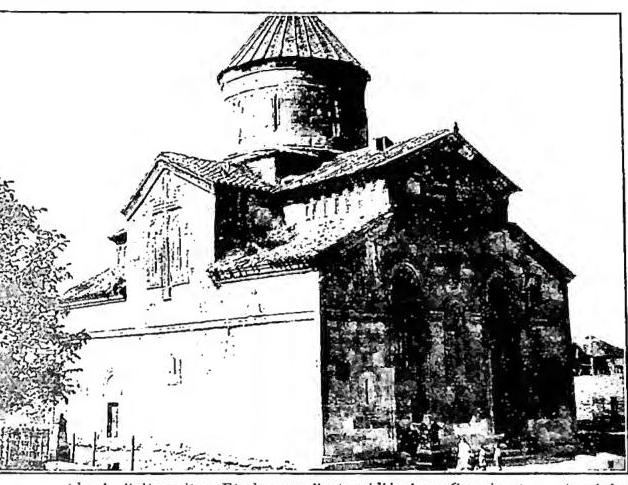
GEORGIA - Chiesa di Ertazmida (secc. XII-XIII).
2. Il Kurtchevani viene dalla Palestina. Nei secc. x-xi s. Eutimio e s. Giorgio di Iviron tradussero quello di s. Sofia, accolto in G. Nel sec. xviii Cipriano Samtavneli ne fece una nuova versione dal greco. Altri libri liturgici sono: Chmani (ἔχος) che contiene i primi quattro toni della domenica e dei giorni feriali e Gverdni (lati) che comprende i quattro altri toni (ἔχος πλάγιος). L'Octoecho e il Paracliticon furono tradotti in georgiano da s. Eutimio e s. Giorgio. Marchvani (Triodion) e Zatikni (Pentecostarion), tradotti da s. Eutimio e s. Giorgio, erano detti in antico Chvedrni ed il loro testo è stato conservato in un manoscritto del sec. ix, pur essendo il testo anteriore a questo secolo. Tveni (Mineon), termine introdotto nel sec. xi al Monte Athos. Anticamente si chiamava Zatiki e comprendeva tutto l'ufficio festivo dell'anno. Un altro nome di Tveni è Iadgari (Memoriale) già noto nei secc. viii-IX. Zanni (Orologion) ed il Typikon che contiene le regole liturgiche. Prettamente georgiano è il Gulani, che conteneva tutti i testi usati nel servizio divino durante l'anno liturgico.
Il canto georgiano, almeno dal sec. xii, era a tre voci e differiva dal canto greco. Secondo Balsamone i Georgiani non usavano lo Zeon nella Messa eucaristica. Il suo uso non deve essere stato introdotto che più tardi, dato che i manoscritti liturgici del medioevo non lo conoscono.
La prima edizione a stampa del Kondaki fu fatta nel 1716 e quella dell'Euchologion, non ritoccato secondo il testo slavo, nel 1713.
V. BIBLE
Georgia, or Iberia in the Caucasus, was won over to the Christian faith by St. Nino or Nina in the time of Constantine the Great. The first missionaries came from "Greece." Initially, the divine service was celebrated in Greek; but soon, Greek was replaced by Georgian, which required the translation of sacred texts into the Iberian language.
The first translation of Holy Scripture dates back to the 5th century: the Gospel was translated for the mother of King Vachtang (5th century). At the beginning of the 6th century, in the Monastery of St. Sabas in Palestine, Georgians sang the Office in Georgian.
Three recensions of the Georgian version are distinguished: Chanmeti (with the superfluous prefix meti "ch"), Sabacminduri (from the Monastery of St. Sabas), and Athonite (from Mount Athos). The oldest are the chanmeti texts.
According to some scholars, the first version of the Gospels was derived from the Syriac via Armenian. Considerable fragments of this translation, dating back to the 6th century, have come down to us, as well as a Tetraevangelion preserved in an Adishi manuscript of 897. In the course of the 6th-7th centuries, this first version was followed by a new revision of the Gospels based on the Greek text, which supplanted the older version. Texts of this version, also called pre-Athonite, have been preserved in many manuscripts, e.g.,
from Opisa (913), Gruči (936), Parchali (973), and Ibeti (995). To the same version belong also the writings of the Apostles (manuscript of 977) and the Acts of the Apostles (manuscript of 974) preserved at Mount Sinai.
Between the 10th and 11th centuries, the New Testament underwent a further revision by St. Euthymius (d. 1028) and St. George (d. 1065) of the Georgian Iviron Monastery on Mount Athos. This Athonite version, based on the Greek text, later became the textus receptus of the Georgian Church. Nothing is known of the Sabacminduri version.
The version of the Old Testament dates back, at least in part, to the 5th-6th centuries and closely approximates the Armenian version. Three versions of the Psalms are known, all prior to the 10th century. The other books have also been preserved in several versions. The most celebrated is the Iviron codex no. 1 of 978.
The ancient version is very important for the textual criticism of the New Testament. According to Blake, this version is an excellent representative of the Caesarean recension. Baumstark, on the contrary, considers it closely related to Tatian’s Diatessaron and believes that for the Old Testament it approximates the Greek recension of Lucian, but also the Hexapla.
As for the canon, the books of the Maccabees are not found in the Georgian version, as they were translated from Slavonic in the 18th century. The first translation of the Apocalypse of St. John was undertaken by St. Euthymius of Mount Athos between 976 and 978.
Printed editions: Vl. Benešević published Mark and Matthew in St. Petersburg (1909-11; Ibeti-Opisa ms.), Blake Mark and Matthew in PO, 20 (1928), and 24 (1933; Adishi ms.). The first edition of the Psalms was published by King Archil in Moscow (1705), and that of the Gospels by King Vachtang in Tiflis (1709). The entire Old Testament was first printed by Prince Vakhtang in Moscow (1742-43).
This edition was reproduced in Tiflis (1884), and Kekelidze published the text of Ecclesiastes according to four versions (Commentaria in Ecclesiastie Metrophanis metropolitae Smyrnensis, Tiflis 1920).
VI. ART
Recent research on the sacred art of Georgia has increasingly highlighted its importance for the history of early and medieval Christian art in the East. This research has demonstrated that the origins of Georgian art, particularly its architecture, date back to remote times and to the works of the peoples of Asia Minor and Mesopotamia, of which the Georgians are also heirs.Georgian art is generally divided into two periods: the first spans from the 4th to the 9th century, and the second from the 9th to the 18th century.
The first period is characterized by the development of particular architectural forms that influence the floor plan, construction methods, and the distribution of interior spaces and external masses of the building. In the second period, ancient forms are refined and harmonized to enhance the monumentality of the structure, while its decoration becomes increasingly elaborate, gradually freeing itself from and becoming independent of the monument. In many respects, Georgian architecture recalls the Romanesque of the Western Middle Ages.
Georgia features various types of sacred buildings: basilical, round, square, octagonal, and others that combine the basilical form with a central-dome plan. Thus, churches with a single apse and a single nave are found, as well as those with up to six apses and four naves; buildings containing two or three superimposed churches are also encountered. The floor plan of domed churches is generally a Greek cross, though often the arm facing east is longer than the others. The dome rises on four pillars or directly on the walls. Typically, medieval Georgian churches feature a conical dome set upon a polygonal drum, with narrow windows and small columns. The façade is often adorned with a raised cross and interlacing decorations.
Below are listed some churches dating to various periods of Christian life in Georgia:
5th–6th century: Zkarostavi, three-nave basilica in Tao-Klarjeti.
6th century: Shio-Mgvime, Mtskhetis-Guari, domed church in Kartli; Nino-Zminda, domed church in Kakheti; Bichvinta, domed church in Abkhazeti.
6th–7th century: Guari of Mtskheta; Gavazi, domed church in Kakheti.
7th century: Samzverissi; Zromi, domed church in Kartli; Kissis-Chevi and Davitiani, domed churches; S. Giorgio and Necressi, three-church basilicas in Kakheti; Isi and Suchbeci in Tao-Klarjeti; Anchiskhati in Tbilisi; Martvili in Mingrelia (western Georgia).
8th–9th century: Ateni, domed church in Kartli; Gurgiani, church with two domes; Necressi and Vachnadziani, domed churches in Kakheti; Bana, round domed church, built between 888 and 923 in Tao-Klarjeti, which the German traveler Koch considered the most beautiful church in the East after Hagia Sophia in Constantinople; Opisa, domed church in Klarjeti (9th century).
10th–15th century: Mtskheta (10th–11th century), Manglisi (11th century), Sion of Tbilisi, Samtavro of Mtskheta, Zilkani north of Mtskheta (12th century), Samtavisi (1050), Metekhi of Tbilisi (13th century), Ikorta (1172), Pitareti and Tzugrugasheni (14th century), Urbnisi, Ruisi (15th century), Achtala (11th–12th century), Ertazminda (12th–13th century), Samshvilde (893–960), Aschuriani (11th century), in Kartli. In Kakheti: Alaverdi and Kveteri (10th century), Bochorma (11th century), Bodbe, Sameba near Kazbeg in the Caucasus. In western Georgia: Seda-Sakdari (10th century), Gelati (11th century), Kutaisi (1003), Ilori with its treasury of sacred objects, Kazchi, Nikortsminda and Savane (11th century), Drandi (9th–10th century), Mokvi and Bedia (10th century). Samtskhe and Tao-Klarjeti offer: Zarzma (11th century), Kumurdo (969), Vardzia (12th century), Tbeti (918), Dadasceni (9th–10th century), Oshki (10th century), Chachuli (10th century), Ishkhani (9th and 11th century), Ekeki (1009), Safara (13th–14th century). All these churches feature a central dome. The ancient architectural tradition was interrupted with the country’s annexation to Russia (early 19th century). From this time onward, Western artistic influences began to prevail.
Great value is attributed to Georgian frescoes. Particularly beautiful are those of Ubissi (13th century), which reveal among their authors notable artistic individualities, including
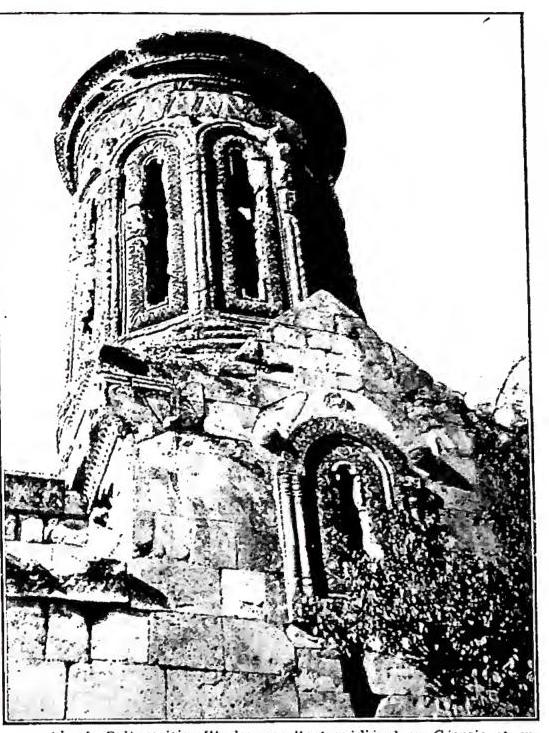
(from J. Baltrušaitis, Études sur l'art médiéval en Géorgie et en Arménie, Paris 1929, pl. 23)
GEORGIA - Church of Tzugrugasheni (14th century).
Those by the painter Damiano. The oldest frescoes date back to the 10th century: Bedia, Oški, Ateni, Chachuli, Shio-Mghvime, Saorbissi, Pavnissi, Ikvi in Kartli; from the 12th century we have Kinzivi, Achtala, Vardzia, Betania near Tiflis, Timotes-Ubani in Kartli, Savane; while the mural paintings of the monasteries in Ossetia, Zalingicha in Mingrelia, Lichne in Abkhazia, Zarzma, Safara, Ciuli in Javakheti, Nabakheti in Kartli are dated to the 13th and 14th centuries. More numerous are the frescoes from later periods.
Perhaps even more important are the mosaics, for example, those of Zromi (7th-8th centuries). In the apse of this church, the Traditio legis is represented: Christ appears between the apostles Peter and Paul, his right hand raised and holding in his left an open scroll with an evangelical text in the Georgian language. The mosaics of Gelati, on the other hand, are attributed to a Greek master. The Georgian miniatures, which have not yet been well studied, also deserve mention. They are contained in many biblical and patristic manuscripts, the oldest of which date back to the 9th century. Their representations are of great finesse and variety and testify to an excellent mastery of technique by the artists.
Sacred goldsmithing is also of notable interest, including numerous works in gold and silver. Famous are the large wooden crosses covered with gilded silver plates featuring figurative motifs with entire cycles depicting biblical scenes and Christian feasts. These crosses, often four meters high, stood before the sanctuary and served the faithful as a true liturgical catechism.
Among these works in gold and silver, many icons must be mentioned: such as the icon of Christ the Savior in Svaneti (12th century); of Simeon Stylites in Mestia (Svaneti), predating the 12th century; of the Madonna of Chachuli, much venerated in the 12th century; of St. George in Alaverdi, adorned by King Constantine III in the 10th century; of the Transfiguration in Zarzma, adorned in the year 886, which is the oldest dated icon in Georgia; the icons of Martvili and of Chofi in Mingrelia. The most famous painted icon, however, is that of Gvtis-Piri (Face of God), venerated in the episcopal church of Ancha in Klargeti as early as the 8th-9th centuries, now in Tiflis in the church of Anchiskhati. According to tradition, this icon was in Edessa in the 6th century. Later brought to Constantinople, it was transported to Georgia during the iconoclastic struggle. Also noteworthy are the Madonna of Portaitissa (10th century) from the Georgian monastery on Mount Athos, whose copy was venerated in Russia under the name "Iverskaja."
Georgia is also very rich in wood carvings, sometimes of exquisite workmanship; such as the church doors in Svaneti, of Mghvime, of Rconi, of Monasteri, of Savane, of Ikvi. The particular type of iconostasis (Georgian kankeli) found in Georgian churches, which has no equal in all the East, also deserves mention. The iconostasis was sometimes a monolith adorned with beautifully carved figures. At least in part, the iconostases of Ateni (8th-9th centuries), of Agara in Imereti, of Safara, of Bobisgheri in Tao, and of Ofara in Svaneti (11th century) have been preserved.
In ancient Georgian churches, the sanctuary was located at a higher level than the nave, and the altar, generally a quadrangular monolith, was placed against the wall of the main apse.
Notable is the influence that Georgian art exerted on the peoples with whom it came into contact. The radiation of Caucasian art indeed extended to Armenia and even to Russia.
Michele Tarchnišvili