
ATHOS, MONTE. – It is the easternmost of the three peninsulas extending southward from the Chalcidic Peninsula. It is almost 50 km long and on average 5 to 7 km wide. A mountain ridge runs along its entire length, ending in a cone 1,935 metres high, which is A. properly speaking; its name has been extended to the entire peninsula. In documents of the 9th century, the name Holy Mountain (τὸ ἅγιον ὄρος) appears for the first time; from it came the name Agiorites (also Athonites, Athoites) for the monks who inhabit II. These began to populate the mountain—which attracted those longing for quiet by its peaceful and remote location—when the Muslim conquest drove them from Palestine, Syria, and Egypt, and when the iconoclastic persecution raged in the Byzantine Empire. The oldest monasteries were established in the level part of A., but later they also spread into the interior of the holy mountain. Around the year 824, St. Euthymius visited the place and remained there in solitude for three years.
I. HISTORY
The history of Athonite monasticism may be divided into four periods.1st period. — This first period, extending from the origins to St. Athanasius the Lauriote, is characterized
by an intense eremitical life, as is shown by the imperial chrysobulls of Basil I the Macedonian (885) and Leo VI the Wise (911), confirmed by Romanus I Lecapenus (934), by which the emperors prohibited molesting the hermits of the holy mountain in any way or otherwise infringing upon their complete independence. Their interests were protected, for the monasteries outside the mountain, by a central authority called the Seat of the Elders; for the monasteries within the mountain, inhabited by solitaries (hesychasts), they were protected by a supreme head called the Proto.
2nd period. — This began with the arrival on A. of St. Athanasius the Lauriote (in the world, Abraham), who in 936 founded a laura (or monastery), still in existence, with a rule (typicon) of cenobitic life, that is, life in common, without individual possessions, and under the obedience of a single head or abbot (hegumen). This innovation in governance provoked protests from the solitaries, which reached the emperor John Tzimiskes; but the visitor Euthymius, whom he sent to the mountain, confirmed Athanasius’s reform. From then onward the Athonite cenobies multiplied, and regulations were drawn up defining the relations among the monasteries and with the supreme head, or Proto, who resided at the center of the peninsula, in Karyes.
The increasing number of monks led, under Constantine IX Monomachus, to the convocation of a general assembly of 180 solitaries, which established a new typicon (1046). This laid down rules of common interest, such as the delimitation of possessions and rights, the prohibition against buying or selling land not yet possessed by anyone, and the rules governing passage from one monastery to another.
The Benedictine monastery of the Amalfitans, τῶν Ἀμαλφινῶν (Μολφινῶν), was founded in the time of St. Athanasius (between 980 and 1000); its first superior was Leo, brother of Pandulf II, prince of Capua. The monastery, from which there also emerged an abbot of Monte Cassino, John of Benevento, was subsequently destroyed by the depredations of the soldiers of the crusade. Some remains of it still survive at the eastern extremity of the peninsula (O. Rousseau, L'ancien monastère bénédictin du Mont-A., Maredsous 1929).
In addition to Greek-speaking monks, Georgians also settled on A.; their monastery, called that of the Iberians (τῶν Ἰβήρων), was founded around 980. The occupation carried out by the Bulgarians in 1230 and by the Serbs in the middle of the 14th century led to the foundation of the Bulgarian monastery of Zografu and the Serbian monastery of Chilandar. The 11th–16th centuries were a period of unrest and bloodshed for A., owing to the incursions of the Saracens and the warriors of the Fourth Crusade, against whom the monks appealed to Innocent III. They did not, however, accept the union established at the Council of Lyons (1274), because it had been imposed by force by the emperor Michael VIII Palaeologus.
In the 14th century, after Murad I’s victory at Kosovo (1339), A. fell under Turkish rule, although the Turks left the monks in a privileged position. In this same century the monks were hesychasm (v.), Gregory Palamas (v.) and opposed by the Calabrian monk Barlaam (v.).
At the time of the Council of Florence (1438–39), the monks delegated by the Great Laura and by the monastery of Vatopedi signed the decree of union, but in practice the matter remained a dead letter.
Around the same period (16th century), the serious abuses of idiorrhythmia appeared among the Hagiorite monks. Taken as a whole, this is a way of life that allows individual monks to dispose of the goods acquired through their own labor or in other ways, and that exempts them from most of the obligations of communal life, replacing pure cenobitism with individualism and particularism. The result was a considerable development of commerce among the monks themselves and with the outside world. The patriarchs Sylvester of Alexandria and Jeremiah II of Constantinople opposed this movement in vain during the 16th century; it was effectively restrained only in the 18th and 19th centuries.
During the first centuries of this second period, monastic life was faithfully practiced in its two forms, solitary and cenobitic. The solitaries lived independently in their hermitages and cells, sometimes isolated and sometimes gathered under a single superior (in which case they were called sketes). The cenobites lived in the great monasteries, subject to a rule (typicon) and to a superior (hegumen) who, assisted by his council, governed and administered the cenobium. Each monastery had its own tribunal and its novitiate (initially one year, later two or three). Profession had three degrees: rasophori, microschemes, and megaloschemes. The first two categories were assigned external and manual labor; the megaloschemes were entrusted with the ancient ascetic prerogatives: prayer, contemplation, and austerity. All were obliged to live in poverty, chastity, and obedience.
All the cells, monasteries, and the territory were under the jurisdiction of the Proto. Formerly three times a year, and later twice, all the hegumens went to the residence of the Proto, which was autonomous, for the election of his counselors and to deliberate on the common interests of the peninsula. The Proto enjoyed special privileges: he received the blessing (σφραγίς) from the patriarch of Constantinople and dispensed it to the other hegumens.
As the authority of the Proto declined, following the increasing wealth and power of the great monasteries, which gradually usurped his authority, the second period of the history of A. came to an end in the 16th century. The name of the Proto appears for the last time in the official acts of 1584.
3rd period. — The 17th and 18th centuries marked the relaxation of Athonite monasticism. From the religious point of view, idiorrhythmia continued to undermine monastic discipline; from the economic point of view, it threatened the very existence of the monasteries through poor administration and indebtedness. In 1744 the patriarch Paisius II attempted to restore the finances of the Hagiorites, and Gabriel IV, in addition to having attempted with a new
During this period there were also attempts at rapprochement with the Roman See. Propaganda activated the long-planned project of founding a school on Mount A., while some Athonite monks went to Constantinople to attend the Jesuit school. There was likewise a noticeable revival of scholarly activity with the foundation of an ecclesiastical academy in the monastery of Vatopedi, called the Athoniade, of which a remnant still survives at Karyes.
Thanks to the constant work of the patriarchs of Constantinople, the discipline of A. was progressively improved and standardized. From 1785 to the middle of the twentieth century, eleven of the twenty monasteries returned to the observance of the cenobitic life standardized by the typicon (the eighth in the series) that Patriarch Gregory V imposed on all the monasteries in 1810. From the administrative point of view, it was established that the property owned by all the monasteries in Wallachia, Moldavia, Bessarabia, and the Caucasus should remain the property of the Russian and Romanian governments that dominated those regions, provided, however, that its revenues be used to maintain only the monasteries of their respective nationals.
4th period. - After the Balkan Wars at the beginning of the twentieth century, the territory passed from the Turks—who maintained a kaimakan at Karyes as the government’s representative, without interfering in the internal affairs of the monasteries—to Greece, by virtue of the Treaty of Bucharest, confirmed by that of Lausanne (1923). According to the constitutional charter, the Hellenic State recognizes Mount A. as an autonomous province and appoints as its representative a monarca with diplomatic rank and privileges. Ecclesiastically, A. constitutes a patriarchal exarchate, over which the patriarch of Constantinople therefore exercises his entire jurisdiction.
At present, in all the monasteries of A., the oligarchic regime has replaced the monarchical one that was in force until the time of Gabriele IV. At the head of the entire monastic federation is the Sacra Epistasia, composed of four members taken in rotation from a group of four monasteries. The representatives of the twenty monasteries form the Sacra Comunità (ἐρὰ κοινότης). In each monastery the egumen is independent in spiritual matters. For its general administration, the Epitropia, consisting of three or four members, is appointed to carry out the decisions of the Gerontia, or council of elders. The Diceo (ὁ Δικαῖος), as superior, governs the skete with his council of epitropi, but may not go beyond the decrees of the Gerontia, composed of the superiors of the kalibes (καλύβαλ), that is, of the cells forming the skete. Only in the monastery of St. Panteleimon and in the two sketes of St. Andrew and St. Elias, where the Russians are in the majority, has the monarchical power of the egumen or local superior remained in force.
As for the monasteries, each is autonomous and regulated by its own typicon, which must be approved by the council of the Sacra Comunità. An essential distinction must be made between strictly cenobitic observance and idiorrhythmic observance. The former is based on the traditions most cherished by traditional monasticism: community of life in all its details and community of goods administered by the local authority. Idiorrhythmic monasticism, on the other hand, consists of a certain number of families living separately, with their own possessions, novices, and occupations, under the guidance of their own superior, who is called a geronto. They assemble only for the sacred offices in the principal church of the cenobium in which they are housed. To direct this convent, one of the gerontes is elected each year; he has at his service a certain number of monk-administrators and may receive novices. The monastery’s common goods are distributed among the various families, which in turn must provide certain services. The internal organization of the cenobia is more or less that described above: novitiate, profession, ordinations, internal and external work, asceticism, liturgical offices, and fasts. Naturally, among the idiorrhythmic communities the way of life is more relaxed. A cenobitic monastery may not now pass to idiorrhythmic observance. From the fourteenth century onward, the close dependence of the cells and sketes on the dominant monasteries became increasingly evident. In the seventeenth century this dependence, as today, was complete. Relations between the former and the latter are determined by a special typicon, which takes the form of a pact with clauses concerning the financial and temporal administration of property and internal life. In the sketes observance is more austere, whereas in the cells the monks are more extensively engaged in agricultural work.
Statistics of M. A. - List of the twenty monasteries according to hierarchical order:
1. 1. Laura of St. Athanasius (963), idiorrhythmic.
2. 2. Vatopedi (972-80), idiorrhythmic.
3. 3. Iviron (ca. 980), idiorrhythmic.
4. 4. Chilandar (second half of the twelfth century), idiorrhythmic, Serbian.
5. 5. Dionisiu (mid-fourteenth century), cenobium.
6. 6. Kutlumusiu (mid-thirteenth century), cenobium.
7. 7. Pantocrator (second half of the fourteenth century), idiorrhythmic.
8. 8. Xeropotamu (perhaps tenth century), idiorrhythmic.
9. Zografu (end of the tenth century), cenobium, Bulgarian.
10. Dochiariu (ca. 976), idiorrhythmic.
11. Karakalu (after 1071), cenobium.
12. Filoteu (before 992), idiorrhythmic.
13. Simopetra (mid-fourteenth century), cenobium.
14. Paulu (perhaps end of the tenth century), cenobium.
15. Stauroniceta (end of the tenth century), idiorrhythmic.
16. Senofonte (end of the tenth century), cenobium.
17. Grigoriu (fourteenth century), cenobium.
18. Esfigmenu (eleventh century), cenobium.
19. Rossiku or St. Panteleimon (thirteenth century), cenobium, Russian.
20. Constamonitu (eleventh century), cenobium.
In addition, there are 14 sketes with approximately 500 kalibes and 205 separate cells; some establishments (καθίσματα) for monks and numerous hermitages.
Placido de Meester
II. ART
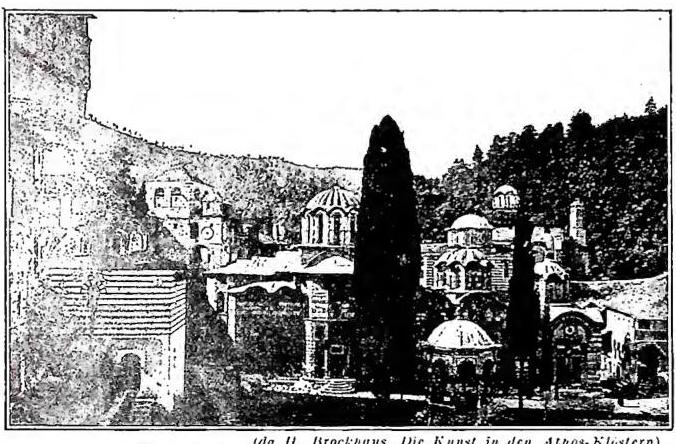
The artistic production of Mount Athos, extending from the tenth to the eighteenth century, developed with a certain constancy and continuity of characteristics, so as almost to constitute a regional variety within the broader framework of Byzantine art.1. Architecture. - The numerous monasteries of Athos are generally of similar form, although belonging to very different periods. Surrounded by an enclosing wall with square, polygonal, or circular towers, sometimes domed, they consist of a large courtyard around which are arranged the monks’ dwellings, small quarters with enclosed balconies and porticoes, often on two stories. At the centre of the courtyard stands the common church (καθολικῶν), preceded by a fountain for purifications (φιτῶλῃ), sheltered by a circular shrine. The churches, beginning with the oldest ones at Laura (tenth century), Vatopedi (eleventh century), Chilandar (late thirteenth century), and Iviron, belong to the cruciform type inscribed within a square or rectangle, with the transverse arms ending in semicircular apses; besides the central dome, the more complex structures have smaller domes over the arms. Another characteristic of the sacred buildings of Athos is their having before them a highly developed domed narthex, called λιτὴ from the processions held within II. The external decoration of the churches of Athos often consists of blind arcading. A similar arrangement is also found in more recent buildings, such as the monastery of S. Paolo (fifteenth century) and the numerous ones of the following century, among which those of Senofonte, Dionisiu, Dochiariu, etc., should be mentioned. Chapels and oratories are likewise very frequent, sometimes of great interest for their painted decoration.
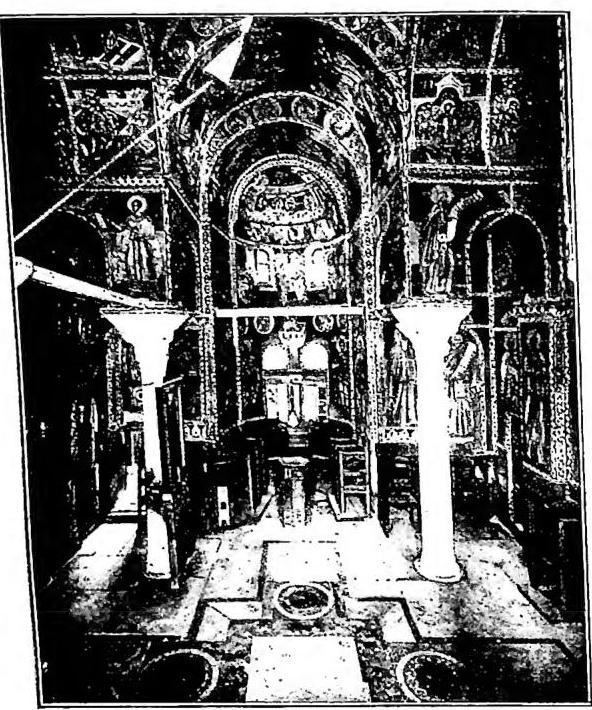
2. Painting. - The study of Athonite paintings is made very complex not only by the tradition that indefinitely prolongs the persistence of older characteristics, but also by the continual restorations to which the frescoes were subjected. Their uniform character is also revealed in the arrangement of scenes and in the decorative system of the various churches, which is repeated with few variations. At Dochiariu there is perhaps the most typical example of this arrangement: in the dome is the Almighty (Pantocrátor) among angels and prophets; in the pendentives are the Evangelists; in the apse, the Madonna with the Divine Liturgy and the hierarchies; on the vaults are represented the twelve major feasts; on the walls are depicted martyrs and saints; above the entrance to the nave is the Prayer (δέχος), with Christ enthroned between the Virgin and the Baptist; on either side of the doors is the Last Judgment. The oldest frescoes, dating from the first years of the fourteenth century, are those of the monasteries of Chilandar and Vatopedi; although reflecting the general characteristics of the Palaeologan Renaissance, they are connected with the Serbian regional manner. Of a more purely Macedonian style, on the other hand, are the fifteenth-century frescoes in the chapel of S. Giorgio in the monastery of S. Paolo, executed by Andronico di Bisanzio. Athonite painting reached its greatest flowering in the sixteenth century; Emanuele Panselino, author of the frescoes in the Protaton of Karyes, celebrated by historical sources, gave Macedonian forms a singular modernity owing to his contacts with Italian art. Panselino had numerous followers, but perhaps his overly vigorous and original manner did not succeed in prevailing over the traditional Cretan manner, represented by other masters such as Teofane di Creta, who worked in the monastery of Laura (1535), and Zorzi, who painted in the monastery of Dionisiu (1547). At Vatopedi there are some mosaics from the eleventh century. Noteworthy too are the portable icons, likewise of the Cretan school. Also to be recalled are the portable mosaics of the monasteries of
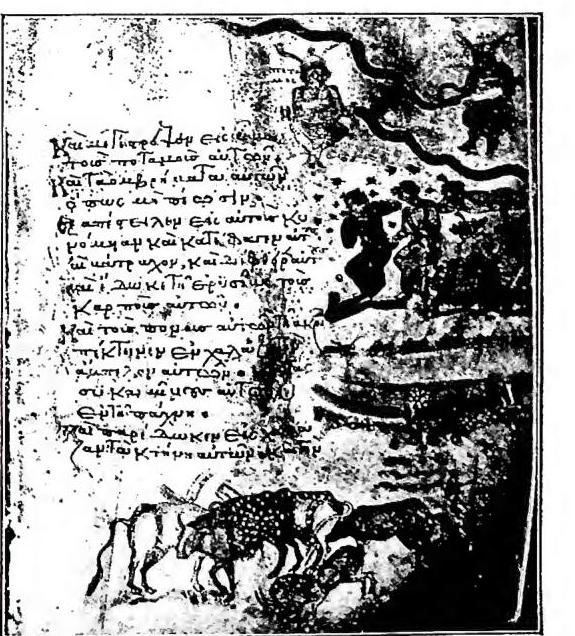
3. Sculptures and treasures. — The churches contain numerous decorative works of sculpture from the Byzantine and post-Byzantine periods, especially presbyterial screens. We may also mention the bronze doors of the church of Vatopedi. The quantity of precious objects preserved in the treasuries is immense, including reliquaries, staurothekes, Gospel bindings, liturgical vessels, steatite plaques (the twelve feasts of Christ at Vatopedi), encolpia, etc. Particularly noteworthy are: the staurotheke of Laura (10th century); the jasper cup of Vatopedi (14th century); a diptych with figures of Christ and the Virgin (14th century). The religious community of A. preserved its own pictorial tradition, attested by a collection of precepts concerning artistic practice (the so-called «Book of the Painters of M. A.», more properly Ἐρμηνεία τῶν ζωηράρων). This treatise, although in the version known today it does not date back beyond the 18th century, reflects the continuity of a school of painters which, though limited to the regional sphere, has its origins in antiquity and is reflected throughout the Eastern-Byzantine world; consequently, the «Book» is of great interest for the history of artistic theory. Vedi Tavv. XXV-XXVI.