
MOLDAVIA. —
I. GEOGRAPHY
One of the 16 federated Republics of the U.S.S.R. (M.A.S.S.R.), which today has 2.4 million inhabitants over an area of 33,700 sq. km., 70% of whom are Moldavians (the remainder Ukrainians, Russians, Jews, Bulgarians, Tatars, Turks, etc.).Following the Ultimatum of 27 June 1940, the U.S.S.R., which had never been willing to recognize the annexation (1918) of Bessarabia (that is, the territory between the Dniester and Prut) to Romania, forced the latter to cede not only that region (44,482 sq. km. with 3.1 million inhabitants), but also northern Bukovina (5,242 sq. km. with 520,000 inhabitants), as well as the district of Horta, which had always belonged to M., that is, to the Romanian territory to which this name more properly applies. The U.S.S.R., which had created in Oct.
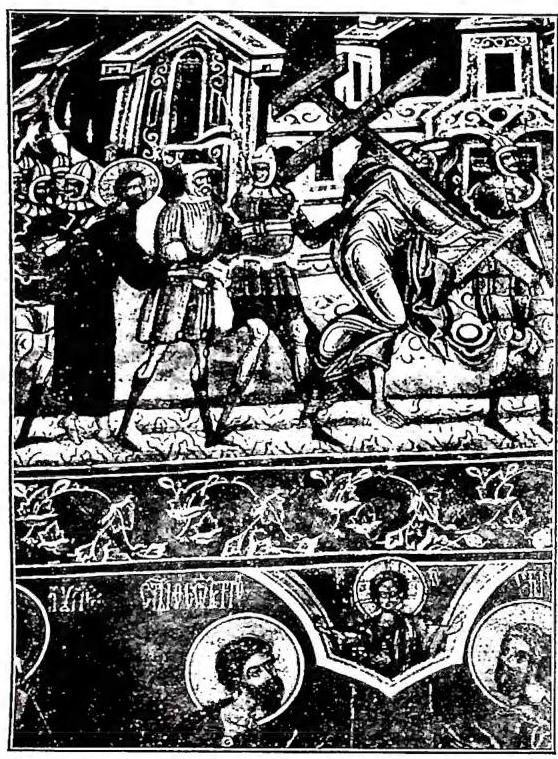
MOLDAVIA - The Ascent to Calvary. The Episode of Simon of Cyrene. Below: St. Teodoro Tirone and St. Teodoro Stratelita. Fresco of the 16th century. Dobrovat, Monastery.
In 1924, on the lower Dniester, a fictitious Moldavian autonomous Republic (8,419 sq km, with 616,000 inhabitants) was created; after 1940, it incorporated approximately half of the 50,254 sq km seized from Romania, thus forming the new federated Republic. This, however, is far from encompassing the whole of Bessarabia, because part of that region, together with Bucovina, passed to the Ukrainian Republic.
The A.M.S.S.R. is a hilly country, with a temperate climate and fertile soil, essentially agricultural and pastoral in character, but also endowed with good mineral resources (lignite, phosphorites, gypsum, and petroleum). Its principal products are maize, wheat, tobacco, and sugar beet. During Russian rule (which lasted until 1918), the region was known for its abundant production of wine and fruit.
The only settlement of any importance is the capital, Kišinev (113,000 inhabitants, two-fifths of them Jews). The true M. itself (38,058 sq km, with 2.8 million inhabitants) should not be confused with the Soviet Republic: it is the neighboring Romanian region lying between the Prut and the crest of the Carpathians.
II. HISTORY
Historically, the name M. designates the second of the two Romanian principalities that came into political existence in the 14th century on the flanks of Transylvania.The traditional date of its foundation is the year 1359, when part of the small Romanian nobility of Maramureș, in north-western Transylvania, after taking part in the conquests of Louis I of Hungary in the lands controlled by the Mongols beyond the eastern Carpathians,
rose up against the Hungarian sovereign and settled in those parts under the leadership of the voievoda Bogdan. His successors continually extended the frontiers of the new State which, under Stephen the Great (1457-1504), reached its maximum territorial expansion: from the eastern Carpathians to the Dniester River, and from Wallachia, the Danube, and the Black Sea to southern Poland, in Pocuzia, with an area of 94,301 sq. km., of which 10,441 lay in the future Bucovina and 44,442 in the future Bessarabia (regions taken from M. respectively in 1775 by the Austrians and in 1812 by the Russians). In 1859 M., or what remained of it, united with Wallachia, together forming the new Romania.
M. had to offer fierce and often victorious resistance to the Turks; Stephen the Great corresponded with Sixtus IV, who in a letter called him, for his brilliant victories, « athlete of Christ ».
As regards ecclesiastical affairs, the first princes of M., a country separated from obedience to the Roman See, depended on the metropolitan of Halicz, a city that also formed part, between 1387 and 1404, of the new State. In 1401 M., after many difficulties and laborious negotiations with the Patriarch of Constantinople, obtained recognition of a Romanian metropolitan, Josif, residing at Suceava, the capital of the principality; this metropolitan see was transferred in 1564, together with the capital, to Jasi. Other bishoprics were subsequently founded.
As regards Catholicism, a first bishopric was founded in 1227 by Gregory IX at Milcov — whose location is uncertain — for the recently converted Cumans, and had as its incumbent the Dominican Teodorico; the Mongol invasion of 1241 destroyed every trace of this city, but the honorary title of bishop of Milcov continued for another three centuries among the Hungarian clergy.
A second Catholic bishopric was erected by Urban V in 1370 at Siret, at the request of the reigning prince Lațcu, who had converted to Catholicism (a personal conversion that had no following); the incumbent, a Franciscan, Andrea da Cracovia, apparently never came to M. He had 4-5 other titular successors, and after 1434 this bishopric is no longer mentioned. Alessandro il Buono (1400-32) authorized, in 1413, a Catholic bishopric at Baia; indeed, he had a fine stone church built at his own expense for the new bishop, the Dominican Giovanni de Ryza, but this bishopric too lasted scarcely more than a century. In 1607 a bishopric was founded at Bacau, which functioned until near the end of the 18th century. Its first incumbent was Gir. Arsengo. Finally, on 27 April 1883, Leo XIII founded the bishopric of Jasi, which still exists.
M. is the cultural cradle of Romanism: here, in the monasteries, the first Romanian chronicles were written; the Moldavian chroniclers Ureche and Miron Costin were the first to reveal its Latin origin to the people; Prince Demetrio Cantemir (1684-1723) and the « spataro » Milescu (v.) were scholars of worldwide renown; literary Romanticism asserted itself with Cogălniceanu and Alessandri; Moldavian was the national poet of the Romanians, Mihail Eminescu, as well as the great historian Nicolae Iorga.
For the Part, V. ROMANIA.