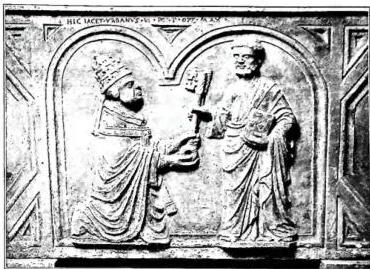
URBANO V, POPE, blessed. - Guglielmo di Grimoard, born in 1310 in the castle of Grisac (Lozère) to the lord of the place, died on 19 Dec. 1370 at Avignon. He began his studies at Montpellier, continued them at Toulouse in jurisprudence, then became a Benedictine monk in the priory of Chirac, dependent on the monastery of S. Vittore of Marseille, continuing his studies of theology and canon law, and attended the Universities of Paris and Avignon.
A doctor by 31 Oct. 1342, he taught canon law. Administrator of the diocese of Clermont, then of that of Trés, he was made prior of Notre-Dame du Pré. On 13 Feb. 1352 Clemente VI appointed him abbot of St-Germain d'Auxerre, and a few months later sent him to Lombardy on an important diplomatic mission, which Guglielmo successfully carried out; he induced the archbishop Giovanni Visconti to return certain papal lands and placed him in possession of the vicariate of Bologna. In 1354 he was sent by Innocenzo VI to Rome, and in 1360 to Lombardy, where he met with Cardinal Egidio d'Albornoz, the papal legate in Italy, and with Bernabò Visconti, who was in conflict with the legate. On 2 Aug. 1361 Innocenzo VI appointed him abbot of S. Vittore of Marseille, and the following year, concerned by the death of Luigi of Taranto, the second husband of Queen Giovanna, sent him to the court of Naples. Guglielmo was in fact in the peninsula when he learned that, following the death of Innocenzo on 12 Sept. 1362, the cardinals, unable to agree on the name of a member of the Sacred College, had elected him pope on 28 Sept. He was consecrated on 6 Nov.
The king of France, Giovanni II, and the king of Cyprus, Pietro of Lusignano, came to Avignon to meet him, and together with them an expedition to the East was decided upon, without U. abandoning the intention, opposed by King Giovanni, of continuing an energetic political and military campaign in Italy: the powers conferred by Innocenzo VI upon Albornoz were extended, and a new crusade was proclaimed against the Visconti. Suddenly, in the autumn of 1363, Albornoz was relieved of his duties in Lombardy and invited to Naples: U. was attempting a policy of peace with Bernabò. In the following years his aims became more clearly defined: while collaborating with the new king of France, Carlo V, in the pacification of that kingdom, he negotiated with the emperor Carlo IV, with Luigi I of Hungary, and with Giovanni V Paleologo to promote war against the Turks, seeking to involve in it the Great Companies of mercenaries that were laying waste to the West, and he prepared for the return to Rome, despite the opposition of the French court and of the College of Cardinals. He left Avignon on 30 Apr. 1367, embarked at Marseille on 19 May, escorted by a fleet that was largely Italian, and landed at Corneto on 3 June. He spent the summer at Viterbo, but the first incidents soon broke out in Viterbo itself. In October U. entered Rome, where the population welcomed him with rejoicing. He sought to improve the administration of the city and to oversee its reconstruction, but the mistrust of the Romans soon manifested itself when, in 1368, six Frenchmen, one Englishman, and only one Roman were created cardinals: U., despite the transfer of the Curia to Italy and his good relations with the emperor Carlo IV, who was in Rome that same year, remained essentially faithful to the Avignonese tradition. The arrival in Rome of Giovanni V Paleologo, in 1369, underscored the Pontiff’s intention of making the Holy See the effective center of the entire Christian world. When the conflict between the kingdoms of France and England reopened, while in Italy Visconti power was again becoming threatening and the Curia’s stay appeared increasingly unsafe, U. left Rome on 17 Apr. 1370, and during a brief stay in Viterbo announced his decision to return to Avignon; he embarked at Corneto on 5 Sept., landed at Marseille, and on the 24th was acclaimed at Avignon. Three months later he died.
As lively and extensive as his political activity was U.’s activity as a reformer of morals. Scrupulous in his private life and orderly in his occupations, he was lavish in promoting the embellishment of the Apostolic Palace at Avignon, the enrichment of the abbey of S. Vittore of Marseille, and the foundation and restoration of colleges and churches in the places dearest to him. He was always consistent in his love of study and in his generous protection of schools and scholars. He left behind a great sense of loss in Provence, where he was venerated as a saint. His cult also spread to the neighboring regions, on both sides of the Alps; on 5 March 1870 Pius IX confirmed his cult.
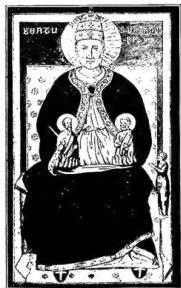
(from H. K. Mann, Tombs and portraits of the Papes of the Middle Ages, London 1889, fig. 61)
URBANO V, POPE, blessed - Portrait, from a drawing in the Dal Pozzo collection at Windsor - London.