
CARLO V, king of FRANCIA. – Son of Giovanni II the Good, he was the greatest figure of the royal house of France, of the Valois branch, in the fourteenth century. Born at Vincennes on 21 January 1337, while still young he was given the government of the Dauphiné, ceded by the last dauphin of the house of Latour du Pin to the king of France on condition that its government should always remain in the hands of the king’s eldest son. He was therefore the first dauphin of the royal house. In 1355 his father gave him the government of the duchy of Normandy. After the battle of Poitiers, in which Giovanni II was taken prisoner by the English (1356), C., the dauphin, assumed the office of regent and lieutenant of the king. The political crisis through which the kingdom passed enabled him, at his own expense, to acquire knowledge of men and to distinguish friends from enemies; thus, although still young, he attained a full awareness of the sovereign’s duties and became convinced of the necessity that the monarch possess complete and absolute authority. In order to secure support for the reorganization of the State, he convened the Estates General, but had to contend with the opposition of the king of Navarre, Carlo il Malo, and of the Parisian bourgeoisie led by an eloquent lawyer, Etienne Marcel. Forced to leave Paris, he found aid among the provincial feudal nobility, which in the meantime was crushing the rural uprising of the Jacquerie; with an army of nobles he returned to Paris and re-established his authority. In 1360 he negotiated the peace of Brétigny-Calais with the English and, when his father returned from captivity, restored the kingdom to him. Giovanni II died on 8 April 1364, and C. then ascended the throne. He reigned for only sixteen years, but his reign was of great importance in the history of France.
A cultivated man, he preferred a secluded life among studies and meditation to the hunting and chivalric life favored by his father. He conceived of his government as necessarily absolute, tempered only by an awareness of the duties of a king and by the honest and intelligent collaboration of cultivated persons. His program was to restore peace and order to the State, bringing to an end the entire legacy of conflicts and wars. The period of industrious peace nevertheless lasted only until 1369. The implementation of the Treaty of Calais in fact led to serious difficulties with the king of England, both because the ransom of Giovanni II was still outstanding and because of the rights of high sovereignty that the king of France claimed over the feudal lords of the territories occupied by the English. The war therefore resumed in 1369. In the king’s Council, the project of invading England was discussed; then, under the command of the new constable Du Guesclin, the French armies conquered Poitou, Saintonge, and Brittany. The death of the Black Prince, the English military commander, and of the king of England caused the war to lose its intensity.
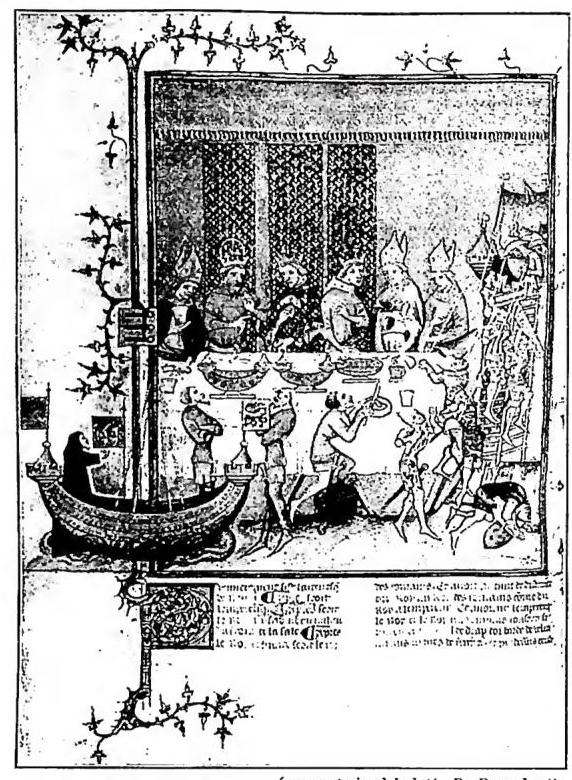
CARLO V. KING OF FRANCE — Banquet offered by C. V to the Emperor Carlo IV and to Venceslao IV of Luxembourg, King of the Romans. Les Grandes Chroniques de France, illuminated parchment codex (14th century) — Paris, National Library, French ms. 2813, fol. 473.
With regard to the king’s political activity in other fields, it should be recalled that C. sought to persuade Urbano V not to return to Rome, but to retain the papal see in Avignon. When the schism broke out in 1378, the king initially recognized Urbano VI, then abandoned him and recognized the new pope of Avignon, Clemente VII. He died on 16 September 1380 at Beauté-sur-Marne and was buried at St-Denis.