
ROBERTO DI GINEVRA (CLEMENTE VII), ANTIPAPA. - Born in Geneva in 1342 to Count Amadeus III of the city and Matilda of Boulogne, a relative of the King of France, canon of Paris, bishop of Thérouanne (Nov. 3, 1361) and subsequently archbishop of Cambrai (Oct. 11, 1368), he was created cardinal by Gregory XI on May 30, 1371.
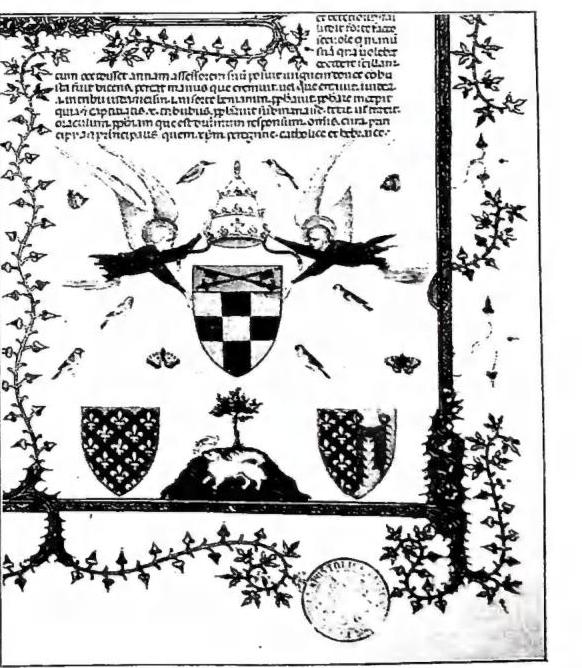
Sent as legate to Italy (1376-78), he commanded the Breton bands that carried out the massacre of Cesena (Feb. 1, 1377). He participated in the election of Urban VI, but withdrew from him, together with the French cardinals who elected him pontiff, at Fondi on Sept. 20, 1378 under the name of Clement VII, thus initiating the disastrous Western Schism. Having failed in his attempt to seize Rome (Battle of Marino, April 30, 1379) and seeing that a stay under the protection of Queen Joan was impossible, he left Italy and on June 20 established his seat in Avignon. The family ties and connections of R., particularly that of Charles V, King of France, who had favored the rebellion of the cardinals, and later that of his son Charles VI, were the strongest supports of the Avignonese obedience. This was formed, in addition to France, by the Spanish kingdoms, Scotland, and occasionally by some German prince and bishop, and never had the majority of Christendom with II. In Italy only the Kingdom of Naples, according to dynastic events, at times subjected itself to Clement VII. He excommunicated his adversary, just as the latter had excommunicated him, but was continually forced to resort to expedients to keep his adherents faithful, who bitterly resented the burdensome levies necessitated by the lack of money, continuous struggles, and the expenses of an extravagant court. As early as 1379 R. created Louis of Anjou, brother of Charles V, a vassal of the Holy See, assigning to him the "Kingdom of Adria" formed from the possessions of the Holy See. In 1382 he appointed him captain of the Church for the conquest of the Kingdom of Naples. Upon his death in 1384, he gave that kingdom to his son Louis II and aided his vain attempts at conquest. There was no lack of pressure on R. in France for the cessation of the schism, first at the time of the death of Urban VI (1389), and then by the University of Paris, which in 1394 made it an almost direct imposition on R., who died of a sudden apoplectic attack on Sept. 16, 1394.