Machine translation of the 1948–1954 Italian original. The original text is authoritative.
WESTERN SCHISM. – It was the gravest danger to the entire structure of the Western Church during the transition from the fourteenth to the fifteenth century. The long residence of the pontiffs in southern France had by then created there the conviction that a return of the papal Curia to Rome was neither desirable nor practically possible, so numerous were the interests conspiring to keep it there. The return to Italy of Urbano V (1369–70) had been short-lived; that of Gregorio XI (1377) had taken place only after stubborn resistance. The death of Gregorio XI in Rome (26 March 1378) had come too soon, before he had been able to take those measures that would truly ensure the papacy’s residence in Rome; above all because the cardinals were for the most part French, as were the lower-ranking curial officials.
At Gregorio’s death, the Romans therefore feared that the new Pontiff would move his see back beyond the Alps and began to make their voices heard in order to obtain a Roman, or at least an Italian, pope, provoking disturbances, though without imposing the choice of one or another individual; and, on the other hand, the fortress of Castel S. Angelo was in the hands of a Frenchman representing the entire S. Collegio and could at any moment serve as a refuge for the electors. The French cardinals themselves were divided into two groups and unable to unite two-thirds of the votes behind a candidate from either party; it was therefore agreed to choose an outsider to the S. Collegio, a Curial prelate well known to all, Bartolomeo Prignani, archbishop of Bari, who took the name of Urbano VI (8 April) and was duly crowned and recognized by everyone. He immediately declared his intention not to
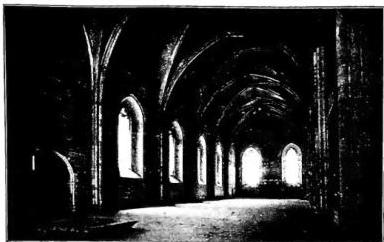
SCISMA D'OCCIDENTE - The Great Chapel (14th century) - Avignon, Palace of the Popes. (photo Estel) SCISMA D'OCCIDENTE – Conclave Corridor (14th century) – Avignone, Palace of the Popes.to leave Rome and create new cardinals; for this reason, and particularly because of his harsh manner, he soon alienated the affections of his electors, who, claiming that they had not been free in electing him, withdrew from him and issued proclamations in various countries; then, having secured the support of Charles V, King of France, and Joanna of Anjou, Queen of Naples, they assembled at Fondi and proceeded to elect one of their number, Roberto of Geneva, who took the name of Clement VII (20 September 1378). Seeing that residence in Italy would be difficult, he returned to Avignon, where he established his Curia (20 June 1379). Thus there came to be two Curias with their own cardinals and two obediences; of these, that of Urban was the more numerous, but they were never so stable that a country, or part of one, did not pass from one to the other, with the result that the Western Christian world was thrown into great confusion. Scarcely, one might say, had the schism broken out when thought had to be given to the means of ending II. The only sure and legitimate method would have been to examine impartially how Urban’s election had proceeded, but it proved impossible to reach this point; nor were Clement’s partisans prepared to repudiate what they had done. It was therefore decided to seek an arbitral compromise between the two parties, a mutual renunciation by the two contenders in order to arrive at a new and certainly canonical election; later it was held that there was no other way than that of a council. Meanwhile, after the death of Urban VI, the cardinals of his obedience immediately elected Boniface IX (2 November 1389), followed by Innocent VII (17 October 1404) and then Gregory XII (30 November 1406), on the understanding that he would renounce the papacy if his adversary at Avignon were willing to do likewise. The latter was then Benedict XIII, who had succeeded Clement VII (28 September 1394); but attempts to this end, which had seemed close to completion, came to nothing, leaving spirits increasingly embittered before the consequences of a schism that had to be resolved in order to restore unity of government to the Church. Gregory XII’s disagreements with his cardinals facilitated their contacts with a large part of Benedict XIII’s cardinals, weary of his obstinacy, and together they summoned a Council at Pisa for 25 March 1409, with the intention of bringing the schism to an end. The two rival Pontiffs then also summoned a council: Benedict at Perpignan, Gregory at Cividale del Friuli, but with very meagre results; at Pisa, however, the two Pontiffs were boldly summoned in due legal form, proceedings were brought against them, they were condemned as heretics, and a new election was carried out without further ado, in the person of Pietro Filargo, cardinal archbishop of Milan, under the name of Alexander V (26 June). Thus the two obediences became three, and the confusion increased: in each obedience people believed they were obeying the true pope, and among them were illustrious persons and even saints, so greatly were judgments distorted concerning the events that had occurred during the schism. Alexander V was succeeded, in an election held at Bologna, by John XXIII (17 May 1410), who, like his adversaries, had to bear the burden of the circumstances continually created by the schism. Having entered Rome temporarily, he was able to hold a council there (1412–13), as the Council of Pisa had prescribed; but as his position became increasingly uncertain, he yielded to the wishes of Sigismund, King of Hungary and brother of Wenceslaus, King of Bohemia, who had entered Italy, and summoned Constance (v.) for 1 November 1414. He did in fact go there, while Gregory and Benedict did not appear, and he presided over II. But when he realized that the atmosphere was unfavorable to him and that his renunciation was being demanded as necessary to end the schism, he fled from Constance (20 March 1415), thinking that the Council would thereby be dissolved immediately. But this was not King Sigismund’s intention, and he insisted that the Council continue, with the cardinals taking turns in presiding over II. John XXIII was forced to appear before it to be tried and to accept the sentence of deposition (29 May). Gregory XII, who was staying at Rimini, then sent the knight Carlo Malatesta as his official representative to King Sigismund; subsequently, before the Council recognized by him, Cardinal Giovanni Dominici, as legate, solemnly presented his renunciation of the papacy, which he legitimately held, conferring upon the Council itself the authority to bring about the cessation of the schism. Benedict XIII remained obstinate in defending what he called his rights and did not yield to the pressure of the King and the Council; proceedings were therefore brought against him and he was deposed (26 July 1417). After this, the election of a new pope took place, conducted by 23 cardinals from the three obediences, assisted by six ecclesiastics for each of the five nations represented at the Council. The elected pope was Martin V (11 November 1417), who was recognized by all except the small group gathered at Peniscola around Benedict XIII. Thus the long schism came to an end, but its consequences survived; first of all, in the necessity of repairing the harm caused by the long period of disputes and by the abuses that had arisen from II. Moreover, a sense of distrust toward papal authority had developed, and it was therefore desired to establish a fixed periodicity for councils (every ten years), so that they might supervise the pope’s work of reforming the Church; supreme authority was to be attributed to the council, which was to have the final decision in every doctrinal and disciplinary matter, and to which appeal was permitted against any alleged grievance. These principles later received their definitive formulation in the propositions of the Gallican Church of 1682.
The new spirit that had entered the Church, and that in those very years was reaching its sharpest and most intolerant expression in Bohemia through the heresy of the Hussites, found an opportunity to manifest itself at the Council of Pavia–Siena (1423–24), which nevertheless failed to achieve any practical measure of ecclesiastical reform. A more sensational episode occurred with the Council of Basel (v.), which, having assembled in 1431 with the Pope’s consent, passed into open rebellion against Eugene IV in 1437 and proceeded to the election of Felix V as antipope (5 December 1439). Meanwhile, Eugene IV was holding his Council of Ferrara–Florence for union with the East; while the anti-Council moved from Basel to Lausanne and then dissolved, and Felix V renounced his office on 7 April 1449.
BIBL.: L. Salembier, Le grand schisme d'Occident, Paris 1902; N. Valois, La France et le grand schisme d'Occident, 4 vols., Paris 1896–1902; G. Hergenröther-P. Kirsch, Stor. univers. della Chiesa, V, Florence 1906, p. 97 ff.; N. Valois, La crise religieuse du XVe siècle: le pape et le Concile (1418-30), Paris 1909; Fr. p. Blemetzried, Literarisch. Polemik zum Beginn des grossen abendländisch. Schisma, Vienna 1909; Hefele-Leclercq, VI, II; VII, 1; M. Seidlmayer, Peter de Luna und die Entstehung der grossen Abendilnd. Schismas, Münster 1933. Further bibliography in J. Calmette, L'élaboration du monde moderne, 3rd ed., Paris 1949, pp. 192–93. Pio Paschini
Cite this article
“SCISMA D'OCCIDENTE.” Enciclopedia Cattolica, vol. XI (1953), p. 89. Azione Romana digital edition, https://azioneromana.com/article/scisma-d-occidente.