
SFORZA, FAMIGLIA. – Originating in Cotignola (Ravenna), the family rose in its principal branch to the lordship of Milan. The family surname, belonging to prosperous cultivators, was Attendolo, but the founder of its initial rise, Muzio, earned the nickname S. from Alberico da Barbiano for his obstinate audacity.
Muzio (Giacomuccio), born in Cotignola on 18 May 1369, joined Boldrino da Panicale’s company at the age of thirteen, and later became a squadron commander under Alberico da Barbiano; he served Gian Galeazzo Visconti and then Florence, for which he fought at Casalecchi (1402) and against Pisa. While marching to the siege of Aquila against Braccio, he drowned in the Pescara on 4 January 1424 while attempting to save a page. A soldier of great ability but with the mentality of a mercenary, he gave his name to a school opposed to the Braccesca, maneuvering with prudence rather than resorting to abrupt attacks. By Lucia di Marsciano, his mistress, he had Francesco and Alessandro, from whom the branches of Milan and Pesaro descended. By other women he had Bosio, founder of the Santafiora branch, and Carlo (an Augustinian under the name Gabriele), archbishop of Milan (1454–57).
I. BRANCH OF MILAN
Its fortunes began with FRANCESCO, born at S. Miniato on 23 July 1401, who followed his father from Ferrara to Naples; upon his father’s death, in ’24, he accompanied Caldoro to L’Aquila, entered the service of the Visconti, and was among those defeated at Maclodio, then, with Piccinino, among the victors at Soncino (1431). While waging war in the March, he wrested from Eugenius IV the title of marquis and gonfalonier of the Church. He then went over to Florence, and subsequently to Filippo M. Visconti, whose daughter Bianca Maria he married. He became the arbiter of peace, which he concluded at Cavriana in his camp and which was proclaimed at Cremona on 20 November 1441. Hard years followed for S., who was harassed and attacked in the March and in the Abruzzi by the hostility of his father-in-law, by King Alfonso of Naples, and by Pope Eugenius IV, who claimed the March. After the death of Visconti and the end of the short-lived Ambrosian Republic, on 26 February 1460, Francesco entered Milan as duke; after a four-year struggle against a Venetian-Neapolitan-Savoyard-imperial coalition, he triumphed by inducing Venice to accept the Peace of Lodi (9 April 1454). From that moment he was the true centre of Italian politics, seeking to preserve peace and keep foreigners at a distance by renouncing the aggressive Visconti policy. In Milan he is commemorated by the Castello, rebuilt for the security of the dynasty but also of the city, and by the Ospedale maggiore; he gave the State a powerful military organisation, which disappeared after him. He died on 8 March 1466.His successor in the Duchy was his eldest son GALEAZZO MARIA (born in 1444). In 1468, at the suggestion of Louis XI, he married Bona of Savoy, against the wishes of her brother, Duke Amadeus. He was killed on 26 December 1476 in the church of S. Stefano in Milan by three young men, out of private resentments and humanistic enthusiasms; his death added another serious cause to the disorder of Italian political life. Besides the child Gian Galeazzo II, he left two daughters, BIANCA MARIA, who married Emperor Maximilian I in 1493, ANNA MARIA, who married Alfonso I d’Este, and, illegitimate, the celebrated CATERINA S., who married Riario, lord of Forlì. He was succeeded by the seven-year-old child GIAN GALEAZZO II, under the regency of Bona of Savoy and the effective government of Cicco Simonetta, formerly secretary to the two preceding dukes. In 1478, LODOVICO (commonly called il Moro), the fourth son of Francesco S., had Simonetta arrested and beheaded, deprived Bona of power, and, dominating the boy, became, upon her renunciation, regent and guardian. From his own time onward LODOVICO was burdened with the accusation that he had called Charles VIII into Italy in order to maintain his usurpation of the Duchy, which was opposed by the King of Naples. As early as 1493 he obtained for himself from Emperor Maximilian a diploma investing him with the Duchy, rather than his nephew.
Luigi Simeoni
ASCANIO, the Moro’s brother, born in 1455, followed and advanced his fortunes in the ecclesiastical State. On 17 September 1579 he received the bishopric of Pavia in commendam, which he held until his death. He was created cardinal deacon of S. Vito by Sixtus IV on 17 March 1484; thereafter, from Innocent VIII, he received in commendam the bishopric of Novara on 25 October 1484 (he relinquished it in 1485 and resumed it in 1503), that of Cremona on 4 August 1486, which he held until his death, and that of Pesaro (from 1488 to 1491); at the same time he was legate in the Patrimony (1484) and at Bologna (1488 and again in 1492). Having formed a friendship with Cardinal Roderico Borgia, he used every means to promote his election to the papacy, and from him received the archbishopric of Agria (31 August 1492–June 1497) and the office of vice-chancellor; in 1493 he arranged the unfortunate marriage of Lucrezia Borgia with Giovanni S., lord of Pesaro. As a result of political developments, he defected from Alexander VI in June 1494, spoke of deposing the Pope, and in November went to Charles VIII, King of France, whom he followed on his expedition to Italy; he took part in the negotiations between the Pope and the King and entered Rome with the latter on 31 December, but on 19 January 1495 immediately departed for Milan, because the Moro had already become alarmed by Charles’s successes. He returned to Rome on 6 March and accompanied the Pope in the following months; he was later even suspected of complicity in the assassination of the Duke of Gandia. Following Alexander VI’s break with the Moro, he left Rome on 13–14 July 1499 for Milan and was taken prisoner in April 1500 by the Venetians, who handed him over to the French. He was unable to return to Rome until the Conclave of 10 September 1503, with aspirations to the papacy; he subsequently adhered to Cardinal Giuliano della Rovere. He died in Rome on 27 May 1505, mourned for his generous alms. He was the true type of the worldly and ostentatious prelate, wholly devoted to political manoeuvring. Julius II had a monument erected to him in S. Maria del Popolo by Andrea Sansovino.
II. PESARO BRANCH
This branch and that of Santafiora descend directly from Muzio and not from Francesco, like the others. The Pesaro branch was founded by ALESSANDRO (born at Cotignola in 1409 to Lucia Terzani), who, by marrying in 1444 Costanza di Varano, niece of Galeazzo Malatesta, lord of Pesaro, obtained its lordship (completing his right with money), recognized as such in 1447 by Niccolò V. He fought for his brother Francesco in the Marches, at Milan, in Tuscany, and for King Ferrante against Giovanni d’Angiò, defeated at S. Fabiano (1460), victorious at Troia (1462), becoming grand constable of the Kingdom, like his father. He was with Colleoni at Riccardina against the Italic League and his nephew Galeazzo M., duke of Milan (1467); he died in the Ferrarese territory in 1473 (3 April). By his first wife he had the daughter BATTISTA, wife of Duke Federico of Urbino, and, illegitimately, GINEVRA, first wife of Sante Bentivoglio (1454) and later of Giovanni II Bentivoglio, whose fall was not caused by her alone; his second wife SVEVA di Montefeltro was confined by Alessandro in a convent (1457). He was succeeded by his son COSTANZO, a good captain and lord, and he in turn by his illegitimate son GIOVANNI, who married Lucrezia Borgia, then, after the marriage was dissolved, was driven out by the Valentino(Alinari photograph)
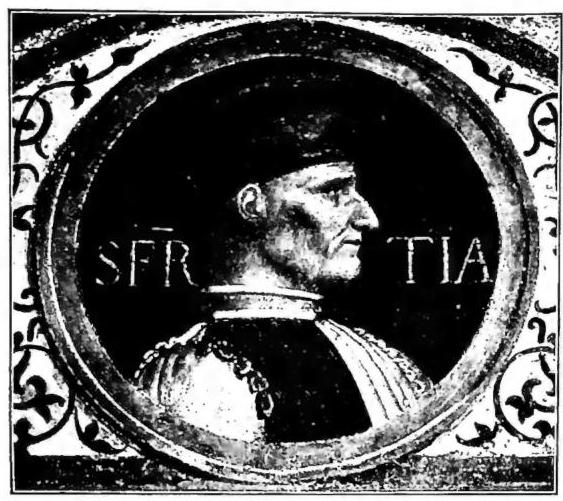
SFORZA, FAMIGLIA — Portrait of Muzio Attendolo S., fresco by B. Luini (16th century) — Milan, Sforza Castle.
in 1499; he returned with Julius II and died in 1510; in 1512 the Pope expelled his illegitimate brother Galeazzo, with whom this branch became extinct in Milan in 1519.
III. BRANCH OF SANTAFIORA
This nominally extant branch descends from BOSIO (1411–76), the illegitimate son of Muzio Attendolo and the uterine half-brother of Duke Francesco; a good soldier, he was lord of Cotignola and Castell'Arquato (Piacenza). By marrying Cecilia Aldobrandeschi, he secured the fief of Santafiora for his son GUIDO. The family gained further distinction through the marriage of his grandson BOSIO II to Costanza, the sister of Pier Luigi Farnese; their grandfather Paul III favored his nephews, two of whom, CAMILLO ASCANIO (d. 1565) and ALESSANDRO (d. 1585), became cardinals of great importance. The family divided into two branches: that of Lombardy, which became extinct in 1644 with SFORZINO, and that of Tuscany, which, by inheriting the estate of the Conti family in 1575, acquired the fiefs of Valmontone and Segni, the latter with ducal title. The family’s greatness, which declined in the seventeenth century, was restored by FEDERICO through his marriage to Livia Cesarini, heiress to this and other families; Segni was reacquired, and the family took the title of S. Cesarini. In 1832 it ended with SALVATORE, but the S. Rota assigned the title and inheritance to his uterine brother Lorenzo Montani. The new line divided into the two branches of the dukes of Segni and Civitavinia and the counts of Santafiora.IV. BRANCH OF BORGONOVO
It originated with S. SECONDO (born in 1435), the illegitimate son of Francesco, who received from his father in 1451 the Castle of Borgonovo in the Piacentino and subsequently the title of count, which the family retained even under the Farnese, serving them in the military and in official posts. In 1607, upon the death of Alessandro III, the fief was confiscated, although there was a cadet branch of the S. of Castel S. Giovanni, descended from JACOPETTO, the second son of the founder of the branch.V. RAMO DI CARAVAGGIO
Founded by GIAMPAOLO, the illegitimate son of Lodovico il Moro and Lucrezia Crivelli (1497), created marquis of Caravaggio and count of Galliate in 1532; he died under suspicious circumstances shortly after his brother, Duke Francesco II (1535); one of his sons, Muzio, died fighting for Carlo V at the siege of Metz (1552); the family continued in Milan, becoming extinct with FRANCESCO II in 1697 and with his daughter BIANCA MARIA in 1717; it had produced many priors and dignitaries of the Order of Malta. — Vedi tavv. XXIV-XXV.L. G. Pélissier, Louis XII et Lodovico S., 2 vols., Paris 1896; F. Malaguzzi Valeri, La corte di Lodovico il Moro, 4 vols., Milan 1913–23; cf. also N. Guastella, Tre pretesi delitti di Francesco II S., in Arch. stor. lombardo, 75–76 (1948–49), pp. 115–67. Luigi Simeoni