
SEGNI, DIOCESE of. – City and diocese in the province of Rome, 58 km. from it, at an altitude of 665 m. above sea level. It has an area of 250 sq. km. with a popula-
(fol. Alinari)
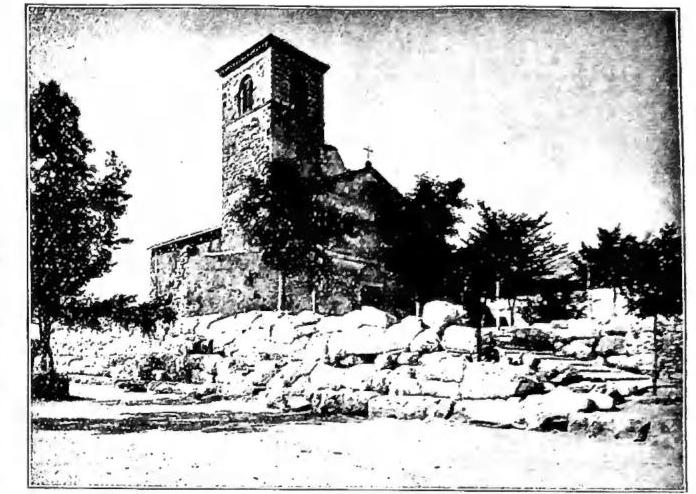
SEGNI, DIOCESE of – Exterior of the church of S. Pietro, built in the 13th century on the middle cella of a Roman temple with three cellae, dedicated to the Capitoline Triad.
It is ancient Signia, in a strongly strategic position, on the compulsory route followed by the Hernician peoples toward Rome. The ancient tradition, preserved by Livy, recalls it as a colony of Latin law. The Signini always remained faithful to Rome, even during the Hannibalic War. The name opus signinum refers to a special waterproof plaster, made of crushed potsherds bound with lime from the local mountains. S. still preserves almost the entire circuit of the cyclopean-type walls, approximately 2 km. larger than the perimeter of the present-day city, which constitute an example of an exceptionally strong defense of a city and acropolis; they are the most imposing in Latium. Particularly noteworthy is the Porta Saracena, which has the special characteristic of narrowing upward and supporting five enormous monoliths. Because of its position and fortifications, S. was not greatly damaged during the period of the invasions; under Byzantine rule it formed part of the Duchy of Rome; in the early years of the 8th century it passed to the Church; then, in 1353, to the family of the Counts of S.; later, through marriage, it came to the Sforza as a fief; it was elevated to a duchy in 1639; subsequently purchased by the Barberini, it returned to the Sforza and finally to the Sforza-Cesarini. In 1557, during the war between Pope Paul IV and Philip II of Spain, it was sacked by the Spaniards of the Duke of Alba, because the inhabitants of the neighboring towns had gathered there.
Among the sacred buildings, the Cathedral (S. Brunone) is noteworthy, with a beautiful central-plan interior and a façade from the early 19th century. Very interesting is the church of S. Pietro, in the highest part of the settlement, where the acropolis stood: it is Romanesque-pointed in style, built above large limestone blocks, using the material and even the walls of a pagan temple.