
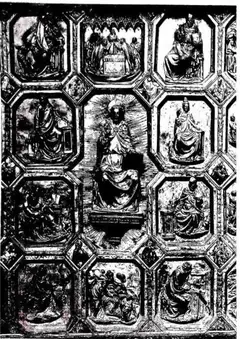
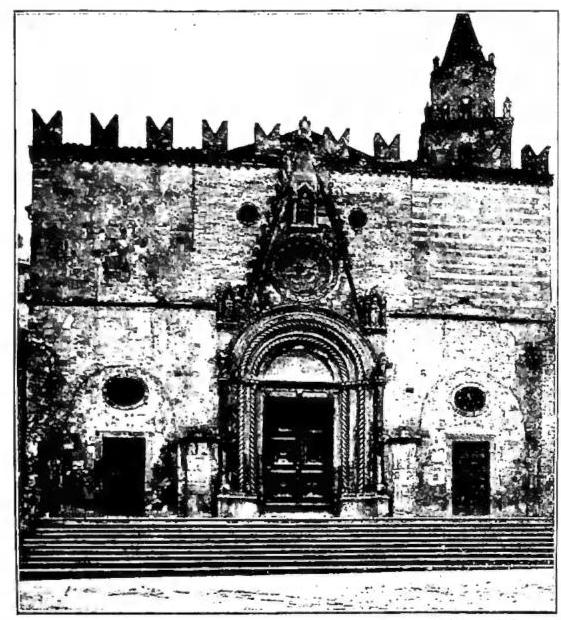
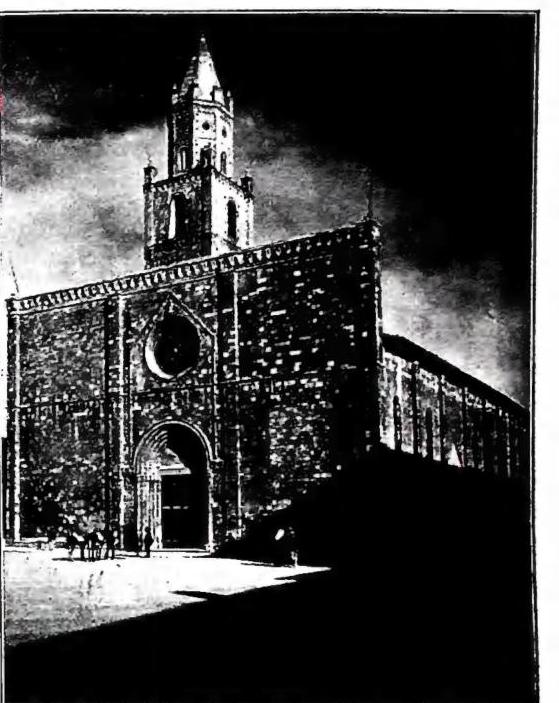
TERAMO AND ATRI, DIOCESE OF. - City and diocese in the province of T. in Abruzzo; the episcopal residence is at T.; immediately subject to the Holy See.
TERAMO
It has an area of over 2000 sq km, with a population of 175,855 inhabitants, of whom 175,637 are Catholics distributed in 156 parishes, served by 161 diocesan priests and 34 regulars; it has a seminary, 11 male religious communities and 32 female ones (Ann. Pont. 1953, p. 420).
The ancient Interamnia Praetutianorum, it is situated between the rivers Todino and Vezzola, at 265 m above sea level; of Umbrian origin, conquered by M. Curius in 268 B.C., attached to the fifth tribe "Velina" (Picenum), it was the center of the Praetutii or Praetutiani; flourishing under the Empire, it declined with the invasions of the Goths, Lombards, and Hungarians; it formed part of the duchy of Spoleto; it was then under the dominion of the counts, over whom, subsequently, the bishop prevailed. Around the end of the 11th century, it was occupied by the Normans, and then united with the duchy of Apulia. It enjoyed notable splendor under the Angevins (14th century), but suffered greatly from the civil discords between the Melatino and Antonelli families. For some years it was held by Fr. Sforza, then, retaken by King Alfonso of Aragon (1442-58), it followed the fortunes of the Kingdom of Naples.
It cannot be said with certainty when T. had bishops of its own: St. Gregory the Great, with a letter of Nov.-Dec. 598, gives a mandate to Passivus, bishop of Fermo, to consecrate the oratory of St. Peter, founded by Count Anio "in castro Aprutino" (PL 77, 1225-26); however, the same Pontiff, in the year 601, writing to the same Passivus, deplores that T. has been without a bishop for too long, and designates as such Opportunus, who was to be consecrated, after the necessary preparation (ibid., 1226-27). Ordinarily the series of the bishops of Aprutium is made to begin with Opportunus, who, almost certainly, is the same person to whom St. Gregory addressed a letter, to comfort him after a severe reproach for things that had displeased him (ibid., 1118). After a notable interruption the series resumes with Sigismund, present at the coronation of Louis III, performed in 844 by Sergius II (844-47; Lib. Pont. II, pp. 89-90; 101-102, n. 9).
The bishops of T. held the titles of "Princeps Terami, baro Roccae S. Mariae, comes Bisemnii," and, among other privileges, that of wearing slung across the shoulder, over the chasuble, at pontifical Masses, a sword, and of keeping upon the altar and upon the "credenza," together with the sacred furnishings, various weapons, banners and military insignia; the bishop G. Silverii Piccolomini took part in 1563 in the Council of Trent and celebrated Mass wearing the arms "more suorum antecessorum"; it seems that the custom lasted until 1639 with the bishop Girolamo Figini-Oddi. According to a local writer (De Jacobis), the series would not have been interrupted, and there would have been eleven bishops, after Opportunus, up to Sigismund: so that the bishops of Aprutium would number 92 up to the present one.
Of the bishops of T. the following are remembered: St. Berard of Pagliara, of the counts of Marsi, a Cassinese monk, from 1115 to 1122; Guido II (1123-70) who, after the burning and destruction of T. by the hand of Count Roberto Loretello (1155), rebuilt the city, encircling it with new walls; he then obtained from King William I the city as a fief, with the title of principality; under him the territory of the diocese, already determined by Victor II in 1057, was confirmed by Anastasius IV (bull Sicut iniusta poscentibus, 28 Feb. 1154), who established that the church of S. Maria Aprutinensis should be considered the mother church and cathedral of the bishop; the present cathedral, dedicated to the Assumption, begun in 1158, was completed in the 14th century, remodeled in 1739 and restored to its original state in 1935; the blessed Antonio Fatati, canon and vicar of St. Peter's in the Vatican (12 Dec. 1450), to whom Ferdinand I of Aragon, by diploma of 20 July 1458, confirmed all the ancient privileges; the man of letters and humanist Giov. Ant. Campano (1463-77).
Pius VII, with the bull Utiliari Dominicae vineae of 28 June 1818, aggregated to T. the diocese of Campli (erected by St. Pius V in 1570 and united with Ortona by Clement VIII), which was being suppressed. Pius XII with the apostolic constitution Diocesium circumscriptiones of 1 July 1949 separated the diocese of A. from that of Penne and united it aque principaliter to the see of T. (AAS, 42 [1950], pp. 135-37). The Sacred Congregation Consistorial, with a decree of 24 Jan. 1950, dismembered 27 parishes from the diocese of Pescara, adding them to the diocese of T. (ibid., pp. 554-55).
ATRI
It has an area of over 150 sq km, with a population of 26,375 inhabitants, almost all Catholics, distributed in 9 parishes, served by 18 diocesan priests and 4 regulars; it has 1 male religious community and 8 female ones (Ann. Pont. 1953, p. 420).
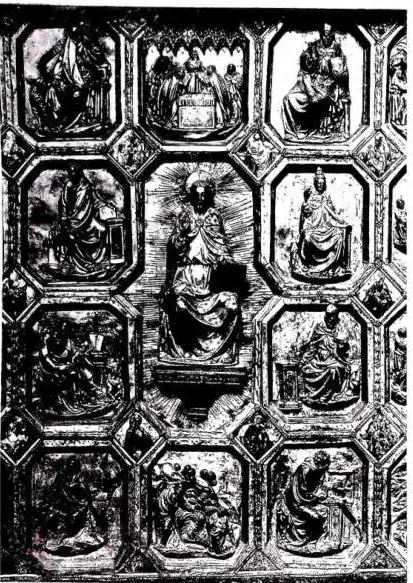
It is the ancient Hatria Picena, according to some (Cluverius) of Etruscan origin, according to others founded or repopulated by Dionysius of Syracuse; it fell under the dominion of Rome, assigned to the "Maccia" tribe of region V. It was devastated by Hannibal; it flourished under the Empire. It was part of the Duchy of Spoleto; it then had the lordship of the Acquaviva, from the 12th century onward, until in 1775 it passed to Ferdinand IV of Naples, I of the Two Sicilies. The diocese of A. had been established (according to some, restored) by Cardinal Pietro di Collemezzo, by mandate of Innocent IV and approved by the latter with the bulls Licet ea quae de mandato nostro fiunt of 15 March 1252, and Honorem Ecclesiae, of 21 August of the same year, and united aque principaliter with that of Penne (5th century), today separated from A. and transferred to Pescara. Clement VII (bull Super universas Ecclesias, 1 June 1526), elevating the Church of Chieti to metropolitan status, assigned to it as suffragans, besides Lanciano, Penne and A., which were restored to their original condition by Paul III (bull Inter cartera, 18 July 1539). The cathedral in the Abruzzese Romanesque style with three naves and pillars dates from the 13th-14th century. - See plate CXL.
Bibliography31 works
Carlo Carletti