
SOVANA-PITIGLIANO, DIOCESE of. – In the province of Grosseto, it has an area of 2,000 sq. km. and a population of 60,000 inhabitants, of whom 59,000 are Catholics, distributed among 51 parishes served by 69 diocesan and 12 regular priests; it has one seminary, 4 male and 17 female religious communities (Ann. Pont. 1953, p. 407).
The S.-P. diocese, suffragan of Siena, has its minor seminary in P.; for the philosophical and theological course it relies on the P. Regional Seminary of S. Maria della Quercia (Viterbo); it has 9 municipalities, of which 8 are in the province of Grosseto: Pitigliano, Castell'Azzara, Manciano, Portercole, Roccalbegna, Samprugnano, Scansano; one is in the province of Siena: Piancastagnaio.
S. (a hamlet of the municipality of Sorano), in the province of Grosseto, at 289 m above sea level: inhabitants 729 (census of 4 December 1951), originally Etruscan in name, the Roman Snana, it was an important Etruscan center in the 7th–6th centuries B.C.; it subsequently underwent a period of decline, from which it recovered in the 3rd century B.C., having passed, as a municipium, under the dominion of Rome. It was besieged and destroyed by the Lombards; but the fact that it already had its bishops in the 7th century suggests that the city had risen again from the ruins. An age of splendor followed under the Aldobrandeschi, a family almost certainly of Lombard origin, which claimed descent from King Ildeprando (736–44) and which already around the year 1000 possessed extensive holdings in the region of Amiata and S. Fiora. At the end of the 13th century it passed, through a marriage in the female line of descent, to the Orsini, who retained possession of it until 1410, finally losing it in 1431 after a brief period of Sienese rule. Having returned under Siena, it subsequently came, in consequence of the events in Tuscany, under the grand dukes, who sought to halt its decline, caused especially by malaria. S. was called the “city of Jeremiah,” precisely because of its state of abandonment and ruin, which in 1672 led to the transfer of the bishop’s residence to P. The territorial organization of the dioceses located in this nonhomogeneous territory of the ancient Aldobrandeschi possessions is interesting and characteristic; around the year 1000, jurisdiction there was exercised by the bishops of Castro (the diocese later passed to Acquapendente), Massa Marittima, Volterra, Siena, Tuscania, Chiusi, and by those of the more recent dioceses of Grosseto, Montefiascone, Corneto (Tarquinia), Montalcino, Pienza, and Città della Pieve.
The first bishop of S., according to Ughelli, was Tadino; but according to others, it was Maurizio, who in 680 signed the acts of the Sixth Ecumenical Council, Constantinople III.
S. preserves few Etruscan remains: noteworthy is a necropolis displaying a variety of tombs, almost all chamber tombs. The Cathedral (SS. Pietro e Paolo) underwent restorations in the 11th, 12th, and 14th centuries, while nevertheless retaining its Romanesque structure; the façade is covered by the canonry; the interior has three naves, is imposing but bare: it preserves the tomb of s. Mamiliano, seventh bishop of Palermo, exiled during the invasion of the Vandals under Genseric in 445, and deceased at S. in 460; an ancient church was also dedicated to the Saint, of which the ruins remain, originally built over the remains of a Roman temple. The protectors of S. are the ss. Mamiliano and Gregorio VII (Ildeprando, son of Bonizone), born near S.
P., a municipality in the province of Grosseto, 85 km distant from it, at 919 m above sea level: resident population 5,760, legal population 5,565 (census of 4 November 1951); it stands in a highly picturesque position, on the edge of the cliffs. Information about Etruscan and Roman P., on whose ruins the present-day city arose, is extremely scarce; having escaped the barbarian incursions, it subsequently belonged, together with its territory, to the Aldobrandeschi, who were succeeded by the Orsini, who, after losing S., styled themselves counts of P. Under them P. became the most important center and the capital of the Maremma county. In the 16th century this family’s rapid decline began; and P., after various lordships and vicissitudes, definitively passed under the grand dukes of Tuscany in 1604. From as early as the 15th century a large Jewish community settled in P., where its members had their own synagogue; many of them later moved to Florence and Livorno. In 1509, the ancient church of S. Maria was raised to the status of a collegiate church, rebuilt from its foundations by Count Niccolò III; Gregory XVI, subsequently, acceding to the requests of Grand Duke Leopoldo II and declaring P. a city, by a bull of 11 January 1844 raised the collegiate church to a cathedral of S. and transferred its Chapter there. The last bishop of S., Barzellotti (70th of the series), was the first to style himself bishop of S. and P.
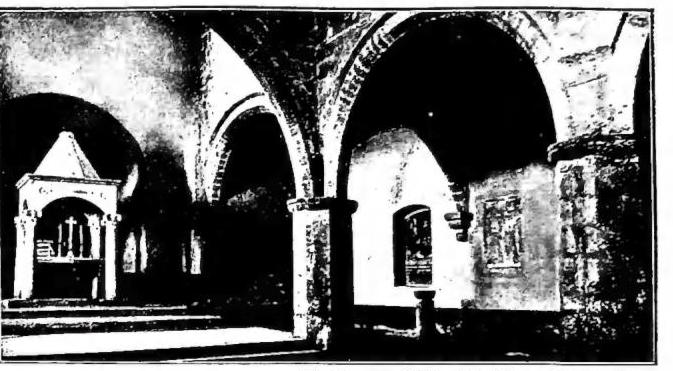
(from Toscana, T.C.I., VI, Milan 1911, fig. 219)
SOVANA-PITIGLIANO, DIOCESE of – Interior of the Cathedral (11th–12th centuries) with a ciborium from the 9th century – Sovana.
with a characteristic bell tower on the left side, consisting of three stories that diminish in size upward: the interior was renovated in the 16th century.