
GREGORY VII (HILDEBRAND), POPE, saint.
I. HILDEBRAND’S LIFE BEFORE HIS PONTIFICATE
Tradition regarding the family, birthplace and year of birth of G. is not unanimous. G. Marchetti-Longhi sought to uphold the thesis that he was born into a family of high Roman nobility, perhaps the Ildebrandi-Stefaneschi, largely on the strength of the saint’s baptismal name, Hildebrand. According to the primitive tradition, however, Hildebrand was born at Sovana (Sorano) in the Tuscan Maremma around the year 1020, the son of Bonizo, a blacksmith, and of “Berta, a matron of the suburbs.” For his liberal arts education and moral discipline, his parents entrusted him to his uncle, abbot of S. Maria in Aventino (of the priory of the Knights of Malta). From his early youth spent in Rome, Hildebrand himself gives four precise accounts in his papal letters, according to which he was received into the Lateran Palace and had two celebrated tutors, Lorenzo of Amalfi and the archpriest John Gratian, later Pope Gregory VI, with whom, after the latter’s deposition by King Henry III of Germany at the Synod of Sutri (1046), he reluctantly went into exile in Cologne as his chaplain. It was probably there that he took the Benedictine habit. The controversy among historians as to whether Hildebrand was a monk or not has been resolved in the affirmative (cf. G. B. Borino, *Quando e dove si fece monaco Ildebrando*, in *Miscellanea G. Mercati*, I, Vatican City 1946, pp. 218-62).With Pope Leo IX he returned to Rome, though still more reluctantly. By the same pontiff, the monk Hildebrand was ordained subdeacon and became prior and administrator of S. Paolo fuori le Mura. There he reformed monastic discipline and restored the Basilica.
From Pope Leo IX and his successors, Victor II and Stephen IX, Hildebrand was employed on various diplomatic missions to France (e.g., against Berengar of Tours) and to Germany. Pope Stephen IX ordained him deacon and appointed him archdeacon of the Roman Church. After the pope’s premature death, Hildebrand skillfully engineered the downfall of Benedict X, who had been uncanonically elected by the Tusculan faction, and the election of Pope Nicholas II (1059-61). By his successor, Pope Alexander II (1061-73), his friend in the reform, he was created cardinal and chancellor of the Roman Church; after the death of Cardinal Humbert of Silva Candida (1061), he became, with St Peter Damian, the pope’s right hand in the struggle for ecclesiastical reform.

He was restored to Rome by Otto III with military support. In the ecclesiastical dispute at Reims, Gregory V intervened successfully on behalf of Arnulf’s rights, but later granted the archbishopric of
II. THE ELECTION OF HILDEBRAND (22 April 1073)
Immediately after the burial of Alexander II, Hildebrand was acclaimed pope by the people in the Basilica of the Lateran and shortly afterwards elected by the cardinals at S. Pietro in Vincoli; he took the name Gregory. Doubts about the canonical validity of the election were raised much later, at the outset of the struggle with King Henry IV of Germany. The young king appears to have confirmed Hildebrand’s election: it was the last time a German emperor performed that act.III. THE PERSONALITY AND CHARACTER OF GREGORY VII
Hildebrand-Gregory was over fifty when he attained the supreme pontificate. He was of extraordinary stature, though slight, with a pale face, yet possessed of incomparable strength of will and spirit. What he conceived, he carried out. He preferred images and comparisons drawn from the language of war. St Peter Damian sometimes likened him to the north wind, at other times called him “holy Satan.” Contemporary adversaries, both fervent and furious, do not render a balanced judgment of his character and great soul, which shines forth in the letters written in his own hand to faithful friends such as the Countess Matilda of Tuscany, Abbot Hugh of Cluny, and Bishop Hermann of Metz. The predominant trait of his spiritual outlook was a burning faith illumined by mystical devotion to the person of Jesus. Justice was the leitmotif of his thinking and acting.IV. HIS REFORM PROGRAMME
Hildebrand-Gregory, who for more than twenty years before his pontificate had worked for the reform of the Church, began from the very first year of his pontificate to implement his reform programme with all his might. Convinced of the plenitude of power conferred upon Peter, he set about uprooting the most deep-seated vices in the clergy: simony and clerical marriage. For this reforming work he desired harmony between spiritual and temporal power, between the priesthood and the Empire. At the Lenten Synod of 1074 he issued decrees against simony and Nicolaitism and at the same time encouraged the laity not to attend the liturgical services of married priests. Opposition from bishops and clerics in Germany, Italy, France and England was strong, but Gregory pursued his work with growing zeal and energy. At the Synod of 1075, in addition to renewing the previous decrees, he issued another against lay investiture of bishops and abbots and demanded freedom in their canonical election, without the intervention of the king or civil authority. Against this decree arose the unanimous resistance of the feudal lords, especially on the part of the king of Germany. Hence the rupture between Papacy and Empire was inevitable. From the same period dates the so-called *Dictatus Papae*, twenty-seven brief propositions dictated by Gregory VII and inserted in his original register [between ep. 55 and 56 of Book II]. Among the various hypotheses about its nature, the most probable is that advanced by G. Borino, namely that the *Dictatus Papae* is the index of a canonical collection. In its content, the *Dictatus Papae* represents the expression of the primacy of the Roman Pontiff, instituted by Jesus Christ and transferred to St Peter. From him derives the primatial position of the Church of Rome and of its bishop, with titles of honour, privileges and royal rights. Hence his supreme authority in legislation, administration and jurisdiction over the universal Church and individual churches. The *Dictatus Papae* also embodies Gregory VII’s conception of the relations between Church and State: a much-debated conception that can chiefly be discerned from his letters to Hermann, bishop of Metz (1076-81). At the foundation of this conception lies the unlimited power to bind and loose given by Jesus Christ to St Peter, and the evident superiority of sacerdotal power over royal power. The apostolic and royal powers are destined by God to govern the world, and their concord was the goal that Gregory VII set himself in his actions for the salvation of Christendom. He regarded not the State as such, but the bad government of tyrants and enemies of the Church in the *civitas terrena*, in the sense of St Augustine, as the work of the devil.V. THE STRUGGLE BETWEEN THE PRIESTHOOD AND THE EMPIRE UNDER GREGORY VII AND KING HENRY IV
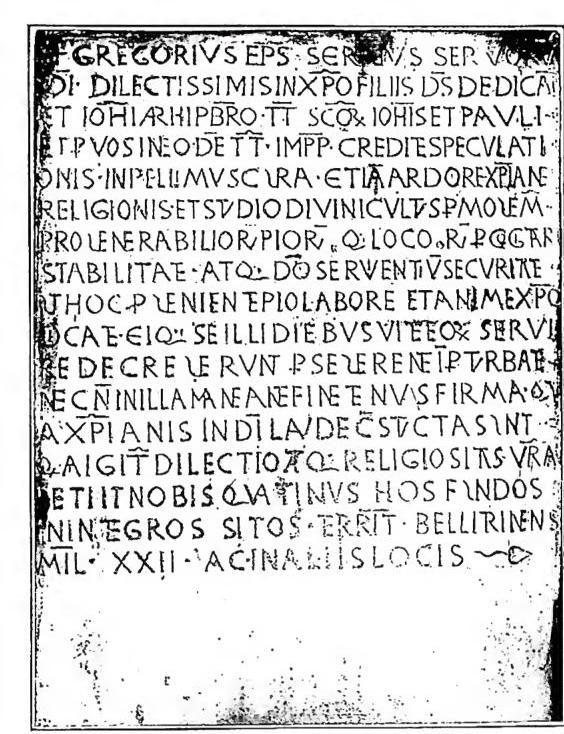
This immense and tragic struggle between the two(from A. di Luca, *Monumenta epigraphica*, Città del Vaticano III (1938), col. 38, 6)
Gregory VII, Pope (1073-84) – Bull concerning the estates of the basilica of SS. John and Paul – Rome.
**GREGORIVS EPIS. SER. VS. SER. V.**
**DI: DILECTISSIMIS INXPOFILIS DEDICATI**
**RITOHARIBPROT. ST. SOC. IOHISET PAVLI.**
**EPVOS INEO. DET. IMP. CREDIS PECVLATI.**
**ONIS. INIPELIMVS. CURA. ETIAR. ARDOREXPIAN.**
**RELIGIONISETSVIDIO DIVINICVLVS. POMOEM.**
**PRO. ENERABILIOR. PIOR. Q. LO CO. R. P. Q. G.**
**STABILITATE. ATQ. D. O. SER. VENTIVS. ESCRIVITE.**
**J. HOC. P. ENIEN. EPILO. LABORE. ETAN. M. X. P.**
**CO. A. E. I. Q. SE. ILL. D. I. B. V. S. V. E. T. E. S.**
**RE. D. E. C. R. E. V. R. V. P. S. E. R. E. N. E. P. T. R. B. A.**
**N. C. N. I. N. I. A. N. A. E. F. I. N. V. S. F. I. R. A. Q.**
**AX. P. I. A. N. I. S. I. D. I. L. A. D. E. C. S. T. A. S. I. N.**
**Q. A. I. G. I. D. L. E. C. T. O. Q. R. E. L. I. G. I. S. T. V. R.**
**E. T. I. T. N. O. B. S. Q. A. I. N. V. H. O. S. F. I. N. D. O. S.**
**P. N. I. N. E. G. R. S. I. T. O. S. E. R. I. T. B. E. L. I. R. I. N.**
**M. L. X. I. A. C. I. N. I. S. L. C. I. S.**
**Q. A. S. I. N. I. S. L. C. I. S.**
**Q. A. S. I. N. E. G. R. S. I. T. O. S. E. R. I. T. B. E. L. I. R. I. N.**
**M. L. X. I. A. C. I. N. I. S. L. C. I. S.**
**Q. A. S. I. N. I. S. L. C. I. S.**
**Q. A. S. I. N. E. G. R. S. I. T. O. S. E. R. I. T. B. E. L. I. R. I. N.**
**M. L. X. I. A. C. I. N. I. S. L. C. I. S.**
**Q. A. S. I. N. I. S. L. C. I. S.**
**Q. A. S. I. N. E. G. R. S. I. T. O. S. E. R. I. T. B. E. L. I. R. I. N.**
**M. L. X. I. A. C. I. N. I. S. L. C. I. S.**
**Q. A. S. I. N. I. S. L. C. I. S.**
**Q. A. S. I. N. E. G. R. S. I. T. O. S. E. R. I. T. B. E. L. I. R. I. N.**
**M. L. X. I. A. C. I. N. I. S. L. C. I. S.**
**Q. A. S. I. N. I. S. L. C. I. S.**
**Q. A. S. I. N. E. G. R. S. I. T. O. S. E. R. I. T. B. E. L. I. R. I. N.**
**M. L. X. I. A. C. I. N. I. S. L. C. I. S.**
**Q. A. S. I. N. I. S. L. C. I. S.**
**Q. A. S. I. N. E. G. R. S. I. T. O. S. E. R. I. T. B. E. L. I. R. I. N.**
**M. L. X. I. A. C. I. N. I. S. L. C. I. S.**
**Q. A. S. I. N. I. S. L. C. I. S.**
**Q. A. S. I. N. E. G. R. S. I. T. O. S. E. R. I. T. B. E. L. I. R. I. N.**
**M. L. X. I. A. C. I. N. I. S. L. C. I. S.**
**Q. A. S. I. N. I. S. L. C. I. S.**
**Q. A. S. I. N. E. G. R. S. I. T. O. S. E. R. I. T. B. E. L. I. R. I. N.**
**M. L. X. I. A. C. I. N. I. S. L. C. I. S.**
**Q. A. S. I. N. I. S. L. C. I. S.**
**Q. A. S. I. N. E. G. R. S. I. T. O. S. E. R. I. T. B. E. L. I. R. I. N.**
**M. L. X. I. A. C. I. N. I. S. L. C. I. S.**
**Q. A. S. I. N. I. S. L. C. I. S.**
**Q. A. S. I. N. E. G. R. S. I. T. O. S. E. R. I. T. B. E. L. I. R. I. N.**
**M. L. X. I. A. C. I. N. I. S. L. C. I. S.**
**Q. A. S. I. N. I. S. L. C. I. S.**
**Q. A. S. I. N. E. G. R. S. I. T. O. S. E. R. I. T. B. E. L. I. R. I. N.**
**M. L. X. I. A. C. I. N. I. S. L. C. I. S.**
**Q. A. S. I. N. I. S. L. C. I. S.**
**Q. A. S. I. N. E. G. R. S. I. T. O. S. E. R. I. T. B. E. L. I. R. I. N.**
**M. L. X. I. A. C. I. N. I. S. L. C. I. S.**
**Q. A. S. I. N. I. S. L. C. I. S.**
**Q. A. S. I. N. E. G. R. S. I. T. O. S. E. R. I. T. B. E. L. I. R. I. N.**
**M. L. X. I. A. C. I. N. I. S. L. C. I. S.**
**Q. A. S. I. N. I. S. L. C. I. S.**
**Q. A. S. I. N. E. G. R. S. I. T. O. S. E. R. I. T. B. E. L. I. R. I. N.**
**M. L. X. I. A. C. I. N. I. S. L. C. I. S.**
**Q. A. S. I. N. I. S. L. C. I. S.**
**Q. A. S. I. N. E. G. R. S. I. T. O. S. E. R. I. T. B. E. L. I. R. I. N.**
**M. L. X. I. A. C. I. N. I. S. L. C. I. S.**
**Q. A. S. I. N. I. S. L. C. I. S.**
**Q. A. S. I. N. E. G. R. S. I. T. O. S. E. R. I. T. B. E. L. I. R. I. N.**
**M. L. X. I. A. C. I. N. I. S. L. C. I. S.**
**Q. A. S. I. N. I. S. L. C. I. S.**
**Q. A. S. I. N. E. G. R. S. I. T. O. S. E. R. I. T. B. E. L. I. R. I. N.**
**M. L. X. I. A. C. I. N. I. S. L. C. I. S.**
**Q. A. S. I. N. I. S. L. C. I. S.**
**Q. A. S. I. N. E. G. R. S. I. T. O. S. E. R. I. T. B. E. L. I. R. I. N.**
**M. L. X. I. A. C. I. N. I. S. L. C. I. S.**
**Q. A. S. I. N. I. S. L. C. I. S.**
**Q. A. S. I. N. E. G. R. S. I. T. O. S. E. R. I. T. B. E. L. I. R. I. N.**
**M. L. X. I. A. C. I. N. I. S. L. C. I. S.**
**Q. A. S. I. N. I. S. L. C. I. S.**
**Q. A. S. I. N. E. G. R. S. I. T. O. S. E. R. I. T. B. E. L. I. R. I. N.**
**M. L. X. I. A. C. I. N. I. S. L. C. I. S.**
**Q. A. S. I. N. I. S. L. C. I. S.**
**Q. A. S. I. N. E. G. R. S. I. T. O. S. E. R. I. T. B. E. L. I. R. I. N.**
**M. L. X. I. A. C. I. N. I. S. L. C. I. S.**
**Q. A. S. I. N. I. S. L. C. I. S.**
**Q. A. S. I. N. E. G. R. S. I. T. O. S. E. R. I. T. B. E. L. I. R. I. N.**
**M. L. X. I. A. C. I. N. I. S. L. C. I. S.**
**Q. A. S. I. N. I. S. L. C. I. S.**
**Q. A. S. I. N. E. G. R. S. I. T. O. S. E. R. I. T. B. E. L. I. R. I. N.**
**M. L. X. I. A. C. I. N. I. S. L. C. I. S.**
**Q. A. S. I. N. I. S. L. C. I. S.**
**Q. A. S. I. N. E. G. R. S. I. T. O. S. E. R. I. T. B. E. L. I. R. I. N.**
**M. L. X. I. A. C. I. N. I. S. L. C. I. S.**
**Q. A. S. I. N. I. S. L. C. I. S.**
**Q. A. S. I. N. E. G. R. S. I. T. O. S. E. R. I. T. B. E. L. I. R. I. N.**
**M. L. X. I. A. C. I. N. I. S. L. C. I. S.**
**Q. A. S. I. N. I. S. L. C. I. S.**
**Q. A. S. I. N. E. G. R. S. I. T. O. S. E. R. I. T. B. E. L. I. R. I. N.**
**M. L. X. I. A. C. I. N. I. S. L. C. I. S.**
**Q. A. S. I. N. I. S. L. C. I. S.**
**Q. A. S. I. N. E. G. R. S. I. T. O. S. E. R. I. T. B. E. L. I. R. I. N.**
**M. L. X. I. A. C. I. N. I. S. L. C. I. S.**
**Q. A. S. I. N. I. S. L. C. I. S.**
**Q. A. S. I. N. E. G. R. S. I. T. O. S. E. R. I. T. B. E. L. I. R. I. N.**
**M. L. X. I. A. C. I. N. I. S. L. C. I. S.**
**Q. A. S. I. N. I. S. L. C. I. S.**
**Q. A. S. I. N. E. G. R. S. I. T. O. S. E. R. I. T. B. E. L. I. R. I. N.**
**M. L. X. I. A. C. I. N. I. S. L. C. I. S.**
**Q. A. S. I. N. I. S. L. C. I. S.**
**Q. A. S. I. N. E. G. R. S. I. T. O. S. E. R. I. T. B. E. L. I. R. I. N.**
**M. L. X. I. A. C. I. N. I. S. L. C. I. S.**
**Q. A. S. I. N. I. S. L. C. I. S.**
**Q. A. S. I. N. E. G. R. S. I. T. O. S. E. R. I. T. B. E. L. I. R. I. N.**
**M. L. X. I. A. C. I. N. I. S. L. C. I. S.**
**Q. A. S. I. N. I. S. L. C. I. S.**
**Q. A. S. I. N. E. G. R. S. I. T. O. S. E. R. I. T. B. E. L. I. R. I. N.**
**M. L. X. I. A. C. I. N. I. S. L. C. I. S.**
**Q. A. S. I. N. I. S. L. C. I. S.**
**Q. A. S. I. N. E. G. R. S. I. T. O. S. E. R. I. T. B. E. L. I. R. I. N.**
**M. L. X. I. A. C. I. N. I. S. L. C. I. S.**
**Q. A. S. I. N. I. S. L. C. I. S.**
**Q. A. S. I. N. E. G. R. S. I. T. O. S. E. R. I. T. B. E. L. I. R. I. N.**
**M. L. X. I. A. C. I. N. I. S. L. C. I. S.**
**Q. A. S. I. N. I. S. L. C. I. S.**
**Q. A. S. I. N. E. G. R. S. I. T. O. S. E. R. I. T. B. E. L. I. R. I. N.**
**M. L. X. I. A. C. I. N. I. S. L. C. I. S.**
**Q. A. S. I. N. I. S. L. C. I. S.**
**Q. A. S. I. N. E. G. R. S. I. T. O. S. E. R. I. T. B. E. L. I. R. I. N.**
**M. L. X. I. A. C. I. N. I. S. L. C. I. S.**
**Q. A. S. I. N. I. S. L. C. I. S.**
**Q. A. S. I. N. E. G. R. S. I. T. O. S. E. R. I. T. B. E. L. I. R. I. N.**
**M. L. X. I. A. C. I. N. I. S. L. C. I. S.**
**Q. A. S. I. N. I. S. L. C. I. S.**
**Q. A. S. I. N. E. G. R. S. I. T. O. S. E. R. I. T. B. E. L. I. R. I. N.**
**M. L. X. I. A. C. I. N. I. S. L. C. I. S.**
**Q. A. S. I. N. I. S. L. C. I. S.**
**Q. A. S. I. N. E. G. R. S. I. T. O. S. E. R. I. T. B. E. L. I. R. I. N.**
**M. L. X. I. A. C. I. N. I. S. L. C. I. S.**
**Q. A. S. I. N. I. S. L. C. I. S.**
**Q. A. S. I. N. E. G. R. S. I. T. O. S. E. R. I. T. B. E. L. I. R. I. N.**
**M. L. X. I. A. C. I. N. I. S. L. C. I. S.**
**Q. A. S. I. N. I. S. L. C. I. S.**
**Q. A. S. I. N. E. G. R. S. I. T. O. S. E. R. I. T. B. E. L. I. R. I. N.**
**M. L. X. I. A. C. I. N. I. S. L. C. I. S.**
**Q. A. S. I. N. I. S. L. C. I. S.**
**Q. A. S. I. N. E. G. R. S. I. T. O. S. E. R. I. T. B. E. L. I. R. I. N.**
**M. L. X. I. A. C. I. N. I. S. L. C. I. S.**
**Q. A. S. I. N. I. S. L. C. I. S.**
**Q. A. S. I. N. E. G. R. S. I. T. O. S. E. R. I. T. B. E. L. I. R. I. N.**
**M. L. X. I. A. C. I. N. I. S. L. C. I. S.**
**Q. A. S. I. N. I. S. L. C. I. S.**
**Q. A. S. I. N. E. G. R. S. I. T. O. S. E. R. I. T. B. E. L. I. R. I. N.**
**M. L. X. I. A. C. I. N. I. S. L. C. I. S.**
**Q. A. S. I. N. I. S. L. C. I. S.**
**Q. A. S. I. N. E. G. R. S. I. T. O. S. E. R. I. T. B. E. L. I. R. I. N.**
**M. L. X. I. A. C. I. N. I. S. L. C. I. S.**
**Q. A. S. I. N. I. S. L. C. I. S.**
**Q. A. S. I. N. E. G. R. S. I. T. O. S. E. R. I. T. B. E. L. I. R. I. N.**
**M. L. X. I. A. C. I. N. I. S. L. C. I. S.**
**Q. A. S. I. N. I. S. L. C. I. S.**
**Q. A. S. I. N. E. G. R. S. I. T. O. S. E. R. I. T. B. E. L. I. R. I. N.**
**M. L. X. I. A. C. I. N. I. S. L. C. I. S.**
**Q. A. S. I. N. I. S. L. C. I. S.**
**Q. A. S. I. N. E. G. R. S. I. T. O. S. E. R. I. T. B. E. L. I. R. I. N.**
**M. L. X. I. A. C. I. N. I. S. L. C. I. S.**
**Q. A. S. I. N. I. S. L. C. I. S.**
**Q. A. S. I. N. E. G. R. S. I. T. O. S. E. R. I. T. B. E. L. I. R. I. N.**
**M. L. X. I. A. C. I. N. I. S. L. C. I. S.**
**Q. A. S. I. N. I. S. L. C. I. S.**
**Q. A. S. I. N. E. G. R. S. I. T. O. S. E. R. I. T. B. E. L. I. R. I. N.**
**M. L. X. I. A. C. I. N. I. S. L. C. I. S.**
**Q. A. S. I. N. I. S. L. C. I. S.**
**Q. A. S. I. N. E. G. R. S. I. T. O. S. E. R. I. T. B. E. L. I. R. I. N.**
**M. L. X. I. A. C. I. N. I. S. L. C. I. S.**
**Q. A. S. I. N. I. S. L. C. I. S.**
**Q. A. S. I. N. E. G. R. S. I. T. O. S. E. R. I. T. B. E. L. I. R. I. N.**
**M. L. X. I. A. C. I. N. I. S. L. C. I. S.**
**Q. A. S. I. N. I. S. L. C. I. S.**
**Q. A. S. I. N. E. G. R. S. I. T. O. S. E. R. I. T. B. E. L. I. R. I. N.**
**M. L. X. I. A. C. I. N
It must be acknowledged that Gregory VII in this instance sacrificed the statesman to the priest, and Henry IV regained his crown.
3. The concluding period of the struggle (1080–85). At the Roman Synod of 1080 Gregory VII decided the cause between Henry IV and his rival Rudolf of Swabia in Rudolf’s favour and declared Henry deposed and excommunicated for breaking his promises. After the Synod of Brixen (1080), in which Henry IV had the archbishop of Ravenna, Guibert, elected as antipope (who took the name Clement III), the king undertook a military expedition against Gregory VII. Only in 1084, however, was Henry able to capture the Leonine City with St Peter’s, where he enthroned the antipope Clement III and had himself crowned emperor. Robert Guiscard, with the army of the Normans, freed Gregory VII from the Castel Sant’Angelo and led him to the Lateran Palace; but because of the sack of the city by the Normans, Gregory VII left with his followers. At Salerno, in a synod of November 1084, he again excommunicated Henry IV and all his accomplices and issued an encyclical that was like his testament, in which he summed up his reforming work and expressed his confidence in the future of the reform. On 25 May 1085 he died at Salerno with the well-known words on his lips: “I have loved justice and hated iniquity, therefore I die in exile.” He was buried in the cathedral of Salerno, where his remains still rest today.
VI. GREGORY VII’S RELATIONS WITH THE OTHER NATIONS OF EUROPE AND WITH THE EAST
Although his struggle with Henry IV, king of Germany, occupied his entire pontificate, he nevertheless maintained relations with other European nations: with William the Conqueror of England, generally favourable to the reform; with King Philip I Augustus of France, hostile to the reform; with Spain, with the kingdoms of Denmark, Norway, Sweden, Ireland, with Poland, Bohemia, Hungary, Croatia, and Dalmatia. He was also deeply concerned with the union between the Christian West and East.VII. JUDGMENT ON GREGORY VII
Although many studies have been made of Gregory VII, his personality still oscillates between the admiration and the hatred of opposing factions. In the grand history of the popes, perhaps no other Roman pontiff was so richly endowed by nature and divine grace to wage that gigantic battle which he undertook to free the Church from so many earthly bonds and political entanglements. His more-than-human greatness and his inflexible firmness prepared the way for his successors to achieve not only spiritual but also temporal dominion over the medieval world. Pope Paul V enrolled him in the catalogue of Roman saintly pontiffs as the staunch defender of the rights of the Church. His feast is celebrated on 25 May. — See plate LXXXIII.He was never a professor. Rainer, the Cistercian, exercised a particular influence on him, driving his natural inclination to contemplation to such an extent that Innocent III alluded to it almost with amazement (PL 214, 675). Apart from this, very little is known about his youth; it is certain that he was not, as has been said, a Cluniac.
**SUMMARY:**
I. Legations
II. Religious action
III. Church politics
IV. Decretals
V. Inquisition
VI. Missions. Ecclesiastical life. — VII. Character and importance.I. LEGATIONS. — Immediately after his election, Innocent III appointed G. papal chaplain (auditor of the Rota) and, later the same year, cardinal deacon; then in 1199 he sent him as legate to southern Italy to Markward of Anweiler, margrave under Henry VI. After being created cardinal bishop of Ostia in 1206, he went twice as legate to Germany, in 1207 and 1209.
Honorius III also recognized his merits as a negotiator and sent him as legate, mostly to the cities of northern Italy (the most important legation being that of 1221, for which G. began his own register). Here the most flourishing cities (such as Lucca, Pistoia, Parma, and in particular Milan) were threatening ecclesiastical liberties and were (like Imola and Faenza, Aquileia and Treviso) engaged in internecine strife, while heresy was also making its appearance; and in many convents the right spirit needed to be restored.
But above all the Pope was concerned with the imminent Crusade, which had been proclaimed by the Emperor for August 1221. Frederick, who had serious reservations, was happy to appoint G. as his vicar, though without giving him all the powers of an imperial nuncio. G. set to work cautiously but firmly: he promulgated imperial and ecclesiastical laws in the communal statutes of Lombardy. This legation became a great confirmation of peace; but perhaps, in Frederick’s view, G. had done too much for peace and too little for the Crusade. In any case, the Crusade did not take place.
II. RELIGIOUS ACTION. — From this time G. abandoned politics and devoted himself entirely to religious action. He aided the Camaldolese, the foundation of Joachim of Fiore, and the Cistercians; in particular he facilitated the growth of the Dominican Order, which had proved its worth in southern France against the Albigensians. But his care for the Franciscan movement is even better documented. G. recognized in the Mendicants the messengers of religious renewal, who at the same time ran the risk of overstepping the boundaries of orthodoxy, and he understood the need to guide them and give them strong support. Frederick called them the Pope’s “evil angels” (Hist. diplom. Frederici, V. BIBLICA., II, V. p. 1059).
G.’s attitude towards the Franciscan Order has often been described, including by Sabatier, as having distorted the character of the movement from within. Today, however, even by non-Catholic scholars, this attitude is generally evaluated positively and understood more deeply than the details would suggest, and is therefore appreciated. The Gospel returned to the forefront and in a fundamental way to consciences; the imitation of the poor life of Jesus was considered as the substance of perfection; and the missionary commitment of the Church regained vigour in the sending of missionaries and the organization of their activity.
G. played a particular part in the perfection of the Order of the Poor Clares (so much so that he has been called their founder) and of the Third Order of St Francis. For the mendicant orders he issued many commendatory letters and decrees, which later in their main points were included in the body of the Decretals (Decr., V, 31 c, 16 sqq.): he granted them new privileges, above all those of preaching and hearing confessions (Potthast, 8042); he renewed the institution of the novitiate (id., 10959); he suggested to Thomas of Celano the idea for the first Life of St Francis, in which he gave particular emphasis to the relations between G. and St Francis; he laid the first stone of the church built over the Saint’s tomb in Assisi and explained in the bull Quo elongati (1230; which was later to have a lasting resonance).
III. CHURCH POLITICS. — The pontificate of G. is characterized by church politics in relation to Frederick II. While Frederick, with ever new pretexts, postponed the Crusade, G. threatened him with excommunication, which he announced to Christendom on 18 October with an encyclical (Hist. diplom., cit., III, 24), releasing from their vows those crusaders who had already set out or were preparing to flee to southern Italy. Frederick, who had not expected the new Pope to show greater energy than Honorius, in a fit of pique went to Jerusalem in 1228 and made a treaty with the Sultan. Christian prisoners were set free, part of Jerusalem and some localities passed into Christian hands, in exchange for sufficient freedoms granted to the Muslims, even in Christian territory, and Frederick was crowned king of Jerusalem.
While Sicilian troops burst into the papal army, G. sent troops to Sicily, but after notable successes, both sides signed the Peace of Ceprano (28 Aug. 1230). Later, supported by Piero delle Vigne, Frederick created in Sicily, which he held as a papal fief, a new bureaucratic state of an absolutist type, proclaiming the Constitutions of Melfi, which were contrary in many respects to communal and ecclesiastical liberties; he would also have desired such unity between Church and State that the Pope would excommunicate all those against whom the Emperor fought. But he did not succeed in obtaining this (Potthast, 9261). When later Frederick, against the explicit will of G., his feudal lord, married his son Enzo to the heiress of Torres and Gallura and occupied Sardinia, G. excommunicated him again (1239), published an indictment of 17 points (Hist. diplom., V, 286 ff.), which was to be proclaimed every Sunday or feast day with the sound of bells (Potthast, 10723), and laid an interdict on the Emperor’s habitual residence. Frederick then countered with some writings and appealed to a council. The conflict sometimes reached the level of passionate polemics on both sides: G. reproached the Emperor, whom he had compared to the apocalyptic beast (Potthast, 10766), with the word of the three deceivers. Frederick, for his part, indicated the Pope as a heretic or even as the Antichrist (Hist. diplom., V, 348). Frederick sought to end the dispute with arms, and fortune did not prove unkind to him. The Pope, for his part, found in Gregory of Montelongo, his legate in Lombardy, a skilled champion of national interests, which were now beginning to become clear; but when he actually convened the council, it no longer interested Frederick, who took the prelates prisoner who were to travel by sea. In Germany the summons initially met with little response, because at that time the Tartars were stationed on the borders of the Kingdom, and when Frederick approached Rome in 1247 with a large retinue, the Pope died. G. had sought the freedom of the Church against a very able and unscrupulous sovereign who used every means to achieve his ends.
IV. DECRETALS. — From the beginning of his pontificate, G. had considered the systematization of new papal legislation, which was actually decided when Frederick promulgated the Constitutions of Melfi, which were to be, in many respects, abhorrent to the Church. The compilation was entrusted to Raymond of Peñafort, who delivered it after three years. It certainly contains a clear opposition to the Emperor’s Sicilian constitution, as, for example, regarding the privilegium fori of the clergy and in civil and criminal matters; but its fundamental purpose, as the bull *Rex pacificus* demonstrates, was to create, alongside the private collections of papal edicts, an official and exclusive system even on the part of the Church. Characteristic is the fact that the Mendicants retained their exemption and other privileges (165, X, V, 37), while preaching was forbidden to the laity (14, X, V, 7), heresy absolved the contracting parties from their obligations (2, X, V, 26), blasphemy was to be punished by the secular arm (16, X, V, 7), «showing no mercy in this matter». Later concessions by G. were partly incorporated into the *Liber Sextus* of Boniface VIII (e.g., that every bishop could alone degrade his own heretical priest and that no longer six bishops were needed). Even if not theoretically, this book of laws, which was soon translated into the vernacular (Actus, III, 249, 291), signifies a powerful strengthening of papal authority and its influence. In the future, especially private arbitration will be hindered by the collections of laws.
V. INQUISITION
Under G. IX the medieval process of the Inquisition was established. In 1224 Frederick had ordered, for Lombardy, that all heretics in the hands of diocesan bishops be handed over to the secular arm to be burned or have their tongues torn out (MGH, Const., II, p. 1267). Now G. in 1227 established in Italy (Florence) and Germany commissions against heretics, against whom until then only bishops had spoken, and made use especially of the Dominicans (Bullarium Ord. Fratrum Praedicatorum, ed. T. Ripoll-A. Bremond, I, Rome 1726, p. 20), without neglecting other Orders or secular priests, such as Conrad of Marburg, confessor of St. Elizabeth. The fact of entrusting this institution to an Order benefited its longevity. A further step was taken when Frederick’s cruel decree of 1224 was introduced in the years 1230–31 into the papal register (Reg., 535) and promulgated as law (ibid., 539 ff.). A final phase is marked by Frederick’s decree (proper to Norman law) for Sicily (1231) and for the Kingdom (1239), according to which heretics were to be sought out by the forces of the State. After denunciation, the Inquisition process officially follows. Alongside the episcopal tribunal, G. established the general papal tribunal (Bullarium cit., I, 47) and appointed inquisitors on his own part, because he did not wish to leave the power of investigation solely to state organs. In 1234 the decretal (15, X, V, 7) was inserted, stipulating that heretics who convert out of fear of death must be imprisoned for life as punishment (Hist. diplom., cit., IV, 301).VI. MISSIONS. ECCLESIASTICAL LIFE. — Already as legate and preacher of the Crusade, G. had worked for the preservation of the Latin Empire of Constantinople, which during his pontificate faced a new enemy in Bulgaria. The Pope persuaded John of Brienne, who had fought for him in Sicily and in 1223 had been elected regent in Constantinople for the underage Baldwin II, to assume this office, albeit reluctantly, (1231–37) and supported him energetically. In 1232 he sent Aymon of Faversham, future Minister General of the Franciscans, with several theologians, to the imperial Greek court at Nicaea, but they achieved nothing. It was rather thanks to John of Brienne that in 1233, after a twofold attack by the Greeks and Bulgarians, Constantinople was saved. When later Baldwin himself went to the West to seek help, G. worked in every way to stir up a great Crusade; but only in France did he find willing ears and aid. Baldwin too was unable to regain the Asian part of the Empire, which definitively fell in 1261. The struggle against the Ghibellines was also fatal to the Latin Empire, since Frederick was allied with the Greeks and forcibly prevented the passage of crusader knights through northern Italy.
The difficult missions in Eastern Europe—Finland, Lithuania, Hungary, Romania—where mainly the new Mendicant Orders worked, have hitherto received little attention. After Frederick’s Crusade, around 1230, the Teutonic Knights appeared; the Order regarded these territories as conquests, lands of the Empire assigned to them. In Lithuania G. permitted the same preaching of the Cross as in Europe (Bullarium cit., I, 32), and introduced the Premonstratensians into Livonia (Potthast, 886).
As regards ecclesiastical scholarship, noteworthy is the foundation (30 Apr. 1233) of the University of Toulouse (Potthast, 9176). To the University of Paris he granted the free study of the books of Aristotle (Reg., 607).
He increased religious life through numerous canonizations: Francis (1228), Anthony of Padua (1232), Virgil of Salzburg (1233), Dominic (1234), Elizabeth of Thuringia (1235), while he was unable to complete the canonization of St. Hildegard of Bingen.
(from Cotalogno d'une Coltertina de Manuscrits a miniaturcs des XV-XVY siecles, Amsterdam 1278, loc. 16) Gregory IX, pope - Decretals with miniature depicting the funeral of the Virgin, work by Niccolò da Bologna (14th cent.) signed. In the initial G, the portrait of Gregory IX - Amsterdam, Antique Market

