
SALERNO, ARCIDIOCESI di - Panorama from the air - Salerno. (photo Eni)
by resorting to genuine cavity surgery, albeit solely for reparative purposes.
Medical therapy, too, was highly advanced, and from the texts one can infer how thoroughly the best of what was found in the works of Galen and Avicenna had been assimilated, without, however, any clear distinction being made between medical treatment and hygienic prescriptions. Salernitan therapy and hygiene are summarized in the anonymous work Regimem salernitanum, in leonine verse, which tradition holds was first written for Roberto di Normandia and which, from the initial 356 verses, was gradually expanded.
A third period followed (a period of decline), due both to the rise of the universities as official schools and to the privileges granted by Federico II to the Neapolitan Studium. Nevertheless, through alternating fortunes, the school continued to exist until the nineteenth century and was officially abolished only by the decree of Gioacchino Murat dated 29 November 1811.
SALERNO, ARCIDIOCESI di. - City and archdiocese of Campania. It has a population of 276,950 inhabitants, all Catholics; it has 164 parishes, served by 229 diocesan priests and 103 religious priests; it has 24 male and 65 female religious communities (Ann. Pont. 1952, p. 347).
HISTORY. - Until the 7th century, that is, until S. was wrested from Byzantium by the Lombards in 646, the city had passed from the Romans to various conquerors without achieving any particular prominence. During the Roman occupation, a Jewish community had settled in S., and this may have favored the introduction of Christianity in the first centuries of the Empire, as attested by several funerary inscriptions datable before the 5th century (CIL, X, I, nos. 664-74). The establishment of the episcopal see may have taken place either in the 4th century or earlier, but the sources are lacking. There is likewise no testimony concerning the first bishops, although they are not only regarded as such but venerated as protectors of the city. Bonoso (Acta SS. Maii, III, p. 373), Gramazio (ibid., Octobris, V, p. 671), Vero (ibid., IX, p. 47), Eusterio (ibid., VIII, 436), and Valentino or Valentiniano (ibid., Novembris, I, p. 657) are remembered. Other authors vary their order and shift the period of their episcopates, but without foundation: all remain shrouded in obscurity, as do two other holy prelates, «Cyrinus» and «Quingesius» or «Quingesius», despite the fact that, in favor of the latter—if the three letters of Gelasius I are truly to be considered addressed to him—there remain three letters (Jaffé-Wattenbach, 743, 654, 712).
The last in the series of bishops and the first in that of the archbishops was Amato (981), under whom, in 984, Benedict VII raised S. to a metropolitan see, with jurisdiction first over Acerno and Campagna, then over Satriano, Capaccio, Pesto, and later over the other present dioceses. His successor Dauferio (991) witnessed the devastation of the monastery of S. Benedetto by the Saracens; Grimoaldo (993) obtained from John XVI the protection and guardianship of the Holy See; and Benedetto (1016) obtained the privilege of the pallium. It was already under these first archbishops that the feudal power of the Church of Salerno began—favored rather than harmed by the Norman conquest under Roberto il Guiscardo (1075)—and in the 13th century it effectively became the greatest fief in southern Italy, second only to Palermo. In 1058 the great Alfano ascended the see of S.; he was an excellent poet (RIS, VI, p. 34) and a most distinguished prelate. He obtained from the Pontiff the authority to appoint and consecrate eleven suffragan bishops, took part in the Roman Council of Nicholas II (1059) and in that of Benevento, witnessed the erection of the cathedral by Roberto il Guiscardo (1079), and received the exiled Gregory VII, who rests in the beautiful tomb erected for him by the Norman duke. Alfano II, his successor, received Urban II in 1093, the Pope who six years later granted S. primacy over Conza and Acerenza, confirmed in 1100 by Paschal II. Romualdo, appointed in 1121, was a cardinal of S. Maria in Via Lata and attended the coronation of Ruggero I; the mosaic pavement of the Cathedral is attributed to him. Another distinguished prelate was Romualdo Guarna (1153), the celebrated chronicler of the period, who negotiated the peace between Adrian IV and Guglielmo I, hosted Alexander III (1165), and played a leading role in the peace negotiations between the Pontiff and Frederick Barbarossa. At the death of Niccolò d'Apello (1221), who together with his brother had been imprisoned in Germany by Henry VI and had been freed with him by Philip of Swabia through the prayers of Celestine III and Innocent III, Pope Honorius III, disregarding the rights of the Chapter, directly appointed Cesario d'Alagno of Amalfi, to whom the Salernitan clergy had previously denied a canonry. Frederick II, however, did not recognize this election and announced that he would prevent him from entering the diocese. For five years, because of this dispute, the see remained vacant; and when the newly elected prelate was able to enter the diocese, he is said to have exclaimed: Quem nobiisti in fratrem, habetis in pastorem. This was the most serious episode to disrupt the ancient traditions governing the appointment of prelates; thus, when Matteo della Porta, the friend of s. Tommaso d'Aquino, was elected in 1263, the opposition of Manfred forced the consecration to be postponed.
This state of affairs led Boniface VIII to abolish capitular election, reserving the right to the Holy See. Indeed, after the death of Filippo Capuana (1208), he appointed the Provençal Guglielmo di Godorio as archbishop, thereby inaugurating the series of French prelates who occupied the Salernitan see. An attempt by the Chapter to recover the lost privilege failed to obtain the necessary agreement, and Clement V was still able to exercise the new prerogative. Thus, with the disappearance of that custom, the Church of Salerno suddenly lost its high prestige and began a slow decline, interrupted only by the golden age of the Sanseverino. Nevertheless, there were quite a few illustrious men, including several cardinals, who honored the Salernitan see. Only Giovanni d'Aragona, prince of the house of Spain (1472), and Cardinal Marco d'Ostos, a Spaniard (1692), reformer of the clergy and restorer of numerous civic buildings, need be mentioned.
In 1818 Pius VII, by the bull De utiliteri dominicae, limited the suffragan dioceses of S. to those of Capaccio, Policastro, Marsico Nuovo, Nocera dei Pagani, and Nusco, and at the same time appointed the archbishop of S. perpetual administrator of the cathedral of Acerno.
For the conciliar region, V. LUCANIA.
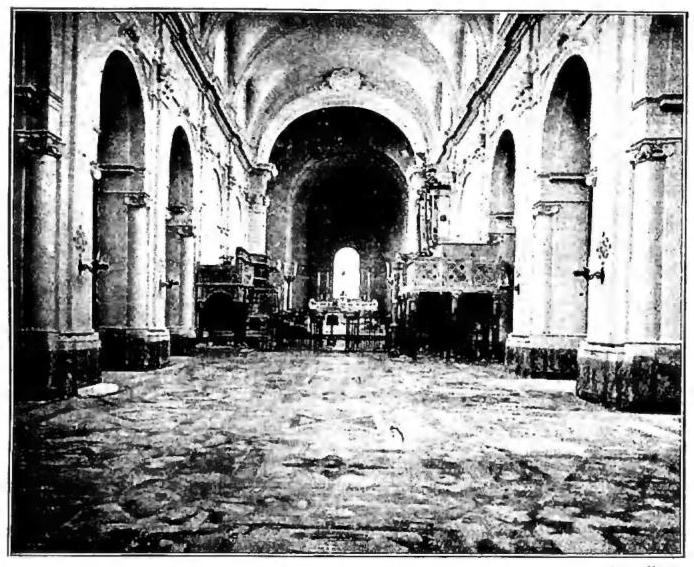
MONUMENTS. — The Cathedral, erected by Roberto il Guiscardo (1079–84) and dedicated to s. Maria degli Angeli, was consecrated by Pope Gregorio VII. Built on the site of the ancient Duomo, it was completely transformed by the eighteenth-century restorations of Archbishop Bonaventura Poerio and Paolo de Vilhana Perlas; it was then partially restored during the major works carried out in the first thirty years of the century. It consists of an atrium, the upper church, and the crypt. The atrium, beside which stands the little church of S. Lazzaro, once the lecture hall of the famous medical school, preserves the fine portal with two lions seated at the foot of the jambs. The architrave, commissioned by the abbot Desiderio of Montecassino, bears the commemorative inscription of the peace concluded between Roberto and Giordano of Capua. Inside, 28 classical columns support the graceful arches of the portico, at the center of which once stood the large monolithic basin that now adorns a fountain in the Villa nazionale of Naples. Various Roman and Christian sarcophagi are arranged beneath the portico, some of them reused for the burial of illustrious men. To the right of the entrance there still remains the chapel of S. Bernardino, the lecture hall in which s. Tommaso d'Aquino taught philosophy and theology.
The church is reached from the atrium through three portals. The central one, original, has richly ornamented jambs and architrave;
the lunette, with its chromatic effects in white and black, preserves a blessing Christ from the school of Montecassino (11th century). The bronze doors, cast in Constantinople (1099) on commission from the spouses Gisana and Landolfo Butromile « protosebaston », have 54 panels, once covered with silver. The interior of the Duomo has lost much of its ancient splendor; concealed within the recent walls are some of the 22 granite monoliths, obtained in various places from the demolition of early Christian buildings; likewise vanished is the mosaic of Archbishop Alfano that adorned the transept. The church is one of the most interesting Norman structures; asymmetrical in plan, it has a presbytery oblique to the central axis, while the uneven floor rises from the entrance toward the transept. On the inner side of the façade there remains a fine mosaic from the Cassinese school depicting s. Matteo; near the presbytery are the magnificent paschal-candle candelabrum and the two splendid ambons of the 12th century (the one on the right a gift of the brothers d'Aiello, respectively archbishop and chancellor of the Kingdom of Puglia and Sicily; the other of Archbishop Romualdo II Guarna). Siculo-Roman art created a masterpiece in the d'Aiello ambon. Twelve columns of red and gray granite support the light, entirely inlaid structure; the lectern is supported by an eagle clutching in its talons a sinner bitten by a serpent and resting upon a lion devouring a bull. The pulpit on the left, by contrast, slender and elegant on four columns, adheres more closely to the principles of the Roman school; its capitals and the symbols of the Evangelists in the spandrels of the front and right side are noteworthy. Another mosaic decoration, with large marble panels, adorns the iconostasis of Matteo d'Aiello; the presbytery floor, commissioned by Cardinal Romualdo I Guarna, is also in mosaic. Of great interest are the sixteenth-century wooden choir, the 15th-century organ, and the Baroque choir gallery. At the back of the apse the cathedra of Gregorio VII has once again come to light, together with remains of ancient mosaics depicting apostles.
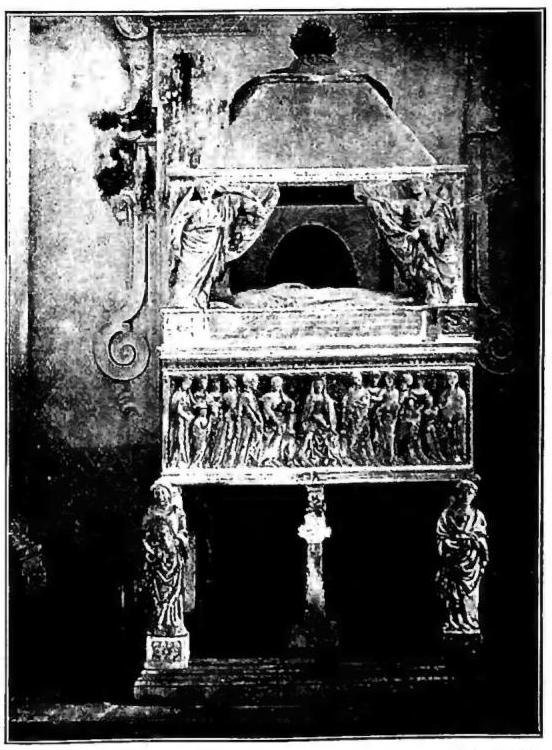
The right apse, formerly the chapel of the Crusades or of Gregorio VII, preserves the tomb of the exiled Pontiff, who died there in 1085. The mosaics in the basin, with figures of saints against a gold background, commissioned by Giovanni da Procida (ca. 1260), clearly reveal the influence of the mosaicists of Palermo, Cefalù, and Monreale. The walls too are frescoed (on the left The granting of the cardinalitial cappa magna to the Chapter of Salerno; on the right The coming of Gregorio VII to S.). Worth noting are: the tomb of Cardinal Carafa (1668), with the fine Greek bas-relief of the Rape of Proserpina at its base; that of Archbishop Paglia, in neoclassical style (1854); a modern throne; the seventeenth-century pulpit on four twisted columns; and the Baroque monument to Archbishop Sanchez de Luna (1771). In the other apse, part of an 11th-century mosaic depicting the Baptism of Jesus is preserved; on the walls are two frescoes perhaps by Solimena. Funerary monuments are numerous, and some are of considerable merit in the transept and the side aisles, in addition to a large canvas by Luca Giordano (Madonna and Child, ss. Antonio and Lorenzo) and an Assumption of the Virgin. Beneath the church, the spacious three-aisled crypt, richly decorated with polychrome marble by Domenico Fontana and his son (early 17th century), preserves the body of the Evangelist s. Matteo, brought here in 954 by Gisulfo I. The central apse contains a twisted column upon which, according to legend, the three Salernitan martyrs Caio, Antes, and Fortunato were beheaded.
Finally, the Museum attached to the Duomo deserves mention; it preserves a precious treasure of relics, liturgical vestments, and valuable objects. Among other things, it contains the well-known «Exultet», a superb 12th-century ivory antependium with 54 bas-reliefs depicting scenes from the Old and New Testaments, and various illuminated codices from the same period.
Other medieval buildings are the churches of the S. Crocifisso (ca. 10th century) and of S. Domenico, with its splendid cloister of Arab inspiration, like the cathedral of Amalfi.