RUVO, DIOCESE of. — City and diocese in the province of Bari, of whose metropolitan see it has always remained a suffragan. R. has an area of 39,880 sq km and a population of 57,387 inhabitants, of whom 57,200 are Catholics, distributed among 21 parishes served by 71 diocesan priests and 5 religious priests; 1 minor seminary; 1 male and 10 female religious communities (Ann. Pont. 1952, p. 343). The Cathedral is dedicated to the Blessed Virgin Mary of the Assumption; the protector of the diocese is St Biagio, bishop.
HISTORY. — The tradition that the origin of the episcopal see goes back to the episcopate of Cletus, who was the 2nd successor of St Peter after Linus, is untenable. Equally untenable is the absurd catalogue of the first seven bishops of R., whose names, as Lanzoni rightly observed, are unknown to Apulian onomastics until the 4th century. The eighth in the series, a Joannes, is mentioned in a Vita et translatio s. Sobini (BHL, 7443) of Canosa as having been present in 493 at the blessing of the church of S. Andrea at Barletta, performed by Pope Gelasius I. The establishment of the diocese of Ruvo may have taken place during the period of Byzantine rule, when the easterners, having become masters of Bari and the Apulian coast, endeavoured to establish new episcopal sees almost everywhere, in order to draw those populations into the orbit of the Church of Constantinople. If this was so, the diocese of R. may have arisen in the 8th century or somewhat later. In the 11th century the first bishop is found, Gioacchino de Zonicis, whom Coleti assigns to 1009 and who, on the authority of an indiculus Episcoporum huius Ecclesiae, is said to have governed the diocese for only 44 days. His successor, Abiatarus de Barghettinis, is likewise doubtful, given the lack of any corroborating document. Guilberto (or Gisilberto), according to the anonymous Cassinese chronicler, took part in 1071 in the consecration of the church of Montecassino performed by Alexander II and, according to Lupo Protospata (Chr. ad an. 1082), donated to the prior of Monte Peloso the church of S. Sabino of R. in exchange for four pounds of wax annually and the escort of a knight whenever he went to Bari or Canosa.
The reasons for these journeys, if they are explicable in the case of Bari, the metropolitan’s residence, are entirely obscure in the case of Canosa, unless relations then existed between the two Churches that are unknown today. Among his successors was a Pietro, not otherwise identified, who is said to have lived in 1110 (but this is highly doubtful); Orso, who consecrated the church of Madonna dei Martiri at Molfetta (1162); and Daniele, who took part in the Lateran Council of Alexander III (1179), already known before that (1177) for having received substantial donations from the Norman Roberto, count of Conversano and lord of R., in favour of the church of the Most Holy Trinity, « pro expiatione Roberti patria sui suorumque parentum ». Finally, the following are remembered: Domenico Ursi of R. (1417), mentioned in an instrument of concession on emphyteusis preserved in the Chapter Archive; and Domenico Galesio (1676), who consecrated the Capuchin church and left his name associated with unfortunate works carried out in the Cathedral. In 1818 Pius VII, by the bull De ulteriori Dominicae, united with R. also the episcopal church of Bitonto, declaring it « aeque principaliter » a co-cathedral.
MONUMENTS. — Many of the oldest churches of R. are now destroyed; such are S. Sabino, the Most Holy Trinity, and S. Giovanni, which tradition claims was the first cathedral. From the Middle Ages there remains only the magnificent Romanesque Cathedral, with its severe forms, whose structures bear the marks of the attempts undertaken and the innovations arising from political events. The church, in the form of a Latin cross, has three apsidal naves set obliquely in relation to the façade; its original plan was subsequently enlarged by the opening of various chapels in the lateral walls, chapels that were removed during the most recent restoration work. The façade, high and steeply pitched, has features altogether different from those of the other Apulian cathedrals, with the exception of that of Trani: no dividing pilasters and little inclination toward empty spaces. At the top, the seated figure on a throne, which some hold to be that of the founder, so to speak closes the series of hanging arches adorning the slopes and begins that decorative verticalism which continues with the mere-
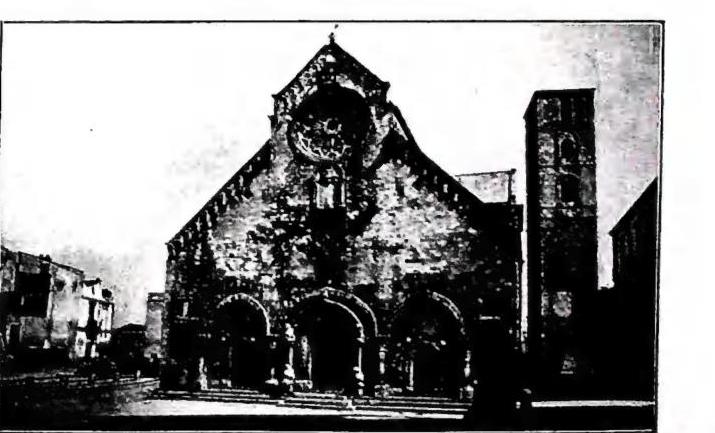
(phot. Michele Fiorelli)