
BITONTO, DIOCESI di. - In the province of Bari. Inhabited by a Greek colony of which traces of furnishings and coins with the inscription BYTONTINON remain, it was later conquered by the Romans and became a municipium, but fell into decay due to the inva-
B. has preserved its episcopal curia with a minor seminary; it has over 36,000 inhabitants with 15 parishes, 52 diocesan priests, and 6 regulars. Mention should be made of the abbeys of S. Leone degli Olivetani and the two female ones of S. Pietro Nuovo delle Olivetane and of the Benedictines alle Vergini.
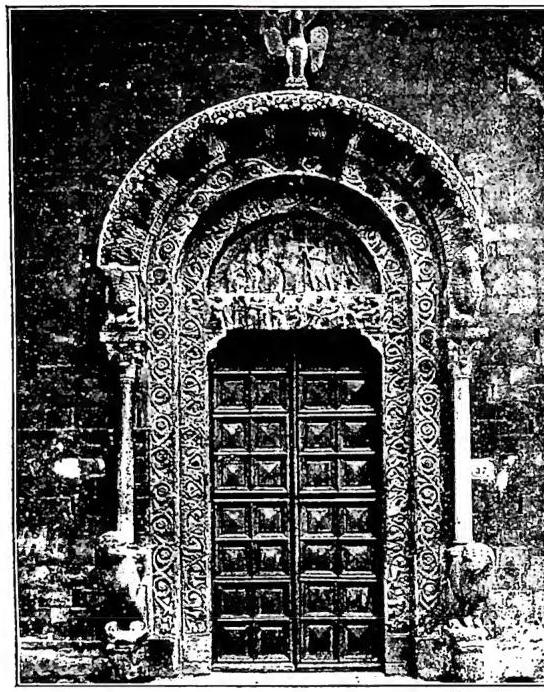
On the exterior, the façade is divided into three zones by two pilasters flanking the central body; the latter features a splendid portal with heavily ornamented arches and an architrave with reliefs, alongside two griffins resting on small columns supported by lions. Above this is a pair of mullioned windows and then the rose window, which is likewise rich in relief decorations. The flank has six arcades on pillars, followed by a loggia or matroneum composed of six hexaphorous openings with thirty small columns. The front of the right transept is also very rich in decoration, featuring a double order of two mullioned windows and a large rose window. The apsidal section is equally beautiful, with a richly carved window and flanked by two bell towers that have been restored several times over the centuries.
The interior, imposing and harmonious, is divided into three naves by 8 columns and 4 pillars. The ground plan is in the shape of an Egyptian cross transformed into a rectangle because of the side chapels that jut out to the width of the transept. The capitals of the columns, upon which solemn semicircular arches rest, are very beautiful. Above these are six large mullioned windows and four single-lancet windows per side. The main nave and the transept have a trussed roof, whereas the side naves have vaulted ceilings dating to the 18th century. Within the interior of the Cathedral, several Apulian artists of the Romanesque era left remarkable evidence of their activity. First and foremost is that Nicola "magister et sacerdos" who, against the right pillar near the presbytery, sculpted the very beautiful ambo in 1220; then that Bonifacio who in 1240 sculpted the pulpit where the relief is enhanced by inlaid colored glass; and finally that Gualtiero da Foggia who a few years later sculpted the ciborium, of which only a few graceful small columns and a cornice remain, which today form the balustrade of the 17th-century tomb of Card. Fabrizio Carafa.
The crypt is interesting, as large as the transept nave and divided into four naves by 30 fine columns. The treasury preserves several valuable reliquaries and sacred furnishings. Adjacent to the Cathedral are the seminary and the bishop's palace, which house fragments of Romanesque sculpture. The church of S. Francesco, built in the final years of the 13th century, retains its primitive façade with the ogival portal and, above it, a triforium with the central arch higher than the lateral ones. The church of S. Domenico, on the other hand, dates from the 15th century. Of some interest for the history of architecture are also the small church of S. Valentino, probably founded in the 12th century, and the abbey of S. Leone. This is a building that boasts very remote origins (3rd century). Until the 14th century it was held by the Benedictines, then by the Olivetans, and subsequently by the Franciscans. Its oldest parts date back to the 13th and 14th centuries. It has ogival windows and a triumphal arch, and, in the apse, an interesting series of 14th-century frescoes. The bell tower, instead, dates from the 13th century, while the cloister was built in the first quarter of the 16th century.
Among the church buildings of the Baroque era, besides the church of S. Gaetano and that of the Crocefisso, it is also worth mentioning the church of S. Francesco di Paola, rebuilt in the 18th century with its tall bell tower.
In Bitonto, interesting medieval and Renaissance civil buildings are frequently encountered. Among the latter, worthy of remembrance are the Palazzo Grottola, with a rusticated ground floor and a two-arched loggia; the Palazzo Sylos Labini with its fine 15th-century portal; and the Palazzo Sylos Calò.