
SACRED FURNISHINGS. –
1. LITURGY
These are the objects used for worship, especially those more closely connected with the Most Holy Eucharist, serving both for the person of the priest (sacred vestments), for the preparation and preservation of the Most Blessed Sacrament (sacred vessels), and also for adorning the altar and the church where the celebration takes place.In imitation of Christ, who instituted the Eucharistic Sacrament in an ordinary room, with garments and in vessels of common use, the first Christians customarily celebrated it without special display and in places lacking any particular distinction. Only later, when the Eucharistic celebration began to assume a solemn character, did sacred furnishings acquire the principal liturgical elements of today. With the barbarian invasions, Roman life underwent a radical transformation, including in dress. Hence the beginning of that separation which gradually became more pronounced between the laity and the clergy, the latter retaining the ancient garments for the celebration of the sacred rites. The same may be said of the sacred vessels, whose form and material were established gradually by particular customs and prescriptions. During the Middle Ages, the tendency toward simplification in the form of sacred furnishings became widespread. Yet the arts of embroidery, chasing, and inlay were always lavished generously, especially in periods when great geniuses enriched churches with so many admirable masterpieces, so that whatever was directly or indirectly necessary for liturgical service would stand apart from objects of common use through its richness and exquisite workmanship.
The material from which sacred furnishings are made must be more or less precious according to whether it comes into more or less direct contact with the Most Holy Eucharist. Thus, silk is necessary for chasubles, dalmatics, the cope, and the humeral veil; linen or hemp for the alb, purificators, pallæ, altar cloths, and amices; gold and silver for the chalice, ciborium, paten, and monstrance. Other metals may also be used for the latter; however, the paten and the inside of the cup of the chalice and ciborium must be gilded. Sacred vestments require a blessing, whereas the chalice and paten require consecration by the bishop or another delegated priest. For the preservation of sacred furnishings, every church has a sacristy or another place designated for this purpose; the more precious items are sometimes kept in a special treasury. More extensive information is given under the respective entries.
2. LAW
The juridical discipline of sacred furnishings—or sacred equipment—is contained in Title XVIII of Book III of the CIC. It provides first of all (can. 1207) that the obligation to provide the furnishings necessary for worship ordinarily falls upon those who are legally bound to repair the church (cf. can. 1186); and therefore, in the following order: upon the church-managing board, the bishop, the canons, and the diocesan clergy when the church is a cathedral; upon the church-managing board, the patron, the holders of revenues, and the parishioners when it is a parish church.With regard to the material and form of sacred furnishings, can. 1296 § 3 merely makes a general reference to liturgical prescriptions, ecclesiastical tradition, and the laws of sacred art. Particular importance, on the other hand, is attached to their custody and preservation (cann. 1296 § 1 and 1302); to ensure this more effectively, can. 1296 § 2 requires that a regular inventory be drawn up.
Cardinals domiciled in the City, even if suburbicarian bishops or abbots nullius, may dispose by donation or testament of their sacred equipment in favor of a church (preferably one of those which they held as a title, in administration, or in commendam), of a pious place, or of an ecclesiastical or religious person; but if they die without having made such provision, all their sacred furnishings, with the exception of the ring and the pectoral cross, pass to the pontifical sacristy (can. 1298). Similarly, the sacred equipment of residential bishops, even when they possess cardinalitial dignity, becomes, upon their death, the property of the cathedral church, except for the ring, the pectoral cross, and all those objects which can be shown to have been acquired by the deceased with assets not belonging to that church itself (can. 1299 § 1). In the event that a bishop successively governed two or more dioceses, or was simultaneously at the head of two or more united dioceses, can. 1299 § 2 establishes the manner of assigning the sacred furnishings to the individual cathedral churches. What is said concerning bishops also applies to clerics who have obtained a secular or religious benefice at some church (can. 1300). Cardinals, residential bishops, and other beneficed clerics therefore have the obligation to ensure, by testament or another valid act, that the canonical provisions just mentioned may in each case receive full execution also in civil law; and they must furthermore promptly designate a person of irreproachable reputation who, after their death, will deliver to the proper recipient not only the sacred equipment but also the books, documents, and other things belonging to the church,
which may happen to be found in their residence (can. 1301).
The use of sacred furnishings and, in general, of everything necessary for the celebration of Mass and for pontifical functions must be granted free of charge to the bishop by the cathedral church (can. 1303 § 1). As for other priests, the ordinary may permit a modest fee to be charged to them for the use of the furnishings if the church in which, for their own convenience, they celebrate Mass is in a state of particular indigence (can. 1303 §§ 2-4).
When required by liturgical norms, the blessing of sacred furnishings may be imparted: a) by cardinals and bishops, without exception; b) by ordinarii locorum who are not bishops, for the churches and oratories existing in their territory; c) by parish priests, for the churches and oratories situated within the parish; d) by rectors of churches, limited to those churches themselves; e) by priests delegated by the ordinary, within the limits of the delegation and of the jurisdiction of the delegating authority; f) by religious superiors and by priests of the same religious institute delegated for this purpose, for their own churches and oratories, as well as for the churches of nuns subject to them (can. 1304).
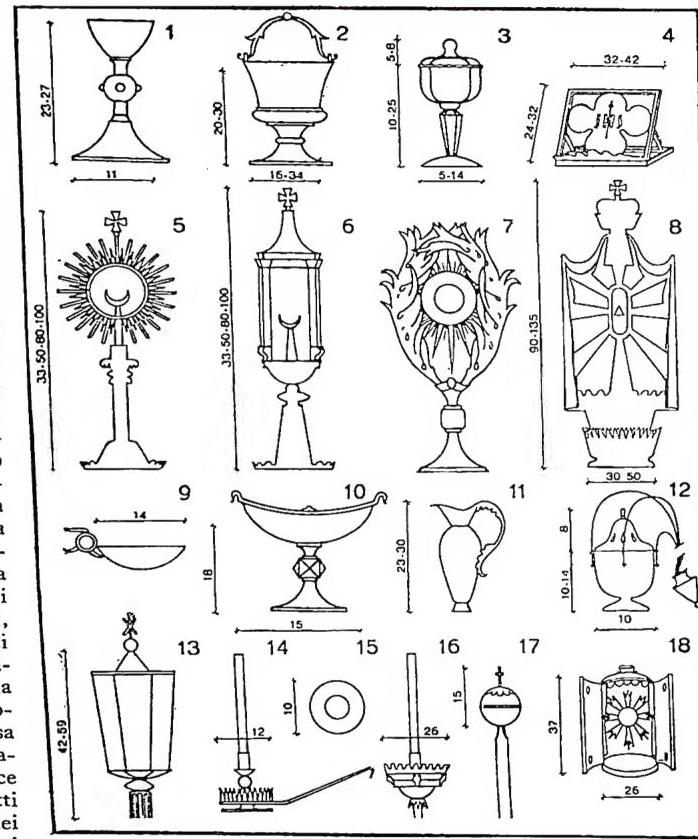
3. Calire
4. Holy-water bucket
3. l'Isside
5. Lectern
6. Radiating monstrance (Roman rite)
7. Temple-shaped monstrance (Umbrosisme rite)
8. Reliquary
9. Throne
10. Conchidiana for baptism
11. Navicilia for incense
12. Ewer for ablutions
13. Thurible
14. Processional lantern
15. Palmatoria or hand candlestick
16. Paten-dish
17. Candle for the candle-bearer
18. Ferula
18. Portable tabernacle.Blessed or consecrated sacred equipment loses its blessing or consecration: 1) if it suffers such damage or alterations as to lose its original form and no longer be considered suitable for the use proper to it; 2) if it has been used for unbecoming purposes or publicly offered for sale (can. 1305 § 1). It should be noted, however, that the chalice and paten do not lose their consecration merely through wear or the renewal of the gilding (can. 1305 § 2).
Finally, particular provisions are intended to safeguard certain sacred furnishings—and especially the chalice, the paten, the purificators, the pallæ, and the corporals—from sacrilegious or impure contact (can. 1306 §§ 1-2). – Vedi Tavv. III-IV.