
CHALICE. — Among the sacred vessels, this is the one in which the Eucharistic wine is consecrated at Mass.
I. ARCHAEOLOGY
Just as the earliest places of worship were a common room in private houses, the earliest altars a simple table, and the earliest liturgical vestments those of everyday use, so too the c. originally was nothing more than an ordinary vessel for daily use; this also accounts for its form, which in general is the same in both the East and the West. The Greeks have ποτήριον, which denotes a c. without handles,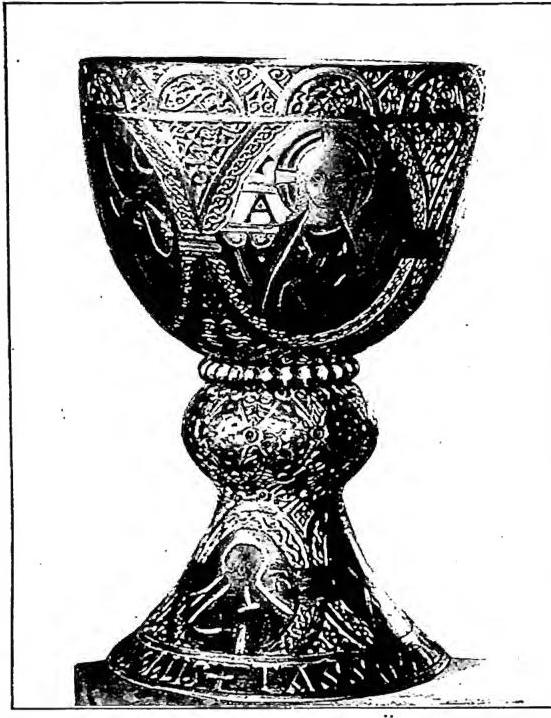
CALICE - Chalice of worked and gilded copper with silver niello work, offered to the monastery of Kremsmünster by Duke Tassilo III (ca. 780): † TASSILO DUX FORTIS † LIVTPRIC VIRGO REGALIS.
whereas κρατήρ is used for the handled chalice; ancient, but rare, is κόπελλον, used in antiquity, for example, in the Apostolic Constitutions (PG 1, 1092) and later by Agathias (d. 580; Histor., I. II: PG 88, 1329). In Latin, the most frequent term of all is calix, from antiquity onward, both because of its form and because in Italy ποτήριον was translated as calix from the Greek κόλιξ.
In the early Christian period, scyphus, from σκόφος, was also used, and Braun holds that by this word the chalice for consecration was meant, whereas calix designated the one used for the Communion of the faithful.
There are also the distinctions of c. sanctus, designating the chalice for consecration used in Rome in the eighth and ninth centuries; c. ministerialis, an expression used in the Lib. Pont. until the eighth century for the chalice used for the Communion of the faithful; c. stationarius, the one reserved in Rome for consecration during the stations; c. maior or minor, according to its dimensions or the liturgical solemnity; c. ad Baptismum, for administering Communion to neophytes in Rome, as recalled in the Lib. Pont. in the biography of Innocent I (401–17); c. ad offerendam faciendam or offerendarius, the one in which the offerings of wine for consecration were collected, or the one with which the wine for the divine sacrifice was carried; c. quotidianus, the one used every day, to distinguish it from the other reserved for solemnities (Lib. Pont., I, p. 418, in the biography of Gregory III [731–41]); c. viaticus, the one used when travelling, often of very small dimensions, in use especially in the eleventh to thirteenth centuries; c. appensorius or pendentilis, not liturgical, but simply placed as a decorative element suspended from the pergulae in basilicas and mentioned in the biographies of the popes of the eighth and ninth centuries: Gregory III (731–41), Leo III (795–816), Paschal I (817–24), Leo IV (844–55), and also mentioned for the same period in the Lib. Pont. of Ravenna.
Material and form of the chalice. - As regards the material, originally there was no distinction; every drinking vessel was permitted, whether of glass or metal, etc.; for the pre-Carolingian period, wood cannot be excluded.
Glass was much used among the Romans, and its use is certainly attested in the post-Constantinian period, while chalices of gold and silver are mentioned in the Lib. Pont., among the Constantinian donations.
In the pre-Carolingian period there were also chalices of bronze and copper, but there is no documentation for them, as there is, by contrast, for chalices of crystal or onyx.
The first Christian monument to offer a representation of a footless chalice is the painting known as the Fractio panis in Priscilla, whose Eucharistic meaning is certain; whereas the chalice from the coemeterium maius, now in the Museo Sacro of the Vatican Library and published by De Rossi in his Bullettino d'Archeologia cristiana of 1879, must be excluded as Eucharistic. It is also entirely implausible that the form of the Eucharistic chalice derived from the one used at the Last Supper. From the beginning, in fact, two different forms were used indiscriminately: the handled form, with handles or auriculae, the handles shaped like ears or in the form of an S; or a chalice without handles. The foot is generally conical, either simple or with a usually round and low knob at the centre; in the East there is a third form: instead of a foot, there is a small base supporting the cup, giving it the form of a modern cup.
The cup may be oval, shaped like a drinking glass or like a vase, or hemispherical. The form is generally the same in both East and West. In some examples preserved in the treasury of St Mark’s and originating from Constantinople, a support or cup-holder is inserted between the knob and the cup.
Types of handled chalices are represented by the chalice of Ardagh, now in the Dublin museum, of uncertain date but attributed by many to the ninth century; by the chalice of St-Denis, now in America in a private collection; by the travelling chalice of the cathedral of Cividale, only 9.5 cm high, with a cup 5.5 cm wide and bearing representations of Abraham and Melchizedek; and by the series of precious chalices in the treasury of St Mark’s in Venice (tenth–twelfth centuries), which are made not of metal but of glass, onyx, crystal, chalcedony, and serpentine.
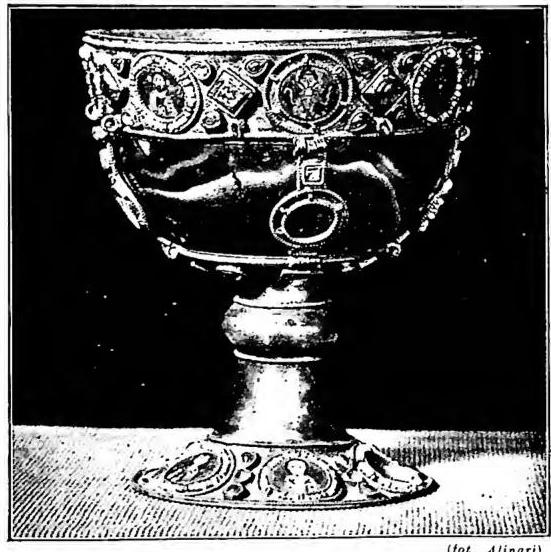
The oldest example of a chalice without handles is offered by the chalice of Antioch (v.). The same form is found in the chalice por-
(Alinari photograph)
CALICE - Byzantine chalice with a chalcedony bowl (10th–11th centuries). Venice, treasury of the Basilica of S. Marco.
carried by the empress Teodora in the mosaic of S. Vitale in Ravenna (6th century). Contemporary is the one in the fresco at Bāwīṭ in Egypt. Others are depicted in the 6th or 7th century on patens, for example the one found at Riha on the Orontes, or in miniatures, as in the Pentateuch of Ashburnam. The form then remained constant: see, for example, the silver chalice offered by the deacon Orso (5th–6th centuries), now at Lamön; the gold and enamel chalice with a conical bowl from Chelles (7th century), now lost, said to have been donated by S. Eligio to S. Batilde; the chalice, dating approximately from the 7th century, from Petöhaza (Hungary); the chalice of Crodegango of Séez (d. 775), now in Leningrad; the copper chalice of Duke Tassilo III (c. 780) at Kremsmünster (Austria); and that of Lutgero (d. 809) at Werden (Germany).
II. ART
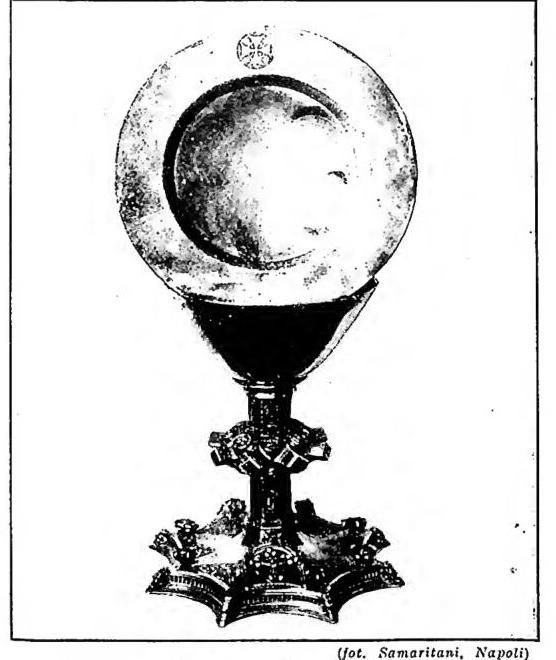
In the Romanesque period, the hemispherical cup is attached directly to the knop, as in the rich example from S. Godeardo in Hildesheim or in the much more modest one said to have belonged to s. Francesco, in the treasury of the basilica of Assisi. At the end of the thirteenth century, the cup takes on a more slender and elongated form; the foot acquires lobed terminations, the stem becomes differentiated, and the knop is faceted in order, together with the other parts, to receive rich decoration in which enamel is combined with chiselling and niello, as well as with every other more refined technique of goldsmithery. The c. of Niccolò IV in S. Francesco of Assisi, made by the Sienese Guccio di Manaia, is a typical example of this new direction. While the Campanian goldsmiths of the fourteenth century, and the Abruzzese ones of the following century, remain more closely attached to traditional forms, the Venetian goldsmiths are distinguished by their delicate execution and by the characteristic form assumed by the knop, with Gothic frames in which busts of saints are placed. In the sixteenth century, the c. loses every remaining Gothic decorative element;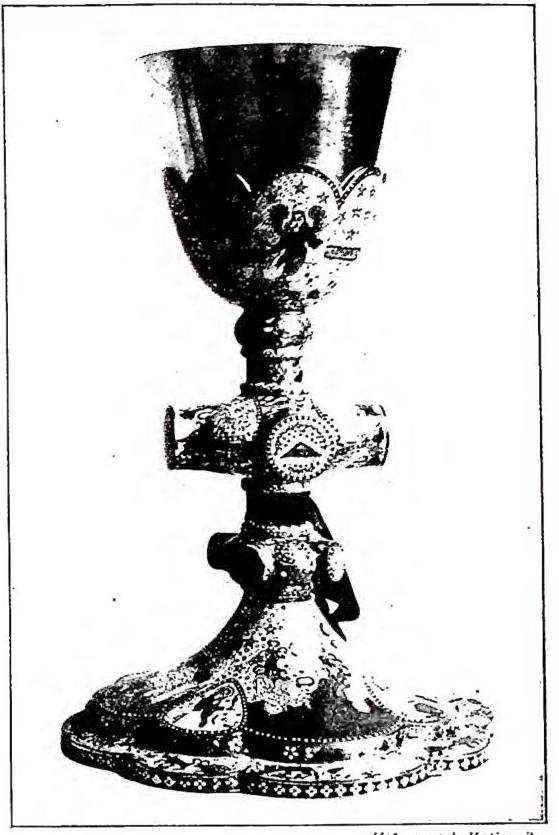
(photo: Vatican Museums) CALICE - C. Chinese chalice donated to Leone XIII. Rome, treasury of the Basilica of St Peter.
III. LITURGY
1. Material
The current prescriptions concerning the material of the c. relate especially to the cup, which must be made of gold or silver, gilded on the inside; other suitable metals may also be used for the stem and base, but not glass or ivory. Special concessions are made for the missions and in cases of extreme poverty (Decreta authentica S. R. Congr., no. 3136, ad 4).2. Form
The c. must have a form that does not arouse wonder among the faithful; hence art must adapt its lines, expression, and decoration to the sacred purpose served by the c.; the cup must be designed so as to avoid the danger of overturning and spilling the Sacred Species (ibid., Appendix, II, no. 4371).3. Consecration
In ancient times the c. remained consecrated through the use made of it in Eucharistic sacrifices. The special rite of consecration does not date back earlier than the seventh century, and it did not become obligatory, by force of the custom that was gradually introduced, until the ninth century. Today the CIC reserves consecration to bishops (can. 1147), non-bishop cardinals (can. 239, § 1, no. 20), apostolic prefects (can. 294, § 2), and abbots and prelates nullius (can. 323, § 2).4. Desecration. — The c. is desecrated: a) if it undergoes damage or alterations such that it loses its original form and becomes unsuitable for its function (e.g., if it is broken in two, or if the cup is punctured or becomes seriously cracked); b) if it is used in unsuitable circumstances (e.g., in a theater) or offered for public sale (CIC, can. 1305, § 1); if the cup has lost its inner gilding, it does not thereby lose its consecration; it merely remains obligatory to have it gilded again (ibid., § 2). — Vedi Tavv. XXIV-XXV.