
ALEPPO. – City of northern Syria, not far from Antioch, formerly called Hallob, in Greek Χαλυβών, and named Βέροια or Βερόη by Seleucus Nicator (312–281 B.C.). Given its proximity to Antioch, the Gospel must have been preached there very early. The seat of a bishopric, Berea was held by illustrious men such as Eustathius, later bishop of Antioch (cf. Sozomeno, Hist. eccl., I, 2), and by the venerable Acacius, who governed that diocese from 378 to 432. According to the Notitia of Anastasius I, restored by S. Vailhé and belonging to the sixth century, Berea, initially a simple bishopric, was later distinguished by the title of archbishopric, that is, governed by an archbishop with the title of « Syncellos », immediately subject to the see of Antioch, of which Berea was always a suffragan. The city today has 132,000 inhabitants, of whom 40,000 are Christians.
Ignazio Ortiz de Urbina
1. A. degli ARMENI. – The origins of the Armenian colony in A. date back to the eleventh century; history, however, has not preserved the complete succession of bishops. In 1439 the bishop Hovakim was sent by the patriarch Costantino V of Armenia to the Council of Ferrara–Florence, together with Sarkis Vartabed and Markos Vartabed. In
1585, the bishop Azaria, later elected patriarch of Sis in Cilicia, presented his profession of Catholic faith to Gregorio XIII.
Beginning in the middle of the seventeenth century, the Armenian Catholic community in A. developed considerably, through the work of the Armenian missionaries trained by Propaganda, as well as through the missions of the Western Orders.
In 1710 the said Catholic community obtained its own bishop, emancipating itself from the jurisdiction of the schismatic bishop, and the see was elevated to an archbishopric in 1899. After its emancipation, the Armenian diocese of A. suffered extremely severe persecutions at the hands of the Turkish government, instigated by the schismatic Armenian patriarchs. The persecution intensified when the prohibition was issued forbidding that community to communicate in divinis and to attend, even for formal purposes, the churches of the schismatic Armenians.
At present the archdiocese of A. numbers approximately 18,000 souls and about twenty priests. It has a cathedral church, « S. Maria Ausiliatrice », and six other churches and chapels. Internally, it is highly organized; it has schools and institutes, Catholic associations, confraternities, and pious unions. The Armenian Church, currently separated, greatly exceeds the Catholic Church numerically and numbers approximately 70,000 souls, with 35 churches and 53 priests.
2. A. dei MARONITI. – Archdiocese, residential see. The Maronites in A. are very ancient. Dionysius of Tell Mahré (d. 845), in Chronique de Michel le Syrien, ed. J. B. Chabot, II, pp. 492–96, speaks of the struggle between Maronites and Melkites for possession of the church of A. But the unbroken succession of Maronite archbishops for that city dates only from 1638. Today there are 3,800 faithful, 6 priests, and 4 churches.
3. A. dei MELKITI. – Considered a metropolitan see since 1790, it has, besides the archbishop, 14 secular priests, 2 Aleppine Basilian religious, and 15,000 faithful. There are 8 parishes and 5 schools. The cathedral is dedicated to « Maria S.ma Assunta ». The dissidents number 5,000, with one bishop and 10 priests.
Ignazio Ortiz de Urbina
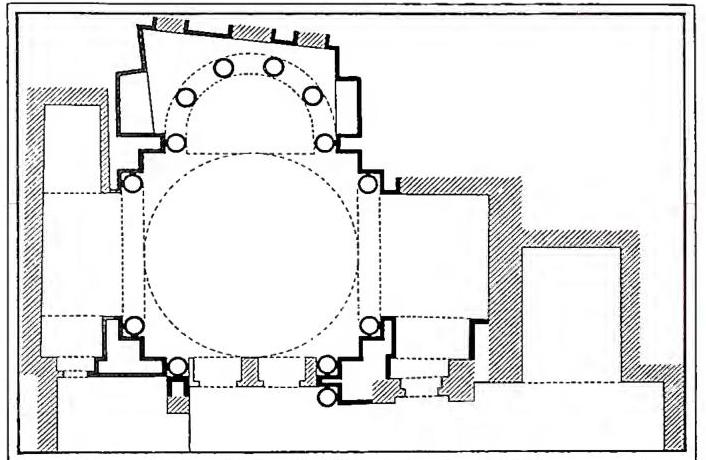
Pietro Sfair
5. VICARIATO APOSTOLICO
In 1644 the Latin bishopric of A. was erected, where the Jesuits had established themselves.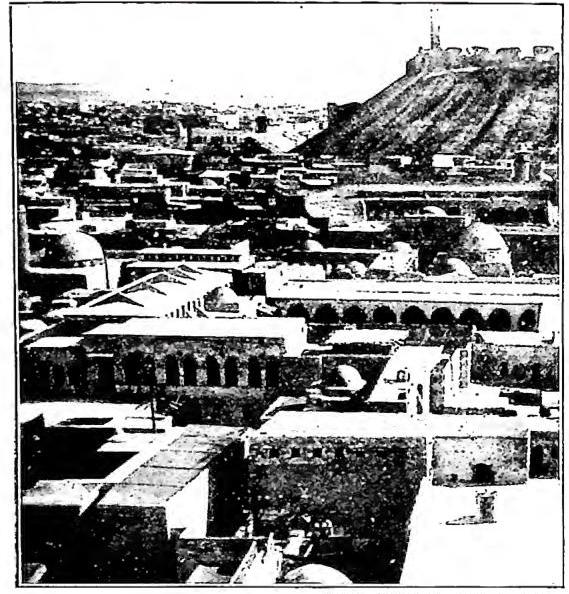
(from J. Sauvaest, Aleppo, 1911) ALEPPO – View taken from the minaret of the Great Mosque.
Ignazio Ortiz de Urbina