
SOZOMENO. - Salamanes Hermias, according to Photius (Bibl., 30). Ecclesiastical historian, born of a Christian family in the village of Bethelia near Gaza and lived in an environment where the memories of the monk Hilarion were vivid. The dates of his birth and death are unknown.
He became a lawyer, lived in Constantinople, where he dedicated his Ecclesiastical History to the Emperor Theodosius II
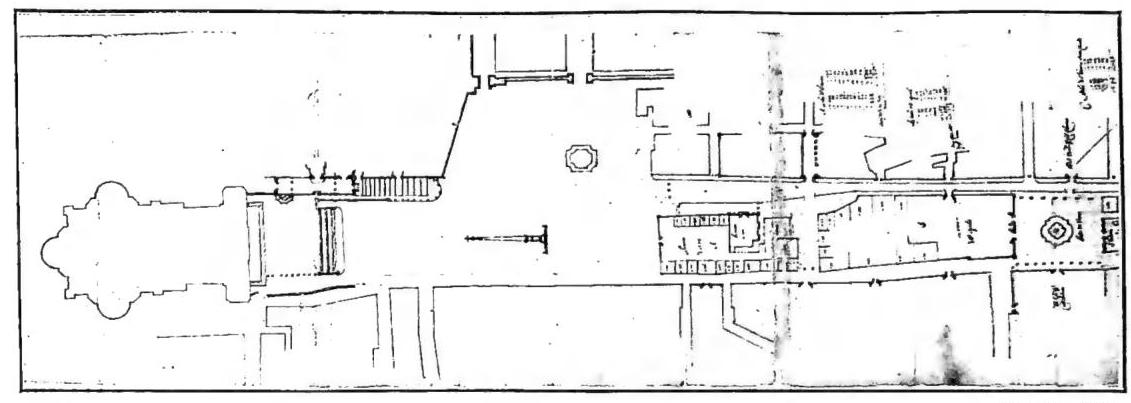
SPADA, VIRGILIO - Islands between the Borgo Vecchio and Borgo Nuovo streets, from Piazza S. Pietro to Piazza S. Giacomo, with the rental value of the individual houses. Autograph drawing by
V. S
Vatican Library, cod. Vat. Ist. 11257, f. 6.This history had been preceded (Hist. eccl., I, 11, 12) by a more concise one that narrated the history of the Church from the Ascension up to Licinius, which has been lost. The Historia ecclesiastica consisted of nine books and was supposed to reach the year 439; the preserved text goes up to 425; for unknown reasons, the end is missing (perhaps half a book).
The work was written after 443 and presupposes knowledge of the Historia ecclesiastica of Socrates. In addition to Socrates, the author used synodal writings, imperial epistles, laws, and other documents. He found this official material largely in the collection of Sabinus (cf. P. Batiffol, Sozomène et Sabinos, in Byzantinische Zeitschrift, 7 [1898], p. 265 ff.) and in the Historia Athanasii (P. Batiffol, Le Synodikon de st Athanase, ibid., 10 [1901], p. 128 ff.); he also knew works by Athanasius, Eusebius, and Rufinus. For profane history he depends on Olympiodorus. S. was a jurist and not a theologian and therefore not always clear in his judgment, but he was a pious man, an admirer of the ascetic life. Photius is of the opinion that the work of S. surpassed that of Socrates stylistically.