Machine translation of the 1948–1954 Italian original. The original text is authoritative.
ILARIONE, saint. - Founder of the eremitical life in Palestine, born at Thabitha near Gaza in 291, died in Cyprus in 371.
Sent by his parents to Alexandria to study, he heard about the solitaire Antonio and his ascetic life; he therefore went to visit him and stayed with him for 2 months, being inflamed-
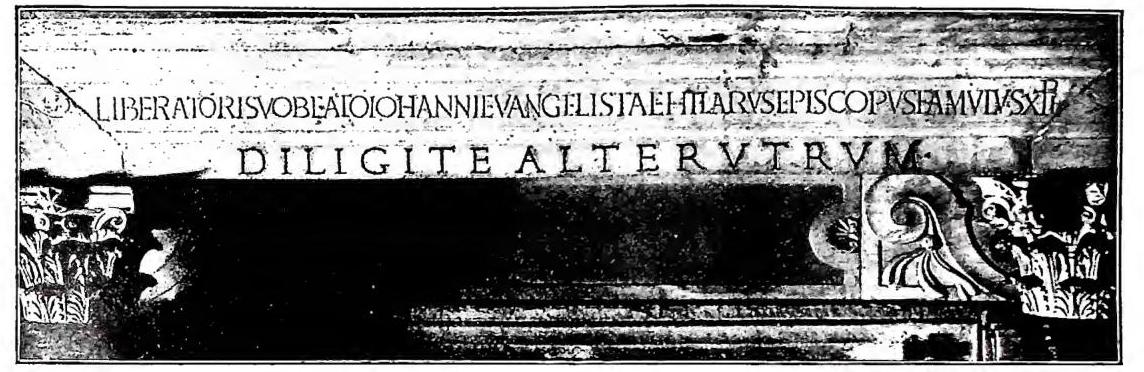
ILARO, POPE, saint - Inscription placed by Pope I. on the lintel of the oratory erected, in the Lateran Baptistery, to St. John the Evangelist. The diligite alterutrum is an addition of the 17th century - Rome. (phot. Exc. Catt.)by that life. He then returned to his homeland, and, finding his parents dead, he distributed all his goods to the poor, and, scarcely fifteen years old, withdrew to a solitary place 7 miles from Maiuma. For 5 years he lived in a hovel, then built himself a narrow cell; sparing in food and austere in clothing, he spent his time in penance and prayer. As the fame of his virtues and the miracles he performed spread around him, many joined him in his way of life. In 329 he built the first monastery, thus giving rise to the cenobitic life in Palestine, which soon saw monasteries multiply. Annoyed, however, by the continuous visits, I. abandoned the monastery in search of a quieter place; he then went to the Thebaid where he visited the places sanctified by Antonio; subsequently he was in Alexandria, in Sicily, in Dalmatia, and finally in Cyprus where, already over eighty, he died. His body was later stolen by his disciple Hesychius and buried in Maiuma.
The biography of I. was written, shortly after his death, by s. Girolamo, around 391; all other subsequent ones depend on it, not excluding the versions, the most ancient of which, in Greek, dates back to the first half of the 5th century and is due to a certain Sophronius, a friend of s. Girolamo himself. The anecdotal character of the Hieronymian biography, stuffed with more or less legendary and rhetorical details, prompted some critics to deny it any historical foundation, maintaining that it was a completely invented romance, not excluding the protagonist. Certainly s. Girolamo wanted to present a model of monastic virtues for the edification of pious souls, and to this end he wrote the biography of I.; but this does not authorize denying the historical existence of the subject. Indeed, the life of the disciples and the veneration that I. enjoyed in Maiuma are also attested, independently of s. Girolamo, by the historian Sozomen. In the Roman Martyrology he is commemorated on October 21.
BIBL.: S. Girolamo, Vita Hilariensis: PL 23, coll. 20-54; Sozomeno, Hist. eccl., III, 14; V, 10; Acta SS. Octobris, IX, Parigi 1869, pp. 16-59; P. Van den Ven, St Jérôme et la vie du moine Malchus le captif, in Le Muséon, 20 (1901), pp. 270-86, 307-26; P. De Labriolle, Vie de Paul de Thèbes et vie d'Hilarion, Parigi (1906); Martyr. Romanum, p. 466 sg. Agostino Amore
ILARIONE. - The second metropolitan of Kiev whose history can be documented (1051-54). He was not Greek, but Slavic. At the invitation of the Grand Duke Yaroslav I the Wise (1019-54), he was elected by the "Russian" bishops and then consecrated metropolitan by the imposition of the relics of St. Clement upon his head. Confirmation of this was not requested from the Byzantine patriarch.
An excellent sermon by him "on law and grace" has been preserved, in which the conversion of Russia is described as an independent event and not as dependent on Byzantium. No expression against Rome is found therein.
BIBL.: W. Philipp, Ansätze zum geschichtlichen und politischen Denken im Kiewer Russland, Breslavia 1940, passim; A. M. Ammann, Storia della Chiesa russa e dei paesi limitrofi, Torino 1948, V. indice. Alberto M. Ammann
Cite this article
“ILARIONE, SANTO.” Enciclopedia Cattolica, vol. VI (1951), p. 938. Azione Romana digital edition, https://azioneromana.com/article/ilarione-santo.