
LAURA (ἡ λαύρα). – Byzantine monastic organization. The term, which in lexical value corresponds to the Latin vicus (cf. Arnobius, Adv. gent., 3, 41: PL 5, 998), was used, in the fourth century, especially in Palestine, to designate a “quarter” or village of monks.
To understand its nature, it is necessary to bear in mind the development of Eastern monasticism, in which three forms of monastic life can be observed that flourished there simultaneously, each independently of the others: the eremitical, the anchoritic, and the coenobitic (v. MONACHISMO).
St. Ilarione, a disciple of St. Antonio, introduced the anchoritic life into Palestine, where it spread widely, giving rise to true “colonies” of monks, which came to be called l. The first of these was that of Faran, in the Judaean desert, founded in 323–30 by St. Caritone.
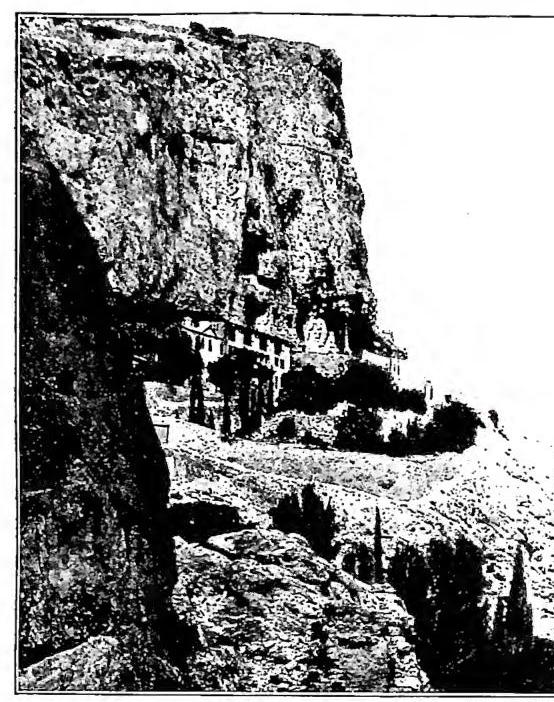
LAURA - Cave and l. of S. Chariton - Palestine, Wadi Fara.
according to S. Sabas, is «hegumen in his own cell». In the 5th century, S. Euthymius and S. Sabas greatly promoted this form of monastic life; the monks, however, who were admitted to live in the cells of the l. first had to undergo a period of formation and probation in a kind of coenobium, which was situated in the same locality. But the system of the l. was not free from drawbacks and made supervision difficult; hence the tendency to transform the anachoretic life into the coenobitic. The fundamental distinction between the two systems frequently recurs in the lives of S. Euthymius and S. Sabas, written by Cyril of Scythopolis, and the different way of life is described in vivid colours by Evagrius Scholasticus (Hist. eccl., II, 21: PG 86, 2477-84).
Common in Palestine, the name and institution of the l. spread throughout the various parts of the Byzantine Empire. With time, however, the term l. became synonymous with monastery, whether the foundation was transformed from an l. into a coenobium, or whether it arose as such from the outset (coenobitic l.). Indeed, in more recent times, l. (ἡ λαύρα, pronounced and transliterated lavra) became an honorific title, used to designate a famous, large, and populous coenobium; consequently, in Russia only four great monasteries are called l.: the l. of S. Sergius near Moscow, the Pečerskij l. of Kiev, the l. of S. Alexander Nevsky near Petrograd (all three residences of the Metropolitan), and the l. of the Assumption at Počaev in Volhynia.
The most famous l. of Palestine, which still exists, is that of S. Sabas at Jerusalem, near the Cedron stream, called the «Great l.», today «Mar Saba», occupied by dissident monks. The great l. of Mount Athos and Mount Sinai have also had particular historical importance.
Closely related to the Palestinian l. is the «Scete» or Skiti (ἡ σκήτη), which recalls the way of life practised in ancient times in Egypt, especially in the deserts of Nitria and Sketi (Σκήτη or Σκήτης), and subsequently imitated elsewhere, Mount Athos (v.): hence «scete» and «l.» were regarded as almost synonymous terms (De Meester [V. BIBLICA.], p. 299). But whereas originally the «scete» was sui iuris, in more recent times, acquiring a somewhat different juridical character, it became, as on Mount Athos, a «dependency» of the great monastery, its hermitage. The small cells (τὰ κελλία), also called «huts» (καλύβαι), are situated in solitary and rugged places; at their centre is a common church. Hence the various names given to the «anchorites» of the l.: «laurites» (λαυρίται) or «lauriotes» (λαυριῶται); «celliotes» (κελλιῶται), «calibites» (καλυβίται), and «scetiotes» (σκητιῶται).