
SINAI - Moses receives the Tablets of the Law on Mount Sinai. Detail from the “Gates of Paradise” by L. Ghiberti (1425–52) – Florence, Baptistery.
SINAI (Heb. Sînaj, Gr. Σινᾶ, Arab. Ṭūr Sînā). – HEBAL (v.), where the Israelites, three months after leaving Egypt (Ex. 19:1), camped for about a year (Num. 1:10) and received from Moses, their leader, both religious and civil organization.
The etymology of the name remains obscure. It is unlikely that the appellation arose from the veneration on the mountain of the Babylonian moon-god Sin, since for the Canaanites and western Semites the moon-god was Jerah; yet it cannot be excluded that it derives from the name of the adjacent desert called Sin (Ex. 16:1; Num. 33:1) because of the abundance of thorny shrubs (Heb. sênêh).
The mountain, situated about eleven days’ journey from Qades Barne (= ‘Ajn Qudejs) by way of Mount Seir (Deut. 2:9), had at its foot a plain large enough to hold the Israelite assembly (Ex. 19:16, 18), from which the summit could be seen. In a striking theophany (ibid. 19:16–25) the Decalogue was promulgated on the mountain (ibid. 20:1–18), followed by the Book of the Covenant (ibid. 21–23) and other divine communications concerning the construction and furnishings of the tabernacle (v.) destined for the dwelling and worship of God (ibid. 24–30). There the covenant with God was sealed, binding the people to observe the Law (ibid. 23:25–31). Several centuries later the prophet Elijah, fleeing Jezebel’s threats, journeyed in forty days “to Horeb, the mount of God” (1 Kgs 19:8).
(
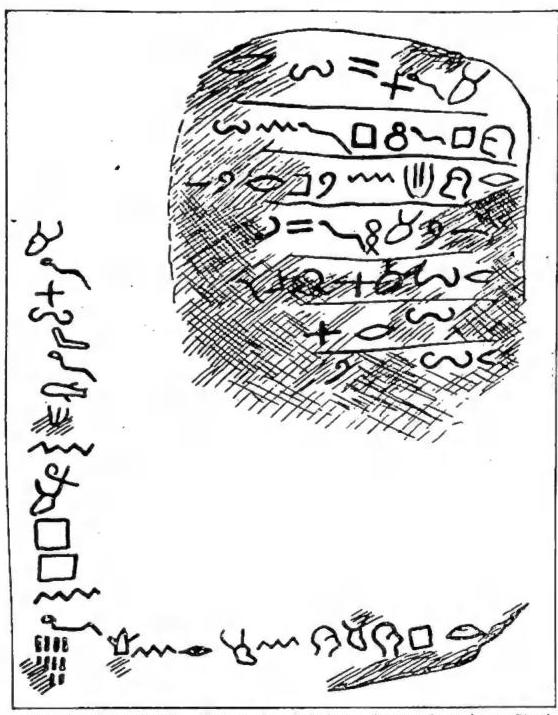
SINAITIC, INSCRIPTIONS — nos. 349 and 357 in the design by W. F. Albright.
The Çebel Mûsâ, called by the Arabs Çebel et-Tûr “the mountain par excellence,” represents the traditional Mount Horeb. Nearly rectangular in shape, oriented from northwest to southeast, about 3,200 m long and 1,600 m wide, it has at its extremities the two highest peaks: the Râs es-Safsâf (1,194 m) to the north and, sharing the mountain’s name, the Çebel Mûsâ (2,244 m) to the south. It is separated from the surrounding mountains by deep wadis: ed-Dejr to the northeast, es-Sabâ'ijjeh to the south, el-Legâ to the southwest, and by the plain of er-Râhâh to the north. This plain, which the Çebel Mûsâ overlooks by only 644 m, is traversed by wadis and irrigated by springs; it is about 1,200 m long and 900 m wide, with ample pastureland. It is identified with the midhbar Sinai (Ex. 19:2; Num. 1:1; 35:15), from which the people witnessed the divine proclamation of the Law. Steep cliffs prevent ascent to the mountain (Ex. 19:12, 13, 23); at two-thirds of its height lies a plateau where Aaron could stop with the seventy elders (ibid. 24:9); on the summit’s face, a cave provided shelter for Moses (ibid. 24:18) and later for Elijah (1 Kings 19:8).
This identification, besides satisfying the topographical requirements of the biblical narrative, is supported by an unbroken Christian tradition. The pilgrim Egeria (q.v.), who visited the holy mountain in 395 and collected all the indications given her by the monks, states that the name of Sinai designates not only the entire mountain system but especially a mountain with two peaks, both marked by oratories: the first in memory of the divine theophany, the second in memory of the rock of Horeb. She adds that this mountain is 35 miles from Pharan, a distance that exactly corresponds to that from Pharan to the Çebel Mûsâ.
In the 6th century, the Nestorian monk Cosmas Indicopleustes (q.v.) departed from the common tradition, arguing for the identification of Mount Sinai-Horeb with the Çebel Serbâl in the region of Pharan. He reasoned from the then-current opinion that the oasis of Fejran represented Raphidim (q.v.), deducing that Horeb-Sinai must lie nearby. However, this identification, still favored by some modern writers, poorly matches the topography of the biblical narrative: the mountain is nearly inaccessible and lacks beneath it a broad plain capable of containing a multitude of people. Most exegetes place Raphidim at Erfâjid, along the route to the Çebel Mûsâ. Recent hypotheses that locate the sacred mountain north of the Sinai Peninsula or nearby—whether in the oasis of Kadesh, the region of Petra, or the volcanic areas east of the Gulf of el-'Aqabah in northern Arabia—have failed to gain acceptance against the traditional identification.
MONASTERY and BISHOPRIC of SINAI — The great monastery of St. Catherine, located at the foot of Mount Sinai, was founded by the Emperor Justinian I; it was dedicated to the Mother of God, but from the 14th century it took the name of St. Catherine (q.v.), whose relics are venerated there.
It has been governed by an igumen (abbot) who, since the 9th century, has also been a bishop and later honored with the title of archbishop. A group of monastic establishments is subject to this great monastery, which may be described as having an international character, as evidenced by the pilgrimages of the patristic age, the Middle Ages, and recent centuries, prompted by biblical memories and the cult of St. Catherine; by the many letters of the popes, the gifts of princes, the offerings of the faithful, the extent of monastic possessions, and finally by the cultural treasures of codices, charters, and images. The popes granted many favors to the monks of Sinai from the time of Gregory the Great onward. Honorius III, Gregory X, John XXII, Innocent VIII, Julius II, Leo X, Paul III, Pius IV, Gregory XIII, Paul V, Urban VIII, Innocent XII, and Clement XI wrote letters in favor of the monastery of Sinai—letters of protection, of indulgences, or of charitable benefaction—still preserved today; two concern the appointment of cardinal protectors by Innocent XII and Clement XI.
The igumen of the central monastery has enjoyed and continues to enjoy a certain autonomy. Today, about fifty monks, dispersed among the various Sinai establishments, depend on the abbot-bishop: St. Catherine, Pharan, Tor, Suez, Cairo, Asmara, Tripoli in Syria, Kyrenia, Paphos, Rizo Karpasso on the island of Cyprus, Candia (Heraklion), Chania, Messara, Spileotissa on the island of Crete, Zante, Chios, Ioannina, Constantinople, and Athens. Even today, many manuscripts are preserved at Sinai: 2,280 Greek, 580 Arabic, 276 Syriac (of which 15 are dispersed), 5 Palestinian, 98 Georgian (of which 8 are dispersed), 41 Slavic (including 1 Latin), and 6 Ethiopic; in addition, more than 2,000 diplomas, scrolls, and firmans in Arabic and Turkish. Research on Latin documents is still ongoing. Besides the codices, icons are also preserved, and in the church a famous mosaic. — See pl. XLI.
Greg. Papamichael, 'Η μονή τοῦ ὄρους Σινά, Athens 1932; G. Hofmann, S. und Rom. in Orientalia christ., 9 (1927), 213–30; K. Amantos, Σιναίτικα μνημεία ἀνέκδοτα, Athens 1928; M. H. L. Rabino, Le monastère de la Ste Catherine du Mont S., Cairo 1938; G. A. Soteriu, Icones byzantines du monastère du S., in Byzantion, 14 (1939), pp. 325–37; G. Garitte, Expédition paléograph. au S., in Le Muséon, 63 (1950), pp. 119–21; G. Hofmann, Lettere pont. edite ed inedite intorno ai monast. del Monte S., in Orient. christ. period., 17 (1951) 283–303. Giorgio Hofmann