
SIN. – Name of three biblical localities.
1. Desert (Hebr. Sin) crossed by the Israelites on their journey from Elim Raphidim (v.) and Sinai (Ex. 16, 1; 17, 1; Num. 33, 11).
It probably corresponds to the sandy plain of Debbet er-Ramleh, which extends in the interior of the Sinai Peninsula at the foot of Gebel et-Tib. The identification with the plain of el-Markhah on the western coast or with the desert of el-Qā'ah along the southern coast of the Sinai Peninsula, proposed by ancient and also modern pilgrims, does not seem to satisfy the topographical requirements of the text, which places S. between Elm (= Wādi Garandel) and Sinai.
2. City, fortress of Egypt, mentioned only by Ez. 30, 15-16; situated in the Delta, but of uncertain identification. The Septuagint transliterated it in V. 15 as Σάς, a city northwest of Bubaste, but one that was never an important stronghold. In V. 16 they identified it with Σάγη, perhaps having read Sin, an abbreviation of Sēwēh, that is, Syene, on the borders of Ethiopia, today Assuan at the First Cataract, and which could therefore be called the fortress of Egypt. The Vulgate transliterated it as Pelusium, a fortified port at the eastern extremity of the Delta, whose capture was necessary for invaders coming from the north-eastern desert.
3. Desert (Hebr. Sin) that marked the southern frontier of Canaan, crossed by the explorers in the Promised Land (Num. 13,21). Cades-Barne was included within the boundaries at the south-western edge of the desert (ibid. 20,1; 27,14; 33,36; Deut. 32,51); it bounded Edom on the west and the tribe of Judah on the south-east (Jos. 15, 1-3). The name seems to have been preserved in the southern region of Palestine, in the Wādi eş-Sinī and the Ard eş-Sinī.
DINAGOGA. - A place of "assembly" for prayer and sacred reading in post-exilic Judaism. The Greek term συναγωγή ("assembly") in the Septuagint generally translates the Hebrew words 'ēdhāh and qāhāl, which have no connection with a place of prayer, a designation that only in later times came to be called s.
By the time of the New Testament, the Greek term προσευχή = "oratory" was used in this sense (cf. Acts 16:13; Philo, Legatio ad Caium, 165; Juvenal, Sat. III, 269; Flavius Josephus, Antiq. Iud., XIV, 258); while the term s. was employed to denote a group of Jews organized for particular purposes, similar to a collegium. In the same city, there could be several s. (cf. Acts 6:9); in the Jewish community of Rome at the beginning of the Common Era, at least 13 are recorded, each
distinguished by a special name referring to benefactors, the neighborhood, ethnic characteristics, etc. Each of these s. had its own place of prayer (προσευχή), to which the originally generic term s. was later reserved (Hebrew bêth hênêseth; Aramaic bêth hênlîtâ) or simply hênlîtâ).
The rise of the s. marked a notable revolution in Judaism. Alongside the unique Temple of Jerusalem, these centers of more individual and inward piety emerged. Since it was impossible to offer sacrifices outside the Temple, prayer, the study of the Law, and the fostering of a life of ever greater perfection took place there. The origin of the s. is unknown, but they must have already functioned during the Babylonian exile (587-538 B.C.). At Schedia near Alexandria, the presence of such a building is attested as early as the time of Ptolemy II Evergetes (264-221 B.C.); and undoubtedly several arose in Egypt (cf. Enoch 46:8; 52:6). However, the oldest known archaeological remains do not date back beyond the 2nd century. Among the oldest and most representative are those of the s. of Sejb Abrêq, Capernaum, Dura Europos, Bejt Alfah, Bethsan, Jericho, 'Ajn Dûq, Gerasa, Chorazin, Emath, Kefr Bir'im, Aleppo.
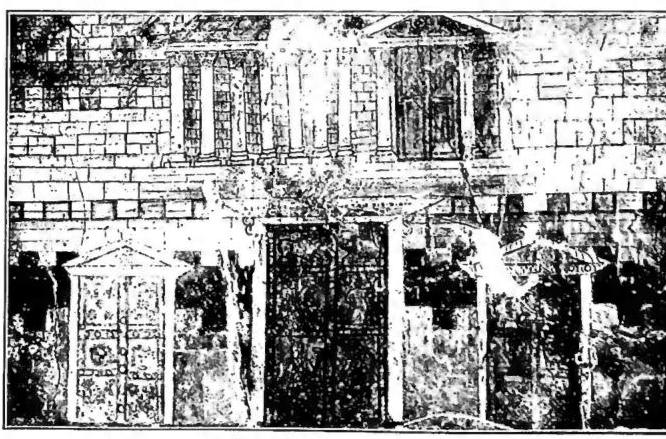
(from Du Mesnil du Buisson, Les peintures de la synagogue de Dura Eûropos, Rome 1939, pl. 33)