
ALEXANDRIA OF EGYPT
A city in Egypt, founded by Alexander the Great in 332 B.C., 14 km west of the Nile branch called Canopus on the Mediterranean shore opposite the island of Pharos (which offered the possibility of two excellent ports).
SUMMARY: 1. A. in Sacred Scripture. –
2. The School of A
3. History of the Patriarchate of A
4. The Councils of A
5. The Alexandrian Rite
6. The Armenian Diocese of A
7. A. of the Copts. – 8. Archaeology.### 1. A. IN SACRED SCRIPTURE
Located at the crossroads of Europe with Africa and Asia, A. became under the far-sighted government of the first Ptolemies one of the major metropolises of the ancient world. In the realm of the spirit, it was the heir of Athens; in commerce, the heir of Tyre, Sidon, and Carthage. Of this latter fact, a small trace remains in the New Testament, where it is read that St. Paul traveled on an Alexandrian ship when he was shipwrecked near Malta (Acts 27:6 ff.); it was also an Alexandrian ship that carried him from Malta to Pozzuoli (Acts 28:11-13).
The name of A. itself never appears in the original text of the Bible. The five mentions of A. in the Vulgate (Jer. 46:25; Ez. 30:14-16; Nah. 3:8) are due to a misunderstanding by St. Jerome, who, believing the city was founded on the site of ancient No (Thebes), replaced the name No in the Hebrew text with the name of A. (v. AMMON). However, the noun "Alexandrian" (ἀλεξανδρεύς) is found twice in Acts: 6:9 (the Alexandrians formed a distinct group in the synagogue of the Hellenist Jews in Jerusalem) and 18:24: Apollos (v.) was a Jew, Alexandrian by birth (ἀλεξανδρεύς τῷ γένει). This fleeting mention indicates what constitutes the true importance of A. for the Bible.
It was the city where, as in no other place, a very large group of Jews, in the best economic and political conditions, lived in continuous close contact with the new center of the Hellenic world, where around the gigantic library of the Museum, since 111 B.C., an intense work flourished in every field of knowledge. In A., from its foundation, the number of Jews was very significant and grew to the point that two of the five districts were considered and called Jewish. Favored first by the Ptolemies and after the Roman occupation also by the emperors, the Jews lived as an independent and autonomous political community in their internal affairs, faithful to the law and traditions of their fathers. Nevertheless, the continuous contact with the dominant Hellenistic population was such that the mass of Jews, from the first century of their residence in A., forgot their sacred language and the spoken one (Aramaic). Greek became the language of daily life, also used in the synagogue, and this resulted in the necessity of translating the Bible into Greek.
This version, called the Septuagint (v.), bears the unmistakable imprint of a mentality strongly influenced by the Greek philosophical environment. The interpreters show a tendency to remove, or at least mitigate, not a few anthropomorphisms of the original text, which offended the sensibility of minds formed in the school of Pythagoras, Anaxagoras, Plato, or even the Stoa. The Greek influence on Alexandrian Judaism also penetrates the orbit of the very word of God. In II Maccabees, the word of God is clothed in all the rhetorical artifices of contemporary historiography. II Maccabees is the only work, preserved in its entirety, of Hellenistic-Jewish historiography before Christ. Of other authors, we know only the names and some more or less extensive fragments. The most important are the dry and plain Demetrius (ca. 210 B.C.), the fabulous Eupolemus (ca. 155), the fantastic Artapanus (ca. 100). More than elsewhere, within the scope of the Bible, the influence of the Alexandrian environment is manifested in the book of Wisdom (v.). Although the author remains faithful to the beliefs of his people, the surprising force, which is not found in the Old Testament, with which in the first part of his book he highlights the afterlife will also be due to the Hellenized and Hellenic environment for which he writes. In the second part of the book (chapters 6-9), the author's Greek erudition is especially manifest. In chapter 7:17-20, the author shows himself open to all the sciences that were so fervently cultivated in the metropolis of Hellenism. Divine Wisdom (7:22-8:1) is described with the terms used by the Greeks for the "Noûs" of Anaxagoras, the "Lôgos" of the Stoics, the "world soul" of the Platonists, with the evident intention of making understood through this "polemical parallelism" that the Wisdom of God is the true Noûs, the true Lôgos, the true world soul. At the same time, the terminology of popular philosophy allowed taking those terms in a broader sense, making it possible to disregard the errors originally associated with them: Platonic dualism and Stoic materialism. In the third part (chapters 10-19), which shows the work of divine Wisdom in the history of Israel, there are two significant digressions. The first speaks of God as merciful even in punishing the adversaries of His people, and this because they too are "men," a sign that in the Alexandrian Jew, the idea of the Creator of all mankind seeks to overcome the barrier of national particularism and to meet with the Hellenistic-Stoic idea of the unity of all men. The second digression is directed against idolatry and constitutes another document of the new mentality grown in the intellectual and cultural climate of A. In the polemic against the gods of the philosophers, the author investigates the reasons for errors, recognizes the aesthetic sense of the Greeks, their good will, their search for truth.
However, the Bible not only received influences from the Alexandrian environment but in turn influenced it and the Hellenistic world. Numerous pagans conformed their lives to the customs of the Jews, and the commemorative feast for the Greek version of the Septuagint was also celebrated by pagans. Thus, just as the Alexandrian version, casting new ferment into the idolatrous environment, prepared the way for the Gospel of Christ to the pagans, so it also paved the way for Christ in the hearts of the Jews themselves to such an extent that in later centuries the version of the Bible was considered in Judaism a disaster worthy of being commemorated with a day of national mourning.
A great part in this "evangelical preparation" was played by the allegorical interpretation of the Bible, a fruit not new but typical of the close coexistence between Jews and Greeks in A. From the certainty of having in the Law of Moses the only source of all religious and ethical truth and from the surprise of finding in Greek philosophy concepts of high spirituality and a very elevated morality, the desire was born to show that all the apparent crudeness in the Bible was pregnant with spiritual truths, and that all the good of Greek philosophy was also found in the Law of Moses, indeed, considering the antiquity of this law, that it was the source from which the ancient priests and philosophers, especially Plato, the great traveler, drew. The infallible means to demonstrate the identity between Greek philosophy and the Law of Moses was precisely the allegorical interpretation. With this method, the Greeks also saved their "Bible," Homer, modernizing it and finding allegorically hidden in it the deepest ideas of philosophy. The father of allegorical interpretation
7. THE ALLEGORICAL INTERPRETATION OF SCRIPTURE IN ALEXANDRIA
The allegorical interpretation of the Bible in Alexandria is Aristobulus (v.) around 160 B.C. But the figure who synthesized and far surpassed all his Philo (v.) of Alexandria, a contemporary of Jesus. The nearly complete preservation of his voluminous works still attests today to the high esteem in which this most celebrated of Alexandrian Jews was held by early Christians, particularly in that first catechetical school (Pantaenus, Clement, Origen) which became the immediate heir of the Alexandrian Jewish school and its method of allegorical interpretation of Holy Scripture.8. THE SCHOOL OF ALEXANDRIA
In a city like Alexandria, rich in so many scientific institutions and philosophical schools, it was natural that the need would also be felt to establish a higher school of religion, one that aimed more at scientific deepening and the defense and illustration of faith than at catechetical exposition. According to Philip of Side, Athenagoras would have been its first teacher, but common opinion attributes its foundation to St. Pantaenus (v.), the Sicilian bee, around 180. He Clement of Alexandria (v.), the philosopher of practical rather than speculative life (from 200 to ca. 202), then by Origen from 203 to 231, a profound scholar and bold philosopher, a most prolific writer and eloquent speaker, the other great figure of the school. Deposed for his audacious and somewhat unorthodox conceptions, he was succeeded Dionysius (v.), and others including Pierius, Achillas, Martyr (v.), Didymus the Blind (v.), who for over fifty years attracted an extraordinary number of disciples (among them Rufinus, Jerome, Palladius), admired for his learning and piety. After him, Rodon (v.) still led the school for a few years, and in the time of Theodosius transferred it to Side in Pamphylia.Little is known about the school’s organization. There was usually only one teacher, and it does not seem to have had a fixed location. The school was public, with a free audience of all ages and conditions; thus, it was hardly possible to have a fixed program, much less a teaching method. In essence, it consisted of lectures on religious and apologetic subjects. Although the school was under the bishop’s supervision and teachers were appointed by him, there nevertheless appears to have been considerable freedom of thought. The two most celebrated teachers, Origen and Didymus, were laymen. Under the influence of the Jewish environment (one thinks of Philo) and the two great early teachers, Clement and Origen, the school’s orientation was twofold: philosophical and scriptural. In philosophy, an attempt was made to penetrate Christianity as far as possible with the then-dominant eclecticism of a Neoplatonic character, to render it more modern and acceptable to cultivated pagan minds; as for the Bible, its total divine inspiration and inerrancy were always upheld, and to make it acceptable as such even to learned pagans, allegorical interpretation was practiced on a vast scale, in the same way that pagan philosophers and lecturers then treated mythology and Homeric texts, despite the fact that Origen himself inaugurated biblical studies on a very broad basis of textual criticism, an example that, however, found no followers.
Serious consequences of this philosophical contamination and unbridled allegorism manifested themselves both in the so-called Origenist errors and in the mystical tendency to deny the fact of the Redeemer’s human nature. Nevertheless, great minds nurtured in this school (such as Athanasius, Didymus, and Cyril) knew how to restrain these tendencies within limits compatible with dogma. Indeed, through the daughter school of Caesarea founded by Origen, the great Cappadocians can in part also be considered a fruit of the Alexandrian school. Through it and within it, the first attempts at a theological synthesis were made, and especially an effort was sketched to demonstrate the harmony of reason with faith beyond the narrow limits within which the apologists proper had confined themselves.
9. HISTORY OF THE PATRIARCHATE OF ALEXANDRIA
This refers to the Greek patriarchate that, after the Council of Chalcedon (451), was designated with the name Melkite (imperial) in opposition to the Monophysite Copts who did not adhere to the Byzantine emperor, supporter of that Council; today, however, the term Melkite is used for Catholics of the Byzantine or Greek rite and Arabic language wherever they may be found.1. From the introduction of Christianity to the Council of Nicaea (325). According to the reliable testimonies of Eusebius, Epiphanius, and St. Jerome, the Church of Alexandria was founded by St. Mark, disciple of St. Peter; Eusebius recounts that under Emperor Septimius Severus (193-211) there were numerous martyrs in Alexandria and in the Thebaid, that is, in southern Egypt. Christian communities existed before the Council of Nicaea in fifty nomes (districts) of Egypt, including Cyrenaica, and more than forty episcopal sees are listed. In the Synod of Alexandria of 320 (or 321), about one hundred bishops were present. Christianity had also penetrated into the villages, as we know from papyrological discoveries and later martyrological documents. Egypt must be counted among those countries of the empire where Christianity was professed by a large part of the population. Cyrenaica, the Pentapolis to the west of Egypt, had given the Church some of its first faithful (Simon; Lucius; the converts of Pentecost), as reported in the Gospels and the Acts of the Apostles. In the second half of the 3rd century, each of the five cities—Cyrene, Ptolemais, Berenice, Arsinoe, and Sozusa—had a bishop dependent on the bishop of Alexandria. Under Emperor Philip the Arab (244-49), the virgin and martyr Apollonia died in Alexandria. If the persecution of Decius in 250, as is certain, recorded apostates in Egypt, there were also martyrs, not a few of whom were soldiers, and others of various ages and social conditions. Other Christian heroes are known from the times of the persecutions of Valerian in 257, of Diocletian in 304, and of Maximinus Daia (310-12). Alongside the martyrs, the Church of Alexandria has the glory of having promoted monasticism (v.), whose principal representatives are Sts. Paul, Pachomius, and Anthony (d. 365). The vitality of the Church of Alexandria is also shown by the fact that it was able to overcome heretical crises (Gnosticism, Sabellianism, Arianism) and the Meletian schism (Meletius of Lycopolis); the victory over these errors was contributed by the Synods of Alexandria, the catechetical school, and above all excellent bishops such as Dionysius of Alexandria, the Great (264-65), Peter the Martyr (300-311), St. Alexander (312-28), and later St. Athanasius.
II. From St. Athanasius (328-73) to the death of St. Cyril of Alexandria (444). The towering figure of St. Athanasius, the most celebrated of the Alexandrian bishops, ranks among the most eminent personalities of Christian antiquity; he is the intrepid defender of the Nicene faith and ecclesiastical liberty against the imperial power that favored Arianism. He refused to readmit Arius to the Church; for this steadfastness, he was deposed by the Synod of Tyre (335) and exiled, beginning his most troubled life and having to remain away from his flock no fewer than five times (v. ATANASIO). Egyptian writers of the 4th and 5th centuries (up to the Council of Chalcedon) include, besides the great Athanasius, Serapion (after 362), rector of a monastery and later bishop of Thmuis in Lower Egypt, Didymus the Blind, a layman deprived of sight from the age of four, teacher of St. Jerome and Rufinus, Synesius of Cyrene (370 or 375 - 413 or 414) bishop of Ptolemais (ca. 410), Nonnus of Panopolis in the Thebaid, Ammonius of Alexandria, and above all St. Cyril, nephew of the patriarch Theophilus, adversary of St. John Chrysostom. St. Cyril (v.) is also a towering figure in ecclesiastical history like St. Athanasius; his activity transcended the boundaries of his patriarchate (412-44), especially due to his struggle against the heresy of Nestorius.
Regarding the ecclesiastical situation of the patriarchate of Alexandria, it should be noted that at the Council of Nicaea, the privileges of Alexandria were confirmed in canon 6, that is, the authority of the bishop of Alexandria over Egypt, Libya, and the Pentapolis, also emphasized—without, however, denying the primacy of the bishop of Rome—in canon 2 of the Council of Constantinople. Nevertheless, the rivalry between Alexandria and Constantinople persisted even after this council; Alexandria remained a great center of culture; the bishops of Egypt could intervene in municipal affairs (appointment of officials, revision of finances, maintenance of municipal buildings, etc.). Exceptional circumstances favored the influence of the patriarchs, such as St. Cyril, in civil and political matters. The honorary title of papa, which remained with the patriarchs of Alexandria, dates back to the 3rd century; the title of patriarch is attested at the end of the 4th century; the title of judge of the universe appears for the first time in the 6th century; the claims of some recent authors who trace it back to the 5th or even the 11th century do not withstand criticism; the title of archbishop was used in the 4th century by St. Athanasius.
III. From Patriarch Dioscorus to the Arab conquest (638). Patriarch Dioscorus (444-51), who sided with Eutyches (Synod of Ephesus, 449, under his presidency) and was deposed by the Council of Chalcedon (451), was banished by Emperor Marcian to Gangra (Paphlagonia), where he died in 454. However, many Egyptians, unwilling to recognize the dogmatic tome of Pope Leo I and the decisions of the Council of Chalcedon, supported by the Byzantine emperor, separated from the Catholic Church out of obstinacy, political reasons, and also the conviction of thus preserving fidelity to the doctrine of St. Cyril, forming a new Church called Coptic, while they contemptuously called Catholics melkites. The first Coptic and Monophysite patriarch was Timothy Aelurus, the second Peter Mongus (v. copti). The Greek patriarchate remained faithful to the Council of Chalcedon. Its history, however, from 452 to the present, is quite meager because Monophysitism had inflicted a grave wound on the Catholic Church, and the number of the faithful was very limited. Among the Melkite patriarchs before the Arab invasion, three saints deserve special mention: Proterius (452-57), Eulogius (580-607), and John III.
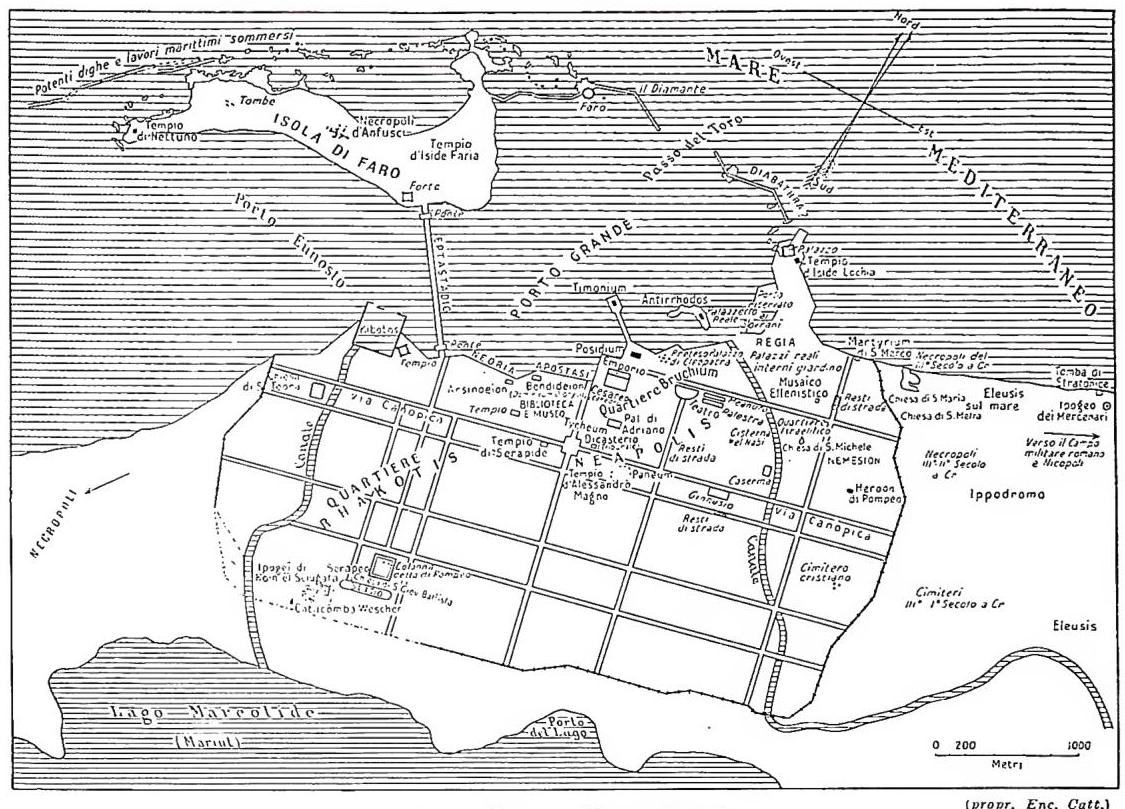
[properly Enciclopedia Cattolica]
Leontius of Neapolis in Cyprus, his friend and compatriot (John was born in Cyprus), wrote a highly esteemed biography of him. When the Persians invaded Alexandria, the patriarch, who did not benefit from the concessions granted to the Copts, retired around 619 to Cyprus. Just as the patriarchate of George (620-30) was most sorrowful due to the Persian occupation of Egypt (617-27), which caused the destruction of churches and monasteries and the deportation and martyrdom of Christians, so too was the patriarchate of Cyrus (630-43) unhappy. During this period, the Arab invasion occurred (638); then the new movement of Monothelitism, which, in the person of Cyrus—protected by his colleague Sergius of Constantinople—seriously threatened to win over other figures to its heresy. In Alexandria, two saints, great champions of Catholic orthodoxy, Sophronius and Maximus the Confessor, vigorously opposed the nefarious doctrines of the patriarch. Of the situation of the Greek Church of Alexandria on the eve of the Arab occupation, which was to last nearly nine centuries, we can form an idea by considering that this Church, once so flourishing under Athanasius and Cyril, after the formation of the Monophysite Coptic Church and the Persian invasion, numbered barely 200,000 faithful, belonging to the circles of officials, soldiers, and merchants—that is, to the "foreigners"—while the "indigenous" Coptic Church commanded the imposing number of approximately 5-6,000,000 (nearly the entire native population). Even Ethiopia, which had received its first bishop, Frumentius, from St. Athanasius, had withdrawn from the Greek Church of Alexandria and submitted to the Monophysite Coptic patriarchate. The at least external union between the followers of Patriarch Cyrus and the Monophysites on the basis of Monothelitism remained sterile.
**IV. From the Arab occupation (638) to the Turkish conquest (1517).** — While the Copts welcomed the Arabs as liberators and soon received a public legal status, the Melkites, as friends of the Greek troops, suffered under the new rulers. Moreover, as mentioned above, their patriarch was a Monothelite, as was his successor Peter II (643-652); after his death, the patriarchal see remained vacant for 73 years. The faithful, greatly reduced in number due to emigration or flight, had as pastors simple bishops subject to the metropolitan of Tyre or, more precisely, consecrated in Tyre. Almost all their churches passed into the hands of their adversaries, who turned them into mosques and Monophysite temples. Under Caliph Hisham (724-743), the Greek Church of Alexandria was able to reorganize; the illiterate Cosmas (727-767) became patriarch, succeeded by the physician Politianus. Consoling was the abjuration of the Monothelite heresy by Patriarch Cosmas in 743, the participation of the Church of Alexandria in the Sixth, Seventh, and Eighth Ecumenical Councils, and the Church’s struggle against Iconoclasm. In the Photian controversies, the patriarch of Alexandria, Michael I (859-871), followed their various developments; he received a letter from Pope Nicholas I (written on 18 March 862) and shared the viewpoint of the Byzantine patriarch Ignatius during the Eighth Council, through a legate; however, in 879, his successor Michael II, in another legation, supported Photius’ cause after Ignatius’ death, while Photius, according to a highly probable opinion, was moving toward agreement with Pope John VIII. It is not known what role the patriarch of Alexandria played in the struggle of Patriarch Cerularius, but it seems that from the 12th century, the Greek Church of Alexandria drew closer to the Byzantine Church separated from Rome, since Patriarch Mark II (c. 1195) had addressed a series of canonical questions to the patriarch of Antioch (residing in Constantinople), Theodore Balsamon. However, we have a letter from Patriarch Nicholas I (c. 1210) to Pope Innocent III, in which he describes the most sorrowful situation caused by the persecution inflicted on his Church during the Crusades by the Muslim rulers; the Pope responded with consolatory letters. In 1367, Patriarch Niphon, together with his colleagues of Constantinople and Jerusalem, wrote a peaceful letter (of union?) to Pope Urban V, who responded with great charity. On the occasion of the Council of Florence, Patriarch Philotheus associated himself with the union at least until the year 1443. In the 15th century, the Church of Alexandria under Mamluk rule was very small, nor did the Coptic Church have many faithful in Egypt. Were it not for the so-called fondachi with consular protection in some Egyptian cities, the Christian citizens of various Western powers and the Byzantine Empire residing in Egypt would have been even more harassed. The fate of the Greek patriarchate of Alexandria worsened after 1517 regarding its independence from the Greek patriarchate of Constantinople, but in some sense, there was an improvement in the face of Turkish power, the new master of Egypt. One would have to await the political action of Mohammed Ali, the founder of modern Egypt (1806-1849), to see the Greek patriarch of Alexandria begin to free himself from the predominant influence of the Phanar.
**V. From the Turkish conquest (1517) *to the present day.*** — Patriarch Joachim Pany (1487-1567), who under the Mamluks had often faced tragic difficulties, was able to begin a new phase under Sultan Selim...
Under the less unhappy circumstances that followed, he—born in Athens—had fled that city when it fell to the Turks and had taken refuge in the monastery of Mount Sinai. Elected patriarch, he resided in a monastery in Cairo; in A. there were then four Christian churches, all or largely dependent on him. After the capture of Cairo, which cost the lives of many citizens, he was able to contribute to improving the situation due to the changed political circumstances and his relations with the Russian court. According to a seemingly accurate manuscript note, he would have reached the age of 119. His successors Silvestro (1569-90), Meletius Pegas (1590-1601), and Cyril Lucaris (1602-20) were, as Cretans, subjects of the Republic of Venice and could thus secure the protection of this then-powerful state for themselves and for the good of their patriarchate. During their ecclesiastical governance, the latter two exerted their influence, especially against the union of the Ruthenians with the Catholic Church. Cyril Lucaris became patriarch of Constantinople in 1620. Relations with Russia, begun under Patriarch Joachim Pany, were developed in the 17th and 18th centuries; the relations of the patriarchate of A. with other Churches (Anglican, etc.) and with the Catholic Church will be discussed later. The patriarchs Gerasimus Spartaliotes (1620-39), who sent his protosyncellus Joseph to Moscow for the translation of Greek works into the Russian language; Paisius (1657-77), who participated in the Synod of Moscow that deposed Patriarch Nikon and promoted higher studies in Russia; and others who sought alms from the wealthy tsars had particular relations with Russia. When the struggle for Hellenic independence began in the early 19th century, the patriarchs of A., Theophilus I (1805-25) and Hierotheus (1825-45), dared to involve themselves in this politics. It should be noted that the patriarchs of this period established their residence in Constantinople, which contributed to making the patriarchate of A. highly exposed to the influence of the Phanar. This abnormal situation ceased in 1846; the Church of A. then counted only ten churches and two monasteries. Patriarch Sophronius IV (1870-99), formerly patriarch of Constantinople, earned great merit for the organization of ecclesiastical finances and for the erection of new churches, chapels, and charitable institutions. Patriarch Photius (1900-1925) founded the two journals Ekklesiastikos Pharos and Pantainos; Meletius IV (1922-33) published statutes in 1934 regarding the election of the patriarch, founded an ecclesiastical seminary, and had the manuscripts and books of the library of Cairo transferred to the patriarchal library in A. It is worth noting that in 1937 an agreement was stipulated between the patriarch and the Ministry of Nahas Pasha regarding the election of the patriarch. A most difficult problem remains for A.: eliminating the rivalry between recently immigrated Greeks and Syrians, as the new immigration of both groups has completely changed the situation of the Greek patriarchate.
VI. Relations of the Patriarchs of A. with Anglicans, the "Non-Jurors," and Other Non-Catholics. — Patriarch Cyril Lucaris sent Metrophanes Kritopoulos in 1616 with a letter to the Anglican archbishop Abbot of Canterbury to pursue literary and theological studies in that kingdom; on another occasion, when he was no longer patriarch of A., he wrote again, sending along with it a precious gift for King Charles I: the celebrated codex of Holy Scripture known as the "Alexandrinus," now in the British Museum. Metrophanes Kritopoulos, after studying at Oxford, visited several Protestant universities in Germany on his return and composed on that occasion the well-known Homologia ("Confessio fidei"), which in some points approaches Protestant doctrine. Returning to A., he became metropolitan of Memphis and in 1636 patriarch of A. He died in Wallachia in 1639.
When Patriarch Samuel Kapasoules of A. sent Metropolitan Arsenius of Thebes to England in 1716 to seek money for his debt-ridden patriarchate, the Anglican sect of the "Non-Jurors" (opponents of the oath) took the opportunity to initiate union projects sponsored by Tsar Peter I, but these were rejected by the Greek patriarchs in 1718 and 1723. The patriarch Photius participated in the Stockholm conference and died on his return in Zurich on 4 September 1925. Anglican ordinations were recognized by the patriarch of Alexandria in 1930.
VII. Letters of the Patriarchs of A. to the Roman Pontiffs and the Roman Curia. — There can be no doubt that Cyril Lucaris wrote a letter to Pope Paul V on 28 October 1608 in which he openly declared his submission to the Supreme Pontiff on the basis of fidelity to the Roman Church. The only question that remains is whether Lucaris wrote this letter with complete insincerity, with a "syncretistic" mentality, or with momentary sincerity while later failing to remain faithful to his word given to the Pope. Another patriarch of A., Samuel Kapasoules, made a profession of Catholic faith twice, on 6 June 1712 and 19 June 1714. However, contradictory contemporary accounts exist regarding his perseverance in the Catholic faith, so much caution is necessary in deciding one way or the other regarding the resolution of this thorny question. Letters of courtesy were addressed by Metrophanes Kritopoulos (on 20 January and 25 May 1637) to Cardinal Prefect of the Sacred Congregation of Propaganda, Antonio Barberini, to obtain the admission of his two nephews into the Greek College of St. Athanasius in Rome, a request to which the cardinal assented. Patriarch Gerasimus Palladas wrote three letters to Pope Clement XI, on 28 November 1703, 25 May 1704, and in February 1712; all three letters are recommendations or supplications on behalf of certain individuals. Finally, Patriarch Cosmas III Kalokagathos complained in a letter to Pope Clement XII, dated 4 July 1738, about Latin missionaries; in a letter to the Congregation of Propaganda on 17 July 1738, he successfully requested the admission of a boy into a pontifical institute. The oeconomus of this patriarch, Archpriest Abdalla, subscribed to the profession of faith according to the formula of Urban VIII in the presence of Monsignor Giuseppe Simone Assemani and another Catholic priest on 21 July 1738.
VIII. Statistics of the Melkite Church of A. — The Greek patriarchate of A. has two patriarchal residences, namely in A. (Monastery of St. Sabas) and in Cairo (Monastery of St. Nicholas); nine metropolises: Tripoli, Leontopolis, Pelusium, Aksum (Ethiopia), Ptolemais, Nubia (Sudan), Hermopolis, Ioannopolis, Carthage, with 94 churches, a clergy of 110 members, 52 communities, 90 schools with 570 teachers and 15,000 pupils, and numerous charitable institutions.
BIBL.:
A. Palmieri, Il patriarcato di Alessandria, in Enciclopedia Ecclesiastica, I, Milano 1908, coll. 765-770; G. Hofmann, Cyrillus Lucaris und seine Beziehungen zum Abendland, in Orientalia Christiana, XI, 1928, pp. 243-280; id., Il patriarcato di Alessandria e la Chiesa russa, in Orientalia Christiana Periodica, V, 1939, pp. 359-380; id., Il patriarcato di Alessandria e la Chiesa anglicana, ibid., VI, 1940, pp. 113-136; id., Il patriarcato di Alessandria e la Chiesa cattolica, ibid., VII, 1941, pp. 129-152; G. de Jerphanion, Les relations du patriarcat d'Alexandrie avec les Anglicans, in Échos d'Orient, XXVIII, 1929, pp. 129-144; P. Bacel, Le patriarcat grec-melkite d'Alexandrie, in Revue de l'Orient Chrétien, XXX, 1935-36, pp. 113-132; V. Laurent, Le patriarcat melkite d'Alexandrie de 1517 à nos jours, in Revue des Études Byzantines, II, 1944, pp. 179-207.
G. Hofmann S.J.
(Ist. Eur. Catt.)
Giorgio Hofmann
10. THE COUNCILS OF A
Among the councils held in A. during the first four centuries, the following are noteworthy:1) Two councils convened against Origen by Bishop Demetrius in 231 (and not in 223, as Baluze claimed). Origen, still a simple layman but celebrated throughout the world for his writings, had himself ordained a priest by Bishop Theotistus while passing through Caesarea in Palestine. This irritated Demetrius, who reproached him upon his return to A., reminding him of his voluntary mutilation: indeed, the practice of the Church of A. was probably opposed to the ordination of eunuchs. Moreover, and this was the principal accusation, Origen had recently published the famous work De Principiis (Περὶ ἀρχῶν), in which bold and erroneous novelties appeared. A first council was then assembled, attended by bishops and priests, where Demetrius deprived Origen of the right to teach and excluded him from the clergy of A.
Soon afterward, in the same year, another council was held, composed exclusively of bishops, in which Demetrius deposed and excommunicated Origen. The sentence was set forth in a synodal letter sent to the bishops of Egypt and even to all Catholic bishops, if we credit an obscure passage in which St. Jerome attests that Rome also ratified the condemnation. Certainly, it was not accepted by the bishops of Palestine, Arabia, Phoenicia, and perhaps not even by those of Cappadocia. But the question remains shrouded in obscurity to this day (cf. Eusebius, Hist. eccl., VI, 8; Rufinus, Apologia, 2, 20; Hefele-Leclercq, I, pp. 156-59).
II. Two councils convened in 263 under Bishop St. Dionysius. The first condemned Sabellius, the second the millenarians Nepotianus and Cerinthus, who asserted the necessity of bloody sacrifices (cf. Fabricius, Bibliotheca Graeca, ed. Harles, XII, Hamburg 1809, pp. 366-67). Hefele does not mention these two councils, perhaps because their existence has not been sufficiently proven. We do know, however, that Dionysius, in condemning Sabellius, seemed to fall into the opposite error, later called Arianism; consequently, denounced in Rome, he was compelled to explain himself.
III. The Council convened by St. Peter of A. around 306 against Meletius, Bishop of Lycopolis, during a truce in the persecution of Diocletian. Very wise rules were promulgated concerning the reconciliation of those who had apostatized in the first period of the persecution, of which only the canons on apostates published by P. de Lagarde, Reliquiae juris ecclesiastici antiquissimae, Leipzig 1865, pp. 63-73, 99-117 (Greek text with Syriac translation), remain. Meletius was so embittered by this that he provoked a schism, organizing a separate Church (cf. A. d'Alès, Le dogme de Nicée, Paris 1926, pp. 203-242).
IV. The Council convened by Bishop Alexander against Arius in 320 or 321 (not in 315), following the contradictory conference in which Arius himself and his opponents had expounded their respective doctrines on the Trinity. Alexander, presiding over the council, declared Arius’s thought heterodox and ordered him to renounce II. Arius refused, and the Council of Egyptian bishops condemned and excommunicated him along with all his followers, among whom were two bishops, Secundus of Ptolemais and Theonas of Marmarica, five priests, and six deacons (v. ARIANESIMO; ARIO); cf. St. Alexander, Depositio Arii: PG 17, 571 ff.V. The Council of 324, convened through the efforts of Hosius of Córdoba, sent to A. by Emperor Constantine—of whom he was the ecclesiastical advisor—to extinguish the affair of Arius, still in its early stages, and put an end to the earlier schisms of that Church. In addition to the Meletian schism, which still persisted, another erupted precisely because of Arius. A certain Kolluthos, a priest of A., believing that Bishop Alexander had shown excessive leniency in dealing with Arius, had separated from him and formed a schismatic group; moreover, though merely a priest, he had the audacity to ordain other priests, including the notorious Ischyras, with whom St. Athanasius would later have to contend.
The Council also examined the Paschal controversy and the question of the Quartodecimans, without resolving them, just as it did not resolve the matter of Arius. However, it succeeded in suppressing the Kolluthian schism by annulling the ordinations performed by its author. Regarding this council, we have little more than scant details from St. Athanasius in the Apologia contra Arianos (64-65).
VI. The Council of 338 or 339, convened by St. Athanasius before his journey to Rome, where Pope Julius had summoned him to re-examine his trial. The assembly numbered around a hundred bishops, all dependent on A.; in it, the accusation leveled by the Eusebians against St. Athanasius—that the holy prelate had misappropriated the grain Constantine had given to the widows of Egypt and Libya—was declared unfounded. The synodal letter, a true apology for a steadfast defender of the Council of Nicaea, was sent to Pope Julius and to Emperors Constantine II, Constans, and Constantius (cf. St. Athanasius, Apologia contra Arianos, 5, 7-9, 18).
VII. The Council of 362, called by St. Athanasius upon his return to A. after his third exile, at the beginning of the reign of Julian the Apostate. This assembly held particular importance, not for the number of bishops who participated (only 21), but for their quality, the nature, and the efficacy of the decisions taken there. Present were not only the Egyptians but also representatives from other parts of Christendom, all persecuted and exiled for the faith of Nicaea. Among them were the Palestinian Asterius of Petra, the Italian Eusebius of Vercelli, and some representatives of Lucifer of Cagliari, Apollinaris of Laodicea, and the priest Paulinus, leader of the Eustathian community of Antioch.
Rightly did Rufinus call this gathering "the Council of the Confessors." The Fathers issued important decisions of a disciplinary and doctrinal nature. Regarding the disciplinary question, they showed considerable indulgence toward bishops who had failed in their duty during the Arian persecution by subscribing to one of the numerous formulas successively imposed by Emperor Constantius. The leaders and defenders of heresy were subjected to penance and reduced to lay communion. As for those who had yielded to violence or been deceived—and they were the majority—the Council preserved them in their dignity after they subscribed to the Nicene formula.
Regarding the doctrinal question, the Council, guided by Athanasius, understood the situation very well. Indeed, it tolerated the terminology of many orthodox who used the word hypostasis (ὑπόστασις) in the sense of persona, while others, in accord with Western terminology, made it a synonym of essence or substance (οὐσία). After explanations, it could thenceforth be said that in God there were three hypostases. The divinity of the Holy Spirit was explicitly affirmed against the heresy of the Pneumatomachi, a logical consequence of primitive Arianism. The nascent heresy of Apollinaris and the Christological dualism of Diodorus of Tarsus were discreetly condemned, without naming the authors.
All the work of the Council was gathered in a synodal letter addressed to the faithful of the Church of Antioch, then divided into three factions, whence the name Tome of the Antiochenes. The letter was undoubtedly drafted by St. Athanasius and forms part of his works (PG 26, 793-810).
The decisions of the Alexandrian Council were generally adopted by the orthodox, not only in the East but also in the West, at least those concerning discipline. Pope Liberius approved them around 360; only the fiery Lucifer of Cagliari rejected them all and thus fell into schism (cf. Hefele-Leclercq, I, pp. 963-969; G. Bardy, in Histoire de l'Église published by A. Fliche-V. Martin, Italian trans., III, Turin [1940], pp. 243-52).
Martino Jugie
11. THE ALEXANDRIAN RITE
12. History
Born in the capital of Egypt at the dawn of Christianity, the Alexandrian rite developed slowly in the time of Clement of A. and Origen, and reached near maturity after St. Athanasius, thanks to the monasticism of the desert, although in the 4th and 5th centuries there was still room for local rites, not entirely supplanted by that of the patriarchal city. Through the work of St. Frumentius, it was brought to Ethiopia. The uniformity that the strong centralization of the patriarchate could have imposed more easily than elsewhere was never achieved due to the Christological struggles of the 5th and 6th centuries; indeed, alongside the rite of the Church of orthodox faith and Greek language, another rite emerged from it, proper to the dissenting Church, more numerous, of Monophysite faith and predominantly Coptic language. Preserving the common foundation, the primitive Alexandrian rite thus developed further in three different forms: the Greek, the Coptic, and the Ethiopian, not without mutual influence. After the Arab conquest, the orthodox lost all authority and, ever fewer in number, leaned more on Byzantium; the rite was so affected that it eventually became entirely Byzantinized. This was the work of long centuries; finally, the negative response of the Byzantine canonist Theodore Balsamon to the patriarch of A. regarding the use of the liturgy of St. Mark (end of the 12th century) marked the death of the Alexandrian rite in Greek language and orthodox doctrine (PG 138, 953). Moreover, the small number of Egyptian orthodox accepted the Arabic versions of the Byzantine liturgy made by the Melkites of Syria in the 17th century.Of the Alexandrian rite that disappeared in the 12th century, we possess a certain number of documents, most important for the history of liturgy.
The Mass. - The Liturgy of St. Mark is the genuine and characteristic Mass of A.; with the same Ordo communis (that is, the fixed parts of the Mass) two other anaphoras were used, that of St. Basil and that of St. Gregory the Theologian, coming from Asia Minor; instead, the Sacramentary of Serapion, bishop of Thmuis, and the incomplete anaphora found in the papyrus of Dêr Balizeh are also Egyptian, but of provincial origin and use only. Of other Mass formularies, fragments remain too fragmentary to increase our knowledge of the rite. The Liturgy of St. Mark has come down to us in five manuscripts, late (12th-16th centuries), more or less contaminated by Byzantine influence (cf. C. A. Swainson, The Greek Liturgies, Cambridge 1884, pp. 1-73); the Strasbourg papyrus (4th-5th centuries; cf. M. Andrieu and P. Collomp, Fragments sur papyrus de l'anaphore de s. Marc, in Rev. des Sciences relig., 8 [1928], pp. 489-515), and that of the John Rylands Library (6th century; cf. C. H. Roberts, Catalogue of the Greek and Latin Papyri, III, Manchester 1938, n. 465) contain precious but only fragmentary texts of the anaphora. There is thus a real difficulty in presenting this Liturgy, especially in the part of its Ordo communis, as it was in the time of its flourishing.
The general structure is that of the Christian sacrifice in any rite: at the beginning, the preparation of the celebrant, the altar, and the oblations, then the scriptural readings interspersed with chants and orations, and after the Gospel, the great supplication: all this forms the Mass of the Catechumens. With the three solemn orations for the Church, the hierarchy, and the assembly of the faithful, the transfer of the oblations to the altar, the kiss of peace, and the recitation of the Creed, everything is ready to begin the great Eucharistic prayer. This consists of the parts
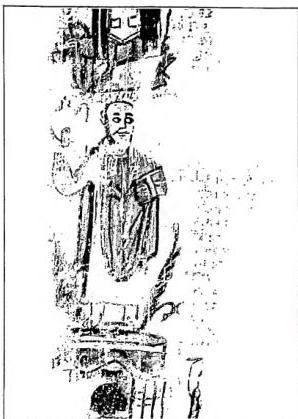
ALESSANDRIA - Bishop Theophilus (4th century) in sacred vestments. Papyrus from the Golenishchev collection (4th-5th century).
the usual parts, but in an order, particularly regarding the prayer of intercession, that is entirely unique; after it, the fraction, the Pater Noster, and the manual acts prepare for Communion. The thanksgiving, the blessing, and the dismissal conclude the holy Sacrifice.
The Liturgy of St. Basil and that of St. Gregory have been handed down to us only in the Greek-Arabic manuscript
(Graec. 325 of the National Library of Paris, 14th century; cf. Renaudot, I, 127-65). Of the Ordo communis and the Mass of the Catechumens, there is almost nothing; the influence of the Byzantine Liturgy and that of the Syrian Liturgy of St. James is evident. Despite this, the anaphora of St. Basil presents a version quite different from the Byzantine and shorter; thus, contrary to the prevailing opinion that it is an abbreviation of the Byzantine, H. Engberding sought to prove through a meticulous analysis of the various versions of the Basilian Liturgy handed down to us in different languages, that the Egyptian version would be the primitive one, which, amplified by biblical quotations and theological thoughts by St. Basil, made its way under the name of the holy Doctor (Das Eucharistische Hochgebet der Basiliostilurgie, Münster 1931). This hypothesis has received the consent of many liturgists, though not all.
The Liturgy of St. Gregory, also ancient, addresses all its prayers to Jesus Christ, probably in reaction against Arianism. The Liturgy of St. Mark in its Coptic version was attributed to St. Cyril; the other two were also translated into Coptic; however, a Greek text exists, with an Ordo communis for that of St. Basil, which was in use in the Coptic Monophysite Church (cf. H. G. Evelyn White, The Monasteries of the Wadi'n Natrân, part I, New York 1926, pp. 200-213).
The so-called "Sacramentary" of Serapion, bishop of Thmuis and friend of St. Athanasius, is a collection of thirty prayers (cf. J. F. Funk, Didascalia, II, Paderborn 1906, pp. 158-81); each of them bears its title. The first contains the entire anaphora: the curiously duplicated order for obvious reasons of symmetry (J. M. Hanssens, Institutiones liturg., III, pp. 360-63) has suggested a second redactor; (cf. the study with definitive conclusions by B. Capelle, L'anaphore de Sérapion, Essai d'exégèse, in Muséon, 59 [1944], pp. 425-43); moreover, its epiclesis asks God, to effect the transmutation, not for the sending of the Holy Spirit but of the Logos; three other post-anaphoric prayers follow. Eleven prayers related to the Mass of the Catechumens are found only at the end of the collection. It is not to be thought that the use of these prayers ever extended beyond the diocese of Thmuis.
Particular to some region or monastery may also have been that anaphora found in a 7th-century papyrus from the monastery of Dêr Balizeh in Upper Egypt (the edition is due to Ch. Wessely, in PO 18, 424-29). Schermann wished to attribute it to the 2nd century, but today it is agreed that it does not date back beyond the end of the 4th century (cf. R. H. Connolly, in Journ. Theol. Stud., 28 [1927], p. 82). From the fragments, its structure can be reconstructed, which is that common to Eastern anaphoras, except that the epiclesis is found before the consecration.
Two, indeed, are the interesting problems posed by these Egyptian liturgies: that of the epiclesis and that of the intercession. In the anaphora of St. Mark and that of Serapion, there is, in the prayer after the Sanctus, an epiclesis in formation: an explicit request for transmutation is not yet made; in the papyrus of Dêr Balizeh, the request is already explicit. But in imitation of the Syrians and Byzantines, the anaphora of St. Mark also adopted a formal epiclesis after the Consecration, which probably took the place of another prayer that was originally found there. This prayer, which perhaps was also found in the anaphora of Dêr Balizeh, asked for the acceptance of the sacrifice on the heavenly altar
(cf. P. De Puniet, A propos de la nouvelle anaphore égyptienne, in Echos d'Orient, 13 [1910], pp. 72-76; A. Baumstark, Le Liturgie Orientali e le preghiere «supra quae» e «Supplices» del Canone Romano, Grottaferrata 1913, p. 414; id., Liturgie comparée, p. 28). This hypothesis is confirmed by two Syriac anaphoras, those of Timothy and Severus, composed in Greek in Egypt: they have preserved the prayer of acceptance that immediately precedes the epiclesis (cf. Anaphorae syriacae, I, Rome 1939, pp. 23, 71).
The prayer of intercession has an unusual place in the anaphora of St. Mark and in the Coptic anaphora of St. Cyril; it attaches abruptly, without any transition of any kind, to the first prayer of the anaphora: "Vere dignum et iustum est"; and after it, that habitual passage which mentions the Angels, the Cherubim, and serves as an introduction to the Sanctus is found again. James of Edessa (6th century) noted the place of that intercession as a peculiarity of the Alexandrian Fathers (cf. Epistula ad Thomam presbyterum, in Dionysius bar Salibi, Expositio liturgiae, in Corp. Script. Or. Christ., Script. Syri, LXIII, p. 10). Today, some authors, exaggerating the importance of this fact, make it the characteristic feature that differentiates the Alexandrian rite from every other Eastern rite. Various attempts have been made to explain that place of the intercession, and it has been asked whether that place is truly primitive (cf. A. Gastoué, V. in DACL; A. Baumstark, in Oriens Christianus, I [1901], p. 4; J. M. Hanssens, Instit. liturg., III, p. 478).
BIBL.:
A. Baumstark, Liturgie comparée, Chevetogne 1953; id., Le Liturgie Orientali e le preghiere «supra quae» e «Supplices» del Canone Romano, Grottaferrata 1913; B. Capelle, L'anaphore de Sérapion, in Muséon, 59 (1944), pp. 425-43; H. Engberding, Das Eucharistische Hochgebet der Basiliostilurgie, Münster 1931; A. Gastoué, V. ALEXANDRIE (Liturgie d'), in DACL, I, 1275-80; J. M. Hanssens, Institutiones liturgicae de ritibus orientalibus, III, Rome 1932; R. H. Connolly, The Egyptian Anaphora of Dêr Balizeh, in Journ. Theol. Stud., 28 (1927), pp. 82-85; P. De Puniet, A propos de la nouvelle anaphore égyptienne, in Echos d'Orient, 13 (1910), pp. 72-76; H. G. Evelyn White, The Monasteries of the Wadi'n Natrân, I, New York 1926; J. F. Funk, Didascalia et Constitutiones Apostolorum, II, Paderborn 1906; A. Raes, Introductio in Liturgiam Orientalem, Rome 1947; L. Duchesne, Origines du culte chrétien, Paris 1925; E. Renaudot, Liturgiarum orientalium collectio, I, Paris 1847.
A. BAUMSTARK
Sacraments and Other Rites. – Of the other parts of the Alexandrian rite in use among the Orthodox, we have scant information. The baptismal rite included the solemn renunciation of Satan, the confession of faith, the blessing of the water, the anointings, and the triple immersion; with this, the formula in the first person was used: «Ego te baptizo...». Ordination was conferred upon the deacon, priest, and bishop through the imposition of hands. From the fact that the Sacramentary of Serapion contains prayers for the oil of the sick and for the deceased, one may conclude that similar prayers existed in the patriarchal Church. A simple note remains that proves the existence of a Mass of the Presanctified of St. Mark (Renaudot, I, pp. 79 and 341). To Egypt also belongs a solemn blessing of the Nile (cf. A. Dmitrievskij, Εὐχολογία, Kiev 1901, p. 684). It is known that in the churches of the great city, the people took part fervently in the divine offices because they could intercalate troparia between the verses of the psalms, while the monks of the desert condemned such a practice as profane. In the minor hours, the Coptic rite of today sings troparia and theotokia that are those of the Byzantine rite: the connecting link between the two rites was that of the Orthodox of A. St. Cyril of A. is credited with the major hours of the Byzantine office of Good Friday. Some ancient hymns were collected by Schermann. We can gauge the number of feasts celebrated in a small city from the Synaxarium of Oxyrhynchus of the 6th century (cf. Anal. Bolland., 42 [1924], pp. 83-99). As for liturgical vestments, the oldest illustration of an omophorion and a phelonion are those worn by Bishop Theophilus in a papyrus codex of the 5th century (cf. Alexandrische Weltchronik, edited by A. Bauer and J. Strzygowski, pl. VI).
13. THE ARMENIAN DIOCESE OF A
The history of the Armenian colony in Egypt (probably engaged in commerce) dates back to the time of the pharaohs; and during the long Arab domination, the relationship between Egypt and the Armenians intensified.Around the year 1076, the first bishop of this Armenian colony appeared, which then numbered about 30,000 souls. He was Gregory Pahlav, nephew of the homonymous katholikos, called Vkaiaser (martyr-lover), who, during a visit to this colony and having noted its flourishing state, before leaving Egypt consecrated his said nephew as bishop for the Armenians. In 1922, three Armenian inscriptions were discovered in a Coptic monastery in the city of Sohag in Upper Egypt, relating to the visit of katholikos Vkaiaser.
The Armenian Catholic community in Egypt, beginning in 1849, was directed by a patriarchal vicar of the see of Cilicia. In 1885, it was erected as a episcopal see and as such continues to this day.
7. A. OF THE COPTS. – The Council of Nicaea (325) confirmed the primacy of A., and thus that patriarchate arose as second in dignity after Rome. The Council of Chalcedon (451) assigned the second place to Constantinople (can. 18), and then the indigenous Egyptians, taking the name of Copts, embraced Monophysitism and from 457 gave rise to the series of their patriarchs alongside that of the Catholic-Byzantines, also Alexandrian. In 1741, the first apostolic vicar of the Catholic Copts was appointed, and in 1899 the first patriarch was installed, who resigned in 1908. From that year, an apostolic administrator held the patriarchate until, on 9 August 1947, the new patriarch was appointed, while to the ancient dioceses of Hermopolis and Thebes was added the new one of Assiut. The Catholic faithful of the Coptic patriarchate number (1947) 65,000: the Monophysites, instead, 2 million.
14. ARCHAEOLOGY
The second city of the Roman Empire had, at the end of the 2nd century A.D., a population composed of Hellenes, among whom Christians were very numerous; it is celebrated for its catechetical school, τῆς κατηγήσεως Διδασκαλείων, a kind of Christian university, center of theology: but the information concerning its Christian community is unfortunately almost entirely literary, not monumental.Eusebius provides documentation of the persecutions that struck the Church of A. and a list of its principal martyrs. In the time of Septimius Severus: Leonidas, father of Origen, Plutarch, Serenus, Heraclides, Hero, Eraïs (according to Delehaye, she would be the Ethiopian saint Emmerayes), Potamiena, Marcella, Basilides. Under Decius: Metra, Quinta, Paula, Serapion, Julian, Cronion, Besa, Macarius, Epimachus, Alexander, Ammonaria, Mercuria, Dionysia, Ater, Isidore, Dioscorus, Nemesius, Ammon, Zeno, Ptolemy, Ingenuus, Theophilus, Ischyrion. Under Diocletian: Philoromus, Bishop Peter of A., with the presbyters Faustus, Dius, Ammonius, and the bishops Phileas, Hesychius, Pachomius, Theodore (besides Eusebius, Hist. Eccl., VI, 1-5; 41-2; VII, 11, 20; VIII, 9, 6; 10, 13; 13,5; 13,7; Clement of Alexandria, Stromat., II, 20, 125; cf. H. Delehaye, Les martyrs d'Égypte, Brussels 1923, extract from Analecta Bollandiana, 40 [1922]).
The ancient Christian burials in A. were both in the open and underground, scattered immediately to the east and west outside the city; but their destruction intensified from the 19th century to extract lime, as G. B. Brocchi noted as early as 1822 in the archaeological observations of his travel journal in Egypt.
On the coast, between Ibramich and Mustafa Pasha, in 1886, pagan, Jewish, and Christian tombs were found together with Greek and Roman sarcophagi (T. D. Néroutsos, L'ancienne Alexandrie, Paris 1888, p. 81). But there were also true Christian cemeteries. St. Peter, bishop of A., was buried εἰς τὸ κοιμητήριον (BHG, 2, 1502).
The type of Christian burial in the form of a hypogeum carved into the limestone rock is, in its structure, identical to those pagan burials by inhumation, so frequent in A.; some of these are datable to the 3rd century B.C., and Adriani believes that they do not belong to imported types but are original products of the funerary architecture of the city (Annuaire du musée gréco-romain, 1933-35, Alexandria 1936, p. 171).
C. Wescher communicated in 1865 to G. B. De Rossi the discovery of a Christian hypogeum found in 1858 toward the southwest extremity of A. with an entrance on the side of the hill; a staircase led to an apsidal vestibule, in whose walls a series of paintings in two layers could be distinguished, depicting the enthroned Redeemer, nimbed with the letters ἰς xῶς, and nearby twelve baskets full of loaves, St. Andrew (ΑΝΔΡΕΑC) carrying a plate with two fish, then St. Peter (ΠΕΤΡΟC), St. John the Evangelist, St. Mark; one then passed into a quadrangular hall with three adjoining chapels featuring paintings of angels and prophets, of whom the names of Daniel and Isaiah remain; in the corner, John the Baptist with a scroll containing in Greek the prophecy of Isaiah, quoted in Mt. 3:3 and Mk. 1:3. On the vault, winged angels prostrate themselves before the Redeemer. From this chamber one enters a vaulted gallery containing 32 loculi. De Rossi dated the paintings to the Byzantine period (Bull. arch. crist., 3 [1865], p. 57; V. Schultze, Die Katakomben, Leipzig 1882, p. 282). The scenes were restudied by Wilpert (Eucharistische Malereien der Katakomben Karmouz in Alexandria, in Ehrengabe Deutschen Wissenschaft dargebsten von Katolischen Gelehrten, Freiburg 1920, pp. 273-82), who corrected some interpretations, recognizing in one part the remains of the scene of the wedding at Cana, and affirmed the liturgical-Eucharistic character of the frescoes, last seen by Richter in 1876 and subsequently destroyed. He confirmed De Rossi’s dating, between the 5th and 6th centuries.
In 1871, a Christian hypogeum was discovered in the eastern necropolis, east of the Delta quarter; it was called Zoneina after the name of a deceased woman who died on March 19, 409 (G. Botti, Le iscrizioni cristiane di A. d'Egitto, in Bessarione, 7 [1900], pp. 270-81, inscr. no. 15; T. D. Néroutsos, op. cit., p. 82).
In 1876, east of the village of Karmuz, the hypogeum called Rufina was discovered due to an inscription found there, though not certainly Christian; it is now destroyed.
In the same year, two hypogea were discovered at Qabarry, beyond the canal; the first contains an invocation to Osiris; the second is certainly Christian: the tomb of Theodatus and Ma-Ammon with an invocation to the Lord.
In 1887, on the road to Mustafa Pasha, the hypogeum called Mustafa was found (A. L. Frothingham, Archaeological News, in American Journal of Archaeology, 3 [1887], pp. 146 and 411).
However, most of these hypogea were already destroyed by 1888.
Epiphanius (Adv. haeres., II, 2, 69, 2: PG 42, 204-205) writes that in A. many churches in the time of Diocletian often received their names not from a saint but from a donor.
The oldest church in A. of which there is record is that built by Bishop Theonas (282-300), restored by Bishop Alexander (313-26), located toward the western port (Athanasius, Apol. ad Const. imp. 15: PG 25, 613; id., De Juga: PG 25, 676). It was also called τῆς ἁγίας Παρθένου Μαρίας καὶ Θεομήνηρος (Sophronius: PG 87, 3460). Christmas was still celebrated there in the 8th century. It was transformed by the Arabs into the western mosque or Gamā'at-el-Garbjut, meaning "of a thousand columns." It was destroyed between 1798 and 1829 (E. D. J. Dutilh, Deux colonnes de l'église de Théonas, in Bulletin de la Société Royale d'Archéologie d'Alexandrie, 7 [1904], p. 55). Dominicum Dionysii: a church built by Bishop Athanasius in 370 on the site of the ancient Forum, in the bendeidion. Transformed into a mosque by the Arabs. It preserved a large number of ancient materials, including columns of cipollino and red granite, Byzantine capitals, and a monolithic variegated vase carved from a precious block of Egyptian breccia. Basilica of St. Mark: near the eastern port in the quarter called boukolia; it contained the relics of the Evangelist. In a homily attributed to St. Cyril (PG 77, 1101), mention is made of three holy virgins: Theotista, Theodota, and Eudocia, whose sacred spring was shown in the basilica of St. Mark; they were said to have been martyred at the same time as SS. Cyrus and John, also buried in the same basilica, the first a monk, the other a soldier. Patriarch Cyril had their tombs opened to transfer them to Menuthis. The basilica of St. Mark burned in 640 and was rebuilt in 680 by the Jacobite patriarch John III. In 828, Venetian merchants removed the relics of St. Mark to transport them to Venice (M. Chaine, L'église de Saint-Marc à A. construite par le patriarche Jean de Samanoud, in Revue de l'Orient Chrétien, 24 [1928], pp. 372-86). In the great church of the Tetrapylon there was an image of Jesus Christ surrounded by the Blessed Virgin, the Apostles, Prophets, and martyrs, before whom SS. Cyrus and John prostrated themselves. Sanctuary of Saturn: transformed into a Christian church by Bishop Alexander (313-26). Cathedral: built by converting the Caesareum; it was called μεγάλη ἐκκλησία ο Κυριακόν. Looted by Count Heraclius in 356, restored and reopened in 365, seized and destroyed by pagans in 366; Bishop Athanasius began its reconstruction in 368. It passed to the Jacobites in 641, to the Orthodox in 727, and was destroyed by fire in 912. Church of St. John the Baptist, whose relics were brought to A. in 396; the building stood on the Serapeum and the body of St. Anthony the Abbot was deposited there (PG 26, 971). Church of St. Michael: adapted by Bishop Alexander (313-26) from the temple of Kronos, located in the Jewish quarter. Church of Arcadius: built by Patriarch Theophilus in the place called ἀγγέλιον in honor of Arcadius, son of the emperor. Church of St. Metra: located in the eastern zone. Church of the Three Youths of Babylon: founded by Bishop Apollinaris (d. 568) in the place called Δόρυξιν. The building contained the consultation room of St. Cyrus and a relic of one of the three youths. Church of St. Victor: mentioned by Cosmas Indicopleustes. Church of St. Dorothea: mentioned by John Moschus (PG 87, 2929). Church of St. Julian, with his relics. Church of St. Serapion. Church of SS. Pierius and Isidore.
On the island of Pharos, the churches of St. Faustus and St. Sophia.
Outside A., the sanctuary of St. Menas or Abā Mīnā. At Menuthis, on the road to Canopus, stood the temple of Isis. Cyril of A., having removed the relics of SS. Cyrus and John from the basilica of St. Mark, wished to transport them to Menuthis, building a sanctuary in their honor between the seashore and a hill; it soon became a destination for pilgrims not only from Egypt and Libya but from every region of the empire. Sophronius of Damascus visited it between 610 and 620 and reported (PG 87, 3560) on over seventy miracles that occurred in his time (G. Lumbroso, Santuario dei SS. Ciro e Giovanni presso Alessandria, in Atti della R. Accademia dei Lincei, Sez. III, Memorie, III, Rome 1878-79, pp. 356-59).
St. Jerome recalls (PL 23, 65) the monastery called Metanoia, founded by Theophilus of A. on the road to Canopus; it was a Pachomian cenobium; another monastery in A. was dedicated to the popular local saint St. Victor (P. Barison, Ricerche sui monasteri dell'Egitto bizantino ed arabo secondo i documenti dei papiri greci, in Aegyptus, 18 [1938], pp. 29-148).
Regarding Christian epigraphy, Lefebvre published 57 Greek inscriptions from A.; he highlighted that the three common formulas in A. are: εὐφύγει, μνησθεῖν ὁ Θεὸς τῆς κοιμήσεως καὶ ἀναπαύσεως, εὐκρίθη (G. Lefebvre, Recueil des inscriptions chrétiennes d'Égypte, Cairo 1907). However, the inscriptions do not belong to the first three centuries; most are not earlier than the 5th century. One (no. 39) may belong to Patriarch Achillas (d. 313); no. 4 refers to a physician; no. 3 to a baker; no. 5 to a gardener.
BIBL.:
G. Botti, L'antica Alessandria, Rome 1900; T. D. Néroutsos, L'ancienne Alexandrie, Paris 1888; A. Adriani, Repertorio d'arte dell'Egitto greco-romano, Palermo 1961-66; G. Lumbroso, L'Egitto dei Greci e dei Romani, Turin 1895; E. Breccia, Alexandrea ad Aegyptum, Bergamo 1922; H. Leclercq, V. ALEXANDRIE in Dictionnaire d'archéologie chrétienne et de liturgie, I, Paris 1907, coll. 1207-1316; A. J. Butler, The Ancient Coptic Churches of Egypt, Oxford 1884; J. Maspero, Histoire des patriarches d'Alexandrie, Paris 1923; P. Barison, art. cit.; G. Lefebvre, op. cit.; M. Chaine, art. cit.
G. ORLANDI
On several occasions, G. Lumbroso and others presented to the Society of Christian Archaeology enthusiasts terracotta lamps of the so-called African type with Christian subjects originating from A.; some bear the names of saints venerated in A., either in monogram or in full. De Rossi highlighted that this type of lamp was manufactured for certain sanctuaries; pilgrims would light them during their prayers in the sanctuaries and then keep them as mementos (other examples in G. Lefebvre, op. cit., nn. 730, 732).
Numerous also are the terracotta ampullae; among these, one of the oldest bears the monogram E and St. Menas with the title MAPTYC (Bulletin de l'Institut Égyptien, 1874-75, p. 108). Other examples from A. are listed by Lefebvre (nn. 690-716).
A. was a center of artistic production of great importance until the 6th century, with workshops for stone, ivory, fabric, and miniature work: cf. J. Strzygowski, Hellenistische und koptische Kunst in A., Vienna 1902. As early as 1899, the same author had proposed (in Byzantinische Zeitschrift, 8 [1899], p. 678) to attribute to Antioch or its school the ivories of the ivory cathedra of Maximian in Ravenna, which Wulff instead believed should be ascribed to Syrian workshops established in A., defined as the cradle of Christian art. E. Baldwin-Smith, in turn, wrote The Alexandrian origin of the chair of Maximianus, in American Journal of Archaeology, 21 (1917), p. 22, recognizing in said cathedra a product of the Hellenistic tradition of A. with Syrian and Palestinian influences.
E. Weigand, however, in Kritische Berichte zur Kunstgeschichtlichen Literatur, (1930-31), p. 31, opposes this comparison with both sacred and consular diptychs of the 6th century, the latter of which were issued by Eastern consuls, thus deriving from Constantinople both the diptychs and the cathedra, which E. Capps suggests may have been executed by Alexandrian workshops existing in Constantinople. More recently, C. R. Morey establishes in A. an Egyptian center for ivory production (Gli oggetti di avorio e di osso del museo sacro Vaticano, I, Città del Vaticano 1936). E. Sjöqvist and A. Westholm recognize in the porphyry sarcophagi of St. Helena from the 2nd century and of St. Constantina from the 4th century two products of the school of A. (Zur Zeitbestimmung der Helena- und Constantinoprophage, Skrifter utgivna av Svenska Institutet i Rom, IV, I, Lund 1934). Likewise, F. Volbach sees in the lotus-leaf capitals an Alexandrian origin (Intorno ai capitelli a foglia di loto in Ravenna in Felix Ravenna, 44 [1944], pp. 124-29).
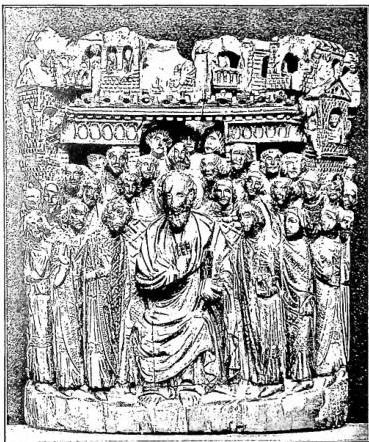
Also regarding the ivory now in the Louvre, in which Strzygowski proposed to identify St. Mark and his successors in the foreground and the city of A. in the background, Duchesne instead believed it to depict St. Paul and the city of Troad.