
NAHUM (Hebr. Nahûm “consoler”). — Seventh of the minor prophets in the canon of the Vulgate.
He was from 'Elqōš (Nah. 1:1), which St. Jerome (PL 25, 1232) places in Galilee (Driver, Cornely, Crampon); but St. Epiphanius (PG 43, 409), St. Cyril of Alexandria (ibid. 71, 780), and all modern scholars place it in Judea, as suggested by an internal examination of the book itself (Bîr el-Qaws near Bejt Gibrîn).
N. announces to Judah the ruin of its most terrible enemy: Assyria.
In chap. 1 he celebrates the power of Yahweh, just and avenging, who saves his people and strikes down their enemies. Divine justice is particularly emphasized. In chaps. 2–3 he describes the imminent fall of Nineveh, and, as a type, recalls the already accomplished ruin of Thebes (Nō'-Amôn: Nah. 3:8 ff.; cf. Ezek. 30:14 ff.; St. Jerome [PL 25, 1260] erroneously translates Alexandria popularum). These two indications make it possible to date N.’s prophecy after 663 (the destruction of Thebes by Ashurbanipal) and before 612 B.C. (the fall of Nineveh); more probably, however (Nah. 3:18), closer to the latter date (625–615).
N. was a contemporary of Zephaniah and Jeremiah. Among modern critics, the tendency prevails to distinguish in N. a psalm (chap. 1) from the prophecy; the latter is authentic, whereas the former, according to many (including A. van Hoonacker [V. BIBLICA.], p. 420 f.), would be by a later author. The arguments adduced do not appear decisive. The alphabetic character of the psalm would document its later date (but cf. the Lamentations, and Prov. 31:10–31); nor is that character certain here: it is only hypothetically deduced from vv. 1–8. Its abstract, theoretical character, in contrast with the living and concrete prophecy, is sufficiently explained by the characteristics of the subject treated.
An attempt has been made to set N. against the other prophets: N. supposedly lacks any concern for morality; but how is such a judgment possible when all that we possess from N. is this very brief oracle? (J. Touzard [V. BIBLICA.], p. 59). “N.’s poetry is exquisite; of all the prophets, he is the one who, in nobility and vigor, most closely approaches Isaiah. His descriptions are picturesque and vivid; his thought is expressed in sculptural form” (S. R. Driver).
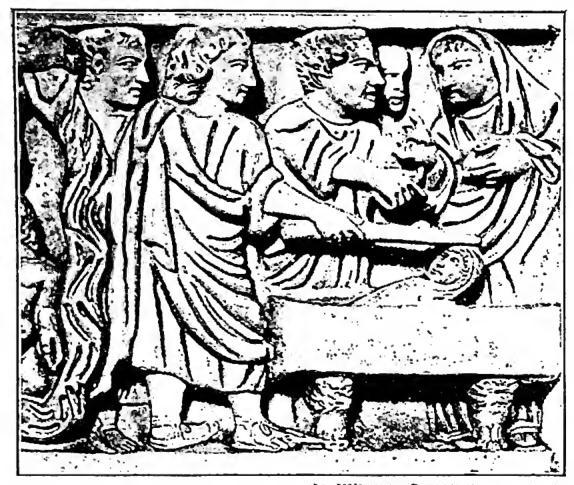
(from Wilpert, Sarcofagi, pl. 2, 3) NAIM – Resurrection of the son of the widow of N. Detail of the front of the Lateran Sarcophagus no. 183 (4th century) – Rome, Lateran Museum.