
MOSÈ (Mōšeh, Μω[θ]σῆς, Vulg. Moyses, Old Latin Moses). — Initiator of the Israelite theocracy, legislator of Israel, who governed for more than forty years as a charismatic leader with a religious-nationalistic character, Pentateuch (v.).
M.’s youth falls in the final decades of the Hebrews’ sojourn in Egypt, that is, according to the various calculations (v. CRONOLOGIA, and DBs, II, col. 916), in the first half of the fifteenth century B.C., or between the end of the fourteenth and the beginning of the thirteenth, when the “oppression” reached its acute phase, with the Israelites employed as slaves in immense building projects undertaken by the pharaohs (Ex. 1, 8-14; cf. 5, 10-23), accompanied by the xenophobia that provoked the ferocious decree, repeatedly intensified, according to which newborn Hebrew males were to be killed (ibid. 1, 15-22). This situation determined the first event in the life of M., son of Amram, of the tribe of Levi. After hiding him for three months, his mother Iochabed placed him in a basket smeared with fatty substances among the reeds of the Nile, leaving one of his sisters to keep watch; a royal princess, who had come, perhaps following a custom known to the child’s mother, to bathe, saw the little boy, had him taken up, and entrusted him for nursing to a woman summoned by the sister—that is, to the mother herself. The woman raised him and, after a few years, returned him to the princess, who gave him the name M. (Egyptian mīw, “son, boy,” cf. Thutmosis, Ahmose, etc.; in Ex. 2, 10 connected with Hebrew māšēh, “to draw out,” an allusion to salvation from the waters). The exposure of a newborn in a basket on a river is also found in an Akkadian legend of Sargon (ca. 2600 B.C.), which, however, differs so greatly in all other respects from the biblical account that the coincidence must be regarded as entirely accidental (H. Gressmann, Altorient. Texte, Berlin–Leipzig 1926, p. 234).
At court M. perhaps remained for about forty years (Ex. 2, 23; 7, 7; cf. Act. 7, 23): a period rich in experi-
ences and decisive for the cultural and spiritual formation of the thoughtful young man. There is no difficulty in admitting that from the Egyptian environment M. acquired a broad conception of all that activity which enjoyed its most remarkable flowering under almost all the rulers of the Eighteenth and Nineteenth Dynasties (v. EGITTO), among whom the pharaohs of the “oppression” and of the Exodus are to be sought: that is, the entire complex of efforts directed toward establishing strong state cohesion, laws and civil institutions, and cultural initiatives in the broadest sense, including religion. The Egyptian reminiscences that Egyptologists identify in the Mosaic institutions may in part be attributed to what M. saw during this period of his life.
Above all, the young Hebrew must have noted the contrast between the condition of his people, enslaved and defenseless, and the Egyptian people’s growing organizational progress; he felt that something had to be attempted. The Bible recalls his visits to his countrymen, employed as slaves in the grandiose building projects (of Ramses II?; cf. H. Gressmann, op. cit., pp. 106, 107). M. killed an Egyptian overseer who was mistreating the Hebrew laborers (Ex. 2, 11-12): an “act” useless in itself, but indicative of the impulses at work in the young man’s soul. The event forced M. to flee Egypt.
The second phase in the formation of the future legislator’s personality begins. From Egypt he proceeded, as others had already done for similar reasons (Sinuhe: cf. H. Gressmann, op. cit., p. 55 ff.), to the desert region beyond the eastern borders of the Delta, where there were various populations more or less related to the Semites. He came to the southeastern area of the Sinai Peninsula, where the Midianites lived. There he found shelter with one of their priestly chiefs, from the family of the Kenites (Iud. 1, 16; 4, 11), named Iethro and Hobeb (or Raguel: Ex. 2, 18; Num. 10, 29); indeed, he obtained his daughter Sephora as his wife, by whom he had two sons, Gersom and Eliezer.
One day, while he was pasturing Iethro’HEBAL (v.), the great divine manifestation took place (Ex. 3, 1-22), transforming the homeless fugitive into a leader. From a bush that burned without being consumed, a voice that presented itself as that of the “God of his father, God of Abraham, Isaac, and Jacob” charged him to go and liberate Israel from Egypt: when asked for his particular name, God revealed himself as “I am” ('ehjeh) and shortly afterward as “He is,” or Jahweh (v.). His mission was specified as leading Israel to settle in the land of Canaan (Ex. 3, 17), assigned to him as its own. To M.’s reluctance, arising from his sense of unfitness for the high office and from a speech defect, God responded by granting him thaumaturgical Aronne (v.), an able speaker, as his collaborator; indeed, he ordered him to go to Egypt immediately. Having taken leave of Iethro, M. departed with his wife and children. During the journey an event occurred, reported in excessively concise and obscure terms (ibid. 4, 24-26), commonly understood as a serious illness of M., which ended when his son Gersom was circumcised. At that time M. was eighty years old (ibid. 7, 7).
In Egypt, having gained recognition from his countrymen, M. began negotiations with the pharaoh. When the latter refused to let the Hebrews depart, M. responded with the miracle of the rod and the miraculous ten plagues (v.) of Egypt (ibid. 7, 14-12, 36). After the tenth, the pharaoh not only permitted but ordered the Israelites’ immediate departure.
The events narrated in Ex. 12-20 now begin: evacuation from Egypt, crossing of the Red Sea, and then the journey through the steppe, Sinai (v.), completed in two months along a route largely identified, in the direction of the coast of the Red Sea.
During this period various important events and incidents occurred, including, from the very day of the departure from Egypt, the institution of Passover (v.), then the ceremony following the crossing, with the performance of M.’s “song” (ibid. 15), the gathering of manna, and a first victorious clash with the Amalekites (v.). Precisely in connection with this last event we find the important statement: “And Jahweh said to M.: Write this as a memorial and impress it upon Joshua’s ears: I shall utterly extinguish the memory of Amalek from under heaven” (ibid. 17, 14).
The encampment was established in sight of Sinai (ibid. 19). M.’s plan is clear: to remain in a locality well known to him in order to organize for the remainder of the journey. There occurred there an intervention of God, one of the most prodigious in sacred history: on the third day M. ascended Sinai, where, amid terrifying phenomena, God pronounced a series of precepts, the first nucleus of the “Law.” It comprised the Decalogue (v. : ibid. 20), the first prescription concerning the altar (ibid. 20, 22-26), and the “Covenant Code” (ibid. 21-23), the basis for the conclusion of the “Covenant” (ibid. 24, 1-11), followed by the delivery of the code written on tablets of stone (ibid. 24, 12-18), later enlarged with many other laws, especially those concerning worship (ibid. 25-31).
During a prolonged absence of the leader, the people’s first apostasy took place: the erection of the golden calf as a symbol of Jahweh and the adoption of pagan cults. At this sight M. smashed the tablets, which shortly afterward, at his own request, God remade (ibid. 32). Other religious and social laws from that period and the following years are scattered throughout Leviticus and the book of Numbers.
After carrying out the first prescriptions concerning worship, including the construction of the Sanctuary and the Ark, M. ordered the departure, this time proceeding directly toward Canaan: approximately one year had elapsed since the arrival at Sinai (cf. ibid. 19, 1 and Num. 10, 11). The new period is narrated in Num. 10 ff., in the form of episodes and notes, mostly in chronological order.
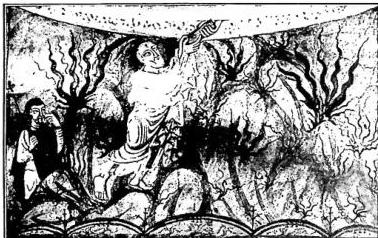
(from M. Lautier-J. Hubert, Les origines de l'art français, Paris 1917, fig. III) Moses—M. receives the tablets of the Law from God on Mount Sinai, miniature from the Bible of Charles the Bald, fol. 27 (second half of the ninth century)—Paris, National Library.
mann, op. cit., p. 25); further rebellions occurred, such as that led by Korah, epidemics, and various “faults,” including one committed by M. himself (Num. 20, 12; cf. 20, 24; 27, 14; Deut. 32, 51), in addition to the general guilt of the people, which seems to have involved a veritable apostasy from Yahweh, as well as from M. (v. NUMERI).
Before the end of the forty-year period, the survivors were reconciled with the old leader, who still had the strength to organize the resumption of the march. To avoid Edom, the great caravan descended somewhat to the south, then turned northward in a march lasting several months, through Moabite territory; it crossed the great ravines descending toward the Dead Sea, Arnon (v.), often forcing its way through with weapons, and came within sight of the Jordan. Among the most important episodes of Balaam (v.), the wars against the allied kings of all Transjordan, and the first disastrous contacts with the local cults, Beelphegor (v.). The conquered region was initially divided according to rules established by M. (Num. 32, 34).
Only the final leap remained for the completion of the undertaking: the occupation of Canaan. But because of the punishment inflicted on M. for his fault (ibid. 20, 12), his mission was complete; he therefore turned his attention to his final arrangements. He carried out a general revision of all the legislation promulgated from Sinai to Kadesh, updating and supplementing it in a series of discourses that were written down (Deut. 17, 18; 25, 58, etc.) and deposited beside the Ark (ibid. 31, 26), Deuteronomy (v.); he renewed the covenant (ibid. 28, 69), ordered the periodic reading of the Law, and finally appointed Joshua, son of Nun, as his successor. More than the laws, M. wished a summarizing song of Israel’s history, which he composed and recited at a final assembly of Israel (ibid. 31, 30–32, 43), to serve as his spiritual testament, together with a series of blessings for the individual tribes (ibid. 33). Then he climbed Mount Nebo, from which he contemplated, beyond the Jordan Valley, the plateau of Canaan, and died in that posture. He was 120 years old.
At his death, M. left an inheritance extending through all the future in its religious significance; it comprises two closely connected parts: one entrusted to writing, the other embodied in lived history.
M.’s work as author of writings that have come down to us associated with his name is the subject of Pentateuch (v.).
The existence of alphabetic writing several centuries before the period in which, however the details are fixed, M. must be placed is no longer a problem.
The account mentioned of the order given by God to M. after the war with the Amalekites directly attests that, from that time onward, it had become customary in Israel to put accounts of events into writing; and it is noteworthy that, alongside the command, “Write this as a memorial in the book” (“any writing to be kept as a remembrance”), it immediately says: “And put it in the ears of Joshua” (Ex. 17, 14). In the small nomadic group, traditions were gradually being established, but a nucleus of written documents, of an official character, was also being formed in their support, since they are said to be “for a testimony.” Numerous narrative passages in the present Pentateuch have the appearance of documents of this kind, such as the lists of stages completed in the desert, accounts of victories (Ex. 13–18; Num. 31–33, etc.), various events in relations with other peoples (Balaam, Num. 22–24; the Edomites, Num. 20, etc.), internal events of the Israelite community (Num. 11, 12, 14, 16, 20, 21, etc.), the account of the census (Num. 1–2), the first division of the land (Num. 32), etc.
With regard to the laws, the question must be differentiated, since they are generally assigned to the Mosaic period, or more specifically to the person of M. Explicit testimonies scattered throughout the “Law” compel us to hold that many prescriptions were written down from that time onward: the detail of the stone tablets for the first laws of Sinai attests this, above Decalogue (v.).
That legislative activity personally goes back to M. cannot be denied. Later tradition could not have invented this detail and attached it specifically to M. rather than, for example, to Abraham. After him no one would have possessed the authority to impose a body of laws such as that which became operative in Israel. Pentateuch (v.) reflects more the characteristics of a settled agricultural people (e.g., Ex. 21–22) than those of a nomadic people presents no difficulty: the Bedouin existence of the forty years in the desert was provisional, always awaiting stable settlement. Mosaic Israel was not simply nomadic: agriculture is already mentioned in connection with the Patriarchs (Gen. 26, 12; 27, 7, etc.); in Egypt, too, besides sheep and goats, the Hebrews had cattle (ibid. 45, 10; Ex. 19, 9, 24) and worked the land (Deut. 11, 10). The fact that the prescriptions remained far removed from actual practice shows that they truly constitute a programmatic, one might also say ideal, code, which is not chiefly the result of codifying an existing practice but proposes a higher state of civilization: another sign of its origin in the work of a personality of exceptional stature.
Mosaic legislative activity included cultic matters (sacrifices, sacred furnishings, etc.). If the Mosaic origin of the cult is admitted, both its legitimate transmission and the degenerations that the prophets later combated can be explained. Thus the foundation of the Ark, the assignment of the priesthood to the Levites (v.), with particular designation for the Aaronites, and all the essentials of the feasts and ceremonies go back to M.
As for the written redaction of traditions preceding M. himself, there is no doubt that M. must have concerned himself with them to some extent, because of the character of those traditions, which was not purely historiographical but religious. With the general affirmation of Yahwism (covenant, law), Israel always connected its single religious text,
which begins with the account of the six days and continues by narrating how, in the general history of pagan humanity, its own history was inserted by divine will (the call of Abraham), the original source of its moral and religious obligations.
It must be concluded that in the pre-Mosaic and Mosaic history, in the Law, including the ceremonial law, there is a directly Mosaic component. But if one examines the testimonies, the whole body of evidence adduced from the Mosaic books themselves, from the other books of the Old Testament, and from those of the New Testament in favor of Pentateuch (v.), it is difficult for this cautious attribution of some, or many, narrative and legislative passages to M. to suffice to show him to be the «author of the Pentateuch». It is still necessary to study what that overall work consisted of, containing these passages recognized as Mosaic, which, eventually modified, updated, and expanded, has come down to the present day as «the Pentateuch», of which M. is said to be the author.
With due respect for the documents, which are to be interpreted, not overturned, the Mosaic historical-literary problem can be posed only in this way. Absolutely speaking, different answers are possible: a dossier of brief documents, for the most part juxtaposed, already differentiated insofar as they were drawn up by various collaborators («secretaries») of the leader, or resulting from different circumstances and periods, perhaps repeated (the doublets), and subsequently increased in number; or several writings properly in the nature of «books», already distinct, perhaps more or less corresponding to the «documents» (E J P D) of criticism; or a single work, subsequently enlarged and glossed, but above all becoming differentiated into «redactions» (north and south; or the sanctuaries, etc.), which left individual traces in the final work, drawn up with the aim of restoring unity to the variety. The present state of scholarship does not permit a choice, while it shows that the efforts devoted to reconstructing the history of the book through the centuries have been fruitful.
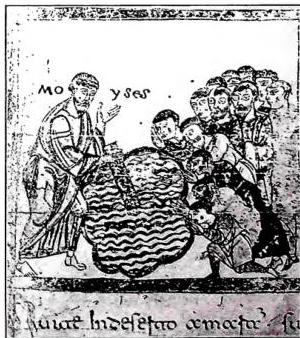
(phot. R. Sanatini)
Moses - The Jews quench their thirst with water gushing from the rock (Ex. 17, 6). Miniature from the pontifical of Landolfo I of Benevento (937-84).
light of the Jewish-Christian religion.
M. was the great consolidator of monotheism: one might almost say that he codified and dogmatized II. With him, every possibility of hesitation between the «God of the Fathers» and other gods was removed. Monotheism, as a religious fact proper to Israel, was historically justified through M.: the separation of monotheism (= Religion) from paganism, which had occurred with the call of Abraham, became clear as a theocratic program, an external factor of history, in which lies the generative principle of Israelite religious civilization and of the future Christian civilization. M. is the necessary predecessor of Christ.
The attempts to remove his figure from the Egyptian setting (as otherwise would the name M. be explained, and more generally the Egyptian names Hur, Ophni, Phinees, Phutiel, etc., and all the reminiscences, such as Ex. 20, 2; Lev. 19, 34; 25, 42; 26, 45; Num. 15, 41; Deut. 5, 6.15, etc.?) and from the Sinaitic setting in which the biblical tradition places him have also been recognized by non-Catholic critics as contrary to historical evidence (C. P. Tiele-N. Sonderblom [V. BIBLICA.], p. 329; E. Sellin [V. BIBLICA.]; etc.). The mention of his defects shows that the compilers of the documents did not work from imagination; they had anything but a creative spirit, all the more so in that, on the part of the people, this episode has nothing heroic about it, but is rather woven from episodes of cowardice, lack of courage and discipline, as well as of faith (the generation that ought to have been celebrated instead turns out to be a mass of crude people, incapable of accepting even the minimum of organization, always disunited and rebellious, so that it will be necessary to wait until it has disappeared before the undertaking can be accomplished). The concreteness and practicality that M. demonstrates even in the great vision (Ex. 3, 2-4, 17), when he asks God for the guarantee, the «name», the seal of authenticity, show that M. was not a wandering agitator. His attitude was psychologically oriented in a sense quite different from the outcome: he did not know that there was a holy place at Sinai (ibid. 3, 5), nor was he inclined toward the idea of going to liberate Israel (ibid. 3, 11; 4, 1-13). The denial of M.’s importance can be made only in contempt of the whole tradition of Israel. If he had not been an exceptional personality, how could he have been regarded as the founder of the religious and national existence of his people?
Rationalist attempts tend to exclude the importance of his «God», whom they identify with a Midianite name, or a volcanic deity of Sinai or Arabia (who speaks on behalf of the Hebrews in Egypt and assigns Canaan to them), under Egyptian influences (the «monotheistic» attempt of Amenophis IV was ephemeral and directed in an entirely different sense); God in M. would have been one of many gods, like those possessed by every people. But «if... the term monotheist means one who teaches the existence of a single God, creator of all things, source of justice, who is equally powerful in Egypt, in the desert, and in Palestine, who has neither sex nor mythology, who has human form (= not bestial), but cannot be seen by human eyes and cannot be represented in any form: then one must say that the founder of Yahwism, M., was certainly a monotheist» (W. F. Albright, From the stone age to christianity: monotheism and historical process, Baltimore 1940, p. 271). Israelite religious consciousness consistently recognized in the Yahweh preached by M. its God. The God of the Fathers (Ex. 3, 6) is at the same time the God of the children of Israel (ibid. 3, 7), who revealed himself under a new name when he established a new relationship with Israel itself. This is a religion that does not come from man, but from God, of whom M. was only the «prophet», the spokesman (Ex. 3, 10; 4, 12; Num. 11, 24 ff.; 12, 2; Deut. 18, 15.18; 34, 10; Os. 12, 4; Ps. 103, 7, etc.). Yahweh, revealing himself as identical with the God of the Fathers, ultimately did nothing more than impose the requirement of fidelity to the traditional one God. Only thus can one explain the remote origin of monotheism, in the precise conception of a personal and moral God, the supreme authority in decisions of a juridical nature, the point of reference for the whole public and private life of those who regulated their existence according to the Mosaic code.
ARCHAEOLOGY. – Dura Europos (v.) there is a series of frescoes, dated to the middle of the 3rd century, including: M., depicted on a larger scale than the others, leads the Israelites out of the city (Ex. 11:3): an inscription in Aramaic summarizes the scene; M., with the virga Dei, touches the waters of the Red Sea and the Egyptians are submerged; M. among the people of Israel and the representatives of the twelve tribes; M., with the virga Dei, touches the spring of salt water, which is miraculously transformed into fresh water: the darting fish symbolize the miracle; M. and the burning bush.
This biblical cycle demonstrates that, in order to facilitate proselytism, the Jews of the Diaspora represented episodes from the Old Testament in their synagogues. The numerous scenes from the life of M. discovered there now suggest that the iconography of M. in Christian art may have derived from such representations. In early Christian funerary art, the scenes relating to M. appear in the frescoes: the miracle of the spring (v.); manna (v.). M. untying his sandals is found in Roman funerary frescoes of the 4th century, as in the coeneterium maius on the Via Nomentana (Wilpert, Pitture, pp. 388–89, pl. 168; id., Die Katakomben Gemälde und ihre alten Kopien, Fribourg in Br. 1891, pl. 26, 1), in the so-called cemetery of SS. Marco and Marcelliano (id., Pitture, p. 389, pls. 215; 216, 2), in the cemetery of S. Lorenzo (id., ibid., p. 389, pl. 205), in Domitilla (id., ibid., pl. 230, 1); but the most remarkable example is that in the so-called crypt of the little sheep in Callistus (id., ibid., pl. 275, 2), where above the prophet the hand of God appears among the clouds to express the command (Ex. 3:5). In funerary sculpture it occurs both on Roman sarcophagi and on those of Gaul (Wilpert, Sarcofagi, pp. 241–44; pls. 86, 3; 205, 4; 206, 1 and 2). The symbolism of the scene was expressed by S. Gregorio Nisseno in the funeral commemoration of S. Melezio, bishop of Antioch: “he has loosened the sandal of the soul in order to walk with the unblemished foot of the mind upon the holy earth where God is contemplated” (PG 46, 861).
In funerary sculpture there are representations of Red Sea (v.), the miracle of the spring (v.), and M. receiving the Law on Mount Sinai. This scene appears more than thirty times in the Roman and Gallic funerary sculpture (Wilpert, Sarcofagi, p. 237); recently two further examples were found, one near the Confession of S. Pietro in the Vatican and the other on a sarcophagus with two registers in catacumbas. There is also the gathering of the quails (Ex. 16:13), which occurs on a sarcophagus from Arles, now in the Archaeological Museum of Aix-en-Provence, on one from Pisa, and on the lid of one from Avignon (Wilpert, Sarcofagi, p. 244 and pls. 97, 2–4; 157, 2 and 209, 2). Some funerary slabs represent the miracle of the spring; in the cemetery known as that of SS. Marco and Marcelliano on the Appian Way, the epitaph of Aurelio Teodulo (4th century) depicts on the right the deceased before the tribunal of Christ and on the left, in a niche, the prophet M., as indicated by the inscription « MOYCHIC ΠΡΟΦΗΤΑ », holding the book of the law given to him by the Lord on Sinai (Wilpert, Mosaiken, p. 1020, fig. 499; id., Sarcofagi, p. 241 and pl. 205, 2).
In non-funerary art, the episodes from the life of M. are more numerous. The richest collection was represented in the mosaics of the central nave of S. Maria Maggiore (Wilpert, Mosaiken, pls. 16–22). Some representations relating to the life of M. were destroyed at the time of Stato V, when the Chapel of the Sacrament was erected, but they were published by Garrucci through the surviving copies (R. Garrucci, Storia dell'arte cristiana, Prato 1873–81, pl. 218, 2–3). Other episodes were depicted at Nola, as testified by s. Paolino (Carm. 27, vv. 630–35); in a basilica in Spain, perhaps Saragozen, as attested by the Dyttochaeum of Prudenzio; and especially in S. Vitale at Ravenna; on the panels of the wooden door of S. Sabina in Rome (5th century); and in the ivory lipsanotheca of Brescia. Likewise in many miniatures; mentioned here are those of the Pentateuch of Ashburnham (7th century), in the National Library of Paris (Nouvelle acquisition lat. 2334, V. ENOCH. Catt., VII, cols. 1039–40) and manuscript Syriac 341. In the Vatican Library, in the miniatures of the codex of Cosma Indicopleuste and in cod. Vat. Reg. 1 of the 10th century. In mosaic cycles, such as in the Palatine Chapel of Palermo; on the arch of the Roman basilica of SS. Nereo and Achilleo (795–816; G. B. De Rossi, Musaici, pls. 22, 1; 26, 27). In the church of the Convent of S. Caterina on Mount Sinai, the apse mosaic represents the Transfiguration. To the right of Jesus is Elia, to the left is M., in the appearance of an old man, bearded, identified by his name (MOYCHIC). The patriarch is also represented on the two sides of a window in the apse arch, in the act of untying his sandals and receiving the Law from the divine hand. The mosaics have been attributed to the end of the reign of Giustiniano (S. Vaillè, La mosaïque de la transfiguration au Sinaï est-elle de Justinien?, in Revue de l'Orient chrétien, 2 [1907], pp. 96–98).