
TRANSJORDAN. — So called (because it corresponded to the Transjordan of the Latin Kingdom of Jerusalem) until 1949; thereafter, “Hashemite Kingdom of Jordan.”
I. GEOGRAPHY
It encompasses a portion of the Syrian-Arabian plateau E. of the depression through which the Jordan flows and in which the Dead Sea expands, which T. divides with the neighboring State of Israel, and, to the W., the so-called Arab Palestine (6000 sq km), occupied in 1949 and annexed the following year. Its 96,000 sq km of territory bring it into contact with Syria, Irāq, Saudi Arabia, Egypt, and Israel, enable it to reach the Red Sea (Aqabah) to the S., and extend it to within a short distance of the Mediterranean; still in the western sector, its frontier cuts through the urban area of Jerusalem. Of this surface, however, less than 1/10 is cultivable; the remainder belongs to the domain of the steppe or even the desert. Pastoralism is therefore the predominant occupation (over 1 million head of cattle and 350,000 sheep), in nomadic and seminomadic form; the sedentary inhabitants, settled in the fertile depression of the Jordan, where irrigation is possible, and on the nearby plateau, cultivate cereals (wheat, barley, and millet), legumes, tobacco, vines (especially for table grapes), and olives (the harvest is destined for oil production). Although mineral resources are not lacking (phosphates, bitumen, copper, salt, and perhaps also petroleum), none of them has yet been exploited.The population, almost entirely Arab and Muslim, amounts to 1.2 million inhabitants, of whom slightly more than 1/3 are scattered across the territory to the E., and somewhat less than 1/3 across that to the W. of the Jordan, where it is denser. Another 400,000 inhabitants are refugees from Israel, gathered in concentration camps organized by the United Nations. The inhabited centers are few and of little importance; foremost among them is the capital, 'Ammān (whose population is estimated at approximately 170,000 inhabitants), on the Hīǧāz railway, which once reached Medina but today operates only from Der'ā to Ma'ān, in Hashemite territory.
T., which formed part of the British Mandate for Palestine, became independent in March 1946 and was constituted as a monarchy two months later. The sovereign’s authority is tempered by a legislative assembly of 20 members elected by male suffrage, and by a Council of Notables of 10 members chosen by the king.
II. HISTORY
The modern political districts into which T. is divided correspond in part to the kingdoms indicated in the Old Testament. Beginning in the north, they are: the district of ‘Aǧlūn (biblical Gilead [v.]), between the Jarmūk (Šerl'at el-Menādireh) and the biblical Jabbok (Nahr ez-Zerqā), a plateau rising from 600 to 800 m., covered with recent volcanic materials, with cultivated areas alternating with woods and pastures. Next comes the district of el-Belqā, from the Jabbok to the Arnon (Sejl el-Mōǧib), an undulating plateau 800–1000 m. high (Gēbel Oša' 1096 m.), Ammonites (v.), with considerable cultivated areas, numerous villages, and the city of ‘Ammān, the capital of the Kingdom. South of the Arnon as far as theWâdi el-Hesâ lies the district of el-Kerak (biblical Moab [v.]), 800 to 1000 m. high, with extensive areas cultivated in cereals, especially around el-Kerak, the principal center of the region; finally, the district of Ma'ân (biblical Edom [v.] and the land of the Nabataeans), from the south of the Wâdi el-Hesâ to the Gulf of el-'Aqabah, with mountains rising to 1000 m., but very arid and with very few inhabited centers, the largest of which is Ma'ân. The Gulf of el-'Aqabah is T.’s only maritime outlet, along barely 5 km. of coast, between the border of Israel and the Hiğâz. Eastern T., east of the railway line from Damascus to Mecca, is a desert plateau with few oases, including the oasis of el-Azraq on the ‘Ammān–Baghdad route and the oasis of Hausa on the southeastern border.
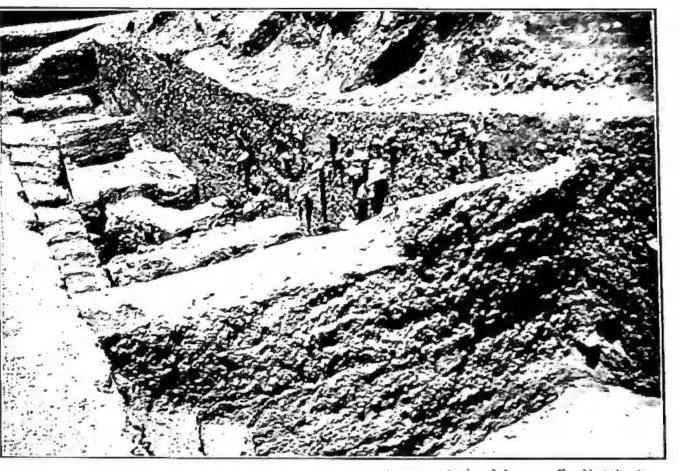
Archaeological exploration and excavations carried out in various parts of the country have established that T. was inhabited from the Paleolithic period onward, as indicated by extensive remains of megalithic culture. After the victories won by Moses over the Amorite kingdoms of Sihon and Og (Num. 12, 26; Jos. 13, 15-32), it was partly inhabited by the Israelite tribes of eastern Manasseh, Gad, and Reuben, and later disputed between the kings of Samaria and Damascus. In the 1st century B.C., Decapolis (v.) flourished in the northern part, Perea (v.) and the Nabataean Kingdom, Petra (v.), in the central part. The emperor Trajan annexed these territories to the Roman province of Arabia, whose southern part (the Petrea) became Palestine III in 400. As indicated by the ruins of ancient churches (Madaba, Nebo, Gerasa), Christianity flourished there until the Muslim period, when the Arabs settled there after the battle of the Jarmûk (A.D. 665). The Umayyad dynasty endowed the desert with a series of palaces, of which magnificent architectural ruins remain. At the time of the Latin Kingdom of Jerusalem, the various territories of T. were united for the first time in a single state, through the fief of the Pays outre Jordain, established by Baldwin I with Le Krak (Kerak) as its capital. The Crusader fortresses of Kerak, Sobak (Montréal), Wâdi Mûsâ (Le val de Moïse), and on the small island of el-'Aqabah (Grave), now Geâret Far'on, still remain, although in ruins.
After the Crusaders, T. remained neglected and, except for the brief period of the Mamluks, was dominated by tribal chiefs. After the Allies conquered the Arab lands of the Ottoman Empire in 1916–18, the Arabs hoped to incorporate them all into the Arab Empire they were preparing to found with King Husejn, leader of the Arab revolt against the Turks, and his sons; instead, the Anglo-French Allies had divided the territory into zones of influence through secret agreements. The sanjak of Kerak, together with Palestine, was entrusted to the British Mandate (Conference of S. Remo, 25 Apr. 1920). Subsequently, after agreements with local tribal chiefs and Churchill’s intervention with ‘Abdallâh, Husejn’s eldest son, in Jerusalem (28 March 1921), it was decided to establish an emirate of T. under Emir ‘Abdallâh, while the territory remained included under the general mandate for Palestine. In the final text of this mandate, approved by the League of Nations (24 July 1922), it was provided (art. 25) that the mandatory Power would have the authority, for the territory east of the Jordan, to derogate from the general provisions. Thus the State of T. came into being, and it followed a course different from that of Palestine (among other things, it was excluded from Jewish immigration and its consequences).
The autonomy of the emirate of T. (in Arabic Şarq al-Urdunu) was proclaimed on 1 Oct. 1922. The new state, not entirely independent, had its capital at ‘Ammān, the residence of the emir and of a British resident dependent on the high commissioner for Palestine, whose seat was in Jerusalem. Relations with Great Britain were defined by the Anglo-Transjordan Agreement of 28 Feb. 1928, by which Great Britain was granted substantial interference in the administration
The Constitution of T., promulgated on 16 April 1928, established the institutions of the emirate within the framework of the mandate of the League of Nations and of the aforementioned Anglo-Transjordanian Agreement; nevertheless, from 1928 T. had an almost constitutional government, with an emir invested with broad powers. Until 1946 T. was thus governed by the emir under the mandate regime; Great Britain derived considerable advantages from the special position it enjoyed in that territory; the Arab Legion, trained and commanded by British officers (first Peake, then Glubb), was useful in checking the Wahhābite incursions from the south and later, during the world war of 1939–45, in operations in Syria and Iraq.
T. also benefited from British financial and technical assistance in improving its economic infrastructure and introducing civil institutions. After the war, once other States subject to mandates (first 'Iraq, then Syria and Lebanon) had become independent, T. too wished to proceed to autonomy and independence: this occurred with the Anglo-Transjordanian Treaty of 22 March 1946, by which Great Britain recognized the termination of the mandate and the proclamation of the independent Kingdom of T. On 25 March 1946 'Abdallâh was acclaimed king in 'Ammân. T., unlike the aforementioned new Arab States, did not succeed in being admitted to the UN. The new Kingdom of T. found itself directly involved in the question of Palestine, which had by then become more acute. Before the world war, the numerous British attempts to resolve the Arab-Jewish dispute arising from the promise (1917) to provide the Jews with a national home in Palestine had failed. After the war, the Palestinian question was referred to the UN, which, amid the atmosphere of widespread human sympathy throughout the world for the persecuted Jews, decided to partition Palestine between the Arabs and the Jews (29 November 1947). The Arabs of Syria, Lebanon, T., Iraq, Saudi Arabia, the Yemen, and Egypt opposed the decision; since 1945 they had been united in an Arab League headquartered in Cairo.
The Kingdom of T. was a member of the League, and its King appeared among the Arab heads of state as the most fervent defender of the Palestinian Arab cause; he also had the advantage of possessing the best-equipped body of troops in the immediate vicinity of the theater of operations. Thus, when, on 15 May 1948, following the termination of the British mandate in Palestine,
the forces of the various Arab States crossed the borders in order to proceed to the liberation, 'Abdallāh’s Arab Legion, having crossed the Allenby Bridge over the Jordan, easily occupied Jericho, Jerusalem (the Old City), Bethlehem, and Judea. The Arabs then encountered everywhere the effective and aggressive armed action of the Jews, and Palestine remained divided between the Jews of the new State of Israel and the Arabs, along armistice lines (1949) which still today (spring 1952) await the conclusion of peace.
The Arabs’ failure in the Palestinian campaign arose, and still depends, on rivalries among the Arabs and disorder within the individual States, including T. This State, in fact, having gained control of the part of Palestine on the right bank of the Jordan occupied in 1948, came into conflict with the Arab League when it decided (24 April 1950) to annex it to its own territory. A de facto annexation had already taken place in 1949, and from that time (1 June 1949) T. had officially adopted the designation « Hashemite Kingdom of Jordan ». The Arabs of Jordan and of the other States reproached King 'Abdallāh for his excessive dependence on Great Britain, the discord that had arisen within the Arab League, his opposition to closer contacts among the Arab States or among some of them (the union of the Fertile Crescent or of Greater Syria), and his tendency to make a separate peace with Israel and reach an agreement with it in order to prevent the internationalization of Jerusalem decided upon by the UN. On 20 July 1951 King 'Abdallāh was assassinated in a mosque in 'Ammān; he was succeeded by his firstborn son Ṭalāl, who was deposed on 12 August 1952 because of a serious nervous illness and left the throne to his son Ḥusqīn. Since 8 January 1952 Jordan has had a new constitution, more liberal than that of 1928, with a government responsible to Parliament.
Donato Baldi - Ettore Rossi
III. RELIGIOUS SITUATION
For the history prior to the First World War, V. PALESTINA. Among a total population of approx. 400,000 inhabitants, overwhelmingly Muslim, there are 35,000 Christians, most of them « Orthodox », who enjoy satisfactory religious freedom.The new Constitution, which came into force on 8 January 1952, although it proclaims Islam the religion of the State (art. 2), guarantees the equality of all citizens without distinction of religion (art. 6, 1) and freedom of worship (art. 14), recognizes the right of religious communities to have their own schools (art. 19), and grants Christian religious tribunals the same rights as Muslim ones (art. 109).
There are approx. 7,000 Catholics of the Latin rite and 6,500 of the Greek rite. There is also a small Armenian-Catholic community with a parish in 'Ammān. The Latin Patriarchate of Jerusalem has been working in T. since 1866 for the conversion of dissidents. In 1908 the Greek Catholics, or Melkites, also began their work, with fewer resources than the Latin mission but with the great advantage of offering the population the possibility of becoming Catholic while retaining the traditional rite in the Arabic language. In recent decades it has been possible to speak of a genuine movement toward union. The Holy See erected in 1932, for the Greek Catholics of T., the diocese of Petra and Philadelphia, with its residence in 'Ammān. Cooperation between Latins and Greek Catholics left somewhat to be desired.
The union between the two rites was greatly strengthened after a popular mission held jointly in 1938 by Latin and Greek priests. At the request of the Greek bishop, the apostolic delegate appointed a permanent visitor of the schools of the two rites, and it was decided never to open two Catholic schools in a single village (one Latin and one Greek), but only one, called simply Catholic. The organization of the « Union of Catholic Schools » now provides for this important work. The Latin Patriarchate has 21 parishes in T., while the Greek-Catholic diocese has about thirty.
There are approx. 60 Catholic schools with a total of 9,000 pupils. Since 11 February 1948, the apostolic delegate for Jerusalem and Palestine has also been delegate for T. Since the end of the last century, Protestants, too, have been working in T., with substantial resources. But their success has been minimal. There are barely 1,000 Protestants.