
IRĀQ. – Arab state of Western Asia, comprising the lower basins of the Tigris and Euphrates and part of the adjoining Syrian and Arabian deserts.
SUMMARY:
I. Geography
II. Civil history
III. Ecclesiastical history.I. GEOGRAPHY
Of the two rivers, the latter has no notable tributaries, whereas the former gathers the waters descending from the more humid northwestern mountainous margin of the Iranian region. Apart from these two higher sectors (up to 1,000 m.), the entire country is plain or lowland, for the most part steppe and desert, owing to its hot, dry climate, distinctly continental in character, with short and relatively cold winters and long, torrid summers.The northern I., extremely poor in rainfall and therefore sparsely populated, bordered as it is by an arid plateau, contrasts with the southern regions, fertilized by the waters and silt of the twin rivers, which at Bagdad merge into a single course (Satt el-'Arab). The extent of the territory, whose boundaries cannot be precisely defined (except toward Iran), is variously estimated (from 292,000 to 452,000 sq. km.); but the area suitable for cultivation, which corresponds in part to the northern mountain zone and in part to the irrigated stretches near the rivers, does not even reach 30,000 sq. km. (although a considerable expansion is envisaged).
Of the population (4.8 million inhabitants), nine-tenths are Arabs, with Kurdish, Turkish, and Jewish minorities. More than agriculture, which produces cereals (wheat, rice, durum wheat), tobacco, opium, fruit, and especially dates (80% of the world harvest), and livestock raising (7.4 million sheep, wool, meat, hides, etc.), the extractive industry stands out in the 'irāqena economy, with a single product: petroleum. The entire eastern mountain arc from Mossul to the Persian Gulf is saturated with II. Production (4.5 million tons in 1948) has surpassed the prewar level. The importance of the other industries (textiles, tobacco manufacturing, soapmaking), on the other hand, is modest. Roads (6,400 km. of roads suitable for motor vehicles) and railways (1,850 km.) are still inadequate for requirements. The port of Basrah is equipped according to modern standards. The capital, Bagdad, has 285,000 inhabitants; next in importance are Basrah (80,000 inhabitants) and Mossul (80,000 inhabitants).
The I. is a hereditary constitutional monarchy with two chambers, one of them elective.
II. CIVIL HISTORY
The treatment of the history of I. is conditioned by the meaning attributed to this name. Strictly speaking, it would designate only that part of the region between the Tigris and Euphrates that extends from the Persian Gulf to approximately the latitude of Baghdad, whereas the area between the two rivers above this point is more properly called Mesopotamia. However, since I. is currently the name of the state that governs both regions, the history of I. will be understood as the account of the events of both territories, projecting into the past a unity that, geographically real, was not politically so for many centuries.I. was the center of autonomous empires between the fourth millennium and 538 B.C. It then became a province—though not always a unified one—of foreign empires, until 1918, the year in which the history of the new national ‘irāqen state began, first under the British protectorate and then, from 1932, in effective independence. For a broader knowledge of ‘irāqen history up to 1918, one must therefore refer successively to the entries: SUMERI; BABILONESI; ASSIRI; PERSIA; ISLĀM.
The ancient period of ‘irāqen history was one of great political and cultural prosperity; on the banks of the two rivers, favored by advantageous economic and geographical conditions, one of the greatest civilizations of the ancient world flourished. Its ethnic components were the Sumerians, the first to establish themselves in the region, and the Semites. Sumerian populations appear in the southern part of the region (Babylonia) from the fourth millennium onward, forming small city-states there and developing an advanced culture. Around 2400 (according to the recent “low” chronology), the Semites, who had long been present on the outskirts of the cities in nomadic conditions, established themselves in the same area and founded the Babylonian Empire. Through various dynasties interspersed with foreign invasions, it lasted until approximately 1500, when it yielded to a long period of non-Semitic domination (the Kassites: ca. 1500–1550). In the north, meanwhile, the Assyrian Empire was gaining strength; under Tiglath-pileser (1115–1093) it extended on one side as far as the Persian Gulf and on the other as far as the Mediterranean. After a long period of prosperity, the Assyrians fell in 612 at the hands of the Medes and the Babylonians; the latter experienced a final period of flourishing from 612 to 538, the year in which their empire too came to an end through the action of Cyrus.
With its conquest, I. became part of the Persian Empire and remained so, under the Achaemenid dynasty, until the conquest by Alexander the Great (331 B.C.). After his death and the division of his empire, I. passed to the Seleucids, who ruled there from 312 to 140 B.C. The region then once again became part of the Persian Empire, first under the Arsacids (140 B.C.–A.D. 226) and then under the Sassanids (A.D. 226–637). During this phase of Persian rule, there were periodic struggles, first with Rome and then with Byzantium, in the northeast, where the Romans had established a province of Mesopotamia from the time of Trajan (second century A.D.).
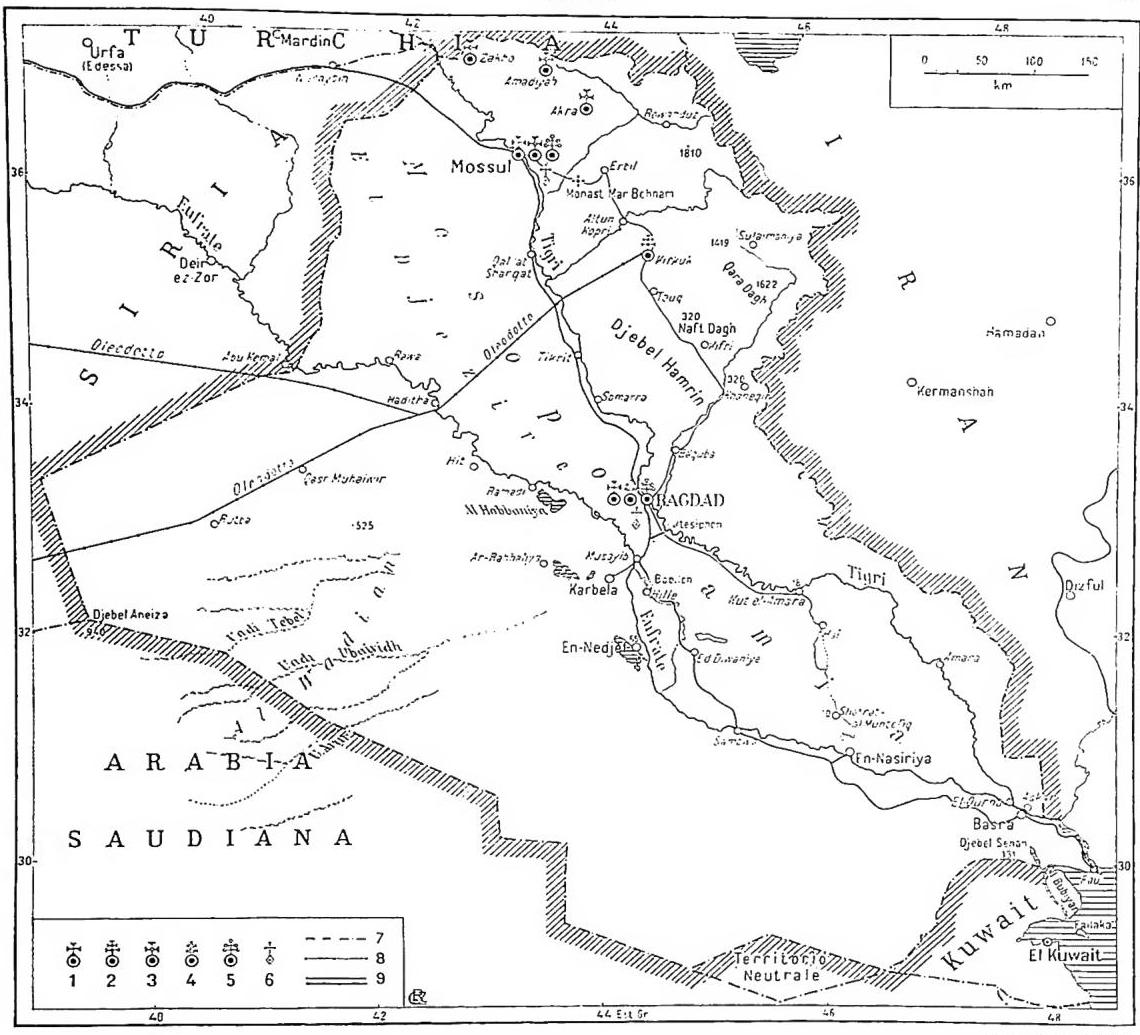
'IRĀQ — 1) Patriarchate of Babylonia; 2) Archdiocese; 3) Diocese of the Chaldean Rite; 4) Archdiocese of the Latins; 5) Archdiocese of the Syrians; 6) Mission; 7) State boundaries; 8) Oil pipeline; 9) Railways.
1258), which placed the center of the state precisely in I., building the new capital, Baghdad, there; in the ninth and tenth centuries the region attained great prosperity, increased by the commerce that radiated from it toward the East and the West; the principal sources of unrest were weakened or disappeared in the new political situation. Then the decline of the ‘Abbasid caliphate also became the decline of I. Although the nominal sovereignty of the caliphs persisted, dynasties of diverse origins established themselves there, among whom the Persian Buyids and the Turkish Seljuks prevailed. Then, in 1258, the caliphate disappeared beneath the Mongol onslaught, which brought I., through the destruction of the irrigation canals and the abandonment of all works of economic and commercial development, a long period of decline. Mongol dynasties succeeded one another in the region; then the onslaught of Timūr Lang passed over it (Tamerlane: 1393). In 1509 I. was annexed to Persia by Shāh Ismā‘īl. Finally, in 1534, it was conquered from the Ottomans by Suleiman the Magnificent, under whom it remained, despite alternating conflicts with Persia, until the end of the First World War (1918).
The year 1918 marks the beginning of the new history of I. But for some time the region’s economic recovery had already been under way, both through the work of the Turkish administration and because of the interest aroused in the great European powers by I.’s economic resources and geographical position. For England in particular, I. constituted an essential link between the Mediterranean and the Indian Ocean; at the beginning of the World War, the English landed in the Persian Gulf and in 1917 conquered Baghdad. In 1920 I. was entrusted to the British mandate, and in 1921 a kingdom was established under Fajṣal, son of the sharif of Ḥiḡāz, Ḥusajn, and known for a previous Syria (v.). Fajṣal reigned from 1921 to 1933. His government marked decisive stages in the progress of the new state, both economically—above all through the exploitation of its petroleum resources—and administratively. On the other hand, periodic disturbances occurred from that time onward, revealing the conflicts that still make the country’s life difficult: they arose from the problems of ethnic minorities (Armenians, Kurds) and religious minorities (Christians, Jews, Yazidis). Relations with England caused further difficulties, as I., like the other Arab states of the postwar period, sought to obtain independence. This was established, with the end of the mandate, by the Treaty of 1932, while England retained considerable economic and military rights. Fajṣal was succeeded by Gāzī (1933–39), under whom political conflicts and disturbances recurred. In 1939 Fajṣal II, six years old, ascended the throne under the regency of his uncle ‘Abd al-Ilāh. When the Second World War broke out, Italo-German propaganda found fertile ground: in 1941 Rašīd ‘Alī al-Kajlānī took power in a coup d’état, appointed a new regent (Šaraf), and opposed the English landings at Bašrah; the English then marched on Baghdad, the government of Rašīd ‘Alī al-Kajlānī was overthrown, and the former regent was reinstated. In 1943 I. declared war on Germany; in 1945 it joined the League of Arab States.
Among the postwar events, the Kurdish uprisings of 1945 and 1947 are noteworthy, as they testify to the minorities’ continuing state of unrest. In 1948, a new Anglo-Iraqi treaty was concluded at Portsmouth, but it was subsequently repudiated by Iraq under pressure from popular agitation. After Parliament was dissolved, new elections were held and several governments succeeded one another. The latest, headed by Tawfīq as-Suwajdī (5 February 1950), displays tendencies favorable to the resumption of negotiations with the British, as well as to the recent project for a Syrian-Iraqi union.
III. ECCLESIASTICAL HISTORY
Since I. was part of the Persian Empire until the Arab conquest, for its religious history, V. PERSIA. Christianity was subsequently represented by the Nestorians (v.); in the 16th century a Catholic Chaldeans (v.). At present the population is predominantly (79%) Arab. Islam is the state religion. The šīʿites predominate. The royal family and the ruling classes, however, are Sunnis.
1. Legal situation of Christians
The Constitution of 1924 guarantees religious freedom to all, in Article 13. Article 18 promises all citizens equality with regard to public employment. In practice, however, it is very difficult for a Christian to occupy a high position. Article 16 guarantees communities the right to have their own schools. Articles 78–80 deal with personal status and guarantee the various communities their own religious courts. In recent times, legislation has shown a dangerous tendency toward secularism, placing the privileges of the communities at risk, as is happening in Turkey. In 1940 a law was enacted subjecting Catholic schools to state control. In 1947 a law on religious courts appeared, making them dependent on state supervision.2. Situation of the schools
Despite the unfavorable school law of 1940, the situation of Catholic schools has improved considerably in recent years. It is true, however, that the majority of the communities’ schools are still in the hands of the government and conducted according to the Muslim spirit. The missionaries’ schools, on the other hand, enjoy sufficient freedom. The Jesuits’ secondary school in Baghdad is flourishing greatly and is attended by the sons of the most prominent Muslim families. Since 1944 the Dominicans have had a secondary school in Mosul.3. Situation of the Catholic communities
I. has an apostolic delegation residing in Baghdad. The most important community is that of the Chaldeans, numbering approximately 160,000 faithful. They belong to the Patriarchate of Babylon, which has Mosul and Baghdad as its patriarchal dioceses, and to the four dioceses of Ker-(from D. Gribavdi, L'Asia anteriore, in Geografia Universale, IV, Turin 1936, p. 203)
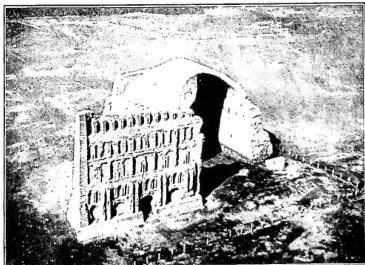
'IRĀQ — Ruins of the Palace of Chosroes (6th century) — Ctesiphon.
Non-Catholic Christians. — The Monophysite or Jacobite Syrians number 12,000, the Monophysite Armenians 15,000, the Nestorians 30,000, and the “Orthodox” of Byzantine origin 230.
For further information V. CALDEI; NESTORIANI.