
TURKEY. - The Turkish Republic, proclaimed on 31 Oct. 1923, is the state that emerged from the dissolution of the Ottoman Empire and the national revival promoted by Mustafà Kemal following the Treaty of Sèvres (10 Aug. 1920). Reduced to a territory almost exclusively Asian, with a European appendage (Eastern Thrace, slightly larger than Lombardy), which preserves for it Constantinople (Istanbul) and thus
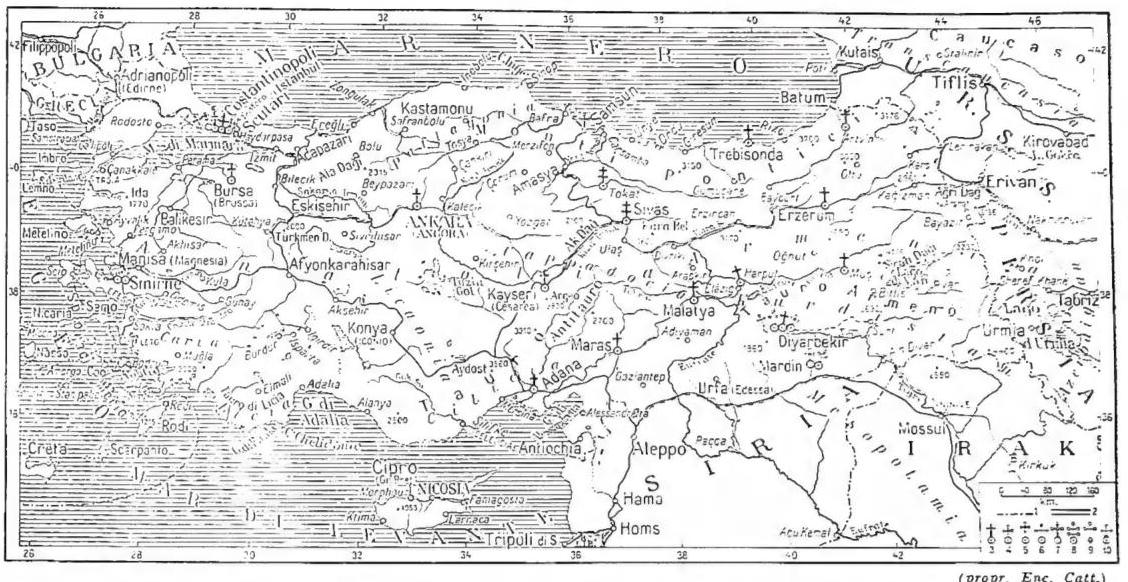
TURCHIA - 1) State borders; 2) railways; 3) Armenian rite; 4) Chaldean rite; 5) Chaldean patriarchal vicariate; 6) Byzantine rite; 7, 8, 9) Syriac rite; 10) Melkite rite patriarchal vicariate.
I. GEOGRAPHY
Its territory, which measures in all 776,747 sq. km. (of which 23,975 in Europe), brings it into contact with Bulgaria, Greece, Iran, Iraq, Syria and the Soviet Union, but its frontiers almost never constitute a clear and solid boundary; indeed, they have left behind disputes and claims that are far from settled. This territory consists essentially of a vast plateau whose average elevation (700 m.) increases from west to east, traversed by various mountain ridges and usually made up of closed basins. Two series of ranges, running almost parallel to the northern (Black Sea) and southern (Mediterranean) coasts, isolate it from maritime influences, creating a marked contrast between the coastal regions and the interior. While the former benefit from abundant or moderate (in the south) rainfall and are therefore covered with lush vegetation or maquis, the interior plateau and the mountains of the east (Armenia) are arid and steppe-like, except for the narrow strips near rivers, which, however, are few and all of a torrential character. There is also a strong thermal contrast between the mild climate, especially in winter, of the coastlands and the harsh, typically continental climate of the plateaus, where the ground is covered with snow for several weeks.Almost half (47.2%) of the territory is pastureland, about one-seventh forest, and a little over one-quarter arable land and tree crops. The interior is the domain of pastoralism, but livestock raising is directed mainly towards sheep (26 million head) and goats (19 million); there are, however, 10 million head of cattle and 3 million horses. In Anatolia, silkworm breeding is also significant. Cereal cultivation is expanding with the aid of artificial irrigation and yields good quantities of grain. In the maritime regions, tobacco, maize and hazelnuts prevail along the Black Sea coast; cotton, vines, olive trees, citrus fruits and fruit trees along the Mediterranean. The mineral reserves are varied and considerable, though knowledge of them is still incomplete and exploitation is in its early stages, with the exception of coal, which is extracted in the Ereğli region (4–5 million tons in recent years). Turkey ranks second in the world for chromite (central Anatolia); production is also notable for copper, iron, sulphur, manganese, lead and zinc. Mercury, molybdenum and antimony are among the minerals now being exploited. Industry, however, is still far below its potential; yet it has made considerable progress since 1923: in some branches (cement) it already meets national demand, while in others facilities are being considerably expanded (textiles, glassworks, ceramics, paper, leather, chemicals) and output is becoming more substantial, even in the case of heavy industries.
The population (20.9 million inhabitants, 27 per sq. km. in 1950) is fairly homogeneous from the national and religious points of view. The largest ethnic minority is the Kurdish (1.5 million souls); there are also, among others, over 150,000 Arabs, over 100,000 Greeks (Constantinople), and perhaps as many Armenians, besides smaller groups of Circassians, Lazes, Georgians, Jews, etc.
Of the urban centres, Istanbul (1 million inhabitants), though the most populous and important, has ceded to Ankara (287,000 inhabitants), in the heart of the plateau, the function of capital of the State (1923). İzmir has 230,000 inhabitants, Adana 118,000 and Bursa 100,000.
II. HISTORY
For ethnic origins, V. TURCO-MONGOLI.1. The Ottoman Empire and its origins
In the second half of the 13th century the Byzantine Paleologi family (since 1261) held from Constantinople the last outposts on the Asian continent, reduced to little more than the borders of Bithynia; another Byzantine dynasty, that of the Comneni, reigned in Trebizond. All the rest of Anatolia (except for the coastal Cilicia still in the hands of the last kings of Lesser Armenia) was in the hands of Muslim Turks who had invaded it since the 11th century.But there was no single Turkish state; the Seljuks, who had predominated from Konya for about a century and a half, had been reduced to vassalage by the Mongols, who had conquered Persia, overthrown the Caliphate of Baghdad (1258) and occupied eastern and central Anatolia. On the marginal territories of the Seljuk state of Anatolia many Turkish emirates had formed: of Karaman in the south (in Cappadocia), which around 1300, with the extinction of the Seljuk state, aspired to assume its legacy; of Menteşe (Caria), of Aydın (region of the Meander), of Saruhan (Magnesia), of Germiyan (Phrygia), of Karasi (Troas), of the Candar (Paphlagonia) and others smaller. Of these emirates one, which took its name from its founder 'Osmân, in Bithynia, on the border with the Byzantine Empire, prevailed in a struggle lasting more than a century, giving rise to the Ottoman Empire. It was the emir 'Osmân (Arabic 'Oṭman, in Byzantine chroniclers Ottoman, from which the name "Ottoman") who first gave considerable consistency to the emirate and extended it as far as Bursa (in 1326, which is also considered the year of his death). His successor Orhan (1326-62) occupied the rest of Bithynia: Nicaea (İznik) in 1321, Nicomedia (İzmit) in 1337, and crossed into Europe by conquering the Gallipoli peninsula in 1354.
Who were these Turks gathered around the family of 'Osmân? When the Ottoman sultans in the 15th century took pleasure in hearing the origins of their dynasty and kingdom recounted, legends and genealogies were formed which were then accepted in Ottoman court historiography. Among these, the most accredited later was that which traced 'Osmân back to an Ertogrul and this to a Sulejmân, a Turcoman prince of the Oğuz tribe and precisely of the Qâjî clan, who had come to Anatolia from Mahan (Central Asia) at the beginning of the 13th century to escape Mongol pressure. The family of 'Osmân would have settled on the borders of Bithynia in the 13th century as vassals of the Seljuk sultan of Konya. This version is largely legendary; there are no reliable accounts of the ancestors of 'Osmân and it must be excluded that they came from Central Asia in the 13th century in the manner described. Rather, it must be considered that, in any case, a frontier emirate, which around 1300 was under the command of 'Osmân, formed in the 13th century on the borders with Bithynia and that the organization of the nascent state was not that of a homogeneous tribe of the Oğuz, but rather of a military lordship made up of Turks who had penetrated Anatolia long before (Oğuz, i.e. Seljuk, invasion of the 11th century) and of native Turkicized peoples, animated by the chivalrous and religious spirit of Muslim conquerors (ghāzī) "fighters for the faith", natural antagonists of the body of akritoi "frontier soldiers" stationed by the Byzantines on their borders. In this situation the Ottomans, heirs of the traditions of armed conquest of Islam, brought to completion in Anatolia and the Balkan peninsula the conquest which Muslim Arabs had attempted in the 7th-9th centuries in Asia Minor and which the Byzantines and then the Crusades had halted, determining a state of equilibrium in the 11th-13th centuries.
The conquest of Adrianople (the date is not certain, but is usually placed in 1361) and the transfer there of the capital from Bursa in 1368 under Murad I (1360-89) gave the Ottomans predominance in Thrace. The Byzantine Empire was reduced to the capital, Constantinople, and its immediate surroundings; the kingdoms of Serbia and Bulgaria became vassals of the Ottomans, who pushed their incursions even into the Morea and Albania. The successor of Murad, Bayezid I the Thunderbolt (1389-1402), became master of much of the Balkan peninsula and besieged Constantinople for the first time in 1391 and again in 1395. The united forces of Christian princes, led by King Sigismund of Hungary, were defeated at Nicopolis on the Danube (1396). In Anatolia too the Ottoman Empire extended, absorbing some of the Turkish emirates and subjugating others, such as the kingdom of Karaman.
At this point the invasion of Tamerlane from the East halted Ottoman expansion and delayed its development by almost half a century. Bayezid was defeated at Ankara in 1402 and died in captivity. As Tamerlane withdrew immediately, the Turkish emirs whom he had reinstated in their states were able to hold out for some time amid the discord of Bayezid's three sons. Constantinople enjoyed a period of relief; but soon Mehmed I, who had established himself on the Ottoman throne, resumed conquests in Anatolia and Europe, and his son Murad II (1421-44 and 1445-51) consolidated Ottoman power by taking Thessalonica (1430) and much of Albania. His son Mehmed II (1451-81) conquered Constantinople (29 May 1453), putting an end to the Byzantine Empire. With the virtual extinction of the political and cultural tradition of which it had been the centre for centuries, Constantinople (Istanbul) became one of the principal religious, political and cultural centres of Islam; Orthodox Christianity survived in a state of subjection under the sultans, increasingly detached from the Christian West, to whose spiritual union it had adhered too late and without great enthusiasm (Council of Florence of 1439).
With the capture of Trebizond (1461) and the Genoese colonies of Caffa and Tana, the Ottomans secured possession of the Black Sea; in the Adriatic too the Turks occupied important bases and in 1480 threatened the Italian peninsula with a landing at Otranto.
2. Peak and decline. — The peak of the Ottoman Empire was achieved by Selim I (1512-1520) and his son Suleiman the Magnificent (1520-66). The conquest of Syria and Egypt (1516-17), of the Muslim holy cities of Mecca and Medina in Arabia, of Belgrade (1521), of Rhodes (1522), of Hungary (1526) and of Mesopotamia, the formation of a fleet that dominated the eastern and central Mediterranean, the capture of Algiers (1516), Tunis (1533) and Tripoli (1551) gave the Ottoman sultans possession of southern Europe as far as the Danube, of Asia Minor and Arabia and of almost all of North Africa, and they assumed and in fact bore the title of caliph emperor of the Muslims. Their antagonists in the East were the Shiite rulers of Persia, in the West the Empire of Austria and Venice, later Poland and Russia and sometimes the union of Christian states. Venice was worn down in the defence of its possessions in the Levant, successively losing Cyprus (1571) and Candia (1645-69) but managing to save the Ionian Islands and Dalmatia. The Empire of Austria saw Vienna threatened for the first time in 1529 and a second time in 1683. From this last failed attempt against Vienna the decline of the Empire is usually dated, although it had already found a limit to its capacity for expansion in other clashes, such as at Malta in 1565 and at Lepanto in 1571.
By the end of the 17th and in the 18th centuries the Empire lost its first territories: Hungary, northern Serbia, the Crimea. In the 19th century the collapse occurred on a larger scale because external attacks, especially by Russia, were accompanied by internal revolutions and national movements. Serbia, Greece (1821-30), Romania, Bulgaria reconstituted themselves as independent states, while Egypt obtained (1841) complete autonomy and Tunis loosened its ties with Constantinople.
From the beginning of the 19th century the Ottoman Empire was no longer the architect of history; overwhelming forces pressed upon its borders: Austria aimed at the Aegean, Russia at Constantinople and the Straits. The preservation of the Ottoman Empire was for a long time assisted by states interested in countering those ambitions; in the Crimean War (1854–55) and in the war of 1877–78 the advance of the Russians was halted by European intervention. The reforms (tanzîmât) begun in 1839 failed to revive the Ottoman Empire; the Balkan War of 1912–13 cost it most of its European territory; defeat in the First World War stripped it of the Arab lands and jeopardised even the independence of the purely Turkish territory. The valour and sagacity of Atatürk (1919–22) saved the Turkish state from the collapse of the Ottoman Empire, which, after the abolition of the sultanate (2 Nov. 1922), became the Republic of Turkey (29 Oct. 1923). The last sultan, Mehmed VI, left Istanbul on 17 Nov. 1922.
3. Constitutional system. — The Ottoman Empire maintained its hold over conquered territories through an administration chiefly military in character, drawing its manpower and resources from the subject peoples. The revenues of the lands were assigned to the sultan, his family, ministers, military leaders and provincial troops under the tîmâr and zî'âmât system (revenue-bearing grants tied to military obligations). The Janissaries, who extended and then defended the conquests, were the sons of Christians reduced to slavery and reared for war; from their ranks came governors, generals and ministers. No aristocracy existed, nor did an Ottoman bourgeoisie form; only the offices
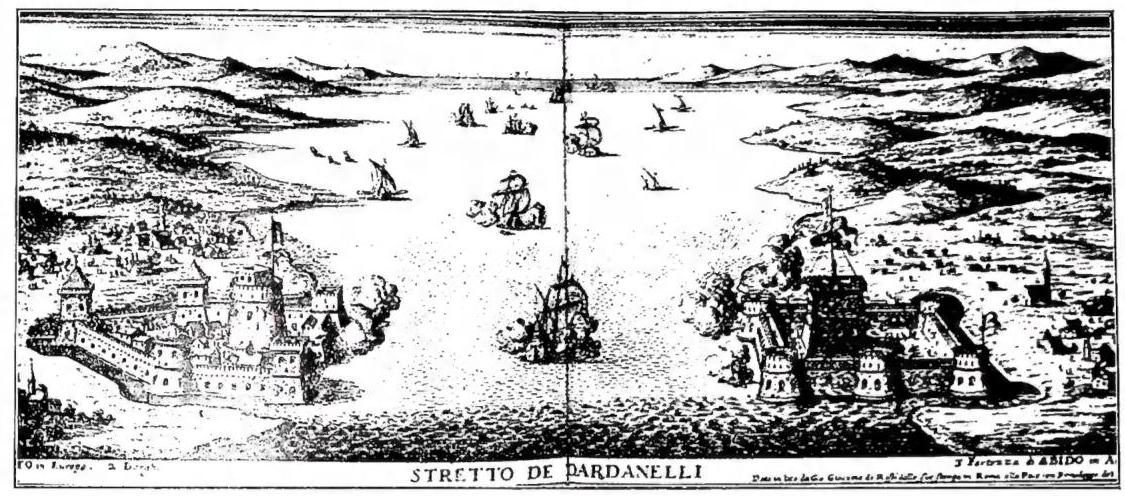
TURKEY — Dardanelles. Engraving by G. De Rossi (Rome 1699).
(photo Fiorentini)
From a religious standpoint, the formation and duration of the Ottoman Empire meant an expansion of the Islamic faith in Asia Minor and the Balkan peninsula; here two-thirds of Albania, much of Epirus and Macedonia, and parts of Bulgaria (Vido, Rhodope), and Romania (Dobruja) adhered to Islam not so much as a result of persecution but due to local interests and the immigration of Turkish elements. With the fall of the Empire, after the population exchange between Greece and Turkey (1923–24), the Muslim element was reduced to Albania and Thrace, with small minorities in Romania and Bulgaria, and in Cyprus. The Latin Catholic rite survived in Istanbul and on the islands.
4. Contemporary History. — Born from the ruins of the Ottoman Empire, the Republic of Turkey (in the new Turkish-Latin alphabet Türkiye Cumhuriyeti) was proclaimed by the Grand National Assembly of Ankara on 19 October 1923. The first ten years of the Republic were marked by a succession of revolutionary reforms according to the doctrine of Kemalism embodied in its president, Mustafa Kemal, who, in imposing the great changes that shook the foundations of the State and society, drew on the immense prestige gained from his conduct of the War of Independence. After the abolition of the Sultanate (1 November 1922) came the abolition of the Caliphate (3 March 1924); the Constitution of 20 April 1924 recognized Islam as the State religion, but an amendment in 1928 removed this provision; the secular orientation was more explicitly enshrined in the constitutional amendment of 1937. The new Civil Code (an almost complete translation of the Swiss Civil Code), which came into force in 1926, meant the abandonment of Muslim personal status law, with the consequent abolition of polygamy and the equalization of women with men in inheritance rights. The revolutionary innovations affected not only external life (abolition of the fez and the obligation to wear European hats, prohibition of traditional garments for religious men) and deep-rooted centuries-old customs (abandonment of the Muslim calendar for the Gregorian calendar in 1925, Sunday holidays instead of Friday), but also struck at the cultural heritage of the Turks, who were abruptly steered toward rapid Westernization. This process was profoundly aided by the abolition of the Arabic script and the introduction of the Latin Turkish alphabet (“new Turkish alphabet,” yeni türk harfleri), ordered by law on 3 November 1928. In the end, this meant turning one’s back on the past, ignoring centuries of Arab-Turkish-Persian culture, a heritage of ideas expressed in a script that would soon become indecipherable to future generations. Even this reform was carried to its extreme consequences, and although it caused a profound cultural crisis, it cannot be said to have lacked positive results, since it helped spread elementary education and sparked a movement of linguistic reform that, despite its excesses and oddities, has contributed to renewing the original Turkish patrimony of written language.
The Kemalist regime also successfully laid the foundations for a national economy essential to effective political independence. Freed from the Capitulations by the Treaty of Lausanne in 1923, Turkey developed its own banking system, promoted national industry, built roads and railways, and liquidated debts contracted
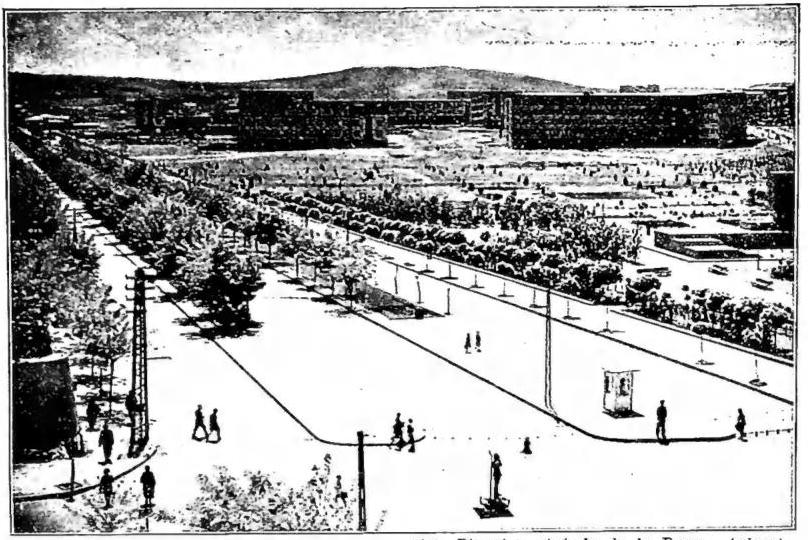
TURKEY - Atatürk Boulevard and the ministerial district - Ankara.
In foreign policy, the Republic of Turkey, having reclaimed its national territory through the War of Liberation (1919-22) and secured recognition of its full independence and sovereignty with the Treaty of Lausanne (24 July 1923), succeeded in asserting itself with dignity on the international stage. It established strong friendly relations with Balkan and Eastern countries and managed to amend the Lausanne Convention concerning the Straits in its favor through the new Montreux Convention (1936). The friendship of neighboring Russia, which had supported the Turks during the War of Independence, continued to provide diplomatic backing up to this point. As the Second World War approached, Turkey recognized the instability of the European and Mediterranean balance and drew closer to France and England, concluding agreements that were finalized in 1939. These agreements brought material aid to the Republic and led to the annexation of the territories of Antioch and Alexandretta, administered by France under its mandate over Syria. During the 1939-45 war, Turkey maintained its neutrality. Russia, which in 1939 had insistently urged Turkey to associate with it in defending the passage through the Straits—receiving a firm refusal—abandoned its stance after becoming involved in the conflict in 1941 and allied with Turkey’s allies. However, it revisited these aspirations in 1945, at the end of the war, during the Allied conference in Potsdam, where it obtained permission to resume negotiations with Turkey to discuss joint Turkish-Russian defense of the Straits and the predominant interest of Black Sea states in that waterway. When, in 1946, Russian pressure on Turkey intensified—while the Turks remained steadfast in rejecting their northern neighbors' demands—former allies, particularly America, took on the task of supporting Turkey with financial means, weapons, and materials. This orientation shaped Turkey’s foreign policy in subsequent years, culminating in its admission to the Atlantic Pact (November 1951).
with the rise of the Democratic Party, which rapidly developed from 1945 onward and, in May 1950, secured a strong majority in the political elections and took power. The Democratic Party shares the same national and foreign policy goals as the previous party but gained greater support in the country due to a more democratic and liberal stance. This has already led to the mitigation of some excesses in Kemalist revolutionary measures, even in religious matters, such as the now-repealed ban on reciting the call to prayer in Arabic and the reopening of certain historical mausoleums closed in 1925.
III. RELIGIOUS SITUATION
For the ancient period V. ANATOLIA; CAPPADOCIA; COSTANTINOPOLI, patriarchate of. In modern Turkey, the Christian religion has undergone a sharp decline, especially in Anatolia. While before the First World War there were 1,800,000 Greeks and 1,700,000 Armenians in Asia Minor, along with other relatively numerous groups of Christians, very little remains today.The Catholic Church could carry out its activities quite freely in the old Turkey, primarily in numerous schools, thanks to the protection of the great powers, particularly France. Outside Constantinople, missionary activity has almost entirely collapsed. The rise to power of the Kemalists cost the lives of over 200,000 Christians who perished in deportations or massacres. The Treaty of Lausanne, signed on 24 July 1923, decreed an exchange of populations for the Greeks: all Greeks, except those domiciled before October 1918 in Constantinople and its surroundings, had to leave Turkey, while Turks were obliged to emigrate from Greece. The Treaty of Lausanne offered no real guarantees for Christians, who consequently began to leave Turkey en masse after its signing. Already before this, 170,000 Christians had left Constantinople following the Kemalist victory at the end of 1922.
The main reason for Kemalist Turkey’s hostility toward Christians lay in the fact that it wanted to be a national and independent state and thus intended to eliminate minorities as far as possible, whose protection had in the past so often provided the Powers with a convenient pretext for interfering in Turkey’s affairs. The position of the remaining Christian minorities changed radically compared to the old Turkey, as the new state was no longer a theocratic Muslim state but a modern secular one. In a Muslim state, Christians
necessarily have their own legislation in matters of marriage and family, that is, their "personal statute." After the promulgation in 1925 of the new civil code, equal for all, the government induced Christian communities to "voluntarily" renounce the right to a personal statute still guaranteed by the Treaty of Lausanne (art. 42). An external sign of the state’s secular character was the 1934 ban on wearing ecclesiastical garments in public (except for the supreme heads of religious communities). Christians were heavily disadvantaged in social life, which caused a continuous decrease in the Christian population. In 1927, there were 257,814 Christians in Turkey, of whom 178,546 were in Constantinople out of a total population of 13,648,270, while in 1950 only 191,262 Christians remained out of approximately 19,000,000 inhabitants.
Catholics of all rites still number 21,950, residing mostly in Constantinople. The following ecclesiastical circumscriptions exist: the apostolic vicariate of Constantinople with 7,700 faithful, which also includes most of Asia Minor except the territories of Smyrna and Trebizond; then the apostolic vicariate of Asia Minor, based in Smyrna, with approximately 1,000 Catholics and a territory of 171,606 km²; finally, the missio sui iuris of Trebizond, erected in 1931, with 214 Catholics over a territory of 189,440 km². Constantinople (v.) there are no separate circumscriptions. None of the numerous bishoprics existing in Asia Minor during the old Turkey are still provided for. There are still some Eastern Catholics and even dissidents in Cilicia, at Alexandretta, and in the southeastern corner of Turkey: at Diyarbakır, Mardin, and in the Tur 'Abdin. Armenians are scattered in small groups across various cities.
In recent years, the Turkish government has somewhat modified its stance toward religion. The return to more democratic forms of government after the death of Kemal Atatürk and the growing danger of communism have led the government to greater tolerance. In February 1949, optional religious instruction was introduced in state schools. Catholic schools have somewhat improved their conditions and enjoy the trust of non-Catholics as well. It is symptomatic that the "Orthodox" Church was able to perform again the traditional ceremony of the blessing of the sea during the Epiphany feast in 1952.
IV. LITERATURE
The literature of the Turks of the present-day Republic of Turkey (since 1923) and of the Ottoman Empire (since 1300) has deep roots in their most ancient history, which it is fitting to recall, even if only in broad strokes, from its very origins.The most ancient homeland of the Turks was in the mountainous region of Tien-shan; from here, since prehistoric times, they pushed eastward to the borders of China and into its very territory, westward to the Caspian Sea and the Black Sea, and southward into Iran and India. The Huns who pressed upon China in the 4th-3rd centuries B.C. and later established a short-lived empire extending into Europe (4th-5th centuries A.D.) were Turks. Later, Chinese and Byzantine sources describe, in the 6th-8th centuries A.D., a vast empire of the Turks of Central Asia, whose rulers are mentioned in inscriptions in the Turkish language found in present-day Mongolia, in the Orkhon Valley, dated to the first half of the 8th century A.D. In these inscriptions, the ethnic name Türk (corresponding to T'uklû) appears for the first time in Turkish.
(photo: Direction générale de la Presse, Ankara)
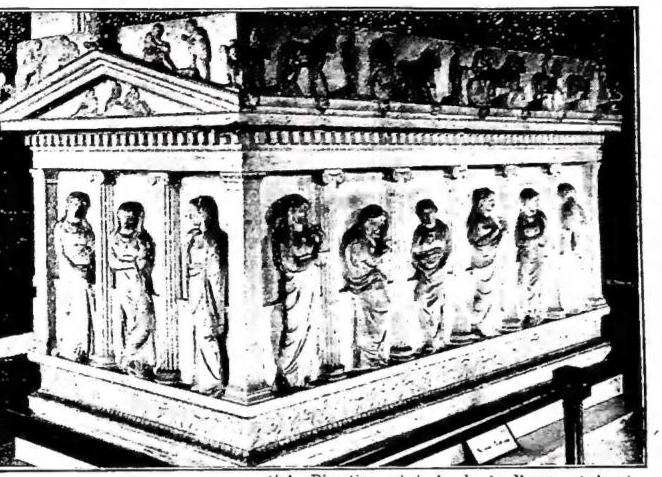
TURCHIA - Hellenistic sarcophagus, known as the "Weeping Women" - Constantinople, Museum.
of the Chinese, Τύβρνοι of the Byzantines). The Orkhon inscriptions, in particular in runic alphabet, besides being the oldest linguistic monument of the Turks, are a remarkable literary document for their epic account of war deeds and the expression of human sentiments. The Türk or Göktürk worshipped a (Turkic) sky god called Tenri and other deities of the earth and waters. Their kingdom ended around 745 A.D. with the rise of the Uigur people, also Turkic, who dominated in present-day Mongolia until 860 A.D. and later, until the 13th century, formed ethnic and political groups further west in what is now called Eastern or Chinese Turkestan.
A new phase in the literary evolution of the Turks began in the 10th century through contact with Muslims and Arab-Persian culture, into which most Turks rapidly integrated following their conversion to the Islamic religion. The first Turkic people to enter Islam en masse in the 10th century was the mixed group of Qarluq, Türkmen, and Oğuz settled between Eastern Turkestan and present-day Russian Turkestan, ruled by the Karakhanid dynasty (10th-12th centuries). One of their sovereigns, reigning in Kašgar in 1070 A.D., was the dedicatee of the poem Kutadgu Bilik ("The Science that Brings Happiness"), a verbose collection of political, moral, and religious teachings by Jûsuf Hâğib (Jûsuf the Minister). Arabic and Persian vocabulary appears, but in reduced proportion; later, the Arab-Persian influence prevails, and even the Uiguric alphabet yields to the dominant use of the Arabic alphabet.
Turkic literature of Islamic inspiration developed especially through the work of mystical brotherhoods in Turkestan; Ahmed Jesevi (d. c. 1166) expressed religious sentiment in short poems collected in a divân that enjoyed wide circulation in Central Asia until recent times. The same Islamic religious current includes the poem Jûsuf ve Zu-
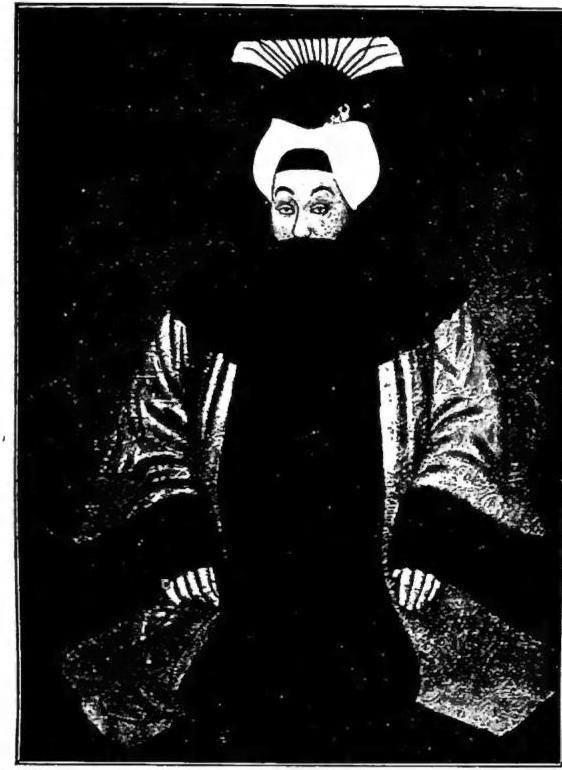
TURKEY - Abdulhamit I. Oil portrait, from the transitional period (late 18th century) - Topkapi Museum.
and the Qīṣaṣ ul-Enbījā ("Tales of the Prophets") by Rabgūzī (early 14th century) in Khwarezm. To the early years of the 14th century is ascribed the only substantial Turkish Christian linguistic document, the Codex Cumanicus, a Latin-Persian-Turkish lexicon with Christian religious texts in Turkish (the Creed, the Pater Noster, hymns to the Virgin) compiled by Italian and German missionaries and merchants on the northern shores of the Black Sea (Genoese colonies).
The limited literary activity of the Turks in Central Asia under Russian and Chinese rule is now expressed in modern varieties of Eastern Turkish (Uzbek, Türki). 2) In the Caucasus and western Persia, Southern Turkish, called Azeri (a form of Oghuz-Turkmen Turkish with eastern influences), lives on in many dialects and has also established itself literarily in the songbooks of Nesīmī, Ḥabībī (15th century), Ḥatā'ī (the poetic pseudonym of Ismā'īl, founder of the Safavid state in Persia), and Fuẓūlī (16th century), and has had interferences with the early development of Anatolian Turkish literature. The so-called Book of Dede Qorqut, an anonymous collection of Oghuz or Turkmen epic tales, remarkable for their expressive power and effectiveness, based on ancient traditions but redacted in the form we know them in the 15th century, is included in Azeri literature. 3) In Anatolia and European Turkey, in the territory of the state that from 1300 expanded to form the Ottoman Empire, absorbing the Byzantine Empire (1453) and the Mamluk state of Syria and Egypt (1516), the so-called Ottoman Turkish literature ('oṭmānī') developed over six centuries, distinguished by linguistic particularities (Southern Turkish evolved without Eastern Turkish influences), environment, and a mixture of cultural and ethnic elements.
Arabic and Persian models (especially in lyric poetry, romantic poems, and novellas) prevail in Ottoman literature, which is not, however, entirely devoid of originality. The learned lyric poetry, called divān edebījāti ("literature of the songbooks"), for which Bāqī (1526-1600), Nef'ī (1582-1636), and Nedīm (1681-1730) are celebrated, describes in brief compositions called qaṣīde the spring or autumn, commemorates men and events, praises and exalts sultans and ministers as benefactors; in other very short poems called ġazel, it develops the theme of love with refined conceits and rhetorical artifices, often veiling in the symbols of love (wine, the cupbearer, the beloved and her charms) a complicated figuration of mystical love, which, though sincere in Fuẓūlī (16th century) and a few others, is not easily recognizable in the mass of imitators. The sincerity of religious sentiment, free from metaphors and rendered more eloquent by the simplicity of language close to popular usage, is characteristic of a few poets such as Jūnus Emre (13th-14th centuries) and others who constitute a distinct current in Turkish literature, the so-called tekke edebīyātī (literature of the convents or brotherhoods); however, even this current degenerates over time into excesses and loses sincerity. Another literary current is the semi-learned one of minstrels or troubadours (the aṭīq called sāz šā'irleri edebījāti), close to the people in language and intended primarily for singing. Nor has the vein of popular poetry, with its genuine and true artistic motifs, ever faded in the deepest layer of tradition.
Ottoman poems sing of romantic subjects already treated by the Persians (the deeds of Alexander, the loves of Jūsuf and Zulejhā, of Meġnūn and Leylā) or expound mystical teachings (the Ġarībnāme of 'Aṭīq Pasciā) or exalt the life of the Prophet (the risāle-i moḥammedījīh of Yazıcıoğlu Mehmed, 16th century). A small masterpiece of this genre, simple and of heartfelt religiosity, is the Mevlid of Süleymān Çelebi (d. 1421), still recited in Turkey today. Almost the last fruit of the Persian mystical-romantic poetic tradition is the poem Hüsn ü Aşk ("Beauty and Love") by Şeyh Gālib (18th century).
Ottoman prose, highly artificial in language and style, includes works of history, some political treatises (one notable one by Koçi Bey in the 17th century), a bibliography by Kātib Çelebi, and a famous travelogue (Seyahatnâme) by Evliyā Çelebi (both from the 17th century).
The most recent Turkish literature from the 19th century to the present day is characterized by an increasingly close approximation to the sources of Western thought and art and, in a sense, passes through the same phases as the political evolution of the Ottoman Empire and the Republic of Turkey that arose from its ruins. By the mid-19th century, while the Ottoman Empire undertook reforms (tanzīmāt) that would not save it from collapse due to the secession of subject peoples (Greeks, Serbs, Bulgarians, Romanians, Albanians, Arabs), the Turks learned foreign languages, primarily French, came to be educated in Europe, reformed schools, developed the press, and gained awareness of their ethnic individuality, once submerged in the broader Islamic or Ottoman community. The first proponents of this new direction were Ahmed Vefik Pasha (1823-91), Şinasi (1826-71), Namık Kemal (1840-88), and Şemseddin Sâmi Frashëri (1850-1904). Yet it was still a period of predominantly Eastern inspiration, at least in pure literature, of which the most illustrious master at that time was 'Abd ul-Haqq Hâmid (1852-1937).
At the turn of the century, coinciding with the political revolution of 1908-1909, a further step toward renewing sources of inspiration and means of expression took place. Its proponents included the philosopher and poet Zîjâ Gök Alp (1876-1924), the short-story writer 'Ömer Seifüddîn (1884-1920), the writer Hâlide Edîb, the novelists Ya'qûb Qadrî and Reşâd Nûri, and the poet Mehmed Emîn (1869-1924). The Turkish novel of Western type was introduced into literature, attempts were made at theatrical works (unknown to Turks, Arabs, and Persians until a century earlier) through imitation or adaptation of European models, and the language was renewed. The Kemalist revolutionary reform of 1923-1938 led Turkish culture to definitive Westernization, the abandonment of the Arabic alphabet in favor of the Turkish-Latin one (1928), the abolition of Arabic and Persian instruction, and the secularization of education. The effect of these reforms can thus far only be described as having disrupted the literary field, provoked a cultural and spiritual crisis, and not seeming to exclude the reconciliation of the present with the enduring values of the past.
V. ART
For some time now, a reaction has emerged in Turkey against the opinion, widespread in the Western world, that Turkish art is merely art (v.), having received more than it contributed to the centers of Muslim culture, variously identified for the individual arts in Iran, Syria, Egypt, and even India. The sources of Turkish art have been traced to the very regions from which all other Central Asian civilizations of the modern world have drawn, and Turkish influences on the art of other Muslim peoples have been documented. It must be acknowledged, however, that specialized studies and knowledge of probative documents remain scarce, so that to this day it is not possible to express a definitive judgment on the subject.The evaluation of the artistic genius of the Turks must first consider the civilization they expressed before their migrations and conversion to Islam. It is certain that in their early Central Asian settlements, they achieved a high level of culture, with frequent exchanges and contributions to the Scythian and Sarmatian civilizations to the west, and to the Hindu and Chinese civilizations to the east. The cycle of the twelve symbolic animals representing the months of the year (mouse, ox, tiger, hare, dragon, snake, horse, ram, monkey, bird, dog, and boar), and the theme so frequent in sculpted friezes of the struggle between two wild animals, for example, seem to belong to primitive Turkish art: from this, with varying meanings, they later passed into all the figurative civilizations of Asia, including the Byzantine.
Naturally, after conversion, the ideological content and prescriptions of the Muslim religion also determined new orientations for Turkish art. The prohibition against depicting living persons, for instance, forced sculptors and painters to abandon portraiture and figurative depictions of human reality, focusing instead on exquisitely decorative creations. This accentuated the process of abstract stylization of zoomorphic and phytomorphic symbols, and, in miniature painting, of the human type itself. Similarly, after the conquest of Asia Minor, it was not
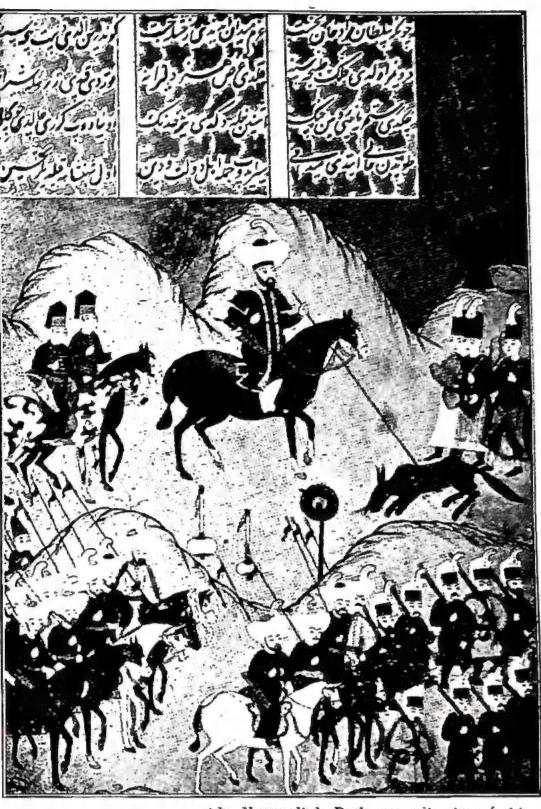
(from Neurvallah Berk, op. cit., pl. f. t.)
TURKEY - A page from Firdawsi’s Shahnameh; the central figure likely represents Mahmud of Ghazna. Miniature by Nakkaş Osman (16th century).
The contact with the advanced Byzantine architecture was not without consequences. There are examples of ancient Christian churches adapted into mosques (among the most interesting constructions, the Guez Han church near Antalya, whose original structure and plan are still identifiable, and the church of Kaleh near Alanya, with its typical Byzantine dome integrated into a system of coastal fortifications).
However, civil architecture remained faithful, despite various functional solutions, to the tradition of the residential house with external loggias and overhangs; decorative art also did not stray and was not drawn outside the orbit of tradition. Only during the Rococo period, due to an infatuation with French culture, and in the 19th century, due to a necessary opening toward the Western world also determined by political reasons, the formal process of Turkish art deviated from its consistent and traditional line.
The group of jamis and méderse artistically most notable dates to the 14th–16th centuries. Particularly interesting as Anatolian products (with courtyard) are the Ulu Cami of Ishak Bey in Manisa (c. 1402), the Yeşil Cami in Antalya, the Ulu Camis of Birgi and Tire; from these derive the jamis and méderse of Sivas, Niksar, Divriği, Akşehir, Van, and Konya. The Isa Bey in Selçuk (1375) can be considered, instead, as the most perfectly preserved example of a mosque without a courtyard. Variants of a more evolved type, which would determine the complex form with multiple iwans and domes, are presented by the mosque of Aqsunqur (1346).
In European territory, the most distinguished monument of this period is the Üç Şerefeli in Adrianople (1410–13). Other Anatolian centers rich in architectural works throughout the surrounding territory include Balat (Miletus), Bergama (Pergamum), and Selçuk (Ephesus). The ritual concept of teaching and the immobility of religious prescriptions soon made the system of constructions uniform, which did not deviate from the fundamental types mentioned above until the appearance of Selim (d. 1578). A genius artist, he adapted his great culture to an intimate need for originality: competing with the masterpieces of Byzantine art, he succeeded in creating a new type of religious building, making the heavy masonry masses and domes agile through a harmonious dialectic of voids and solids. Among the greatest constructions by Selim (over 300), the Süleymaniye (1550–56) and the Şehzade Mosque in Constantinople are remembered, as well as the Selimiye in Adrianople (1570–74), highly articulated in its five vertical registers, with large bundled pillars, galleries of columns, matronea, and loggias, which exalt the space enclosed by the dome in a multiplicity of perspectival variations, characterized by an aerial ascent.
Civil architecture, during the period of greatest splendor of the Ottoman Empire, was enriched with sumptuous palaces, such as the Old Seraglio in Istanbul, which from the Çinili Köşk (1466) to the Baghdad Köşk (1639) engaged the activity of the best Turkish architects and decorators. Public fountains (sebil), caravanserais, bazaars, and baths (particularly famous those of Eski and Yeny Kaplıca near Bursa) constitute the considerable heritage of a remarkable and original architectural civilization.
As with architecture, so too for the decorative arts and particularly for miniature painting (the only language through which Turkish painters could express themselves for many centuries), the original themes and forms must be sought in Central Asia, and the relationships appear close not only with the art of the great Persian masters (Behzad and Mani), but also with Chinese and Indian miniaturists. The advent of the Turco-Mongol Empire, which reached its apogee in the 13th century, coincides with the first great flourishing of Turkish decorative art, particularly in the centers of Bukhara, Herat, and Samarkand.
The miniaturist of the History of the Mongols, written by Rashid al-Din (14th century), is almost certainly Turkish, and the great Persian miniaturist Behzad himself seems to be of Turkish origin. After occupying Anatolia, Konya became the most important center of the new Empire and was adorned with architects and painters such as Tabrizi and Yavaki, and miniaturists like Fethi, Fasihi, and Aynuddevle (also a portraitist).
But it was during the Ottoman period, when the center of cultural irradiation shifted to Bursa, that Turkish miniature painting reached its apogee, with a series of masters not inferior to those of Persia and India.
From Sinan Bey, a painter who left a portrait of Mehmed II in competition with Giovanni Bellini, to his pupil Bursalı Ahmet, to Mirza Ali and Nakkaş Osman, authors of the 110 illustrations of the Hünername (1577), to Baba Nakkaş, who seems to have studied in Venice in Paolo Veronese’s workshop, to Ahmet, called Nakşi, to Mustafa, called Sai, whose work is entirely lost; to Haydar, called Nigâri, all from the 16th century, one arrives in the second half of the 18th century at a final vigorous assertion of creative originality with Abdulcelil Çelebi, called Levnî, considered by many the greatest miniaturist of all time.
Under the reign of Mahmud II, in the 18th century, a conscious shift toward the positions of European culture took place, and the historical value of pictorial documentation was admitted, overcoming the inveterate Islamic prejudice.
Turkish art had differentiated itself from the outset from that of other Muslim regions precisely by its innate and vigorous realism: so much so that in the search for expression, the mark of the Turkish artist appears almost crude when compared, for example, with that of a Persian painter. Once the restrictions, to which only the great masters of the past had not always adhered, were removed, Turkish painting created vigorous portraits (the most beautiful of which, in the 18th century, is perhaps the Ahmed III by Levnî). Later, with the introduction of oil painting, a flourishing of works of considerable interest emerged in this field, such as the anonymous portraits of Abdulhamid I and other princes, preserved in the Topkapı Museum in Istanbul.
However, it was only later, during the reigns of Abdulmejid (1839–61) and especially Abdulaziz (1861–76), a painter and collector himself, that the definitive encounter with European culture occurred. Artists such as Şeker Ahmet Paşa (1841–1907), Süleyman Seyyit (1842–1913), Osman Hamdi (1840–1910), Hoca Ali Rıza (1864–1935), Hüseyin Zekâi Paşa (1860–1919), and Ahmet Ziya Akbulut (1869–1938) were influenced in turn by Courbet, Corot, Fantin-Latour, and Renoir. Subsequently, the modes of Impressionism asserted themselves, thanks to portraitists like İbrahim Çallı (1882) and Reyhan Duran (1886); and landscape painters like Nazmi Ziya (1881–1937) and Hikmet Onat (1885); while the solitary Ruhi (1883–1913), a popular realist unaware of Western influence, and the controversial official painter Hüseyin Avni Lifij (1889–1927), a pupil of Cormon and imitator of Puvis de Chavannes, were active.
BIBL.:
E. Diez, Türkische Kunst, Berlin 1918; G. Goodwin, A History of Ottoman Architecture, London 1971; A. Gabriel, Monuments turcs d'Anatolie, Paris 1931-34; O. Aslanapa, Turkish Art and Architecture, London 1971; R. Ettinghausen, Turkish Miniatures from the 13th to the 18th Century, London 1965; F. Taeschner, Das anatolische Wegenetz nach osmanischen Quellen, Leipzig 1924; E. Kühnel, Islamische Kleinkunst, Berlin 1925; A. Sakisian, La miniature persane, Paris 1929; C. Huart, Les calligraphes et les miniaturistes de l'Orient musulman, Paris 1908; M. S. İpşiroğlu, Das Bild im Islam, Wien 1971; Neurvallah Berk, Türk minyatür sanatı, Istanbul 1946.
G. C. ARGAN
The new generations have produced Muhittine Sâbât (1903-37), a promising master who died prematurely, a group of interpreters of national folklore among whom Turgut Zâym (1904) and Malik Akşel (1903) stand out, as well as the popularizers of French cubism and Italian futurism such as Ali Avni and Zeki Kodgiameni. Together with others, these artists founded in 1928 the so-called "Group D," with the aim of renewing Turkish art and aligning it with Western experiences.
In the post-World War II period, Turkish participation in major international exhibitions has been intense, particularly in London, Paris, and Turin (1949), Amsterdam.
For the minor arts, see in particular the entry TAPPETO. Ceramic craftsmanship flourished in the past. The interior of the Rustem Pasha Mosque in Constantinople is entirely covered with beautiful ceramic tiles.
VI. SCHOOL SYSTEM
It must be noted that in Turkey a genuine school system, worthy of the name, did not begin to take shape until the advent of the republican regime. Before that time, there were no special departments within the Ministry of Public Instruction for the various branches of education, nor offices for libraries and museums. The State subsidized certain types of schools, but without fixed regulations; it did not concern itself with the education of the masses and left every initiative in educational matters to families, who, according to their financial means, would turn to some religious figure to hold classes in a mosque or nearby. The authorities responsible for education at that time were: the head of the religious affairs; the Ecaf, a kind of administrative director; the heads of religious minorities; the authorities overseeing foreign schools; representatives of individual institutions; and, lastly, the Ministry itself.The Republic immediately brought a breath of innovation. As early as 3 April 1924, even before the Grand National Assembly approved the new Constitution (30 April 1924), a fundamental education law established the principle of free and compulsory primary education; in 1928, Article 2 of the Constitution, which recognized Islam as the state religion, was repealed, the Latin alphabet was imposed, and the study of Arabic and Persian was abolished in secondary schools, where only Turkish was to be used; in 1931, Turks were forbidden to receive primary education in foreign schools; moreover, the Ministry took over the directive functions of the school organization and supervision of everything pertaining to culture and civilization (libraries, post-school institutions, publications, and archaeological collections).
At present, schools are divided into seven types:
a) Kindergarten. — Established in 1908, it underwent substantial improvements, especially through the training of new and more numerous teachers better prepared for their duties.
b) Primary School. — Five years in duration. Existing schools in cities and large centers were renovated, updated, and multiplied; but particular attention was given to villages and rural areas, where the rural population had been largely neglected. Thus, rural schools were opened everywhere, intended to raise the level of the great masses of peasants and shepherds. Indeed, these schools were given a prominent position, since the majority of the Turkish population is rural. To ensure a sufficient number of suitable teachers in a short time, the so-called “Village Institutes” were established in 1936—special eight-month courses to train rural educators. These educators must be selected from among peasants who have completed military service with at least the rank of corporal, preferably own a small plot of land, and possess the requisite qualities for the mission they are to undertake. These graduates are responsible for all types of instruction and agricultural work concerning the village where they teach, and they oversee that viticulture, gardening, and similar tasks are carried out properly according to scientific methods, thereby truly promoting the well-being of the population. Primary education also includes daytime and evening courses held in appropriate facilities for the state education of adults.
c) Middle School. — Three years in duration, with instruction in: Turkish language, history and geography, mathematics, physics and chemistry with elements of natural sciences and hygiene, calligraphy, music, physical education, and military culture. Other types of middle schools specialize in preparing students for arts and crafts, commerce, or employment.
d) Lyceum. — Three years in duration; admission is by examination after middle school. It includes: literature, philosophy, psychology, history and geography, mathematics, physics and chemistry, natural sciences, foreign languages, physical education, and military culture. Following the ordinance of 30 November 1940, Latin was introduced in middle schools and lyceums to prepare students for classical studies.
e) Normal School. — Parallel to the lyceum, it trains future primary school teachers. It also includes specialized schools for training teachers of music and drawing, manual labor, and physical education for both primary and middle schools.
f) Vocational Schools. — These are under the direct supervision of a special department within the Ministry of Public Instruction. Initially entrusted to foreign specialists, they are now run by Turkish teachers. The types and curricula vary according to the importance of the professions.
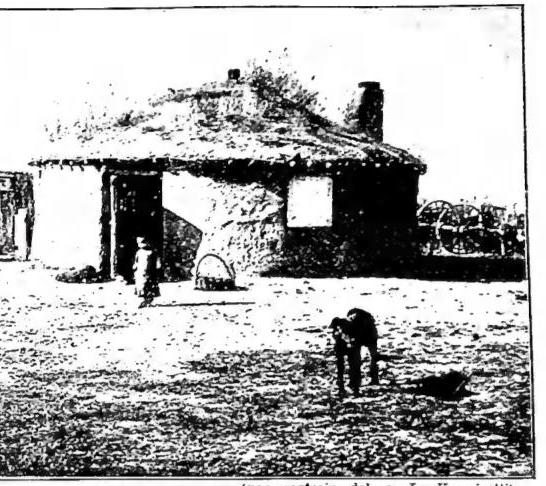
(courtesy of Fr. L. Vannicelli)
TURCO-MONGOLI - Abitazione stabile, in terra battuta, dei mongoli sedentari - Mongolia centrale.
1. ad Ankara: a) l'Università, erettavi dopo il trasporto della capitale da Costantinopoli, che comprende: la Facoltà di lettere, storia e geografia, fondata nel 1935; la Facoltà di legge, fondata nel 1925; la Facoltà di scienze politiche, uno degli Istituti turchi di istruzione superiore meglio attrezzati e più moderni, che richiama le sue origini dal 1848, dalla Scuola di servizio civile creata dal governo ottomano per preparare i funzionari di Stato; b) l'Istituto di educazione fisica « Gazi », uno dei più perfezionati di Europa; c) la Scuola superiore di Agricoltura; d) il Conservatorio nazionale, che raggruppa i principali insegnamenti musicali.
2. ad Istanbul: l'Università, istituita nel 1925 con la riorganizzazione dell'antica Università di Costantinopol