
FUTURISMO. — It is commonly held that f., a literary and artistic movement that made a sensational appearance with the Manifesto published by Filippo Tommaso Marinetti on 20 February 1909 in the Paris newspaper Le Figaro, although marked from its beginnings by a fatuous dilettantism and a merely voluntaristic revolutionism, benefited Italian culture during its period of transition between Carduccian classicism and D’Annunzian decadence on the one hand, and the new literature of the twentieth century on the other. The merit of f., in fact, lies not only in its ironic devaluation of the great deal of sentimental old rubbish, “romantic” in the pejorative sense of the term, but also in having restored the artist’s personality to its naked relationship with the poetic world created.
For Marinetti, creation is “forward movement and a revolution in terms and values” (Pellizzi), and f. “theorizes the closest adherence to the activism and dynamism of the modern world, hence the abandonment of stereotyped contents, psychology, intimate and affective motives, and the adoption of a repertoire of sensations drawn from today’s life, from the new scientific and mechanical reality” (Sapegno). And, to let Marinetti speak, just as “literature has exalted, until today, thoughtful immobility, ecstasy and sleep,” so now the futurists wish “to exalt aggressive movement, feverish insomnia, the running stride, the somersault, the slap and the fist.” Here the debased motives of f. leap clearly into view (motives that, quantitatively and spiritually, unfortunately proved to be the most substantial): a jumble of words without order or connection, and for that very reason “words in freedom,” lyrical anarchy, mental confusion, programmatic and forced revolutionism carried to the utterly improbable, indeed to the ridiculous. In poetry, a din of words; in painting, an abstract whirling of lines and forms; in music, orchestral and choral compositions with intona-rumori; in architecture, an abstract piling up of volumetric blocks; in sculpture, deformed plastic forms intended to destroy staticness and exalt figurative dynamism. Moreover, all this was trumpeted through a series of lectures, conferences, manifestos, newspapers and journals, in an intense and youthful enthusiastic activity that may be said to have lasted, with ever-decreasing attention from the public, until the beginning of the Second World War.
The futurists were Palazzeschi, Soffici, Papini, Carrà, Boccioni, Govoni, Severini—that is, some of the most important writers and artists of our century. But whereas for these f. was simply a human and literary experience, for others (Prampolini, Sant'Elia, Polgore, Buzzi, Balla, Corra, Depero, Russolo, Balilla, Pratella, etc.) f. was the completion and fixed point of their entire artistic and cultural development. With regard to religious thought and moral attitude, the futurists, although they did not engage in any particular polemic against the Faith or against the Church, were ironizing agnostics, skeptics in search of amusement. Their morality was not wholly diffused, not even in the crude form of an imperative of a mechanical conscience, throughout their practical and propagandistic activity.
F. Flora, Dal romantismo al f., Piacenza 1921; C. Pavolini, Cubismo, l'espressionismo, Bologna 1926; C. Pellizzi, La lettere italiane del nostro secolo, Milan 1929, pp. 221–37; A. Moretti, F., Turin 1939 (with bibliography); A. Viviani, Il poeta Marinetti e il f., Turin 1940; B. Croce, Contro gli atteggiamenti artistici, neutrali e morali dei cosiddetti giovani, in Pagine sparse, I, pp. 372–79, Naples 1943.
Giorgio Petrocchi
F. IN ART.
- F. in the field of the figurative arts, especially painting and sculpture, appeared at the beginning of our century as an Impressionism (v.), to which, however, it was linked, Cubism (v.). But while Cubism— cu-
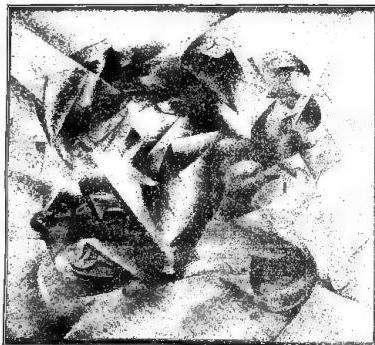
Within this relationship, in addition to light and space, time too must find its expression; hence the artist will depict in his works « the synthesis of what is remembered and of what is seen ». In other words, once the object has been broken down, as the cubists demand, into its formal elements, a more or less whirling sense of motion is imposed upon them. A gesture will no longer be a moment arrested in universal dynamism, but a series of moments following one another and generating a complex movement of lines and masses that convey the interpenetration of the objects themselves in a whirlwind of intersecting planes moving according to spirals, ellipses, triangles, or reflected in spheres, prisms, and so on.
Nevertheless, in comparison with cubism, f. had « the disadvantage of shifting attention beyond the artistic fact instead of concentrating it, as the French movement did, for better or worse, on form » (Salvini, op. cit. in bibl., p. 186).
The first Futurist manifesto, in which the movement’s artistic theories were set forth, dates from 8 March 1910; others followed it, while between 1910 and 1915 the movement attracted some of the most gifted Italian artists to its ranks: particularly Boccioni, who was not only a painter and sculptor
The Futurists assigned a position of great importance in the field of architecture to Antonio Sant'Elia. He, who in 1914 had published his « manifesto of Futurist architecture » and who just two years later died in the war while fighting on the Carso, deserves to be remembered less as an architect (there are no buildings by him, and his drawings are more expressions of a fervent imagination stimulated by an acute polemical sense than manifestations of a builder) than as a critic of architecture. Some of his statements, such as: « By architecture one must understand the effort to harmonize freely » with great daring the environment with man, that is, to render the world of things as a direct projection of the world of the spirit; or that the modern city must be understood as a « gigantic machine in which our tumult may unfold without seeming a grotesque anachronism, because only when architecture has its rationale in the special conditions of modern life will it acquire
its correspondence as an aesthetic value of our sensibility », are truly illuminating for identifying the bonds that must unite modern sensibility with the most current architectural forms.