
TESSALONICA (today SALONICO). – A city on the Aegean Sea, still a frequented port and a populous city. In antiquity it was called Therma, whence the gulf at the end of which it lies was formerly called the Thermaic.
Cassander rebuilt and enlarged it (316 B.C.), giving it the name of his wife Tessalonica, daughter of Philip II, king of Macedonia. After the battle of Pydna (168 B.C.), it fell under Roman power and became the capital of the second of the four
divisions of Macedonia. The city had a hinterland of exceedingly fertile countryside, irrigated by several rivers, including the Vardar; but its characteristics were those of a port city. The port was the object of particular care on the part of the Macedonian rulers, and later of the Romans, who had docks there (navalia: Livy, XLIV, 10. 32) and brought it to considerable prosperity. It was the headquarters of the Pompeians before the battle of Pharsalus (48 B.C.). During the second civil war, it sided with the triumvirs Octavian and Antony; and these, after the victory of Philippi (42 B.C.), granted it recognition as a free city, governed by six πολιτάρχαι, a title used in Acts 17:6, 8. Because of its geographical position, between Thrace, Macedonia, and Achaea, T. attracted St Paolo, who must have considered it a center for the spread of the faith, as it in fact became (I Thess. 1:6 ff.).
An important road network extended from T., whose principal artery was the Via Egnatia, which came from Dyrrachium and was considered the overseas continuation of the Via Appia. It was a meeting point of religions and races, sustained by the traffic of three and the basin of the eastern Mediterranean and by the various industries that flourished there, especially weaving. St Paolo (ca. A.D. 50) found there an important Jewish colony.
EVANGELIZATION. - Christianity entered T. in the apostolic age. In 50–51, during his second journey, s. Paul, coming from Philippi by way of Amphipolis and accompanied by Silvanus (Sila) and Timothy, preached in the Synagogue for three consecutive Sabbaths (Act. 17, 2); there he founded the second Christian community in Europe, recruited especially from the Greek element. The Jews fomented riots and forced the missionary to take refuge first in Beroea and then in Athens, where Paul was joined by Sila and Timothy (Act. 17, 15; 18, 5), whom he subsequently sent back to T. (I Thess. 3, 1).
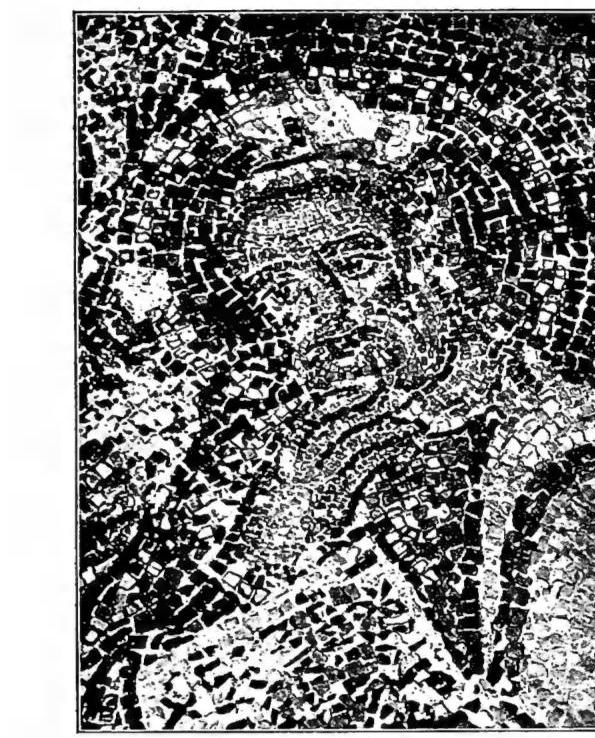
(from S. Bettini, I monaci bicantini, Firenze 1939, plate 5) TESSALONICA – The prophet Habakkuk. Detail of the apse mosaic of the church of St. David.
Bishop Alexander appears at the Council of Nicaea in 325 and at the consecration of the Church of the Holy Sepulchre in Jerusalem in 335. Eusebius identifies him as metropolitan (Vita Constantini, 4, 43, 3). In 378 Theodosius converted to Catholicism at T., whence in 380 he issued the severe Edict against the Arians. After 379 Macedonia was united with the Eastern Empire but remained within the patriarchate of Rome. The metropolitans of T. were the apostolic vicars of Eastern Illyricum from 382 to 389. A Council was held at T. in 518; in 649 the conflict with Rome broke out (Hefele-Leclercq, III, p. 208); in 732 the emperor Leo III definitively separated Illyricum from Rome in order to unite it with Constantinople. T. thus turned toward the schism prepared from the beginning of the sixth century by the separatist intrigues of Andrew and Dorotheus; while, through the activity of Saints Cyril and Methodius,
who were born at T., this city became, from 860 onward, a missionary center for the evangelization of the Slavs. In 904 T. was devastated by a Saracen raid, and in 1185 it was taken by the Normans. In 1204 the Kingdom of T. was created for Boniface of Monferrat (v. CROCIATE), but it had a brief existence; in fact, in 1246 T. once again became part of the Greek Empire of Nicaea. Ceded to Venice in 1423, it was taken by the Turks in 1430, who occupied it until 1912, when it passed to Greece.
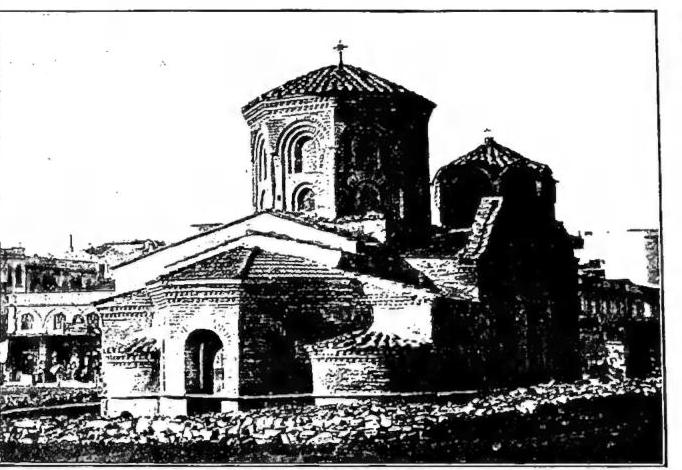
EARLY CHRISTIAN MONUMENTS. - The church of S. Giorgio is built on a Roman rotunda, contemporary with the Arch of Galerius (a. 297); it was transformed into a church in the 5th century, with an apse added on the eastern side. In the dome and in the niches hollowed out in the walls, the mosaics imitate Hellenistic models, whereas the figures of the saints are in the Oriental style. Particularly noteworthy is the frieze with the calendar from the mid-6th century, especially important for its inscriptions relating to the cult of the saints (E. Weigand, in Byzantinische Zeitschrift, 39 [1939], pp. 116–45). The church of S. Demetrio, erected on the site of the martyr’s execution, was built in 412 under Leonzio, prefect of Illyria. It was rebuilt in the 7th century in the form of a cross and subsequently restored several times; in 1917 it was severely damaged by a fire. The original building was a Hellenistic basilica with an atrium and narthex, initially with three and later with five naves separated by columns, and a matroneum. After the fire, several mosaics dating from the 4th to the 9th century were recovered (s. Demetrio, the praying B. Vergine, s. Sergio), together with several frescoes datable from the 6th to the 9th century. The church of S. Parasceve (or Vergine Acheropoietos), from the 5th century, presents the type of the three-aisled Hellenistic Christian basilica, of perfect symmetry, with columns, arches, and Theodosian capitals. The metropolitan church of S. Sofia is the last church built in the Justinianic period; it is a domed basilica with mosaics from the 8th–9th centuries (praying Madonna, G. Cristo, Ascension). Later are the church of S. Davide, with mosaics from the 9th–10th centuries representing the beardless G. Cristo with the symbols of the four Evangelists; the church of the Theotokos, from 1028; the church of the Apostles, with five domes and a cruciform plan, erected in the 14th century under Patriarch Nifone on a pre-existing building; and finally the church of the Transfiguration, from the 14th–15th century.
IL CIMITERO CRISTIANO DI T. - Rinvenuto nel 1899, si sviluppò dietro la necropoli pagana che era situata lungo la via Egnatia fuori delle porte dei Calamari e di Telli-Capon. Era formato di una serie di formae disposte su più file rivestite internamente in stucco spesso, più raramente in marmo bianco; alcune lastricate con grandi mattoni; erano chiuse con grosse lastre di marmo o di schisto e poi ricoperte di terra; l'iscrizione veniva incisa su una piccola lastra di marmo bianco. Si è trovata una grande tomba a volta a cui si accedeva da una scaletta; essa era decorata ai lati con riquadri; nel centro una croce tra due palme e un uccello; nella volta una grande croce. Tra le epigrafi si ricorda quella in latino con «Depositio Barbationis notarii v(iri) c(larissimi)»; una altra in greco di un Doroteo, d'un villaggio probabilmente della Siria, e di una Teodora (P. Perdrizet, Le cimetière chrétien de Thessalonique, in Mél. d'arch. et d'hist., 19 [1899], pp. 541-48). Nel Museo Reale di Bruxelles sono conservate alcune iscrizioni cristiane di T., una in greco appartenente ad un militare di nome Massimiano del corpo degli Ascarii minores; una latina ricorda un tale «Domesticus positus ad do(mnum) Ioan(nem)» che pagò 3 soldi e mezzo per la sua tomba (P. Perdrizet, Inscriptions de Salonique, in Mél. d'arch. et d'hist., 25 [1905], pp. 81-95 e tav. 1). Nota è l'iscrizione greca di Calocero a Macedonia e Sosigenia suoi genitori carissimi con l'augurio di: «sono fino alla resurrezione», e il pesce (G. B. De Rossi, in Bull. arch. crist., 1890, pp. 54-60 e tav. 5, 2); ivi la parola καυμητήριον è in senso individuale, come in altre pure di T. (P. Perdrizet, Inscriptions de Thessalonique, in Mél. d'arch. et d'hist., cit.) caratteristica quella di un Flavio Callisto preposto all'amministrazione dei domini dell'imperatore nella regione, in cui si ripete anche l'augurio per dormirvi fino al giorno della resurrezione (P. Perdrizet, Inscriptions de Thessalonique, in Mélang. d'arch. et d'hist., 20 [1900], p. 229); altre ancora con l'espressione καυμητήριον in senso individuale (ibid., 25
[1905], pp. 86-88; Ch. Azen e Ch. Picard, La nécropole de Thess., ibid., 32 [1912], p. 351). Nella chiesa di S. Sofia fu trovato un frammento epigrafico greco menzionante una giovane Ioanna morta il 21 nov. 535 (I. Pargoire, Le soi-disant épitaphe de la fille de Bélisaire, in Échos d'Orient, 5 [1901-1902], pp. 302-303; ibid., 6 [1903], pp. 62-63). A ca. 30 km. ad est di T. sui monti è una chiesa cruciforme di S. Andrea de Péristerai del sec. IX (A. Orlandos, Τὸ καθολικὸν τῆς παρὰ τὴν Θεσσαλονίκην μονῆς περιστερῶν, in Ἀρχείον τῶν βυζαντινῶν μνημείων τῆς Ἑλλάδος, 7 [1951], pp. 146-47). Recentemente Ch. I. Makaronas ha illustrato la scoperta di un edificio ottagono in muratura, conservato fino a 7 m. al di sopra del suolo primitivo, lastricato di marmo, con decorazione a mattoni rappresentante una croce tra due cipresi. Vi si è trovato un frammento di statua virile nuda e una parte d'un pulpito paleocristiano (Τὸ ὑκτάγωνον τῆς Θεσσαλονίκης, in Πρακτικά Ἀρχαιολογικῆς Ἑταιρείας, 1950, pp. 303-21).