
CYRIL (CONSTANTINE) and METHODIUS, saints. — Greek brothers, called the “apostles of the Slavs”; they lived in the 9th century.
I. IN BYZANTIUM
C. and M. were born in Salonica to the noble magistrate Leone. After the premature death of their father, the protection of the children was undertaken by the imperial chancellor Teoctisto. M., a practical jurist, was entrusted with the administration of a province inhabited by Slavs, probably Macedonia.The younger, Costantino (who took the name C. upon becoming a monk), was summoned by Teoctisto to Constantinople to be educated together with the underage emperor Michele III, among whose teachers were Leone known as the Mathematician and Fozio, the future patriarch. Having completed his studies, C. rejected a court career and received Holy Orders, subsequently accepting the office of patriarchal librarian. But shortly thereafter he secretly withdrew to a monastery. When he was found, he no longer wished to return to the office of librarian; nevertheless, he accepted the chair of philosophy, in which he distinguished himself so greatly that he received the nickname “Philosopher.” At that time he went to the court of the caliph of Baghdad as an imperial ambassador.
Meanwhile, the year 855 brought important political changes. Bardas, the uncle of the emperor Michele and a bitter enemy of Teoctisto, succeeded in gaining the young emperor’s complete confidence and had Teoctisto killed. The empress mother Teodora had to withdraw from government and was later confined to a monastery. Under the government of Michele III, the direction of state affairs effectively passed into the hands of Bardas. The tragic end of Teoctisto and Teodora, protectors of C. and M., also had serious consequences for them. M. renounced his office and became a monk in a monastery on Mount Olympus in Bithynia. C. too withdrew from public life and soon joined his brother at Olympus, where both devoted themselves to prayer and study. The political changes also had consequences in the ecclesiastical sphere. In 858 the patriarch Ignazio was deposed and Fozio, the friend and adviser of Bardas, was elected.
C. and M. kept themselves apart from this painful conflict. Around 860 the emperor entrusted C. with a political-religious mission to the Chazari, who at that time lived along the shores of the Black Sea between the Don and the Caucasus. C. had to submit to the emperor’s order and set out accompanied by M. During the stop at Cherson in Crimea, he took an interest in the tomb of S. Clemente, pope and martyr. Having identified the traditional site of the tomb, C. discovered the relics of s. Clemente and took them with him. C.’s mission achieved its intended purpose: numerous Chazari received Baptism, and the Chan formed a friendship with the emperor. On their return to Constantinople, C. settled near the church of the SS. Apostoli, while M. withdrew to the monastery of Polichronio, of which he became abbot.
II. MISSION IN MORAVIA
Meanwhile, an embassy from Prince Rostislav (846–60), ruler of Great Moravia, arrived in Constantinople to request a bishop and missionaries who could speak the language of his people. Moravia had already been partly Christianized through the work of Western missionaries, who, in addition to spreading the Christian faith, promoted the expansion of the German Empire. Rostislav wished to free his state from the political influence of the German bishops and to provide Moravia with its own hierarchical organization. The emperor chose C. and M. for this mission because, being natives of Thessalonica (Salonika), they spoke Old Slavic well. At that time neither the Moravians nor the other Slavic peoples had a literature of their own. Therefore, before departing, C. devised a new alphabet and began translating the sacred books into Old Slavic. In 863 C., accompanied by M. and several disciples, set out for Moravia, bearing a letter of recommendation from the emperor.In Moravia C. and M. devoted themselves chiefly to preaching and to the formation of the young clergy. With M.’s assistance, C. also translated Byzantine liturgical texts and some Latin ones into Old Slavic. Preaching and the celebration of the sacred rites in a language understood by the people met with great success, but at the same time aroused the hostility of the German clergy, who accused C. and M. of heresy before Rome. After approximately three and a half years of missionary activity in Moravia, C. and M., together with a number of selected disciples, went to Rome. They were solemnly received by Pope Adrian II (867–72), because they had brought with them the relics of St. Clement. Having been informed of their activity in Moravia, the Pope recognized the orthodoxy of C. and M. and approved the use of Old Slavic in the liturgy. M. was ordained a priest, and C. probably a bishop. Meanwhile, C. fell seriously ill. During his illness he took the monastic habit. C. died on 14 Feb. 869 and was buried in the basilica of St. Clement.
After negotiations with the princes of Moravia and Pannonia, the Pope appointed M. archbishop of Sirmium and sent him to Moravia as a papal legate. While returning, M. was arrested and imprisoned after a semblance of a trial held at a synod attended, among others, by Adalwin of Salzburg, Annone of Freising, and Ermenrich of Passau. Only after three years, thanks to the energetic intervention of the new Pope John VIII (872–82), was M. released and able to return to Moravia. But he was again accused of heresy in Rome, especially through the efforts of the German priest Viching, who succeeded in winning the sympathies of Prince Svatopluk (870–94), Rostislav’s successor. M. went once more to Rome, where he fully vindicated himself, while the Slavic liturgy was again approved. Moravia received its own hierarchical organization under M.’s leadership; but Viching too, thanks to Svatopluk’s protection, obtained the suffragan see of Nitra. M. devoted the rest of his life to consolidating the ecclesiastical organization, drawing on an extensive literary activity. But his perfidious suffragan Viching succeeded in completely alienating Svatopluk from M. and, through various intrigues, embittered the final years of his archbishop. M. died on 6 Apr. 885, after designating as his successor his disciple Gorazd, a Moravian nobleman.
III. LITERARY ACTIVITY
S. C. is rightly regarded as the father of Slavic literature, the inventor of the Slavic alphabet, and the first writer in Old Church Slavonic. He translated the Byzantine liturgy into this language, namely the Euchologion (Ritual), the Gospels, the Epistles, and also certain Latin liturgical texts; after his death M. completed the translation of Sacred Scripture, except for the books of the Maccabees, translated the Nomocanon and an anthology of the works of the SS. Fathers. C., for his part, wrote in Greek a brief history of the discovery of the relics of s. Clement, a panegyric and a hymn in his honor, and a polemical work against Jews and Muslims, later translated by M. into Old Church Slavonic. The literary activity of the ss. C. and M. was continued by their disciples, especially in the Balkans, whence it later spread to Russia.IV. THE CULT
Immediately after their death, C. and M. were venerated as saints by the Slavic peoples, in both the Western and Eastern rites. In addition to the respective days of their passing — C., 14 February; M., 6 April — their common feast is also celebrated. In the Latin rite, established on 5 July when it was extended to the universal Church (Leo XIII, 25 October 1880), it was later transferred to the 7th of the same month (11 December 1897); in the Eastern rite it is celebrated on 11 May by both Catholics and dissidents. The work of SS. M. and C. left a clear mark on the early Christian culture of the Slavic peoples, and they are therefore venerated by them as the « apostles of the Slavs ». However, C. and M. were not numbered among the saints of the dissident Constantinopolitan Church, probably because of their constant fidelity to Rome.Fr. Pastrnek, Dějiny slovanských apoštolů Cyrilla a Methoda, Prague 1902, in the appendix, sources; Fr. Grivec, Die heiligen Slavenapostel Cyrillus und Methodius, Olomouc-Mainz 1928; C. Mohlberg, Il Messale glagolitico di Kiev, Rome 1928 (with an extensive historical introduction); P. Lavrov, Materialy po istorii vazniknovenija drevnejšej slavjanskoj pišmennosti, Leningrad 1930 (Old Slavonic sources); Fr. Dvornik, Les Légendes de Constantin et de Méthode vues de Byzance, Prague 1933; G. A. Iliinskii, Opyt sistematicheskoj bibliografii, Sofia 1934 (complete bibliography); Fr. Grivec, Vitae Constantini et Methodii, in Acta Academiae Velehradensis 17 (1941, t-itt), pp. 1-127 (Latin version of the Old Slavonic lives with notes); Fliche-Martin-Frutz, VI, pp. 467-80.
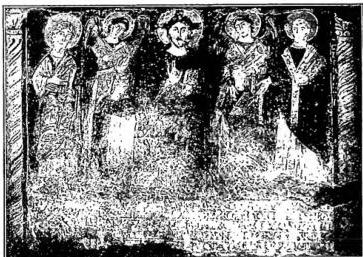
CIRILLO E METODIO - Christ the Judge. Scene interpreted by Wilpert as the particular judgment of St. Cyril, who died in Rome on 14 February 869. Fresco from the tomb of St. Cyril in the lower church of San Clemente (10th or 11th century) - Rome.