
SLOVACCHIA (SLOVENSKO). – Historical region of central Europe, formerly part of Hungary (906–1918), then of Czechoslovakia (1918–39), subsequently an independent State (1939–45), and now once again part of Czechoslovakia.
I. GEOGRAPHY
The traditional boundaries of S., which between March 1939 and May 1945 constituted a stable unit detached from Czechoslovakia, are marked in the west (toward Moravia) by the ridge of the White Carpathians and the lower course of the Morava, and in the east by the valley of the Ung, which divides it from so-called Subcarpathian Russia (now annexed, under the name of Transcarpathia, to Soviet Ukraine). The Beskids form the traditional frontier with Poland to the N., and the Morava that with Austria to the S., while the boundary with Hungary is, except for an initial stretch (the Danube), entirely conventional. S. covers 48,957 sq. km. (approximately Piedmont and Lombardy combined).S. consists of a larger northern part, formed by a series of fairly high elevations (Gerlachovka, in the Tatras, reaches 2,663 m.), covered with forests, massive and monotonous, yet traversed by longitudinal valleys (the upper valleys of the Vah and the Hron, flowing into the Danube; and of the Poprad, a tributary of the Vistula) and transverse valleys, on whose floors cultivation and settlement are possible; and a southern part, where the plains open out, the most important of which extends along the Danube, between the mouths of the Morava and the Hron.
The population (12.5 million inhabitants; density 72 per sq. km., 53 in the mountain regions, 110 in the southwestern plain) includes one-fifth immigrants (Hungarians, Israelites); the remainder consists of Slovaks, related to the neighboring Czechs and, like them, belonging to the Western Slavs, but distinguished from them by the strong influence undergone during the nine centuries of Magyar subjection.
The economy of S. combines modest agricultural resources
(cereals, sugar beets, potatoes; nearly all of Czechoslovakia’s wine and tobacco) and pastoralism, which predominates in the northern regions (sheep and horses), with considerable industrial development (mechanical, steel, chemical, ceramic, and food industries), favored by an abundance of raw materials (iron, copper, mercury, nickel, cobalt, in the Ore Mountains; manganese, salt, petroleum; nor are gold and silver lacking), which made it the most industrial region of the former Kingdom of Hungary. Its forest resources too (one-third of the total territory) are considerable.
Only one city, Bratislava, the capital, exceeds 100,000 inhabitants (185,000 in 1939); among the others, the most notable are Komárno (31,000 inhabitants), another port on the Danube, and Košíce (61,000 inhabitants), in the upper basin of the Hernad (Tisza), an economic and cultural center of eastern S.
II. HISTORY
Before the Slavs, Celtic and Germanic tribes occupied the territory of S.: Marcomanni, Quadi, Boii, Hunni, etc. From the fortified limes on the Danube, the Roman Empire advanced beyond it in the 2nd century A.D. The emperor Marcus Aurelius intended to establish a new province of the Empire precisely in the territory of S., and twice personally led his legions in wars beyond the Danube (A.D. 169–75 and 180). A Roman legion settled on the site of the present-day city of Trenčín (then Laugaritio), where it carved a dedicatory inscription into the rock. This is the oldest written monument on the soil of S. (A.D. 179). The first Christians were in fact the Roman soldiers of Marcus Aurelius. The historical reliefs on the Column of Marcus Aurelius in Rome preserve the memory of a miraculous rain, obtained through the prayers of the Christian soldiers (v. Grisar, Il prodigio della legio fulminata, in Civ. Catt., 1895, 1, pp. 716–24).The Slavs (Slovèni, Slovaks) crossed the Carpathians in the 6th century and settled in the Danubian plain and beyond, in Pannonia, where they remained permanently, although in the following centuries part of the Croats, then the Avars, and finally the Hungarians passed through that region. In the 7th century, the leader Samo attempted to organize the first Slavic state in-
From the 11th century onward, the missionary work of the monastic Orders also began; the Benedictines established themselves at Zobor (1000), Sv. Beňadik (1075), Opátska pri Košiciach (1143), and in twelve other monasteries. Then came the Cistercians (Lipovník 1141, Štiavníkána Spiší 1223); the Premonstratensians (Bzovík 1130, Jasov), the Carthusians (Lapis refugii-Skala útočišťa 1299); the Augustinians (Velký Šariš 1270); the Paulines (Mariánka 1377); the Franciscans (Bratislava 1240, Trnava 1240, Okoličné 1314); the Dominicans (Gelnica 1288, Košice 1300), etc.
For their part, from the 12th century German merchants and craftsmen, invited by the kings and benefiting from their privileges, settled in the mineral-rich mountain regions, founding flourishing towns (e.g., Kremnica, Banská Štiavnica, Kežmarok, etc.) rich in important Gothic monuments. Many of these colonists gradually assimilated into the Slavic population; the others, in the region of Spiš (Zips) and Kremnica, remained until 1945, when they were obliged to leave the country. The Turkish invasions also opened the gates to the Protestant Reformation, which was favored by inadequate ecclesiastical organization. The Slovak territory was divided between the two dioceses of Nitra and Esztergom; the latter remained vacant at the most critical moment for a full 34 years and in 1543 had to be transferred to Trnava, where it remained for three centuries. The restoration of Catholicism was begun above all by Archbishop Nicholas Oláh (1553–68), who summoned the Jesuits; in 1561 they established themselves at Trnava, and in the 17th century they had 22 houses in the territory of present-day S. They founded the University of Trnava in 1635 (transferred to Budapest in 1776), then the Academy of Law at Cassovia, as well as several colleges, residences, and missionary stations. Several of them suffered martyrdom in the work of Catholic restoration, for example, the bb. Cassovia (v.). Particular merit also Pázmány (v.) for having made Trnava the center of Catholic influence for the surrounding regions.
In the 20th century, on the other hand, there was a revival through the penetration of the new religious Congregations: the Brothers of the Christian Schools, Redemptorists, Salesians, Verbites, Consolers, etc. During the 19th century, after the Edict of Toleration, peace finally came to the religious sphere. The number of Protestants (Lutherans) remained stationary from that time onward (16%). Revolutionary ideas from the West had no influence in ecclesiastical affairs, and until 1918 the Church occupied a privileged position: the bishops were treated as princes, and the traditional system of pastoral care remained intact, since the people were deeply religious. National awakening, on the other hand, began, led by Catholic priests gathered around Fr. Bernolák. This movement, initially neglected by the Hungarians
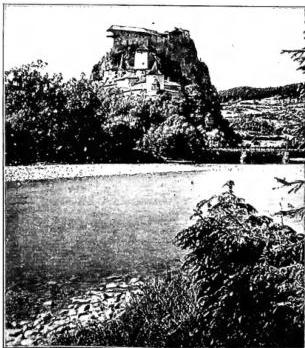
(by courtesy of Fr. Lachá, S. J.) SLOVAKIA - Orava Castle (13th–18th centuries).
and after 1848 encouraged by the Austrians, was instead targeted by the Hungarian government after 1867. And while, following the Hungarian Revolution of 1848, Slovak bishops were appointed in S., with 1867 a period of Magyar domination began. The bishops of S. were exclusively Hungarians. The simple Slovak priests remained with the people and were often persecuted for this reason, such as, for example, Radlinský, Slotta, Mišík, Hlinka, Medvecký, and Osvald. At the beginning of the 20th century, this situation provoked opposition to the Church of a secular nationalist character, led by the school of the “Hlasists,” disciples of Masaryk. If the opposition did not degenerate into the open apostasy of the masses after 1918, as in Bohemia, this was due to the Catholic steadfastness of priests such as Hlinka, Vojtušák, etc.
During the period of the independent Slovak Republic (1939–45), the Catholic People’s Party took over the direction of the country. Indeed, the priest Tiso was elected president of the state. During these years, although they were a time of war, the development of Catholic institutions continued. The representative of the Holy See resided in Bratislava, and in this way agreement was reached between the State and the Church concerning the financing of Slovak schools, the foundation of the Catholic Academy of Sciences, the Central Office of Catholic Action, etc.
After the war (1945–51), the reconstituted Czechoslovakia entered the sphere of the U.S.S.R., and communism began
(by courtesy of Fr. Lacko, S. J.)
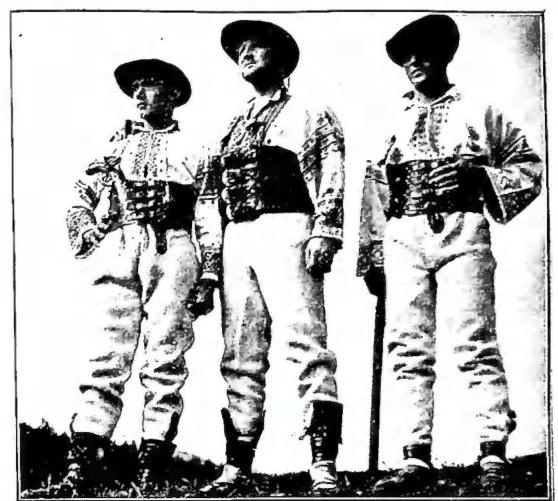
SLOVACCHIA - Men’s costume of Čičmany.
III. ECCLESIASTICAL ORGANIZATION
From the ninth century, the territory of S. depended on the diocese of Passau. In 870 Pope Hadrian II assigned the entire territory of Moravia and Pannonia to the reconstituted archdiocese of Sirmium (Sirmium), under the direction of St. Methodius. In 880 Pope John VIII established the metropolitan see of Moravia (Moravensis), probably based at Velehrad; other places under consideration are: Nitra, Devin, Ostrihom (Strigonia), Vyšehrad. At the same time, the diocese of Nitra was established, and permission was granted to found another. Around the year 1000, King St. Stephen established, for his Kingdom of Hungary, the metropolitan see of Strigonia (whose territory extended over almost all of present-day S.), and ten dioceses. Only the diocese of Nitra, and part of that of Agria (Eger), lay in S. It was only in the seventeenth century that Cardinal Pázmány began to consider dividing the dioceses and founding new ones: thus, in 1771, the Greek Catholic diocese of Mukačevo was established, also embracing all the Eastern Catholics of S. In 1776, three new dioceses were formed from the archdiocese of Strigonia: Neosolio (Banská Bystrica), Scepusio (Spiš), and Rosnavia (Rožňava). In 1804, the diocese of Cassovia was separated from Agria; in 1818, the Greek Catholic diocese of Prešov was detached from Mukačevo (so that until 1918 the metropolitan see of Strigonia had as suffragans Neosolio, Nitra, Mukačevo, and Prešov, as well as the dioceses in Hungary); that of Agria had as suffragans Cassovia, Rosnavia, Scepusio, and Šatmar.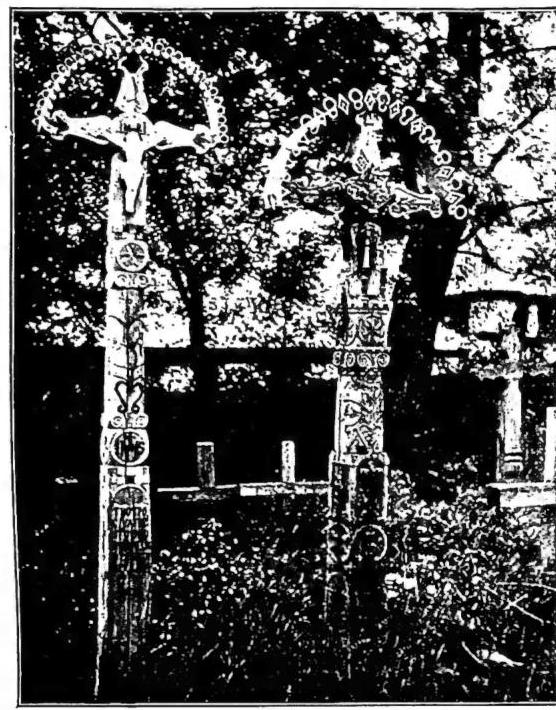
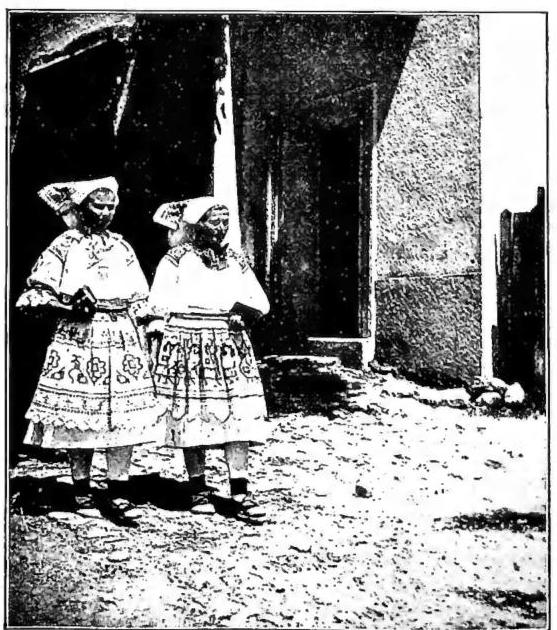
(photo by Ján Hajduch) SLOVACCHIA – Women’s costume of Čičmany.
(courtesy of Fr. LACA, S.J.) SLOVACCHIA - Crosses in the cemetery of Devta (folk art).
In the modus vivendi of 1928, the Holy See undertook to delimit the dioceses anew within the frontiers of the Czechoslovak State and to establish two new archiepiscopal sees: one of the Latin rite in S. and one of the Byzantine-Slavic rite in Subcarpathian Ruthenia, which would also include the Greek Catholics of S. The two archbishoprics were not, however, erected; instead, in 1937 the Holy See decreed that the dioceses delimited according to the frontiers should be immediately subject to II. At present, S. has the five Latin dioceses of Cassovia, Neosolio, Nitra, Rosnavia and Scepusio; the Greek-Catholic diocese of Prešov of the Ruthenians; as well as three apostolic administrations (Tirnava, Satu Mare annexed to Cassovia, and Mukačevo annexed to Prešov).
In 1950, the Greek-Catholic diocese of Prešov was violently destroyed and occupied by the schismatics. In the part of the apostolic administration of Mukačevo, the new schismatic diocese of Michalovce arose.
IV. LETTERATURA SLOVACCA: V. CECOSLOVACCHIA.
V. SACRED ART
The oldest sacred monument in S. is the little church in the castle of Nitra, consecrated ca. 833. It is still debated whether the present structure dates from the 9th century or from the 12th (Hodál-Mencl). Only a few examples of Romanesque art remain: the Rotunda of Skalica (13th century), the Benedictine churches at Deákovce (1228), Biňa (1217), and Jánošovce. The Romanesque cathedral church of Scepusio (Spišská Kapitula) preserves only the western section with the façade. In the villages, several little churches of feudal lords have been preserved: Dražovce, Pominovce, Kliž-Hradište, etc.Gothic art, by contrast, is widely represented, especially in the centres formerly inhabited by Germans: the cathedrals of Cassovia, Bratislava, and Tirnava; the churches of Levoca; St Nicholas in Prešov (16th century); and St Giles in Bardejov (15th century). Jewels of Gothic art are the two family chapels of Zápol'ský at Spišská Kapitula and Spišský Štvrtok (15th century), and in Bratislava the towers of the Franciscans (14th century) and the Poor Clares (16th century). In the province of Scepusio, the type of Gothic church with two naves and a row of columns in the centre developed: Lubica, Veľka, etc. Numerous wooden altars and their corresponding predellas have been preserved in the churches from the Gothic period. The principal Gothic artist was Master Paolo da Levoča, whose most important work is the high altar of St James in Levoča (1518).
Baroque art is even more widespread; it should be noted that only exceptionally is the central space of churches covered by a dome (the Holy Trinity in Bratislava, the chapel of the Seminary in Tirnava); churches generally have a longitudinal layout, with imposing façades featuring two towers and characteristic spires. The most important Baroque monuments are: the University church of Trnava (1640), the cathedral of Neosolio (B. Bystrica), the former Jesuit church in Trenčín, that of Cassovia, the Pauline church at Saštín, the Franciscan church at Prešov, and the Premonstratensian church at Jasov. The Gothic church of Nové Mesto nad Váhom was decorated in the Rococo style. In the 19th century, the Neoclassical style was used almost exclusively by Protestants (Cassovia, Levoča, B. Bystrica). Modern art is still little developed. The most significant examples are the church in Bratislava-Petržalka and St Mary of Peace in Cassovia.
An indigenous art appears in the construction of certain wooden churches, especially among Eastern Catholics in the Carpathians. The wooden church generally consists of three central spaces: the choir (separated from the congregation by the iconostasis), the space for the congregation, and the space beneath the tower. Almost always, characteristic Eastern spires rise above all three spaces.
VI. THE SLOVAKS IN AMERICA
From 1880, approximately 700,000 Slovaks emigrated to the United States and Canada. They were poor, simple, but religious people. Lost in the new world, they soon began to organize themselves, and even before they had priests they built churches and established parishes, subsequently offering everything to the bishop, provided that he supplied the necessary clergy. Today the Slovaks have 290 parishes and approximately 700 priests in the United States and Canada. In Cleveland (Ohio) there is the flourishing Benedictine abbey of S. Andrea Svorad, founded in 1922. In 1951, a convent of Slovak Benedictine nuns was also opened in Chicago. There is, moreover, an indigenous congregation of Slovak religious women: the Sisters of SS. Cirillo and Metodio, with their motherhouse in Danville, Pa. The father of the Slovak emigrants, the priest Stefano Furdek, founded the «Katolická Jednota» Association in 1890; it numbers approximately 170,000 members.V. anche: CECOSLOVACCHIA.
VII. SCHOOL SYSTEM
The particular national circumstances also had a great influence on schooling. Since the Middle Ages, S. had entered the orbit of Hungarian cultural influence, and in the nineteenth century, as Magyarization progressed, the Slovak school system was forced to succumb to II. In 1875 the last secondary schools (3 gymnasia) were suppressed, and in 1907, with the Apponyi Law, the elementary schools too were Magyarized. Thus, after the First World War, the reborn S. had no school whatsoever in the national language. The entire school system therefore had to be rebuilt from the beginning. This radical change took place with great speed, while leaving the minorities schools in their own language. The elementary schools were state-run and free. The great majority belonged to the Catholic Church. The secondary schools—the gymnasia—were almost all taken over by the State after the First World War, but gradually the Church succeeded in reclaiming its rights over some of them. Thus, during the Slovak Republic, out of 53 secondary schools, 17 belonged to the Church. All Catholic schools were subsidized by the State during the brief period of the Slovak Republic (law of 1940). In 1919 the University known as Komensky University was founded in Bratislava; later it was called the Slovak University. From 1936 the Faculty of Theology was also attached to II. After the Second World War, from 1945 onward, with the advent of the Communist regime, the school system was greatly changed; all private schools were suppressed, and the State claimed the monopoly over education. All schools are free of charge. Education was divided according to the Soviet model into three levels: 1) first level: elementary school, lasting 5 years; 2) second level: secondary school, lasting 4 years; and these two levels are compulsory for everyone; 3) third level (lyceum), lasting 4 years, together with the corresponding vocational schools; 4) followed by the university.From 1945, alongside the University of Bratislava, the University at Cassovia (Košice) was founded. In 1949 all minor seminaries were also suppressed, and in 1950 the major seminaries as well. In their place, the (Communist) State opened a Central Seminary in Bratislava, but without agreement with the ecclesiastical authority. Under the Communist system, the school is a powerful instrument for propagating Marxist ideology in Slovakia. -Vedi tavv. XLIX-L.