
SLESIA. — A historic region of central Europe, formerly German and now divided between Poland, which contains almost all of it, and Czechoslovakia, which retains the modest portion (4,423 sq. km with 800,000 inhabitants) assigned to it at Versailles.
I. GEOGRAPHY
Taken as a whole, S., whose boundaries are rather undefined, covers approximately 50,000 sq. km. and essentially encompasses the basin of the upper Oder, from the Sudetes to the Trzebnica Mts., which separate it from the plains of Posnania and Cuiavia. Its mineral wealth (coal, iron, zinc, lead, nickel) has made it one of the most important centres of heavy industry in Europe.Most of S. is divided among the Polish voivodeships of Wrocław (Breslavia), Opole (Oppeln), and Katowice. Its population (6–7 million inhabitants in all) is concentrated largely in the cities; seven of these already have more than 100,000 inhabitants: Wrocław, Chorzów, Katowice, Zabrze (Hindenburg), Gliwice, Bytom, and Czestochowa.
II. HISTORY
In the late Imperial period, various Germanic tribes were settled there, among them the Siling Vandals, in the territories of Breslau, Schweidnitz, and Nimptsch, which subsequently formed the pagus Silensis. The movement of the Germanic tribes westward in the 4th and 5th centuries permitted the advance of Slavic tribes. Slavic settlements were established in the region in the 7th and 8th centuries. In the 9th century, Silesia perhaps formed part of the vast
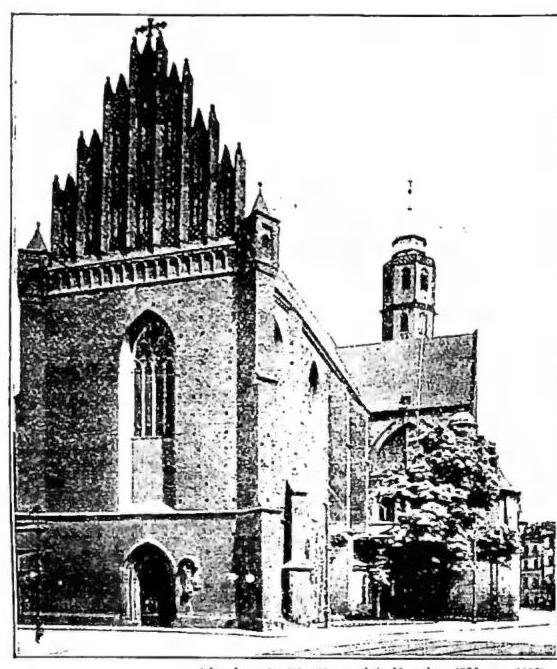
(from La vie d'Italia e del Mondo, 1933, p. 1138)
SLESIA - The church of S. Adalbert in Breslavia (1497).
Cistercians. Thus, in the second half of the 13th century, S. entered the framework of Germany’s economic life, while the dukes’ ties with Poland grew weaker. A new development was the investiture of the vacant Duchies of Breslavia and Lower S., granted by the King of the Romans to his son-in-law, Venceslao II, King of Bohemia (1290), who in 1296 was proclaimed their king by the Poles. The Silesian dukes now began to orient themselves toward Bohemia, and the Bohemian kings of the House of Luxembourg took advantage of this. Several Piast dukes acknowledged their dependence on King Giovanni, and later others did so with Carlo IV. In 1348 he definitively incorporated S. into the Kingdom of Bohemia, together with Moravia and Upper Lusatia. In the 15th century, under Sigiamondo, the war of the Hussite heretics in Bohemia had serious repercussions in S., and the heresy itself also spread considerably. When, in 1459, Giorgio Podiebrad was proclaimed King of Bohemia, Breslavia attempted to resist. During the conflict between Mattia Corvino, King of Hungary, and Vladislav, King of Poland and Bohemia, an attempt was made in 1478 to detach S. from Bohemia and unite it with Hungary. S. continued to remain connected with Bohemia, and in 1526, upon the death of Luigi, son of Vladislav, Bohemia and S. passed to Ferdinando d’Asburgo, brother of Carlo V. Germanization, which had come to a halt in the 14th century under the Luxembourg rulers, now resumed, and Lutheranism also spread. It was only at the beginning of the 17th century that Carlo d’Asburgo, Bishop of Breslavia, energetically began the work of Catholic reaction. The Thirty Years’ War was disastrous for S., which had become an open battlefield between the Imperial and Swedish forces: the country’s economy was ruined. After the war, the Habsburgs introduced new elements into S., granting fiefs to Austrian families; in 1675 the last branch of the Piasts of Liegnitz disappeared. The peace of S. was suddenly shattered by the invasion of Federico II of Prussia in 1740. The attempts by the government of Vienna to reconquer the region were unsuccessful: in the Treaties of Berlin (1741), Dresden (1745), and Hubertsburg (1763), the Prussian occupation was recognized, and the Habsburgs retained only the Duchy of Upper S., with Troppau (Opava). The Prussian occupation led to a deeper Germanization of S., especially when, in the 19th century, a major textile and metallurgical industry developed there. The collapse of Germany in the 1914–18 war awakened the ambitions of the two countries that had dominated S. in the Middle Ages, the Poles and the Czechs.
The Treaty of Versailles (28 June 1919) established a plebiscite in Upper S. (the Oppeln district), where the population was mixed German and Polish. The plebiscite of 20 March 1921 produced 705,000 votes for Germany and 479,000 for Poland. By a decision of 20 October 1921, the League of Nations assigned to Germany the centers of Oppeln, Glewitz, Hindenburg, and Beuthen, and to Poland part of the Ratibor district, with Rybnick, Pless, and Katowice. The Duchy of Troppau was divided between the Poles and the Czechoslovaks. Of Upper S., Poland received 3,221 sq km and Germany 316 sq km; of Lower S., Poland received the territories of Reschtal and Bralin, comprising 512 sq km. The situation of S. remained unchanged until the Second World War. After the Soviet occupation, any subsequent changes are unknown.
BIBL. - M. Morgenbesser, Gesch. von Schlesien, Breslavia 1908; A. Kutsch, Die Stelling Schlesiens zum deutschen Reich im Mittelalter, Berlino 1924; A. O. Meyer, Schlesien in d. deutsch. Gesch., in Histor. Zeitschr., 155 (1936), pp. 278-95; I. Klapper, Schlesische Volkskunde, ivi 1925. Moreover: K. Piwarski, Hist. Słuska w zarysie, Katowice-Breslavia 1947. Other specific works: F. Hanus, Church and State in Silesia under Frederick II, Washington 1944; id., Die ältere Gesch. der Zisterzienser, Breslavia 1947; F. Stumpe, Schlesien, Kitzingen 1951. Francesco Cognasso