
POLAND. - I. GEOGRAPHY. - Poland, as constituted after the Second World War (1945), presents significant differences from the state that existed between 1918 and 1939. Poland was indeed compelled to cede its eastern territories to the U.S.S.R. (180,000 km²), obtaining in compensation from Germany part of East Prussia, Pomerania, and Silesia (103,000 km²). The borders of the new Poland, though not yet definitive (they will be so only after the peace with Germany), are formed to the west by the Oder and the Neisse (Nisa) rivers and to the east by the Bug. The Baltic coastline is now much more extensive (497 km instead of 140 km), and the southern border rests against the Carpathians.
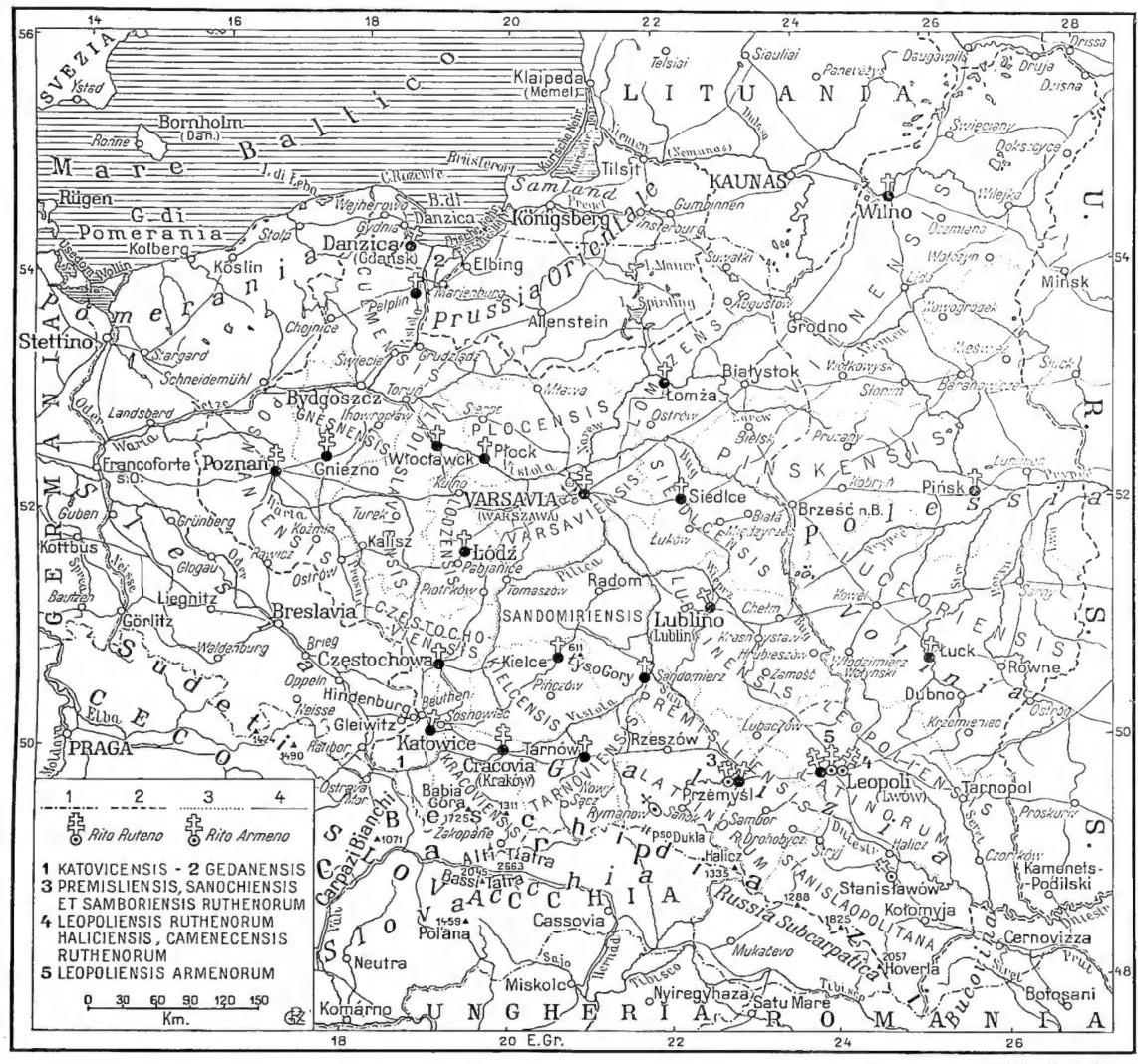
POLAND - 1) Current State border; 2) State border in 1939; 3) ecclesiastical circumscription border; 4) railways.
Poland is a predominantly agricultural State with rich cereal cultivation and substantial production of potatoes, sugar beets, flax, hemp, rapeseed, tobacco, and hops. The livestock population, almost fully restored, includes, among other things, over 6 million cattle, approximately 6 million swine, and 3 million horses; its forest resources (22% of the national territory) are likewise considerable. Fossil coal (Silesia) and petroleum (Carpathians) provide the country with the energy necessary for the development of a varied and vital industry, which has already achieved significant growth, also benefiting, in the western provinces, from pre-existing infrastructure. Steelworks, metallurgy, textile, chemical, and electrotechnical industries all yield substantial surpluses for export. The new Poland offers far better conditions for trade than the old one: greater access to the sea, where there are now at least four ports (Danzig, Gdynia, Stettin, and Kolberg), a more efficient network of roads and railways, and a broader clientele.
Poland is constituted as a unitary republic, termed "people's" according to communist phraseology, with an elective president and diet (Sejm); a State Council and a government, the latter two constituted in different ways, serve as the executive power.
Giuseppe Caraci
II. CIVIL AND ECCLESIASTICAL HISTORY
Origins and the Piast Dynasty (963-1370).
The true history of Poland begins with Mieszko I (963-92), of the Piast dynasty, which emerged from the Polani tribe (region of Poznań and Gniezno). Mieszko I united the other Polish tribes around the Polani and resisted the advance of imperial Germanic forces; defeated in 963, he took revenge in 967 and 972. The most significant act of Mieszko I’s reign was the Christianization of Poland (966), to which his wife, the Czech Dombrowka or Dubrawka, was not indifferent. Thus, Poland entered the sphere of Western Roman Christianity. The first Polish bishopric was that of Poznań (968), of a missionary character and directly dependent on Rome. From 985-92 dates the first national Polish document, the much-discussed Dagome (or "Dagone") iudex, by virtue of which Poland was offered to the Patrimony of St. Peter.
Mieszko I was succeeded by his son Bolesław I (992-1025), who expanded Poland’s borders to the west, reaching the Elbe and the Elster, to the south the Danube, and to the north the Baltic; he occupied Prague (1003), entered Kiev (1018), and reannexed Red Ruthenia (region of Lviv), taken from his father (981). Initially at peace with the Empire, Bolesław I met with Otto III at Gniezno in 1000, then waged war against Henry II (1002-18), which concluded with the victorious Peace of Budziszyn (Bautzen). He supported the mission of St. Adalbert among the Slavs on the southern shores of the Baltic and the Prussians. He founded many monasteries, calling monks from Italy (Camaldolese of St. Romuald), Germany, Bohemia, and Hungary; in Gniezno, he oversaw the establishment of the first Polish ecclesiastical province (1000), with the suffragan dioceses of Wrocław, Kołobrzeg, and Kraków; he also protected the missionary work of St. Bruno on Poland’s eastern borders. In 1024, Bolesław I was crowned king. The reign of his son, Mieszko II (1025-34), was unfortunate. Assailed from all sides (Empire, Bohemia, and Ruthenia), he had to capitulate before Emperor Conrad II (1033); nevertheless, he continued his father’s religious work and, it seems, oversaw the foundation of the diocese of Kuyavia (Władysławia), with its seat at Kruszwica. During the interregnum of 1034-1038, a violent pagan reaction destroyed the ecclesiastical organization of the first three Piasts. It was the son of Mieszko II, Casimir I (1038-58), who restored it, with the Empire’s favor. For security reasons, the capital was moved to Kraków. Initially, only the two dioceses of Kraków and Wrocław were reconstituted, with clergy coming from Germany.
The son, Bolesław II the Bold (1058-79), emulated the deeds of his great-grandfather Bolesław. In the Investiture Controversy, he sided decisively with Gregory VII, who in 1076 sent his legates to renew the metropolitan see of Gniezno. To this period likely dates the foundation of the diocese of Mazovia, with its seat at Płock. On December 25, 1076, Bolesław was consecrated king by the new metropolitan Bogumił. However, Bolesław had Stanisław, bishop of Kraków, killed, who had probably reproached him for his cruelty toward opponents who had taken advantage of an expedition against Kiev to rebel. The violent death of Stanisław provoked such outrage in Poland that the king had to seek refuge in Hungary. He was succeeded by his brother Władysław Herman (1079-1102). Of a peaceful nature, he was compliant with the Empire and subject to German influence.
Bolesław III Wrymouth (1107-38), unlike his father, renewed the deeds of his predecessors by conquering Pomerania between the Vistula, Szczecin, and beyond (1109) and defeating Emperor Henry V (1110). He greatly promoted the Church’s interests, fostering the foundation of the diocese of Lubusz on the Oder (1124) and the restoration of that of Kuyavia, whose seat was transferred to Włocławek (Władysławia). Around 1104, Bolesław received the papal legate Gwalon, bishop of Beauvais; following this visit, a synod was held in Poland that implemented Gregorian reforms.
With the testament of Bolesław III, Poland was divided into four duchies, assigned to his sons; this disintegration of the kingdom lasted from 1138 to 1305, marked by violent struggles among the sons of Bolesław III, then among his grandsons, and finally among the different branches of the dynasty, weakening it severely.
Evidence of this is the submission of Bolesław IV to Emperor Frederick Barbarossa (1157), reaffirmed in 1173, and of Casimir the Just in 1184. Pomerania and Gdańsk broke away from Poland. In 1226, Conrad, duke of Mazovia, to defend himself against the Prussians and carry out missionary work among them, invited the Teutonic Knights into northern Poland. This date marked the beginning of repeated conflicts between Poland and the Order. In 1241, Poland suffered the great Tartar invasion, the first of ninety others until 1697, both Tartar and Turkish. The external danger highlighted the need to reunify the ancient kingdom, which seemed achieved with the election of Przemysł II in 1295. But the following year, the king was assassinated. Amid new turmoil, the Bohemian Wenceslaus II (1300-1305) occupied the Polish throne. Upon his death, Władysław the Short (1305-33) took power, ending the era of "Regional Division." A politically unfortunate period but fruitful from a religious standpoint: the Church grew in strength and authority; synods extended Gregorian reforms (notable was the work of the archbishop of Gniezno, Kietlicz). The Mendicant Orders arrived: the Dominicans in 1222, the Franciscans in 1236, and they also established missions on Poland’s eastern borders. Testimony to the deepening of religious faith is the significant number of blessed and saints from this period (the blessed Wincenty Kadłubek and Ceslaus, St. Hyacinth, the forty Dominican martyrs of Sandomierz, the blessed Bronisława, Salomea, Jolenta, Kinga, and St. Hedwig). The cult of St. Stanisław decisively took hold, becoming a symbol of national unity and canonized by Innocent IV in Assisi in 1253. From the end of the 1300s, the Catholic hierarchy arose in defense of the Polish language and customs against the influence of German colonists (Synod of Łęczyca in 1285, Jakub Świnka, archbishop of Gniezno). Władysław, resisting Bohemian claims to the Polish throne, was crowned king in Kraków in 1320. He fought against the Teutonic Knights (Płowce, 1331), who had occupied Pomerania (massacre of Gdańsk, 1308), Kuyavia, and the Dobrzyń land, definitively establishing their seat at Malbork (1309); however, he did not succeed in recovering the lost territory. Władysław was also faithful to the Roman Church. With his son, Casimir the Great (1333-70), a period of splendor began for Poland. A skilled diplomat, Casimir had the Teutonic Knights cede Kuyavia and the Dobrzyń district (1343), abandoning Pomerania; he secured Bohemia’s renunciation of its rights to the Polish throne; he turned Polish expansion toward Red Ruthenia and Podolia. In Halicz (1367), he founded the second Latin metropolis, later transferred to Lviv (1414). With the clergy’s help, he codified the country’s legislation and, with Urban V’s approval, established the University of Kraków, modeled on that of Bologna but without a Faculty of Theology (1364).
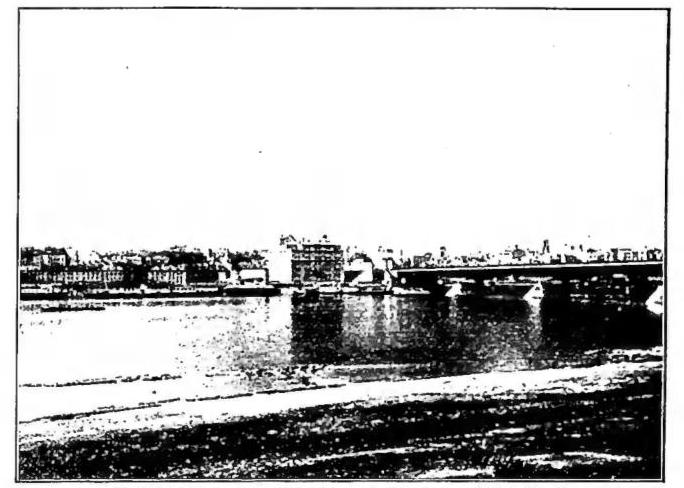
(From Bolesław Bierut, Szeciolatni Plan odbudowy Warsaw, Warsaw 1338, tzv. non numerale)
POLONIA - View of Warsaw, in the foreground the Vistula.
The death of Louis was followed by a highly tumultuous interregnum (1382-84), also determined by the resentment caused by the detachment from Red Ruthenia (1378), desired by the king, and by his attempt to place a German pretender, husband of his daughter Maria, on the throne of Cracow. The crisis was resolved with the decision of the Polish dignitaries to accept Louis's youngest daughter, Hedwig. She indeed came to Cracow and was crowned in 1384. Two years later, by decision of the nobles of Little Poland, Hedwig married the sovereign of Lithuania, Jogaila.
Jagellonians. Era of Greatness (1386-1572). — The pacts of Krewo (1385) laid the foundations of the Polish-Lithuanian union. Having come to Cracow in 1386, Jogaila was baptized with the name Władysław and took the crown after his marriage to Hedwig. In 1387, he introduced Christianity first in Lithuania (where the Catholic bishopric of Wilno was established), and a few years later in Samogitia. Meanwhile, Hedwig obtained the restitution of Red Ruthenia. An important event of Władysław's reign was the "great war" with the Teutonic Knights, which culminated in the victory of Grunwald (1410) and which the Poles failed to exploit, as the Teutonic Knights resumed arms between 1414 and 1424 and again between 1430 and 1433, though without success. At Horodło (1413), the Polish nobility fraternized with the Lithuanian nobility, and the remarkable introduction, dictated by the scholars of Cracow for these pacts, is a singular document of the nobility of intentions and the profound Christian spirit of the nation. In 1400, the University of Cracow was restored with the addition of the Faculty of Theology, by the explicit will of the queen, who had died the previous year in the odor of sanctity. Władysław was succeeded by his ten-year-old son Władysław, known as the Varnese (1434-44), under the guardianship of the great bishop of Cracow, Zbigniew Oleśnicki. The latter was a declared enemy of Bohemian Hussitism (for this reason, the Bohemian crown was refused by Władysław Jagiełło in 1420 and by the Varnese in 1437) and conceived a crusade against the Turks in the Balkans. Accepted in 1440 by Władysław the Varnese, the Hungarian crown initiated the struggle against the Turk, which, after some initial successes, had a tragic outcome in the battle of Varna, where the twenty-year-old king and the core of the Polish and Hungarian armies fell. Casimir, Władysław's brother, then took the crown. During his long reign (1444-92), he pursued a policy of opposition to the great lords of the country in favor of the middle and petty nobility; thus, at the Assembly of Nieszawa (1454), it was sanctioned that every law had to be approved by the local small diets, the "sejmiki," which by natural evolution progressed to gather in a first general Diet, the "sejm walny," or Parliament. Casimir waged a thirteen-year war against the Teutonic Order (1454-66), which concluded with the Peace of Toruń, whereby the master of the Order became a vassal of Poland, which reacquired Pomerania with Gdańsk, the land of Chełmno, Miechów, Warmia, and the region of Marienburg. Casimir's son later also obtained the thrones of Bohemia and Hungary.
Casimir was succeeded by his three sons: John Albert (1492-1501), Alexander (1501-1506), and Sigismund I the Old (1506-48), as elective kings in Poland and hereditary grand dukes in Lithuania. The dynasty ended with Sigismund II Augustus (1548-72), son of Sigismund I. The constitution "Nihil novi" (1505), signed by Alexander, confirmed all the privileges of the nobility and definitively sanctioned the principle that no law or military measure could be taken without the approval of the Diet (Sejm), which consisted of the King, the Senate (the king's council), and the Chamber of Deputies elected by the sejmiki.
Under Sigismund the Old, war broke out with the Grand Duchy of Moscow, which attempted an alliance with the Empire. To counter the danger, the king had to consent to the marriage of his brother's sons, king of Bohemia and Hungary, with the Habsburgs. During this period, the Teutonic Order embraced the Reformation, but Sigismund failed to exploit the favorable opportunity to occupy Prussia. The threat from Moscow induced Livonia to surrender to Sigismund (Treaty of Wilno, 1561). The Union of Lublin (1569) definitively sealed the union between Poles and Lithuanians, creating the "Rzeczpospolita": a true community of peoples (Poles, Lithuanians, Ruthenians) with full equality of rights and duties, with a common Polish-Lithuanian diet; it was also established that future kings would be elected by the nobility.
With the Jagellonian dynasty, Poland reached its greatest splendor in all fields. Especially the magnificent flourishing of science, art, and literature made the Polish 16th century the "golden age" of national culture. Having overcome the infiltrations of the Hussites, the Church in Poland produced a new host of saints, such as St. John Cantius, Bl. Władysław of Gielniów, Bl. Simon of Lipnica, St. Casimir, son of King Casimir Jagiełło, and others. It was, however, unprepared after 1518, when Lutheran ideas reached Poland. Soon, sects began to proliferate, including Socinianism, and much of the nobility adhered to Calvinism; there were even calls for the establishment of a national Polish church with the king at its head; Lutheranism found success especially in the cities. The merit of having saved Poland belongs essentially to Stanisław Hozjusz (v. 1504-79), who was aided by the Nuncio Commendone and the best elements of the Polish clergy, among whom Karnkowski, Herburt, Solikowski, and others stood out. In 1564, the king accepted the decisions and reforms of the Council of Trent brought to him by Hozjusz, who the following year invited the Jesuits into the kingdom. Thus, the Catholic cause in Poland was saved.
Period of Elective Kings (1572-1595). — With the extinction of the House of Jagiełło, Poland established constitutional norms for the election of new kings, whereby, during the vacancy, the first authority of the state (interrex) was the archbishop of Gniezno, to whom the Council of Constance had granted the primatial title; and it was decided that the nobility (siritim) had the right to choose its new sovereign. Warsaw was designated as the site of the elections (the capital was transferred from Cracow to Warsaw only in 1596). The first elected king was Henry of Valois (1573-74), who, like his successors, had to swear the "pacta conventa," which set the limits of royal power.
After Henry's very brief reign, Stephen Báthory (1575-86) ascended the throne of Cracow, described as the greatest of Polish kings. Báthory pursued a far-sighted and tenaciously firm policy, aided by the excellent Polish statesman Jan Zamoyski. The king implemented internal reforms and fully supported Catholicism, which, thanks especially to the efforts of the Jesuits, definitively triumphed over Protestantism. In 1578, the king transformed the Jesuit College of Wilno into an Academy. He waged a victorious war against Moscow (1579-81) and died while preparing an expedition against Turkey.
BIBL.:
For the general history of Poland: J. Dąbrowski, Dzieje Polski średniowiecznej, 2 vols., Cracow 1925-26; O. Halecki, Dzieje unii jagiellońskiej, 2 vols., Cracow 1919-20; S. Kuttner, Kirchenrechtliche Grundlagen der polnisch-litauischen Union, Rome 1938; J. Kłoczowski, Młodsza Europa. Europa Środkowo-Wschodnia w kręgu cywilizacji chrześcijańskiej średniowiecza, Warsaw 1998; for the Jagellonian period: J. Bardach, Historia państwa i prawa Polski, Warsaw 1964; S. Gawęda, Polska i Litwa na przełomie wieków średnich, Cracow 1987; for the reign of Sigismund I: W. Pociecha, Zygmunt Stary, 2 vols., Poznań 1946-50; for the religious history: J. Umiński, Dzieje Kościoła katolickiego w Polsce, Warsaw 1948; T. Silnicki, Dzieje i ustrój Kościoła polskiego w średniowieczu, Poznań 1953; for Stephen Báthory: L. Kolankowski, Dzieje Wielkiego Księstwa Litewskiego za Jagiellonów, Warsaw 1930; W. Sobieski, Trybun ludu szlacheckiego, Warsaw 1923.
— G. M.
Subsequently, the Waza dynasty ascended to the throne with Sigismund III (1587-1632) and his two sons: Ladislaus IV (1632-1648) and John Casimir (1648-1668). During this period, despite the exploits of Polish hetmans, the signs of incipient state disintegration became more severe. Sigismund, a devout Catholic, sought to strengthen his power but provoked the Zebrzydowski rebellion (1606). In attempting to seize the Swedish throne, he involved Poland in a futile war with that power. Victorious in the war against Moscow, which was occupied by his army, he failed to capitalize on the success. In 1596, at Brześć Litewski, the union of the separated Polish Church with Rome was achieved, championed by the Polish Jesuit Piotr Skarga (1536-1612); however, it also claimed illustrious victims, such as St. Josaphat Kuncewicz, Archbishop of Polock (d. 1623), and the Jesuit St. Andrew Bobola (d. 1657). Ladislaus, more prudent than his father, succeeded in concluding peace with Turkey and Sweden. He dreamed of conquering the shores of the Black Sea, but the nobility did not support him. In the year of his death, he witnessed the sudden outbreak of the Cossack rebellion under Chmielnicki. The reign of John Casimir was tragically turbulent: assailed from all sides (Cossacks, Moscow), with its territory occupied by the Swedes, the king sought refuge in Silesia; yet he managed to overcome adversity. In 1660, the Peace of Oliwa was concluded with Sweden (emancipation of Prussia), and in 1667, the Treaty of Andrusovo with Moscow (Ukraine, left of the Dnieper, passed under the Tsar's dominion). Under John Casimir, the so-called liberum veto was first exercised (1652), that is, the disruption of parliamentary debate by the opposition of even a single deputy. After John Casimir's abdication, the nobility elected two "Piast" kings, i.e., Polish, Michael Korybut-Wiśniowiecki (1669-1673) and John III Sobieski (1673-1696), the hero of the great victories at Vienna and Parkany in Hungary (1683), which dealt a mortal blow to Turkish power. After him, foreign domination began to prevail. Indeed, the last Polish kings—Augustus II the Saxon (1696-1733), his son Augustus III (1733-1763), and finally Stanisław August Poniatowski (1764-1795)—were placed on the throne through the intervention of other European powers.
During this period, Poland reached the depths of its decline. After the Battle of Poltava (1709), in the face of Russia's unchallenged dominance and Prussia's intrigues, the Confederation of Bar (1768) emerged as a religious-national movement, led by the Carmelite Marek Jandołowicz. Russia, Prussia, and later Austria responded with the first partition of Poland (1772). When, during the Four-Year Sejm (1788-1792), the renewed Polish ruling class drafted the celebrated Constitution of May 3, 1791—deemed by Herzberg, minister of Frederick William of Prussia, superior to the English one—Russia and Prussia opposed it once more and carried out the second partition (1793). Finally, when the exasperated nation rose under Kościuszko (1794), appealing to the peasant masses, Russia, Prussia, and Austria sought to erase Poland definitively from the political map of Europe with the third partition (1795).
Century of Servitude (1795-1918). – In the two decades from 1795 to 1815, Poles looked with hope to revolutionary France and then to Napoleon. However, he did not fully satisfy their national aspirations. The Peace of Tilsit created only a surrogate of the former kingdom in the Duchy of Warsaw, formed from territories taken from Prussia and later expanded (1809) with some Polish regions wrested from Austria. This state lasted until the emperor's fall. From the Congress of Vienna (1815) to World War I, the Polish geopolitical framework remained largely unchanged, except for Austria's annexation of the Free City of Cracow in 1846 and two anti-Russian uprisings. Poles lived within the borders of the three neighboring powers under different political conditions.
The portion under Austria, called "Galicia," initially underwent intense Germanization and subtle societal divisions (peasants incited against nobles, the "Galician slaughter" of 1846) but later, after 1866, enjoyed a degree of autonomy, becoming, with its cities of Cracow and Lviv and their universities, the driving center of the nation's cultural life. The Prussian part, known as the "Grand Duchy of Poznań," despite fluctuations in Prussian policy and open resistance through a single armed uprising led by Mierosławski (1848), became, after 1840, the scene of ruthless Germanization, intensified under Bismarck. In the Russian part, the largest of all, Lithuania, Volhynia, Podolia, and Ukraine remained incorporated into Russia, while the rest formed the Kingdom of Poland (often called the "Congress Kingdom") with its own parliament and army, united with the Russian imperial crown. It was here that the two successive uprisings (1830-1831 and 1863-1864) provoked profound changes. After 1831, the Kingdom's Statute disappeared, and after 1864, even the remnants of limited autonomy ceased to exist. Yet, in these desolate conditions, the Polish nation demonstrated surprising vitality. The Church and clergy inspired and animated its resistance. When Prussia attempted to weaken the primatial see of Gniezno by personally uniting it with the diocese of Poznań (elevated to archiepiscopal dignity for this purpose in 1821), the clergy opposed it with extreme resolve. During the Kulturkampf, Archbishop Ledóchowski, later cardinal of Propaganda Fide (d. 1902), distinguished himself. Similarly, in Austrian territory, Catholic initiatives flourished, aiming to rally the people around their clergy in a courageous struggle against the centralizing Josephinism of the Habsburgs. The journal Przegląd Powszechny, still in existence, was founded, and the theological faculties of Cracow and Lviv grew in prestige and authority. Russia attempted to separate the Polish Greek Catholic Church from the Catholic Church but faced resolute resistance led by the Basilians. The government showed some tolerance toward Catholics until the first revolution, after which the situation worsened and became tragic after 1863. Feliński, Archbishop of Warsaw, was deported, and the same fate befell other bishops, such as Krasiński, Popiel, and Lubieński. Religious congregations were dissolved, and the Ecclesiastical Academy of Warsaw was transferred to St. Petersburg in 1867. All these persecutions failed to break Poland's religious unity. Exiles, supported by the great poet Mickiewicz, gave life to the new religious order of the Resurrectionists, which took on the task of upholding the religious consciousness of their compatriots. In this spirit, the Capuchins also worked within the "Congress Kingdom," carrying out an intense grassroots evangelization.
Period of Independence (from 1918 onwards). - The outcome of the First World War allowed Poland to regain its independence. Before and during the conflict, notable figures such as Dmowski and Piłsudski had fought for this cause. The faltering Central Powers, seeking to win the sympathies of the Poles, created the Kingdom of Poland on 5 November 1916 with a Regency Council composed of the Archbishop of Warsaw, Monsignor Kakowski, and the princes Lubomirski and Ostrowski. Soviet Russia also declared itself in favour of independence (1917), which was made effective with the fall of the Central European empires (1918). The Treaty of Versailles delineated Poland’s western borders, later adjusted by uprisings and the plebiscite in Silesia, though these did not secure the longed-for access to the Baltic. The eastern borders were instead decided by the war with Russia (1918-20), which concluded with the Polish victory in 1920, sealed by the Treaty of Riga (1921). The eastern borders were subsequently recognised by the Western powers (1923). The early life of the Polish Republic was not easy. Nevertheless, the most severe wounds of war were healed in a short time. In 1921, the first Constitution of the new Poland was voted. The year 1924 marked the great monetary reform. Through a coup d’état, Piłsudski seized power in May 1926. The second Constitution was drafted in 1935.
Great was also the fervour of religious revival: in 1920, a Catholic university was founded in Lublin, and in 1925, a concordat was stipulated with the Holy See. Architects of this awakening, under the guidance of the Visitor and later first Apostolic Nuncio, Achille Ratti (v. 1910-21), were the finest figures of the Polish episcopate, from Bilczewski, Latin-rite archbishop of Lviv, to Monsignor Teodorowicz, Armenian-rite archbishop of the same city, to Cardinals Hlond, Primate of Poland, and Sapieha, Archbishop of Kraków.
The outbreak of the Second World War found Poland united and cohesive. Attacked on 1 September 1939 by Germany and struck from behind by the U.S.S.R., Poland fell. Millions of citizens perished in German concentration camps, while hundreds of thousands were deported by the Russians. The supreme page of glory was written with the tragic Warsaw Uprising (1944). It is therefore no surprise that at the Yalta and Tehran Conferences, in response to yet another attempt to partition Poland, the nation responded with a solemn protest.
III. ECCLESIASTICAL ORGANIZATION
1. For the faithful of the Latin rite, Poland comprises 5 metropolitan dioceses with 25 suffragan dioceses: a) Cracovia, with the suffragan dioceses of Częstochowa, Katowice, Kielce, Tarnów; b) Gniezno and Poznań, with the suffragan dioceses of Chełmno and Włocławek; c) Lviv, with the suffragan dioceses of Łuck and Przemyśl; d) Warsaw, with the suffragan dioceses of Łódź, Lublin, Płock, Sandomierz, Siedlce; e) Vilnius, with the suffragan dioceses of Łomża and Pinsk. 2. For the faithful of the Armenian rite: the archdiocese of Lviv. 3. For the faithful of the Ruthenian rite: the metropolitan see of Lviv with the suffragan dioceses of Przemyśl and Stanisławów. 4. For the Ruthenian faithful of the Byzantine rite: the apostolic exarchate of Lemkowszczyzna.The legal status of the Church in Poland is characterized by two significant events: the denunciation of the Concordat by the provisional government in 1945 and the so-called agreement with the episcopate in 1950.
The Concordat with Poland (AAS, 17 [1925], p. 273 ff.) dated back to 1925 (signed on February 10, entered into force on August 2) and ensured the Church broad freedom of action within its sphere of competence. It regulated, among other matters, issues of particular national interest, such as the ecclesiastical circumscriptions of the various rites (art. 9), the question of ecclesiastical property (art. 24), and the economic treatment provided by the State to the clergy and ecclesiastical institutions, as outlined in a special annex. The denunciation was made following a resolution of the Council of Ministers on September 12, 1945, due to alleged violations by the Holy See, consisting in the appointment of an apostolic administrator for the diocese of Culma in the person of the bishop of Danzig and of an administrator (not archbishop) of Gniezno and Poznań in the person of the German Breitinger, for the Germans residing in the dioceses of Gniezno and Poznań. These were acts in line with common concordatory practice, especially in fluid situations such as those in Poland between 1939 and 1944.
Currently, as far as is known, the condition of the Church is regulated by an agreement signed on April 14, 1950, by a joint commission of government and episcopate representatives. In reality, this is not a true agreement, nor a modus vivendi, and even less a concordat. It is well known, in fact, that in the constant practice and law of the Church, defining the relations between hierarchy and State within a nation falls under causae maiores, which are the exclusive competence of the Roman Pontiff, in relation to the primacy he exercises over the entire Church.
The Polish bishops, in referring to the signed document, have used the term common declaration, which is perhaps the most appropriate.
It consists of 19 articles, some of which—specifically articles 10 (religious practices for students outside schools), 17 (religious assistance in prisons), and 18 (religious assistance in hospitals)—include an explanatory annex, and of an additional Protocol comprising 4 articles, with two explanatory and supplementary annexes to articles 1 and 2.
The first 9 articles contain the government’s demands. They are phrased in harsh terms (even invoking raison d'État, art. 5) and attempt to compromise the Church with political commitments (arts. 1, 2, 6, 7, 8) and territorial ones (arts. 3 and 4), alien to its mission and tendentious in their formulation.
The other ten represent the episcopate’s requests, all and solely aimed at the good of souls (saving what could be saved in matters of religious education in schools, Catholic associations, charitable and welfare works, Catholic press and publications, public worship manifestations, religious assistance to the military, in prisons and hospitals, and freedom of action for Orders and Religious Congregations).
The additional Protocol contains provisions regarding the transformation of Caritas into an association for aiding the indigent, possible economic assistance from the government to the clergy and religious institutions, and the military service of seminarians and priests and religious after their vows.
Pietro Palazzini
LITERATURE. - 1. The Beginnings.
The light of faith did not reach Poland from Byzantium, as it did for other Slavic nations, but from Rome; and the Polish soul received, with Baptism (966), a Catholic and Latin imprint, which is revealed in all its manifestations and first of all in literature. Flourishing, as in every other country, in the shadow of monasteries and cathedrals, it was in its beginnings of an ecclesiastical character and in the Latin language: lives of saints, annals of monasteries, chronicles; among these, the Chronicon Galli anonymi and, later, the chronicle of Magister Vincentius (Kadłubek). The first composition in the Polish language that has survived is the hymn Bogurodzica ("Divine Mother"), sung by warriors fighting against the Teutonic Knights at the end of the 13th century and which became the true national anthem. Religious poems followed; the chronicle of Janko of Czarnków and the Rozmowa Mistrza ze Śmiercią ("Dialogue of Master Polikarp with Death"), the most interesting work of the Polish Middle Ages for its indirect depiction of all the life of the time.
In the 14th century, the migrations of Polish students to the University of Padua intensified; in 1364, King Casimir founded the Studium Generale of Kraków, which became an important cultural center. Among its students was Johannes Długosz (Longinus), author of the monumental Historia Polonica. The introduction of Humanism in Poland occurred not only through students returning from Italy, but particularly through the work of Filippo Buonaccorsi (Callimachus Experiens), a humanist at the court of Kraków; while the taste for Italian art was brought by a legion of Italian artists in the retinue of Queen Bona Sforza.
2. The Golden Century
The magnificent flourishing of literature in the 16th century harmoniously reflects, in a dual Latin and Polish expression, a single spirit. The influence of Humanism merges with the nation's growing self-awareness at the moment of its greatest prosperity. Of classical elegance are the Latin verses of Krzycki (Cricius), Dantyszek (Dantiscus), Hussowski (Hussovianus), and Clemens Janicki (Ianicius), crowned with the poet's laurel. Janicki studied at the University of Padua, and among his works is remembered a beautiful Ode to Italy. Polish poetry reached its greatest heights with Jan Kochanowski ([v.], 1530-84): Pieśni ("Songs"), Fraszki ("Trifles"), various poems, of which Proporzec ("The Banner") is the most beautiful, as well as some dramatic works. A perfect Hellenist, he drew inspiration from antiquity in The Refusal of the Greek Ambassadors, from the people for the Song of St. John at the Sobótka (a traditional festival); he took from his paternal grief the subject of his masterpiece, the Treny for the death of his little daughter Orsola. Kochanowski found many imitators; among them Mikołaj Sęp Szarzyński, whose sonnets are imbued with profound sadness. Elegant versifiers in Polish were Sebastian Klonowicz (1545-1602) and Szymon Szymonowicz (Simon Simonides, 1558-1629), of whom the delicate idylls (Sielanki) are remembered. A wholly original and characteristic work is The Life of an Honest Man by Mikołaj Rej (1505-69), who opposed the classicizing tendencies of the time, judging them a diminution of the national spirit, which he valorized in a simple and colorful description of the life of Polish gentlemen of the time. Belonging to this century is the version of Baldassare Castiglione's Courtier made by Łukasz Górnicki, adapting the protagonist's figure and the setting to Polish psychology and customs, thus making it an original work. Also noteworthy are the bold polemicist St. Orzechowski and Andrzej F. Modrzewski, creator of a project for internal reform of Poland: his Monumentum pro Reipublicae ordinatione had a wide echo throughout Europe.The introduction of the "Reformation," which had ephemeral success in Poland, naturally aroused strong opposition. Sacred oratory flourished with Piotr Skarga ([v.], 1536-1612), whose Sermons to the Diet are justly celebrated not only for their high religious and political sense, but also for their style.
3. Decline and Renaissance. - The 17th century was a century entirely of war for Poland, and literature suffered its repercussions. Nevertheless, though it cannot be compared to the previous one, it does not lack works of value. Maciej Sarbiewski (Sarbiewius, 1595-1640) gained European fame by continuing the Latin tradition and was crowned by the Pope as "the Polish Horace." Another Kochanowski, Piotr (1566-1620), translated Jerusalem Delivered, in the manner in which Górnicki had translated Castiglione, that is, making it a Polish work in sentiment and customs. Andrzej Morsztyn (1612-93), a delicate lyric poet, translated Marino's Adone and Corneille's Cid. The religious and warlike soul of Poland manifested itself in The War of Chocim by Wacław Potocki (1625-96) and in the Psalmodia by Wespazjan Kochowski (1633-1700). In prose, the most representative work of the time is constituted by the Pamiętniki ("Memoirs") of Jan Chr. Pasek, a bizarre and adventurous spirit: he participated in the war against the Swedes, quarreled all his life with his neighbors, had loves and fantastic adventures which he recounted with a spontaneity and truth that give his narrative the character of a lived novel. Under the Saxon kings, all Polish life declined; and literature declined as well.
The Italian influence, which had predominated until the late 18th century, was replaced by French influence with the accession to the throne of Poland of Stanisław August Poniatowski. The new Enlightenment currents influenced literary and philosophical production, preparing the social reforms that, desired by the noblest spirits, were concretized in the Constitution of May 3, 1791, drafted by Abbot Hugo Kołłątaj. Despite the worsening of historical events, there was a renaissance in the field of thought and studies. Notable figures include Ignacy Krasicki ([v.], 1735-1801), bishop of Warmia, a versatile mind, polished prose writer, dramatist, poet, author of the first Polish encyclopedia, of fables, satires, and didactic works; Stanisław Staszic (1755-1826), who wrote political works and a diary of his travels, with interesting pages on Italy; Stanisław Trembecki (1735-1812), a vigorous mind who renewed the literary language; his main work is the poem Zofiówka. Stanisław Konarski, a Piarist priest, concerned himself with the—
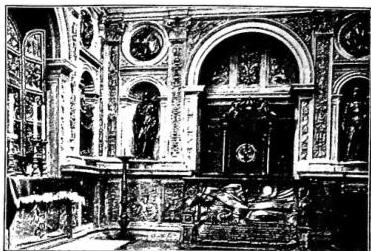
(from Wł. Tatarkiewicz, Architektura Nowożytna od Renesansu do Klasycyzmu, Lvov 1911, fig. 18)
POLONIA - Interior of the Sigismund Chapel of the Cathedral of Cracow. Arch. Bartolomeo Berrecci (1517-36).
4. Classicism and Romanticism. - The conditions of Poland after the partitions and the Napoleonic epic, which had awakened and then dashed Polish hopes, played no small part in the predominance that Romanticism achieved in Poland (v. ROMANTICISMO), where the classical tradition was flourishing and had a center represented by writers such as Feliński, author of the tragedy Barbara Radziwiłłowna, Bishop Jan Paweł Woronicz, and Juljan Ursyn Niemcewicz. Meanwhile, translations of English and German poets created an atmosphere favorable to the development of new tendencies; and when Brodziński (1791-1835), in 1818—six years before the preface to V. Hugo’s Cromwell—published his essay on Classicism, Romanticism, and the Spirit of Polish Poetry, he garnered fervent support from the most refined spirits of the time. Warsaw remained the domain of the classicists until 1820, but in Vilnius, the victory of the Romantics was affirmed through the work of Adam Mickiewicz (1797-1855), and subsequently, of Juljusz Słowacki, Zygmunt Krasiński, and other most noble writers. Adam Mickiewicz presented in Dziady ("The Forefathers") his personal tragedy and that of his homeland; in Konrad Wallenrod, the drama of vengeance against the oppressor; in Pan Tadeusz, the masterpiece of Polish literature, the poem of Lithuania itself, with its enchanting nature, its people, and its customs. The Ballads and Romances, sonnets, and lyrics are imbued with a lofty religious and patriotic sense. Juljusz Słowacki possessed rare dramatic talents: author of numerous plays, poems, and lyrics, he is among the three greatest Romantics the one who best mastered the magic of verse. Zygmunt Krasiński was a thinker and poet; his dramas (Iridion; The Undivine Comedy), like his poems, are marked by the sorrow that shadowed his life and was comforted by a profound faith. Other Romantics included Antoni Malczewski, author of the poem Marja; Seweryn Goszczyński (Zamek Kaniowski); Bohdan Zaleski, who sang of the beauties of the eastern lands; Teofil Lenartowicz (1822-1893), who lived for many years in Florence; and others. Romantic novelists included Michał Czaykowski, a bizarre adventurer who wrote fantastical Cossack novels; Count Henryk Rzewuski, a delightful narrator of episodes from the life of old Poland; and the highly prolific novelist Józef Ignacy Kraszewski, who brought Polish history to life. Comedy flourished with Aleksander Fredro, the greatest of Poland’s comedic playwrights. History found an excellent cultivator in Joachim Lelewel. Finally, Cyprian Norwid (1821-77), profound and at times obscure, connects Romanticism to the Symbolist tendencies.
5. Positivism. - The reaction against Romanticism was determined not only by currents sweeping across Europe but essentially by the very conditions of the homeland that had given such strong impetus to the Romantic movement. Faith in the resurrection of the homeland and the prophecies of its inspired poets had been shattered by the bloody repression of the 1863 uprising. To weary and grieving spirits, salvation seemed to lie in the vision of stark reality, confronted to resolve the problems afflicting the nation. Polish culture thus aligned itself, like all of Europe, with the new doctrines. The poet Adam Asnyk (1838-97) sang: "Shaped by the school of harsh misfortune, we have rejected the sweetness of dreams; thirsting for truth, we seek it alone." Asnyk was one of the most eminent lyricists of the time; alongside him, Marja Konopnicka (1842-1910) stands out, exquisitely sensitive to the beauty of nature and art (one of her finest collections of lyrics is inspired by Italy), as well as to the suffering of the people laboring at home and across the world (Pan Balcer in Brazil). Among the novelists of the period, Bolesław Prus (Aleksander Głowacki, 1847-1912) emerges, who, with Lalka ("The Doll"), provided a portrait of Polish life in which characters are finely drawn; with The Pharaoh, he recreated the atmosphere of ancient Egypt; and he also wrote excellent short stories.
Eliza Orzeszkowa (1841-1910), whose finest novel is Nad Niemen ("On the Niemen"), is also the author of Jewish-themed novels (Meyer); Adolf Dygasiński (1839-1902) is a keen observer of nature (Gody życia, "The Feasts of Life"); Adam Szymański (1852-1916), a political exile in Siberia, drew from his experiences the living material for his Szkice ("Sketches") and stories, in which one finds the kindness, sorrow, and harsh life of exiles. Józef Weyssenhof (1866-1932) is a sober and elegant novelist. But the greatest of all the writers of the time was Henryk Sienkiewicz (1846-1916), who initially belonged to the Positivist current but later broke away with his grand historical novels (the Trilogy, The Teutonic Knights, etc.) and gained worldwide fame for the novel Quo vadis?, set in Neronian Rome, contrasting the pagan environment with that of the early Christians, and containing pages of warm faith. His other works of modern subject matter include Without Dogma (Bez dogmatu) and The Polaniecki Family (Rodzina Polanieckich); many of his short stories, including Hania and The Lighthouse Keeper (Latarnik), are justly regarded as masterpieces. He also wrote travel correspondence, including from Italy.
6. Polish literature from the beginning of the present century to the German invasion. - The reaction against Positivist tendencies in Poland occurred under the influence of French poets (Mallarmé, Verlaine, Baudelaire) and D'Annunzio; but primarily due to the impulse toward inner liberation following the failure of the Positivist program of social and cultural reconstruction. Moreover, Poles already had in their past the finest precursors of modern tendencies: Słowacki and Norwid, whose full value was only then being discovered. The journals Życie ("Life") and Chimera gathered the most notable figures: Stanisław Przybyszewski (1868-1925), author of dramas, essays, and novels tied to Nordic Symbolism; Stanisław Wyspiański (1869-1907), painter, poet, musician, renewer of typographic art, and playwright, who evokes in his intellectual formation certain great figures of the Renaissance. His artistic torment, patriotic passion, and lofty religious sense of life inform his vast production in every field. Belonging to "Young Poland," the poetic school of the early century, are Jan Kasprowicz (1860-1926), whose inspiration reveals profound religiosity, broad humanity, and love for nature; Kazimierz Tetmajer (1865-1940), a delicate lyricist of beauty and love; and Leopold Staff (still living), considered one of the greatest Polish poets. Eminent prose writers of this period include Stefan Żeromski (1864-1928), in whose work patriotic passion prevails; Ashes (Popioły) is the epic of Poland in Napoleonic times; his short stories and dramas reflect the inner
The torment of the search for national freedom. Władysław Reymont (1868-1925) stands out for a humane, serene consideration of social themes. Chłopi ("The Peasants"), Nobel Prize 1924, represents the poem of the land through the changing seasons: men are depicted in the labors of daily life, with their faults and virtues. Ziemia obiecana ("The Promised Land") shows the rise of industrial power in what it has most at odds with the simple and spontaneous life of the spirit, also swallowed by the machine that absorbs all human activities. Eminent prose writers include Wacław Berent (b. 1872) and Wacław Sieroszewski (1860-1940), who, exiled in his youth to the Far East, drew inspiration from his memories in novels of exotic subjects, as Szymański had already done; Juljusz Kaden Bandrowski (1885-1944, shot by the Germans) was a writer of most noble character.
After the First World War, reborn to freedom, Poland saw a broad flourishing of poets and prose writers, among whom it is difficult to choose. The greatest gather around the magazine Skamander: Julian Tuwim, Antoni Słominski, Jan Lechón, Jarosław Iwaszkiewicz, all living; Maria Pawlikowska, who crafted her brief lyrics, similar to Spanish coplas. To the ruralist group Czartak belongs Emil Zegadłowicz; the Pawlikowskis, a true literary dynasty, founded a publishing house for their works and also published those of Maryla Wolska, a poet luminous for her serene vein and religious faith. Finally, Kazimiera Illakowicz holds a special place among modern lyricists; her poem Historia Męczennika Moskwy ("The Story of the Martyr of Moscow") is remarkable, a moving evocation of the Polish priest Budkiewicz killed in Russia. Distinguished novelists include: Marja Dąbrowska (Nocy i dnie, "Nights and Days"); Zofia Kossak, who favors the historical genre; Andrzej Strug; Ferdynand Goetel, and others.
7. War and Post-War
The year 1939 marked the beginning of a catastrophe in the Polish world: it seemed that war would extinguish every manifestation of the spirit. Scholars and artists were deported, universities closed, libraries destroyed. But Poland, accustomed by centuries-old traditions to invasions and wars on its territory, offered a marvelous example of resistance: an underground university arose; countless clandestine newspapers and publications appeared, among which the most famous is Kamienie na szaniec ("Stones on the Trench") by Gorecki (pseudonym of A. Kamiński). Many Poles took refuge abroad, forming intellectual centers of a new emigration in Hungary, Italy, France, England, Persia, and Palestine.Among war correspondence, the following should be remembered: Bitwa o Montecassino ("The Battle of Montecassino") by Melchior Wańkowicz; testimonies of concentration camps: Z. orchłani (translated as "The Death Camp") by Zofia Kossak and Wspomnienie Starobielskie ("Memories of Starobielsk") by Józef Czapski, all of a chronicle nature; while notable literary value is found in: Droga wiodła przez Narwich ("The Road Passed Through Narwich") by Ksawery Pruszynski; Dymy nad Birchenau ("Smoke Over Birkenau") by Szmaglewska; Listy z pod morwi ("Letters Written Under the Mulberry Tree") by Gustaw Morcinek.
Two collections of poems by Marja Pawlikowska, published in England, should be noted; verses by Illakowicz, printed in Hungary; the beautiful poem Kwiaty polskie ("Polish Flowers") by Julian Tuwim and the novel Srebrne Orły ("Silver Eagles") by Teodor Parnicki.
The profound political and social change that began in Poland in 1945 will undoubtedly also influence its literature; but the events are too recent to predict with accuracy how much Poles will be able to preserve of Western cultural tradition, to which they are so deeply tied.
VI. CHRISTIAN ART
The foundations of medieval art in Poland are characterized by an absolute lack of Byzantine influences. Having accepted Christianity from the West in the second half of the 10th century, Poland’s civilization was entirely shaped by Latin centers. Only fleeting traces of slight contact with Byzantine art are noted in Poland, not before the early 15th century, when the rise of the Lithuanian Jagiellonian dynasty brought Poland into contact with the Ruthenian civilization of the Dnieper region.The first to import Western artistic models into Poland were the Benedictines; their oldest Polish abbeys, from the 11th and 12th centuries, particularly that of Tyniec, exhibit a Romanesque character. The Cistercian abbeys (Sulejów), widespread in Poland from the 13th century, oriented their forms toward French Gothic models; and the first churches of the Dominicans (Sandomierz, Kraków), which flourished in Poland following the apostolate of St. Hyacinth, drew inspiration from the so-called mendicant Gothic.
Gothic architecture of the 14th century in Poland achieved its own individual character, the so-called "Vistula Gothic," in buildings where red brick dominates, sometimes fanning out around slender columns. Among the finest examples of Gothic with a distinctly local Polish character are the churches of St. John and of the Virgin Mary in Toruń, the cathedrals of Gniezno and Kraków—both rebuilt in the 14th century—the cathedral of Chełmno, the two-naved collegiate church of Wiślica, the churches of the Virgin Mary and St. Catherine in Kraków, those of the Virgin Mary in Starogard and Poznań, the courtyard of the old University of Kraków, the Town Hall of Toruń, and the chapter house in the Castle of Malbork. This stylistic cycle also included the grand Church of the Virgin Mary in Gdańsk and the Church of the Virgin Mary of Nowe Miasto in Warsaw, both destroyed during the Second World War.
The 15th century marked a greater artistic dependence in Poland on German concepts, linked to bourgeois culture. Ecclesiastical painting and sculpture were then heavily influenced by the late Gothic of Nuremberg, the apogee of which is revealed in Poland in the magnificent altar with the Stories of the Virgin, carved in wood by Veit Stoss around 1490—a masterpiece adorning the apse of the Church of the Virgin Mary in Kraków. Moreover, the 15th century left in Poland some traces of Ruthenian Byzantine-influenced painting, for example, the frescoes of the cathedral of Sandomierz, those of 1415 in the Chapel of the Most Holy Trinity in the Castle of Lublin, and those of 1470 in the Chapel of the Holy Cross in Kraków Cathedral; these form the only Byzantine exceptions in the entire course of Poland’s art history. It is also noted that the expansion of Polish civilization, spreading from the 15th century and particularly in the 16th century into the Ruthenian lands of the Grand Duchy of Lithuania, brought with it the artistic forms of Western Europe, and that, in these borderlands between Poland and the East, Byzantine art was in retreat before Polish civilization, entirely of Latin content. Italian Renaissance taste arrived in Poland in the very early 16th century. It was protected by the court of King Sigismund I, husband of Bona Sforza, and intensely disseminated by courtiers, particularly the grand chancellor Krzysztof Szydłowiecki. The construction of the Wawel Royal Castle in Kraków, entirely rebuilt between 1502 and 1530 by the Italian architects Francesco Italo and Bartolomeo Berecci, became the major center of Italian artistic culture in Poland; which, soon after, with Gian Maria Mosca, known as il Padovano, architect of the Cloth Hall (Sukiennice) in Kraków and of the episcopal palace (1550), dominated the taste of 16th-century Polish architecture and sculpture. Subsequently, between 1600 and 1650, the long and highly productive stay in Poland of the Venetian Mannerist Tommaso Dolabella of Belluno also gave 17th-century Polish painting an Italianate stylistic aspect.
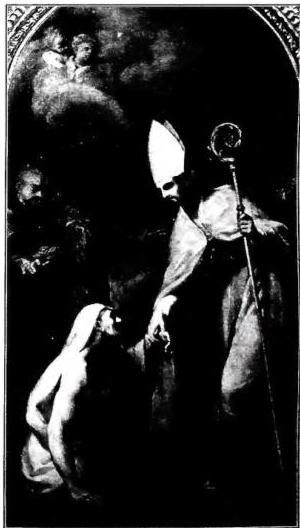
(courtesy of Dr. Wehr)
POLAND – St. Stanislaus, bishop and martyr, resurrects the knight Peter known as Piotrowin. Altarpiece by Tadeusz Konicz (1752). Rome, St. Stanislaus of the Poles.
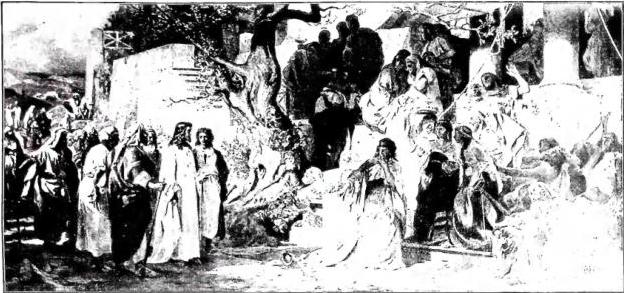
POLAND - The Adulteress. Painting by Henryk Siemiradzki (1873) - St. Petersburg, formerly in the collection of Emperor Alexander III.
the Holy Cross in Warsaw and that of the missionaries in Vilnius, usually have facades adorned on the sides by two towers.
The Baroque flourished at the end of the seventeenth century, leaving some fine monuments in Poland; among them, the suburban villa of Wilanów near Warsaw, built for King Jan III Sobieski, the church of Antokol in Vilnius, and the Krasiński Palace in Warsaw. The Baroque, imbued with a more Italian spirit, was succeeded in eighteenth-century Poland by Rococo, which was rather influenced by the taste of Dresden, where the joint Saxon and Polish court of the time mostly resided. A typical product of this aesthetic orientation is the Brühl Palace in Warsaw. This period is particularly characterized by fantastical altar decorations. In Polish painting of the first half of the eighteenth century, however, the Italianizing trend always manifested itself, represented primarily by Szymon Czechowicz (1689-1776), a Polish painter educated in Rome, traditionally considered the last pupil of Carlo Maratta and a faithful imitator of the latter in his numerous altarpieces, scattered throughout various churches across Poland.
The reign of neoclassical taste arrived in Poland in 1764, with the accession to the throne of Stanisław August Poniatowski, a patron and protector of the arts. It had its first brilliant period throughout the reign of this king from 1764 to 1795; a second flourishing period under the Duchy of Warsaw (1807-15); and a third, more ponderous one after the Congress of Vienna. In its brilliant eighteenth-century phase, neoclassical architecture in Poland was led by Domenico Merlini (1731-97) and his pupil Jan Chrystian Kamsetzer (1753-95), to whom we owe primarily the interior reconstruction of the Royal Castle Zamek in Warsaw (destroyed during the Second World War) and the construction of the charming Łazienki Villa in Warsaw, an architectural jewel of this era. The Polish architect Wawrzyniec Gucewicz gave a neoclassical appearance to the monuments of Vilnius: to the Cathedral in 1777 and to the Town Hall in 1781-83. Painting under the reign of Stanisław August was elevated to a notable level largely through Italian culture, both via Polish painters educated in Rome, such as Tadeusz Konicz (d. in Rome in 1796), a follower of Pompeo Batoni, and Franciszek Smuglewicz (1745-1807), and by Italian masters who settled in Poland, among whom the first was the Venetian vedutista Bernardo Bellotto, known as Canaletto, called to Warsaw by Stanisław August in 1767 and then remaining there uninterruptedly until his death in 1780. The true leader of neoclassical painting in Poland, however, was Marcello Bacciarelli (b. in Rome in 1731, d. in Warsaw in 1818), a painter of sacred, allegorical, mythological, historical scenes, and also a portraitist, whose activity in Poland was highly appreciated by his contemporaries, as shown by the fact that he was ennobled by the Diet of Poland before the final partition of that state. The Tyrolean J. B. Lampi (1751-1830) and Giuseppe Grassi (1758-1838), son of Italian parents abroad, worked in Poland in the late eighteenth century, leaving some excellent examples of their portraitist activities. French culture also contributed to the artistic effort in Poland, having in this era an exquisite representative in the painter Jean-Pierre Norblin de La Gourdaine (1745-1830), a worthy follower of Fragonard. At the dawn of the nineteenth century, the activity of the portraitist Kazimierz Wojniakowski (1772-1812) is noteworthy. In this period, a typical style of furniture was also created in Poland, in which classical forms were adapted to local materials, especially ash wood. Neoclassical architecture persisted in Poland beyond 1850; its forms became increasingly heavy and decorated in an exuberant manner. The leading architects of this late neoclassical period were two Italians active in Warsaw: the Tuscan Antonio Corazzi (1792-1877), designer of the Opera Theatre in Warsaw, and the Roman Enrico Marconi (1792-1863), to whom numerous palaces and the first railway station in Poland are owed, that of Warsaw, known as the "Vienna line," built between 1838 and 1840.
Romantic painting in Poland had its representatives in Aleksander Orłowski (1777-1832), a Pole also active in Russia, and in Piotr Michałowski (1801-55), a precursor of modern twentieth-century pictorial language, a master of high synthetic quality, somewhat derived from Goya.
The second half of the nineteenth century marked a fruitful development in Polish painting; it was inaugurated by the graceful Winterhalterian portraitist Józef Simmler (1832-68). Excellent illustrators followed: the tragic Artur Grottger (1837-67), inspired by the sad end of the Polish uprising of 1863, the battle painter Juliusz Kossak (1829-1899), and the lyrical draftsman Elwiro Michał Andriolli (1836-93), son of an Italian and a Polish woman, born in Poland but educated in Lucca. With the powerful personality of Jan Matejko (1838-93), Kraków became the most important artistic center of the Polish lands in the second half of the nineteenth century; among Matejko's numerous pupils, only the two most notable are recalled: the painter, poet, and playwright Stanisław Wyspiański (1869-1907) and Józef Mehoffer (1869-1940), both excellent designers of stained glass for churches; the latter also worked outside Poland, mainly in the cathedral of Fribourg in Switzerland. The realistic current in Polish painting was largely inspired in the late nineteenth century by the Munich school, where a large group of Polish masters studied; the most notable among them are Józef Brandt (1841-1910), Alfred Wierusz-Kowalski (1849-1915), Władysław Czachórski (1850-1912), the brothers Maksymilian (1846-74) and Aleksander Gierymski (1849-1901), the latter somewhat influenced in his late period by the Florentine Macchiaioli. The exquisite landscape painter Józef Chełmoński (1850-1912), though a pupil of the Munich school, oriented his art rather according to French pictorial taste. Henryk Siemiradzki (1843-1902), a painter of high classical culture, evocator of ancient scenes, was linked to Italian art. Jacek Malczewski represents Symbolism, translated into a language of remarkable chromatic sensitivity. The art of Julian Fałat (1853-1929) and Leon Wyczółkowski (1852-1936) has a distinctly Impressionist formation, of Parisian origin: nonetheless, it is expressed in a highly individual manner.
VII. SCHOOL SYSTEM
The Polish school system was reformed and reorganized between 1945 and 1950. Its aim is to provide youth with purely practical instruction and to educate them according to socialist principles.The Council for School Affairs, established on 28 October 1947, oversees education in collaboration with Parents' Committees and the Student Coordination Committee, founded on 6 November 1947. Students have been granted the right to participate in teachers' meetings whenever school-related issues are on the agenda. Particular importance in general and school education is assumed by the Parents' Committees, established on 26 February 1949. Their tasks include: securing scholarships, books, overseeing school meals and summer camps, promoting socialist education, and monitoring teaching programs and methods. Since 29 September 1950, meetings between Parents' Committees of individual urban centers and the teachers of those centers have been mandatory. Education is divided into preschool, school, and post-school levels. Through this complex organization, the State and the Party exercise full control over the entire development of education. - Vedi tavv. CXIV-CXV.