
LITUANIA. — Baltic republic, which proclaimed its independence from the Russian Empire on 16 February 1918 and was annexed, as a federated republic, to the U.S.S.R. on 22 July 1940. Following the restitution of Vilna and its territory (6,656 sq km with 458,000 inhabitants), obtained from the U.S.S.R. on 10 October 1939, the area of L. rose to 62,550 sq km.
I. GEOGRAPHY
The territory is a portion of the great lowland and, like it, flat, and even more suitable for agri-LITUANIA — 1) State boundaries in 1939; 2) state boundaries in 1950; 3) ecclesiastical district boundaries; 4) railways.
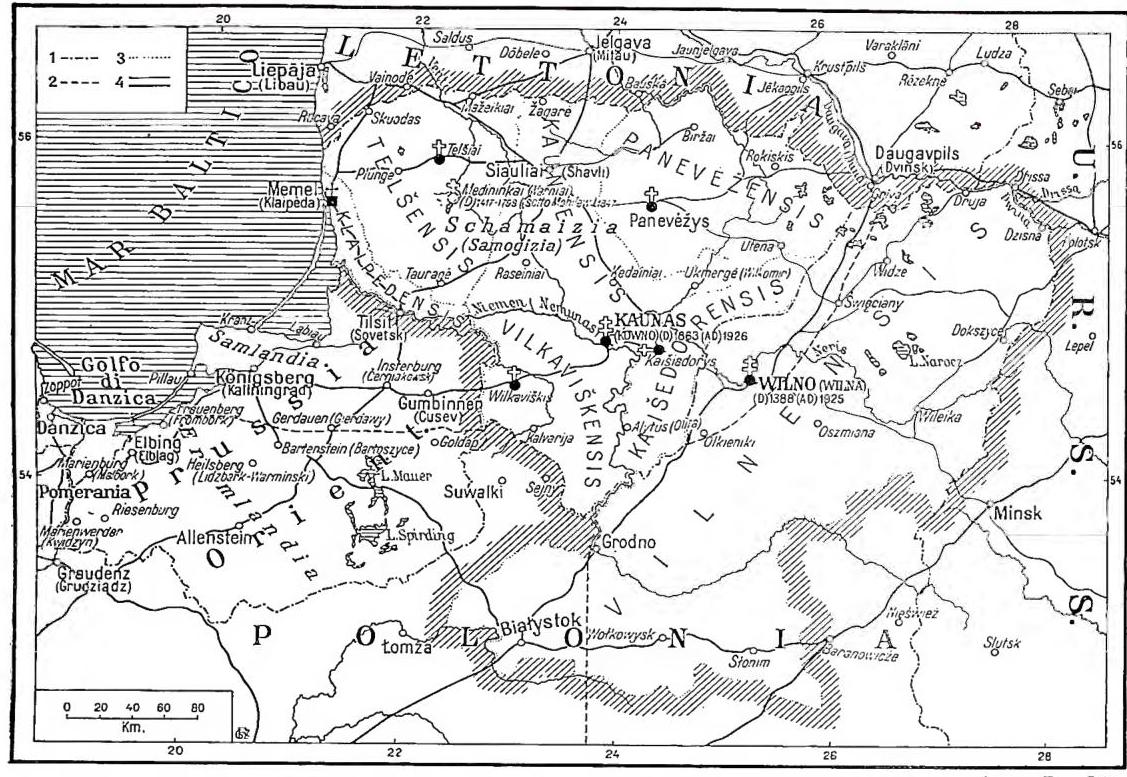
Its coastline on the Baltic, by contrast, is limited (90 sq km, even more noticeably so after the loss of Memel in March 1939, a loss annulled by the return of the Soviets in 1944).
The population, which numbered 3.3 million inhabitants in 1940, suffered greatly from the deportations that accompanied the German and Russian occupations, and from the exodus of the Germans, who constituted a significant minority (1.4% of the total). At that time, Lithuanians formed 84% of the population; Jews 7.7%, Poles 3.2%, and Russians 2.7%. The capital, initially established at Kaunas (153,000 inhabitants in 1939), was transferred after 1941 to Vilna (210,000 inhabitants), which Lithuanians have always regarded as the center of their nation.
L. has a predominantly agricultural economy (77% of the population was engaged in it), with the production of cereals and, above all, flax (a state monopoly) and hemp. Forest resources are considerable: timber supplies the cellulose and paper industries. Livestock farming was also prosperous (1.2 million head of cattle) and made possible a substantial export of meat and butter. The incorporation of L. into the Soviet Union inevitably produced a profound transformation in the country’s economic structure, of which, however, little is known.
II. CIVIL AND RELIGIOUS HISTORY
The Lithuanians, together with their neighbors the Letts and Prussians (the latter having disappeared under the rule of the Teutonic Order), belong to the Indo-European stock. Having remained relatively isolated for a long time, they have preserved their ancient linguistic forms.Modern Lithuanian, with its archaic forms, is the closest of all European languages to ancient Sanskrit.
From the time of the Corded Ware culture of the Neolithic period (c. 1800 B.C.), traces of the ancient ancestors of the Lithuanians are found in the area between the Vistula and Dvina rivers. Tacitus, in the Germania, distinguishes them by the generic name Aestiorum gentes, and Ptolemy (A.D. 150) already names two distinct tribes. The numerous discoveries of Roman objects (ornaments, coins) demonstrate the existence of flourishing cultural and commercial relations with the Romans in the first-fourth centuries A.D.
1. Ancient religion
Modern research into the ancient religion of the Lithuanians shows that it consisted in the spiritualization of the various forces of nature and their manifestations.In his conception of the world, the ancient Lithuanian saw no clear line of demarcation between human beings, the plant and animal kingdoms, or the heavenly bodies. In every manifestation of the surrounding nature he perceived the presence of life, whose varied manifestations he attributed to mysterious vital forces.
Certain beings (animals, plants, etc.) appeared to him to possess a mysterious life to a pre-eminent degree. Thus, in historical sources, almost until the seventeenth century (including the reports of nuncios), mention is made of the survival among the people of traces of ancient paganism in the veneration of the serpent, which people kept in the corners of their houses. Among other animals, judging also from the ornamental motifs of folk art, the horse, goat, ox, and cock seem likewise to have been objects of particular predilection.
Trees too were held in special esteem: among them the oak, lime, rowan, fir,
Death and evil were imagined as spirits, mysterious immaterial forces that threatened human beings at every step and could dwell both in various parasites, bringers of disease, and in the eyes of human beings (the evil eye). For warding off evil, the sound of a little bell was also effective, and it was considered lucky to have a rowan stick with one.
The most powerful means of warding off evil and purification, which annihilates and consumes everything, was considered to be fire. It was believed that even in a conflagration it was the spirit of fire that manifested itself powerfully and mysteriously in the lightning, which, by kindling the flame, demanded and took for itself the sacrifice of human possessions. Hence the rites of spontaneous offerings, burned to propitiate the divinity of fire. Many survivals of this particular cult were tenaciously preserved even after the introduction of Christianity; even today no one, not even a child, would spit into the hearth or otherwise upon a lighted fire. Another means of purification was water.
The force of life is perpetuated through the conjoint action of a male element, represented by the divinity of lightning, Perkūnas, a very vague personification of lightning and thunder, and of a female element: Mother Earth, Žemyna (Žeme = earth), who produces all manifestations of life; and for this power of giving life and producing fruits, she was considered sacred. Neither the one nor the other ever possessed, beyond the proper name, anthropomorphic features or any precise plastic representation. Only literary Romanticism, relying on sources that were far from scientifically reliable, could create a kind of Lithuanian Olympus.
In listing the various Lithuanian divinities, one must avoid the error into which historians and literary figures of the nineteenth century fell: relying solely on works from the sixteenth and seventeenth centuries, they presented place-names as the names of divinities, listing as many as seventy. In reality, the names derived from reliable chronicles are only those of Perkūnas, Žemyna, and Medeine.
Among the ancient Lithuanians, a firm belief in the afterlife is very evident. Since cremation and burial succeeded one another in funerary rites, excavations have also yielded irrefutable evidence of this belief, confirmed by written sources (the term zirmen, in Lithuanian šermenys = «funeral», is already found in fifteenth-century sources).
On anniversaries, as well as during the funeral ceremonies following burial, food was brought to the graves for the souls of the dead. J. Dlugosz relates that in the alkai (sacred places) there were altars belonging to individual families or entire settlements, upon which cremation ceremonies were performed; afterward, food was brought there on wooden or bark plates, to be left there, while beverages were poured directly upon such altars.
Until the sixteenth century, the custom of bringing food to graves as an offering to the deceased was preserved, since it was believed that their souls refreshed themselves with it during the night. Positive data are lacking concerning the organization of the cult and the existence or otherwise of a priestly hierarchy, but the latter must be excluded because the religion had neither anthropomorphic forms of worship nor idols of clearly defined divinities, whose representatives such priests would have been. Instead, there were individuals who could present themselves as magicians, sorcerers, or holy men, and offer themselves to the people as mediators, especially when presenting propitiatory offerings to the di
(from S. Grande, Russia - europea, Finlandia, Estonia, Lettonia, Lituania, in Terra e Nazioni, Milan 1926, p. 235)
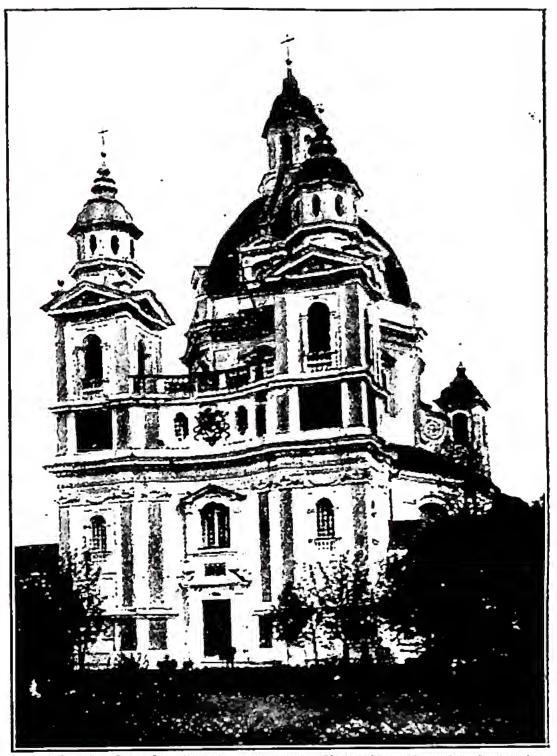
LITUANIA - Church of the monastery of Pazaislis near Kaunas.
deities capable of keeping evil spirits away, of healing with herbs or incantations. The ancient Lituani indeed felt themselves surrounded by the evil or benevolent influences of various spirits, whose names are known: slogūtis, kaūkas, āitvaras, laūmē, etc., and such mediators, who according to their various specializations were called būrtininkas, kerētojas, etc.; the documents seem to know the žyniai better than the others (žynys in the singular, from the verb žinōti = «to know»).
2. Christianity
The first contacts with Christian Europe were relatively late. In 997 the attempt to evangelize the Prussian tribes undertaken by the archbishop of Prague, St. Adalbert, failed, and he himself fell there as a martyr. A similar fate befell in 1009 the monk Brunone of Querfurt (German) and his 18 companions, martyred, according to the documents, «on the borders between L. and Russia».At the beginning of the 13th century the Order of the Sword-Bearers established itself along the Baltic coasts; it soon merged (1237) with the Teutonic Order, which had shortly before transferred itself (1230) from Palestine. The Order soon showed that it was chiefly intent on extending its territorial conquests throughout the entire country. In fact, having reached the Nemunas (Niemen) River, the Order attacked L. (1283). Since the beginning of the 13th century, L. had presented a strong, unified state formation under the power of King Mindaugas. In 1250 Mindaugas embraced the Christian faith and received the royal crown from Pope Innocent IV, while L. was declared by the same Pontiff to form part of the patrimony of St. Peter (1252). The first diocese of L. (Lethovien. dioec.) was then erected, directly dependent on the Apostolic See; its first bishop was Cristiano, a priest of the Teutonic Order. The methods of evangelization by fire and sword, however, followed by the Teutonic Knights, who did not cease to devastate the country with their incursions, were not conducive to a rapid expansion of the Christian religion. Thus, with the death of Bishop Cristiano (1279), the diocese he had founded also came to an end. The struggles lasted for almost two centuries. The Lituani defended themselves to the utmost, while at the same time extending their State toward the East.
During the 14th century there were repeated attempts to resume the Christianization of L. In 1322-23 Gediminas («Rex Lithuanorum et multorum Ruthenorum») wrote for this purpose from his capital Vilnius to many cities in Germany, to the Franciscans, and to Pope John XXII. Under his son Algirdas, in Vilnius, Naugardukas, and elsewhere, the Franciscans were not only able to carry out their peaceful missionary work undisturbed, but also openly enjoyed the protection of the Lituanian sovereigns. In 1386 the sovereign of L., Jogaila (= Ladislao Jagellone), by marrying Edvige, heir to the throne of Poland, became king of Poland itself and promised the conversion of L.; this took place in February 1387.
The diocese of Vilna (dioec. Vilnensis) was also erected in the capital. The Teutonic Order, seeing its plans of conquest jeopardized, spread the claim that the Baptism of L. was invalid and continued its military expeditions against L.; but on 15 July 1410 the united forces of L. and Poland, under the command of Vytautas the Great (1392-1430), completely defeated the Teutonic Order near Tannenberg. Thus the Teutonic claims to Samogitia also came to an end, and the Council of Constance (1417), at the proposal of Vytautas, provided for the erection of the second Lituanian diocese in this western part of L., in the region of Medininkai (Mednicens. dioec.), with its see at Varniai.
Catholicism, although introduced late, became consolidated. The long period of peace during the reign of Jogaila’s son, Casimiro IV, grand duke of L. (1440-92), contributed to this. His son Casimiro (d. at Vilna in 1484) was enrolled by the Church in the list of the saints as patron of L.
Catholicism subsequently encountered a major obstacle in the scarcity of clergy; this, together with the Teutonic Order’s passage to Lutheranism (1525) and the favor shown to Calvinism by the Polonized Lituanian nobles, contributed to the expansion of the «Reformation»; but the positions of the Catholic Church were soon regained through the zealous work of the Jesuits, Piarists, Dominicans, Basilians, and Bernardines. It was also helpful that the sovereigns of L., after the royal union with Poland (1569), which made them common to both States, were fervent Catholics. Much was also accomplished by the Lituanian bishops; for example, Merkalis Giedraitis (d. in 1609), bishop of Samogitia, who earned from the people the name of saint, and his collaborator Nicola Daukša, who in 1595 published the first Catholic catechism in the Lituanian language. King Sigismondo Vasa (1588-1632) declared Catholicism the State religion, and in 1596 the union of the «Orthodox» with the Catholic Church was proclaimed at Brest Litovsk.
In the successive partitions of Poland (1772, 1793, 1795), almost all of L. came under Russian occupation (1795-1915). The ecclesiastical jurisdictions were reorganized; but the failed political uprisings of 1831 and 1863 brought harsh and atrocious persecutions. The German occupation of 1915 also contributed to dispersing the inhabitants, who emigrated abroad in large numbers. The restoration of Lituanian independence on 16 February 1918 restored freedom to the Church, which was able to regularize the question of the ecclesiastical jurisdictions (cf. the apostolic constitution Lithuanorum gente of 4 April 1926), and on 27 September 1927 the Voldemaras government concluded the Concordat with the Holy See. In it were sanctioned full freedom of worship, jurisdiction, and governance according to its own canons; exemption of ecclesiastics from military service; compulsory religious instruction; exemption of ecclesiastical property from taxation; the State’s obligation to pay the bishops and diocesan clergy each year the sums established in the concordat; and full recognition granted to Catholic Action.
The Second World War, which brought occupation first by the U.S.S.R. (15 June 1940), then by Germany, and then once again by Russia, destroyed everything, and brought mass deportations, massacres, and imprisonments. The entire Catholic hierarchy was suppressed; the bishops were either dead or in exile.
In 1949 Pope Pius XII established the Ecclesiastical College of St. Casimiro in Rome, thus responding to the requests of the metropolitan archbishop, Mons. J. Skvireckas, who donated to the young ecclesiastics the summer residence near Tivoli, while the urban headquarters was offered by Mons. A. Briška, a Lituanian parish priest in Chicago. Provision was thus made to ensure the formation of the young Lituanian clergy destined to make good the grave losses suffered by the Church in L.
From the point of view of international law, L. continues to be recognized as a sovereign national state, only temporarily prevented from effectively exercising some of the prerogatives of its sovereignty. The constitutional organs of L., abolished within the country, continue to exist abroad, where legitimate diplomatic representatives of L. operate, fully recognized by the governments to which they are accredited. Thus, Lithuanian legations exist at the Holy See, in Washington, and in London, and their operation has been restored in Paris; a series of Lithuanian consulates also operates in America. The Supreme Committee for the Liberation of L. (v. L.I.K), which headed the resistance in the country occupied by the Nazis, after transferring its headquarters abroad, conducts the struggle in defense of L.’s lawful rights, coordinating the various initiatives of the individual Lithuanian communities in exile or emigration and acting as spokesman for oppressed L. before the UN and the various governments.
BIBLI: J. Totoriatis, Die Litauer unter dem König Mindaus, Friburgo 1908; A. Viscont, La Lithuanie religieuse, Parigi 1918; P. Klimak, Der Werdegang des Litauischen Staates, Berlino 1919; French trans., Parigi 1919; A. Giannini, Il Concordato con la L., Roma 1928; De Ecclesia Lituana, in Jus Pontificium, 9 (1929), pp. 270-80; J. Jakulis, La Lithuanie restaurée, Lovanio 1932; A. Voldemaras, La Lithuanie et ses problèmes, I, Parigi 1933; N. Turchi, La L. nella storia e nel presente, 2nd ed., Roma 1933; B. Colliander, Die Beziehungen zwischen Litauen und Deutschland 1915-18, Abo 1935; Kriššionyč Lietuvoje (Il cristianesimo in L., collective monograph), Kaunas 1938; Z. Ivinskis, A Contribution to the history of the Conversion of Lithuania, in Baltic Countries, 1 (1939); Th. Chase, The Story of Lithuania, Nuova York 1946 (extensive bibliography); K. Grčys, Katalikijski Lietuva (La L. cattolica), Chicago 1946 (extensive bibliography); H. de Chambon, La tragédie des nations bibliques, Parigi 1946; Vitols, Kaasik, Kajeckas, L'annexion des Etats Baltes, Stoccolma 1946; E. J. Harrison, Lithuania's fight for freedom, 3rd ed., Nuova York 1948; A. Šapoka, Lithuania through the ages, Monaco 1948; C. Jurgela, History of Lithuanian Nation (extensive bibliography), Nuova York 1948; Living in Freedom, A sketch of independent Lithuanian achievements 1918-48, Augusta 1948; R. Schmittlein, Etudes sur la nationalité des Aestiti, I, Baden 1948; J. Mauclère, La situation de l'Église catholique en Lithuanie, Le Raincy 1950; A. Šapoka (editor of a collective work), Lietuvos istorija (La storia della L.), 3rd ed., Fellbach-Württemberg 1950.
III. LITERATURE
Religious poetry, which developed after the adoption of Christianity as a new branch from the extraordinarily rich heritage of popular songs, is earlier in its anonymous oral form than written poetry, and created sacred songs and hymns of rare beauty and intense Christian feeling. Many are sung by the people during Mass, and also chorally within families as a collective prayer during Lent, Advent, Christmas, and Easter.The first books in Lithuanian appeared through the work of Lutheran preachers. The Jesuits, who came to combat them, promoted through popular preaching the publication of numerous Catholic books in the Lithuanian language. Among the writers of that period, mention should be made of the canon Mikalojus Daukša (1527–1613) and the Jesuit Konstantinas Širvydas (1580–1631). A place apart belongs to C. Duonelaitis (1714–89), author of a poem in hexameters entitled Metai (The Seasons).
From the religious literature of the nineteenth century there emerged the new branch of didactic narrative, composed chiefly of edifying tales for the people. Its most prolific author was the bishop of Samogitia Motiejus Valančius (1801–1875), followed by several Lithuanian priests, among them Dovydaitis and Tatarė. Meanwhile, nourished by popular poetry, the first genuinely Lithuanian representatives of cultivated poetry arose: the priest Antanas Strazdas (1763–1833), the bishop Antanas Baranauskas (1835–1902), and the priest Antanas Vienaišindys (1871–92), whose lyrical production almost immediately became part of the popular heritage and contributed greatly to keeping Catholic faith and patriotic love alive among the people. A prominent place belongs to the poet of the national revival, the prelate Janas Maironis-Mačiulis (1862–1932). A guide for the generations of an entire era, in his lyric poetry (collected under the title Pavarario Balsni [Voices of Spring]), in his poems and theatrical works, he expressed the ideals of national rebirth with evocative beauty and profound optimism. In narrative and journalism, a similar influence was exercised by the canon Juozas Tumas-Vaižgantas (1860–1933). In his masterpiece Progiedruliai (Clearings), a classic of modern Lithuanian prose, no one like him succeeded in showing how national consciousness, besides being an inner fact of the individual soul, is also a collective fact of the soul of an entire people. Another masterpiece by Vaižgantas, wholly pervaded by a Franciscan love of creation, is Dedes vi Dodienes (Uncles and Their Wives), in which he pauses to illustrate the mysterious and subtle bonds existing between the events of nature and human life.
The prelate Aleksandras Dambrauskas, alias Adomas Jakštas (1860–1938), devoted his multifaceted work to the propagation and deepening of Catholic ideology. A versatile personality, he succeeded in harmoniously and broad-mindedly uniting within himself the Christian philosophy of the East (Soloviev) with Western Thomism; always on the front line in the defense of Catholic values, he exercised an incalculable influence on the Catholic revival among Lithuanian intellectuals.
After the reconstruction of the independent State, the new literary movements reached the young writers, bringing the ideas of liberalism and Marxism alongside the other avant-garde literary tendencies then in vogue in Western Europe. Nevertheless, Catholics retained leading positions during this period as well. The principal driving force behind the movement of philosophical, pedagogical, and social thought was Stasys Šalkauskis (d. 1942), an apostolic spirit and thinker with a sound Thomistic education and a knowledge of Soloviev’s philosophy. Antanas Maceina (b. 1908) was formed at his school and now continues his literary activity in exile.
In poetry, the symbolist Jonas Aleksandriškis-Aistis (b. 1904) attained a considerable position; his lyric poetry investigates the anguishing problems of human existence, without Christian ideology managing entirely to dispel its pessimism. Paustas Kirša (b. 1891), on the other hand, meditates on the problem of eternity, toward which he advances like a pilgrim who, while journeying, seeks to grasp its mystery; whereas at first the mists hindered his vision of the essence of eternity, he now clearly glimpses the Divinity as Providence sustaining all things. Not a philosophical seeker like Kirša, but a prophet and herald of the eternal God, is Bernardos Brazdžionis (b. 1907). His lyrics often contain the antithesis between the primordial innocence of nature and humanity which, having turned away from the Creator, proceeds blindly, together with all its civilization, toward perdition. Of the poets of the present generation, Brazdžionis is perhaps the most explicitly Catholic and the most popular. Kazys Bradunas sings with talent of the feelings of the Lithuanian peasant, tenaciously attached to his land and to God.
In the field of prose, most Catholic writers describe Lithuanian life and its problems. Some of them portray figures and settings by drawing on the past and dwelling on the psychology of their people. Among these, a first-rate place belongs to Antanas Vaičiulaitis (b. 1906), miniaturist of the Lithuanian landscape and evoker of the muted suffering of humble people. Also worthy of note are the short-story writer Juozas Grušas (b. 1901) and the novelist Vincas Ramonas (b. 1905), author of Dalkeis randonam Saulelaidy (Dust in the Red Sunset) and Kryšiai (The Crosses), both of which refer to the Bolshevik invasion of Lithuania. Jurgis Jankus (b. 1906), in the form of a novel composed of short stories, dealt with human destiny under the influence of the dual totalitarian regime (Naktitant moru: The Night among the Mulberry Trees). The Bolshevik invasion forced seventy percent of Lithuanian writers into exile; those who remained in the homeland are silent, freedom having disappeared.
Giuseppe Brazaitis
IV. ART
Only with the introduction of Christianity did L. become incorporated into the common movement of Western civilization, and European art first made its appearance there with the erection of numerous churches. Some art historians distinguish, as substyles, Baltic Gothic, the Polish Renaissance, and Lithuanian Baroque, and it is undeniable that artistic production bears witness to a synthesis of heterogeneous elements, yielding an interesting and original result. A further artistic reworking, in the direction of a subsequent greater acclimatization and fusion with the indigenous artistic tradition, was carried out by anonymous craftsmen devoted to folk art; in this process of assimilation, the original Western stylistic element can be recognized only with some difficulty, so thoroughly has it been transformed through successive stages of reworking. The existence ab antiquo of a vast heritage of decorative motifs and ornaments rich in pre-Christian symbolism leads to the conclusion that, from time immemorial, the Lithuanian people cultivated art in its various manifestations in their own forms.With their conversion to Christianity, the Lithuanians placed this traditional art of theirs at the service of the Christian idea. Original in their lines, their structural details, and above all their decoration are the Lithuanian wooden churches, as well as the bell towers that rise in isolation on the churchyard and reproduce architectural motifs dear to the people.
But the archaic character of the decorative forms predominates and stands out in the countless rustic chapels and wooden crosses that constitute the country’s characteristic feature, which is often called the “land of crosses.” The variety of types of these crosses and chapels is such as to seem inexhaustible. Almost all of them, however, are characterized by an extremely rich sunburst, sometimes double or triple, since, besides the crossbar at whose height the figure of the Crucified is attached, there is almost always a wheel-shaped, variously rayed sunburst in wrought iron crowning the summit. Sometimes, in addition to the wooden figure of the Redeemer, there are also figures of the Madonna and s. Giovanni Nepomuceno, of s. Giorgio on horseback killing the dragon,
of s. Floriano extinguishing the fire, of s. Isidoro guiding the plow, of s. Antonio with the Child Jesus, of s. Francesco receiving the stigmata, of the Madonna with her heart pierced by the seven swords, and of s. Casimiro, king and protector of L. In this wooden statuary, the so-called Rupin-tojelis, that is, the pensive Christ, stands out for its powerful expression of sorrow; not even great art can claim to have achieved such expressive force. Common iconographic features are also found in folk painting and in woodcut engravings, often in several colors, which may be encountered in rural chapels or Lithuanian farmsteads.
As for cultivated or individual art, political circumstances permitted its revival only after the revolution of 1906. Among the Lithuanian painters of that period, the powerful and profound art of M. K. Čiurlionis, painter and musician, stands foremost, along with the notable works of the portrait painter A. Varnas, the landscape painter A. Žmuidinavicius, and the sculptors P. Rimša and J. Zikaras. Many other artists joined them when, after state independence was restored in 1918, work began on the foundation of the National Art Association and the Academy of Arts, as well as the art gallery named after M. K. Čiurlionis in free L. The younger generation of Lithuanian artists, raised in the independent homeland, broke with the preceding generation’s nineteenth-century romantic tendency and followed the various new contemporary movements, without nevertheless distancing themselves from the traditions of national art. - Vedi tav. XCVIII.