
LATVIA (Latvia). - A Baltic republic, proclaimed independent from the Russian Empire on 18 November 1918 and annexed, as a federated republic, to the U.S.S.R. on 4 August 1940. In 1945 a part of the Jaunlatgale district (1,160 sq. km. with 30,000 inhabitants) was detached and passed to the R.S.F.S.R. (Russian Soviet Federative Socialist Republic). In this way Latvia now extends over 64,630 sq. km., remaining the largest (though not the most populous) of the three Baltic republics incorporated into the U.S.S.R.
I. GEOGRAPHY
The territory, which forms part of the great Sarmatic lowland (maximum elevation 314 m.), is flat and well cultivated and has a coastal perimeter of about 500 km., curved by the wide Gulf of Riga. The climate has a continental character, slightly tempered along the coast.The population, which numbered 2 million before the last war, was estimated at 1.8 million in 1945 due to losses suffered as a result of military actions and the forced exodus of the German minority and those deported for political reasons in the U.S.S.R. Alongside the 75.5% of Latvians, there were, before the war, 12% Russians, 3.2% Germans, 2.5% Poles, 4.8% Jews, etc. Only one city, Riga, the capital, exceeded 100,000 inhabitants (385,000 in 1935), and one, Liepaja, exceeded 50,000 (57,000).
Agriculture (to which more than two-thirds of the population is devoted), forestry (27% of Latvia’s surface area is covered by woods), and livestock form the basis of the national economy. The first provides cereals (insufficient for domestic consumption) and especially flax, a state monopoly; the second yields a good production of timber; the third (cattle) supports, among other things, a flourishing butter industry. Mineral resources are modest (peat). Industry allowed for limited exports (cellulose, paper, and matches), but the trade balance closed before the war with a more or less significant deficit. Latvia’s integration into the Soviet economy has certainly decisively altered its characteristics, but nothing precise is known.
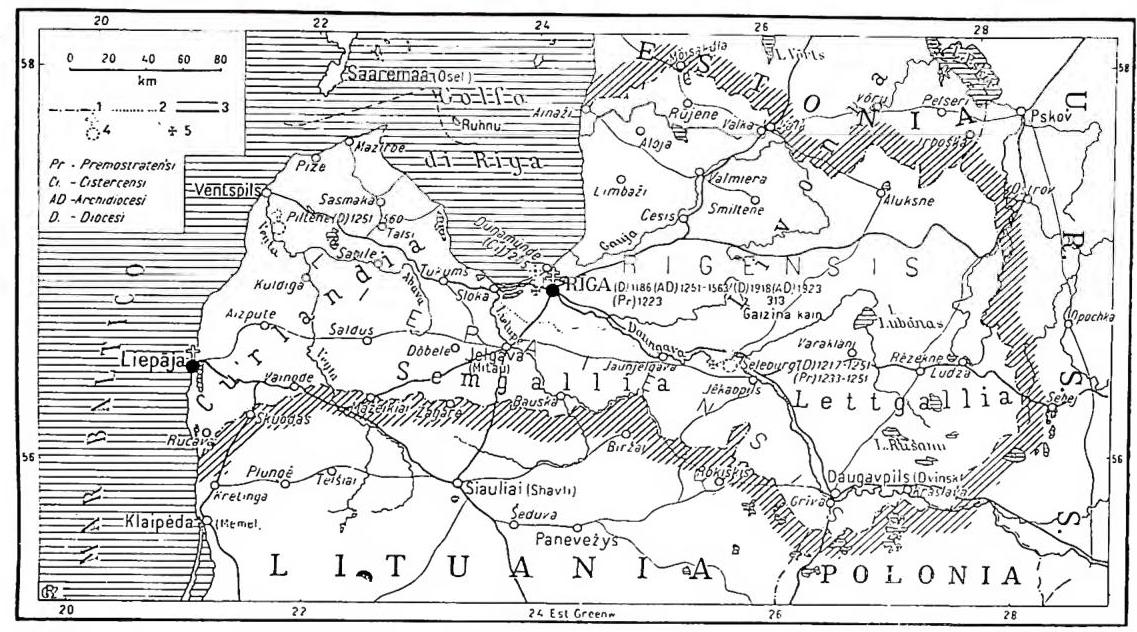
II. HISTORY
The Baltic branch of the Indo-European peoples settled on the shores of the Baltic Sea and in the adjacent territories during the first migratory waves of the Indo-Europeans, beginning from the early and middle second millennium B.C. In historical records the Balts appear, in the works of Roman writers, especially in Tacitus’s Germania, under the name Aesti.Strong demographic growth and the great expansion of the Slavs from the 6th century A.D. onward forced the various Baltic tribes, then resident in the basins of the middle Dnieper and to the north and east of it, to move northwestward, pushing some Finnic tribes, such as the Livs, toward the north. From the end of the 8th century the influx of Vikings (Varangians) brought political threats to the western Balts (e.g., the Curonians), to which they often responded by attacking the Swedish and Danish coasts.
These vast population movements led to political crystallization, that is, the creation of ethnic-political units capable of defending themselves in such situations. From around the 8th century, the appearance of Latvian state-regional units based on dialectal groups is dated; these were arranged in the basins of the country’s four main rivers (Venta, Lielupe, Daugava, Gauja). These units resisted the pressure of their neighbors until the 13th century, that is, until the Saxon attack. Their juridical and political functioning can be deduced, among other things, from the nomenclature adopted in historical records, for example, in the famous treaty of 28 December 1230 between the papal legate Baldwin of Alna and the king of the Curonians, Lammechinus.
The Christianization of the Balts occurred very late and was carried out by the German Saxons. The cause of the delay was their geographical position, which constituted a kind of wedge between the regions of the Latin and Greek Churches, as well as their centuries-long resistance against the Eastern Slavs and the Vikings. The Holy See had particular designs on this “new vineyard of the Lord” (a phrase used in the bull of Innocent III), and its project of the Terra Mariana would have been an ideal solution (cf. the bull of Pope Honorius III, 19 February 1225: Ubi spiritus Dei est debet esse libertas, and that of Gregory IX, Praefata terra, quae iuris et proprietatis beati Petri esse dinoscitur). The conquering forces of the Teutonic Order—the only one among the knightly orders of this classical period that succeeded in creating a powerful political state in Prussia and Livonia (which then included Latvia and Estonia)—gained the upper hand, and thus in place of spiritual freedom came dominium, followed as a shadow by servitus. The feudal period in Livonia, formally tied only to the Holy Roman Empire, was characterized by incessant struggles between the Order, the cities, and the bishops, who were secular rulers. Here too it was the Order that decided matters. It, which during these centuries was unus inter pares in the international political game, collapsed before the disproportionately increased forces of Lithuania-Poland and Muscovy, which was about to become Russia. This occurred in 1561, shortly after the beginning of the so-called Livonian War (the invasion by Ivan IV).
At the beginning of this century, Livonia was also one of the fields of expansion of the Reformation. This expansion took place with greater development of struggles and agitation among the burghers of the cities than among the landowners, with the impassive indifference of the rural population, “non-German.” Things intensified with the arrival of the Counter-Reformation with A. Possevino, P. Skarga, and others after the peace with the Muscovites in 1582.
The political fortunes of the eastern Baltic coast from the 16th century onward can be summarized as follows: Lithuanian-Polish Livonia (1561–1621); the Duchy of Courland (1561–1795); Swedish Livonia (Estonia; 1561); Livonia (1621 to 1710; respectively 1721); Russian Livonia (1710; respectively 1721–1918); Russian Courland (1795–1918); Estonia and Latvia again independent (1918–40); Bolshevik occupation (1940–41); German occupation (1941–44/45); Bolshevik occupation from 1944–45.
Foreign conquest first brought about the destruction and denationalization of the local aristocracy and the incorporation of an entire people into a social class (G. Merkel, 1798). Meanwhile, during the time of the Order, taxes were not excessive: they amounted to the classic tithe, as well as certain labor services, which, however, in times of war could degenerate into heavy burdens. The hardest period for the Latvians began toward the end of the 15th century, assuming in the following century the legally harsh and morally degrading form of adscriptio glebae, with nuances then fashionable of serfdom according to Roman law. Economically, this process corresponded to the formation of large estates on the ancient foundations of medieval fiefs. With the arrival of the Russians after the Northern War, the peasant was further degraded, and the records of these centuries are often depressing.
New times for the Latvian peasant came with the era of the French Revolution and the intensification of agriculture. Personal freedom, called “bird’s freedom,” was granted in Estonia in 1816, in Courland in 1818, and in Livonia in 1819, and the freedom to purchase, for large sums, the same land that centuries earlier had belonged to the Latvians, came in the second half of the 19th century, at the time of the Latvian national awakening. The agrarian law of free Latvia of 16 September 1920 annulled the social privileges of the former conquerors and gave private ownership of land plots to about one-fifth of the entire population, previously landless laborers.
During the last years of the second Bolshevik occupation, another agrarian reform has been ordered with the aim of destroying the class of small and medium landowners. The subsequent collectivization was intended to complete the enterprise of reducing, with the well-known Bolshevik terror, the Latvian peasant to the level of the Russian one and imposing on him the psychology of the human herd of the Eastern type.
Today about 10% of the Latvian population has emigrated, attempting to escape Bolshevik oppression; these people are now dispersing throughout the entire world, though forming strong national nuclei in their current countries of residence (England, the United States, Canada, Australia, etc.). In the metropolis, behind the iron curtain, terror is strong because of passive and active resistance and because of Bolshevik strategic and military plans. The more or less mass deportations of elements hostile to communism, especially of peasants, have intensified in recent times.
III. LITERATURE
The Latvian people, having long been politically subject to foreign domination, records in its past literary development a centuries-old division between popular literature and learned literature.
The beginnings of written Latvian literature date to the 16th century; these are works of a religious
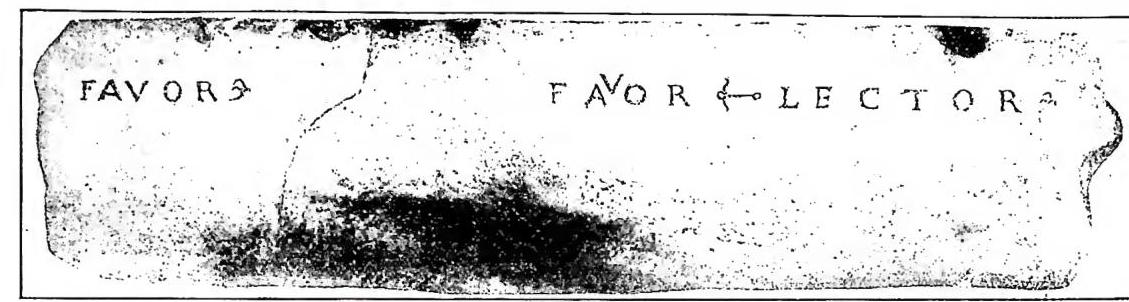
LETTORATO – Sepulchral inscription of the lector FAVOR – Rome, cemetery of St Agnes (late 2nd – early 3rd century).
Religious and confessional (Catholic and Protestant). The classic period of the development of Latvian religious literature falls in the 17th century (Mancelis’s Postillae, Fureccerus’s Poems, E. Glück’s translation of the Bible). In this and the following 18th century notable studies on the Latvian language are to be recorded (G. Stenders).
With the beginning of the 19th century the first attempts at truly national literature appear, as do the first periodicals in the Latvian language (1822). From the middle of the century, at the time of the Latvian national revival, literature had reached such maturity as to be able to create an overview of this decisive epoch, for example the historical novel by the Kaudzite brothers. Also in full bloom is lyric poetry, with classical themes (N. Alunāns) or with mythological-patriotic outpourings (Auseklis).
On the eve of the First World War various literary currents were already developed in Latvia. The most prominent names are: the playwright R. Blaumanis, the poet and narrator F. Poruks, the symbolist F. Rainis, the lyricist Aspazija, etc.
The years of independent Latvia can boast many valuable works, some already translated into foreign languages. The dominant figure is E. Virza, poet and essayist; strong and vivid are the novels of F. Grīns; deeply national are the lyrics and poetic fairy tales of K. Skalbe; the number of poets is considerable, among them the delicate poetesses E. Stērste and V. Strelberte. Most Latvian writers now live abroad, following the Russian occupation of the national territory.
IV. ART
Among the oldest evidence of Latvian artistic activity are the illustrations of the Gospel Book, once in Moscow, a work by the Latvian Iurgis (1270), whose character nonetheless does not differ from that of contemporary Russian painting of the Novgorod school. Similarly, the manifestations of popular art in the following centuries are to be related to the art of the neighboring regions, when artists from Germany and Sweden also worked in Latvia.Then in the 19th century some Latvian artists, such as the painters K. Huns (1830–77), J. Fedders (1838–1909), and J. Roze (1823–77), brought Latvian pictorial culture closer to that of other European regions, while the architects Pēkšens and Baumanis constructed noble buildings.
Toward the end of the 19th century, with the revival of national consciousness, other Latvian artists also engaged in intense activity. Among them were the painters A. Alkanis (1864–97), A. Baumanis (1866–1904), I. Rozentāls (1866–1916), T. Udris (1868–1915), A. Romana (1878–1911), and P. Kalve (1882–1913). At that time, V. Matveja (1877–1914) imitated the particular chromatic and design intonations of ancient Byzantine painting.
Among contemporary artists, special mention should be made of the architect P. Kundzins, who reworked ancient folk forms and built the church of Allazi.