
LIBIA. – Classical name originally attributed (5th century B.C.) to the entire African continent (although only a small part of it was known), and officially used after 1917 to designate the territories that came under Italian sovereignty following the victorious war against Turkey of 1911–12.
I. GEOGRAPHY
L., which fronts the Mediterranean for approximately 1,800 km., from Ras Agadir to the Gulf of Sollum, consists of several distinct natural regions: Tripolitania, a coastal plain dominated by the Gebel, that is, by the edge of the inland plateau; the Syrtica, a flat and arid coastal strip curving around the Gulf of Sidra; Cyrenaica, a compact peninsula formed by a limestone plateau fringed by a narrow coastal strip; and Marmarica, a low, likewise arid and steppe-like tableland that continues into Egypt. The inland region is occupied by a broad rocky desert (hammada) or sand-dune desert (edeien), interrupted by oases, most of which are grouped in the Fezzan, but some of which are entirely isolated (Cufra, Gadames). The climate is mild along the coastal strips, with long, dry summers and winter rains (less scanty on the Gebel and the Cyrenaican plateau), and everywhere suitable for whites. In the absence of rivers, water is obtained from the water table and (in Cyrenaica) from springs; wherever possible, the soil is cultivated, though in extremely rare and limited areas: the Gefata (olive trees, vines, almond trees), the Gebel (fruit, cereals, and tobacco), the Benghazi plateau (olive trees and cereals), and a few others. There is also woodland in Cyrenaica (434,000 ha.). Among the wild plants, alfa grass and esparto grass are noteworthy and widely used (including for cellulose). The most important cultivated products are barley, wheat, dates, wine, oil, and citrus fruits. Animal husbandry is transhumant in character; sheep and goats are raised above all. Tuna and sponge fishing are active in the coastal areas; sea salt, extracted from the coastal salt pans, is also a valuable resource. Industry is modest in scale and is directed chiefly toward products for domestic use (carpets, soap, bricks and tiles, flour milling, and oil pressing).The population (817,000 inhabitants in 1936, the date of the last census) consists of approximately two-thirds Arab-Berbers speaking Arabic, and for the remainder of Arabs (250,000), Cologli (mixed descendants of indigenous people and Turks, 42,000), Jews (29,000), and blacks (10,000). The Italians, who numbered more than 120,000 on the eve of the Second World War, are now greatly reduced in number. The Allied occupation (French in the Fezzan, British elsewhere), by causing the abandonment of the numerous and flourishing agricultural enterprises established by the Italians (almost entirely vanished in Cyrenaica), dealt a mortal blow to the country’s economic development. L. should achieve independence in 1952; meanwhile, it will be governed by a consultative commission of the UN, on which Italy is also represented. The pre-war administrative division is given below:
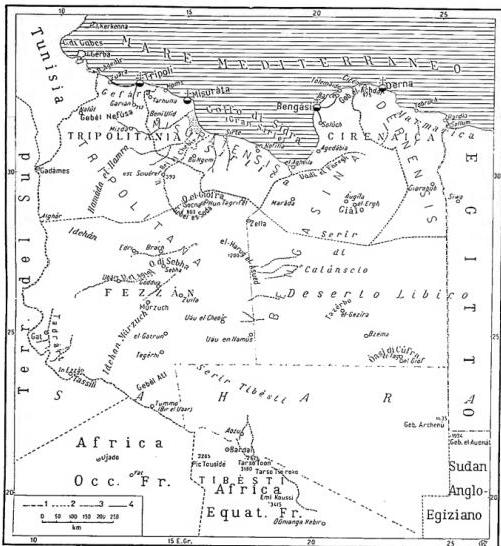 | Provinces and territories | Area in sq. km | Population | Provincial capital (and its population in thousands of inhabitants) | |
|---|---|---|---|---|---|
| resident population, 1936 census | density per sq. km | ||||
| Tripoli | 191,200 | 392,564 | 2.1 | Tripoli (96) | |
| Misurata | 98,940 | 215,877 | 2.2 | Misurata (50) | |
| Bengasi | 152,030 | 113,744 | 0.7 | Bengasi (58) | |
| Derna | 111,700 | 46,788 | 0.4 | Derna (17) | |
| Libyan Sahara Terr. | 1,205,600 | 48,403 | 0.04 | Hon | |
| L. | 1,759,470 | 817,376 | 0.5 |
and also the Vulgate adopt this twofold meaning in rendering: 1) Pâṭ (Ier. 49, 9; Ex. 36, 5), a territory along the shores of the Red Sea, probably present-day Somalia; 2) Lâbhîm (Dan. 11, 43; II Par. 12, 3; 16, 8; cf. Lâhâbhîm of Gen. 10, 13), always associated with Mîṣrâṭîm (= Egypt), designating the region west of the Nile Delta or present-day L.
In Roman times it was divided into two parts: Lower L. (Marmarica) and Upper L. (Cyrenaica). The territory was inhabited by many Jews (Fl. Josephus, Antiq. Ind., I, 6). Among those present in Jerusalem on the day of Pentecost were also Jews «inhabiting L. near Cyrene» (Act. 2, 10). The history of Christianity in L. is closely connected with that of Egypt, and its most Synesius (v.).
Donato Baldi
III. EVANGELIZATION OF L
Although some Franciscans had already been temporarily present in L. from the thirteenth century, genuine continuous missionary activity began only in the second half of the seventeenth century, with the arrival in Tripoli in 1668–69 of the first apostolic prefect, Fr. Mansueto da Castrogiovanni. Apart from individual and sporadic cases of conversion, the mission of the Franciscans was devoted to assisting European Christians. The relief of slaves, religious assistance to European merchants, and efforts to bring apostates back to the Church constituted their difficult mission, which under the Qaramanli regencies (1711–1835) obtained an explicit declaration of freedom and protection in 1732. The definitive abolition of piracy, secured through the armed pressure of France and England (1830), and immigration, especially from Italy, gave the Franciscan mission a new direction and ensured its stability.The missionaries took care to follow the immigrants in order to assist them spiritually. Whereas previously they had not gone beyond Tripoli, they were now able to extend their activity to the other cities: Benghazi, Derna, Merg, Misurata, and Homs. For the Christian education of the young, the Franciscans sought the cooperation of the Sisters of the Good Shepherd (1846–54), the Sisters of St Joseph of the Apparition (1854), and the Marist Brothers (1881). In 1859, a first hospital open to all was established in Tripoli, which at that time had approximately 2,500 faithful; conversions of Muslims also took place there. After Italy’s occupation of L. (1911–12), the apostolic vicariate of L. was established in 1913. The apostolate of the Franciscans was devoted to the spiritual assistance of the Italian colonists: pastoral care, therefore, as in Christian countries, but pastoral care exercised under the eyes of Muslims, through charitable institutions (hospitals, clinics, and shelters) and schools open also to them and their children. Conversions of Muslims subsequently occurred as well. The missionary teaching and hospital personnel consisted of the Brothers of the Christian Schools, who succeeded the Marist Brothers in 1912; the Sisters of St Joseph (1854); the Franciscan Missionaries of Egypt (1903); the Daughters of Charity of St Vincent (1912); the Sisters of the Immaculate Conception (1912); the Sisters of the Holy Family (1920); and the Franciscan Missionaries of Mary (1925). In 1927, the apostolic vicariate of L. was divided into two vicariates: Tripolitania (now Tripoli) and Cyrenaica (now Benghazi), entrusted to the Franciscans. In 1939, the apostolic vicariate of Derna, entrusted to the Pious Society of Salesians of d. Bosco, and the apostolic prefecture of Misurata, entrusted to the secular clergy and later given to the Franciscans, were detached.