SACRA FAMIGLIA. - I. LITURGY
The liturgical cult of the Holy Family is recent.
Its first manifestations are found only in the seventeenth century, in Italy, France, and Belgium. From France it spread to Canada, where it underwent notable development, chiefly through the efforts of the ven. servant of God Francesco Montmorency de Laval, first bishop of Québec (d. 1708), and of the b. Margherita Bourgeois (d. 1700). The feast, with the rite of a second-class feast, was celebrated on the second Sunday after Easter.
Meanwhile, concessions multiplied elsewhere as well, on the most disparate dates, such as, for example, the second, third, or fourth Sunday after Easter, the last Sunday of May, and the third Sunday of November.
proposed that the titular feast be celebrated on the Sunday within the octave of Epiphany, because of the ideal proximity between the Christmas feasts and the Holy Family. But Leo XIII, on 14 June 1893, fixed the feast for the third Sunday after Epiphany, establishing in addition that it should be granted without further formality « omnibus petentibus ». Leo XIII himself composed the hymns for the Office.
The International Marian Congress of Saragossa (1908) promoted the extension of the feast to the entire Church; the b. Pius X, on the other hand, had it removed from almost all particular calendars (1914), and where it was retained, it was fixed for 19 January. At the same time, however, permission was granted to celebrate two votive Masses on the third Sunday after Epiphany; but following numerous petitions, Benedict XV permitted it on the Saturday preceding that Sunday (1920). The following year, however (26 October 1921), while expressing the hope for an ever wider diffusion of the Association of the Holy Family among the Christian faithful, as an effective example to be followed, he extended the feast of the Holy Family to the entire
Church, assigning it to the Sunday within the Octave of Epiphany with the rite of a greater double feast. As the lesson of the second Nocturn, in place of the sermon of St Augustine In psalmos, a text from Leo XIII’s brief of 14 June 1892, Neminem fugit, on the Holy Family, was inserted.
II. ART
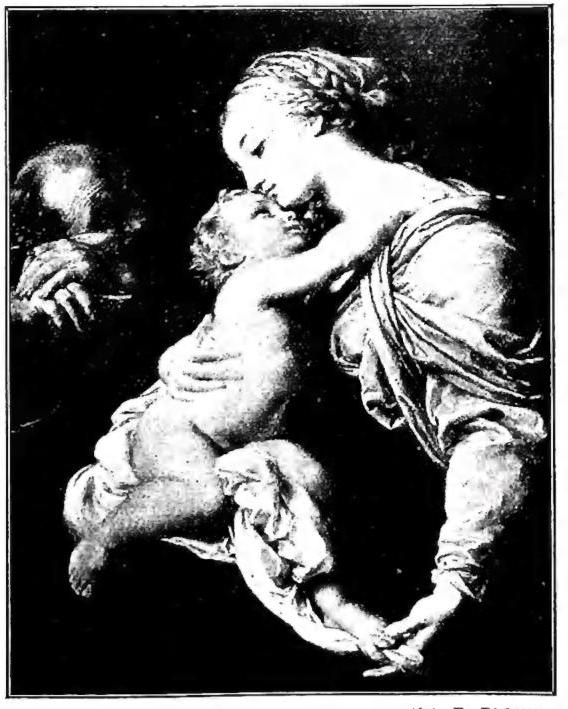
The simplest image of the Holy Family depicts only three persons: Maria, St. Giuseppe, and the Child Jesus; it often also includes St. Giovannino playing with the Child Jesus. St. Elisabetta, too, is not infrequently present. Thus they may fin-SACRA FAMIGLIA - S. F., painted by Pompeo Batoni (ca. 1765). Rome, Pinacoteca Capitolina.
[Non-Text]
The Ground Truth image displays a single, solid horizontal line. According to Rule 2 (UNDERSCORE & LINE RULES), this is a stylistic or background line, not a placeholder underscore. Therefore, the OCR result must ignore it and output nothing or only meaningful text. The provided OCR content is "____", which consists of four underscores. This is an incorrect interpretation of the line as a placeholder, violating the rule that stylistic lines must be ignored. The OCR has hallucinated underscores where none should exist based on the GT's visual context. Hence, the OCR result is inconsistent with the Ground Truth.
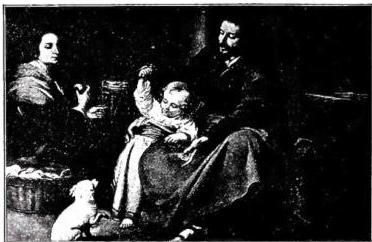
SACRA FAMIGLIA - S. F. called del Pajarito, painted by Murillo (17th century). Madrid, Museo del Prado.
one may find in representations of the S. F. as many as four, or even five, persons, besides whom various saints and adoring angels sometimes appear. The conception of the representation aims to evoke a tranquil image of life, of absolute peace and purity, in the house of s. Giuseppe at the time of Our Lord’s childhood, reflecting an intimate happiness and a sublime blessedness in the gentle atmosphere of family life. These representations are a late iconographic type in sacred art; they did not appear before the Italian Renaissance.
As an early example one may cite the tondo by Pinturicchio, datable to around 1480, in the Galleria di Siena. Several three-person S. F., painted in tondi, were left to us by Florentine painting of the early sixteenth century; among them, first place must be given to the tondo in the Galleria degli Uffizi painted by Michelangelo in 1504 for the marriage of Agnolo Doni and Maddalena Strozzi. The Uffizi also preserve tondi with the S. F.: one by Signorelli and another by Franciabigio. The Gabinetto delle Stampe of the Uffizi possesses a drawing of the S. F. by fra' Bartolomeo della Porta, also in tondo form.
There are also numerous S. F. by Raffaello and his school. The most famous is the altarpiece painted by the master in 1518 for the king of France, Francesco I, now preserved in the Louvre. This altarpiece, with five sacred persons and two angels, became a true prototype for the numerous Mannerist representations of the late sixteenth century, among them that by Scipione Pulzone in the Galleria Borghese in Rome. It may be observed that in some S. F. by Raffaello, s. Giuseppe is in the background and smaller in size than the Madonna, s. Elisabetta, the Christ Child, and s. Giovannino. Thus he appears in the S. F. called della Perla, painted by Raffaello in 1518 and now preserved in the Prado in Madrid, and in that by the same master in the Museo nazionale di Napoli. Raphael’s followers likewise gave s. Giuseppe a less prominent place in their various S. F., as may be seen in the Madonna della Gatta by Giulio Romano, one replica of which is in the same Museo nazionale di Napoli and another in the sacristy of S. Maria d'Aracoeli in Rome. The well-known panel in the Museo nazionale di Napoli, called Madonna del Passeggio, the work of an immediate follower of Raffaello, likewise presents s. Giuseppe in the background of the picture, in tiny proportions. Among the many other S. F. left to us by Italian Renaissance painting, one of the most notable is that by Bernardino Luini in the Pinacoteca Ambrosiana in Milan, as well as the lunette-shaped fresco over the door in the chiostro della S.ma Annunziata in Florence, called Madonna del Sacco, a masterpiece by Andrea del Sarto, to whom we also owe a fine S. F. in the Galleria Borghese in Rome. Sodoma too painted several S. F., among which the most important is
that in the Palazzo pubblico at Siena, where the Christ Child is seen being adored by s. Francesco, and the serene panel in the Galleria Borghese in Rome. Among Renaissance works one may also cite the S. F. by Cesare da Sesto, owned by the Pinacoteca di Brera in Milan.
The art of northern Europe in the early sixteenth century also devoted itself to depicting the S. F.; this may be illustrated by a naïve woodcut by Lucas Cranach the Elder, datable to 1508, in which the sacred group is seen being adored by hosts of dancing little angels. In the late sixteenth century, in northern Europe, s. Giuseppe was sometimes indicated only incidentally; thus, for example, in an S. F. by Jan Bruegel called dei Velluti, in the Galleria Doria in Rome, where the composition is reduced to a Madonna with the Christ Child set against a magnificent landscape, in the midst of which a small s. Giuseppe may be seen.
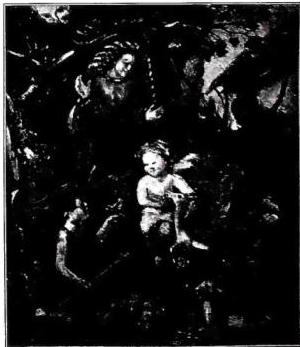
At the dawn of the seventeenth century a special variant came into being: the S. F. was depicted resting during the flight
into Egypt. This variant belongs to the centuries-old iconographic genre of the Flight into Egypt, of medieval tradition, now reformed and reshaped according to the new concepts of intimacy associated with the S. F.
SACRA FAMIGLIA - S. F. returning from Egypt, oil painting by Orazio Amato (1950).
Several S. F. were painted by Rubens, among them one, with three figures, is in the Royal Gallery in Turin, and another, with five figures, in the Pitti Gallery in Florence. The S. F. paintings by van Dyck are even more numerous: among them, the most noteworthy are the one with five figures, owned by the Royal Gallery in Turin, and the one with three figures in the Alte Pinakothek of Munich. They are a vivid image of intimate family life, and this characteristic, common to all seventeenth-century representations, is particularly heightened in the form of a gentle genre scene in the S. F. by B. E. Murillo, a masterpiece of Spanish painting, preserved in the Prado Museum in Madrid. In general, however, the S. F. paintings of late-seventeenth-century Italian painters retain a less realistic character. Such are Sassoferrato’s canvas in the Doria Gallery in Rome and Carlo Maratta’s in the Capitoline Picture Gallery in Rome.