
SACRA CONVERSAZIONE. – A composition in which images of saints are depicted in attitudes and expressions of conversation, either with one another or with the Virgin and Child.
There are hints of it in the fourteenth century, but the genre reached its full development in the first decades of the fifteenth; the animation of the figures and the spontaneity of their affections led to a participation in real life, owing to the irruption of the humanistic conception of life into the new figurative canons of art.
In the Tuscan school of the mid-fifteenth century, the theme of the S. C. appears for the first time: in intimate conversation, the ss. Cosma and Damiano, Francesco and Lorenzo, Antonio and Pietro martire are gathered in pairs around Giovanni B. in a rectangular marble exedra set against the background of a garden, in Filippo Lippi’s painting of 1457–58, now in London at the National Gallery. This type of S. C., however, found no following among painters. While in Tuscany the theme of the S. C. either died out or assumed a different grandeur in complex altarpieces, from the end of the fifteenth century onward it was treated principally by the Venetians. At first there is a composition in which, shown three-quarter length, figures are represented at the sides
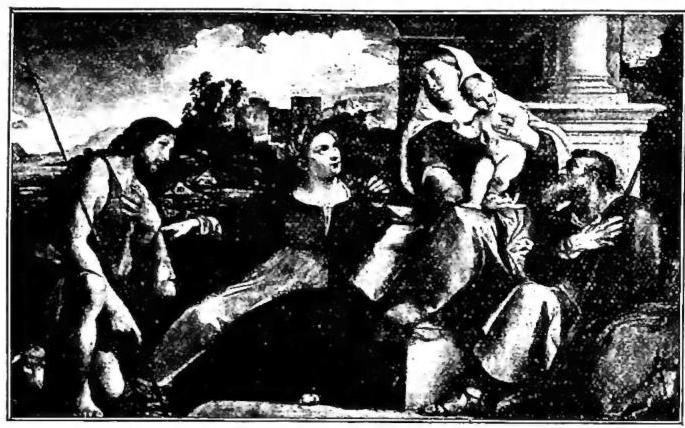
Alongside the S. C. set in a closed and austere environment, there was at the same time a full development of the open-air S. C., carried forward by Palma il Vecchio, who in his balanced compositions achieves a sense of pastoral idyll. In a broad landscape, many saints are seated or kneeling in harmonious disorder around the Virgin and Child, often accompanied by s. Giuseppe, as in the one in the Accademia of Venice. At times these S. C. take their subject from the presentation to the s. Vergine by the saints of one or more donors, arranged on a level lower than that of the sacred figures; thus, in Palma’s S. C. in Naples of 1523–25, two donors kneel at the foot of the elevation on which Maria and the saints stand, and on their behalf s. Girolamo and s. Giovanni address entreaties to the Virgin, while the Child watches them attentively. Maria Laura De Nicola