
BRIGIDA (Swedish and Latin Birgitta), saint. — Foundress of the Brigittine Order of St. Saviour.
I. LIFE
Born, it seems, in the year 1303 at Finsta Castle in Uplandia (Sweden), she died in Rome on 23 July 1373. The sources for her biography consist, first and foremost, of her own writings, of a Vita s. Birgittae compiled by her confessors and theological advisers Petrus of Alvastra and Petrus of Skänninge, and of the records of the process for her canonization. Of lesser documentary value is the Vita s. Birgittae by Bertholdus, a monk of the Brigidine Order in the fifteenth century, reproduced in the Acta SS., as is also an anonymous verse biography, Vita metrica s. Birgittae.S. B. could boast an aristocratic ancestry, being the daughter of one of the most eminent figures of her time, the powerful governor of Uplandia, Birger Persson, and of Ingeborg Bengtsdotter, of the old royal lineage of the Folkungar. Her mother’s family was well known for its profound religious devotion, and Finsta Castle, where B. lived with her parents until the age of twelve, when her mother died, was a center of high culture, more religious than secular, with strong tendencies toward mysticism; it could not fail to exercise a decisive influence on the formation of her character. At only ten years of age B. had her first conversation with Christ, and already as a young girl she displayed a vibrant enthusiasm for asceticism. After her mother’s death she was sent to one of her aunts, Ingrid, wife of the kingdom’s Grand Chancellor, Knut Jonsson, to complete her education. In the year 1318 she married, for political reasons, the eighteen-year-old Ulf Gudmarson, who later became governor of Ostrogoria, and the young couple took up residence at Ulvåsa Castle. Her husband, who was also of royal lineage, had a mild and rather weak character, and during the marriage, which produced four sons and four daughters, another aspect of s. B.’s character had the opportunity to develop and stand out: her iron will, her practical energy, and her indomitable perseverance. Her life was divided between the administration of her very considerable estates, a high court office—for in 1335 she was summoned as first lady-in-waiting by Queen Bianca of Namur, wife of King Magnus—and her duties as wife and mother. Court life brought her into direct contact with the troubled political life of the period and awakened in her a keen interest in European politics, an interest she thereafter always maintained.
At the center of her life, however, religion remained indisputably paramount. She summoned to Ulvåsa the foremost Swedish theologian of her time, the canon of Linköping, Magister Matthias, as her confessor and personal adviser in religious matters. Through his teaching she became acquainted with the contemporary mystical and apocalyptic religious literature, which played a major role in her spiritual formation. Alongside this study, the reading of Holy Scripture and of the works of s. Bernard of Clairvaux helped perfect her religious education. She also gathered around her other teachers of theology, such as Nicolaus

(phot. Ensmrott)
This year represents a highly significant date in the life of s. B. She left Ulvåsa and took up residence Alvastra (v.), where she received the first of a long series of religious revelations. These revelations generally came to her in a state of ecstasy, and upon awakening she either wrote them down herself or dictated them in Swedish to her confessor, who subsequently undertook their translation into Latin. According to the content of the first revelation, Christ had called her his bride and chosen her as an instrument to lead people onto the path of Christian righteousness. In the subsequent revelations she vehemently denounced the moral corruption of the time, and especially the court life of King Magnus; she also sought to restore peace between France and England through divine messages and to induce the Pope to return to Rome. Magister Matthias corrected the Brigidine revelations from a dogmatic and theological point of view. They spread rapidly through the various centers of Europe, giving their revelator a clear reputation as a prophetess and considerable influence in the political and religious world. It was during these years that
s. B. conceived the idea of founding a new religious Order called that of the Holy Savior, whose rule was dictated to her in one of the revelations. Meanwhile substantial donations began to reach her, and in 1346 the king, in his will, donated Vadstena Castle, together with extensive lands, for the future convent. In order to obtain the Pope’s approval of her rule, she went to Rome in 1349, arriving there with a large retinue during the jubilee year of 1350. She probably took up residence in the house of Francesca Papazura at Campo Marzio, later left to the convent of Vadstena as the “Hospitale S. Birgittae de Regno Sueciae” for Swedish pilgrims, and eventually transferred to the possession of the new nuns of s. B., a refounded and modified form of the original Order (1911). The house, with its adjoining church and chapel, is located at Piazza Farnese 96, where the cells of s. B. and her daughter Caterina can still be visited.
In Rome s. B. devoted herself to charitable works, study, spiritual exercises, and dictating her revelations. In the latter she repeatedly urged the Pope, in very clear and sometimes even threatening language, to return to Rome, and it seems that she exercised a certain influence upon the
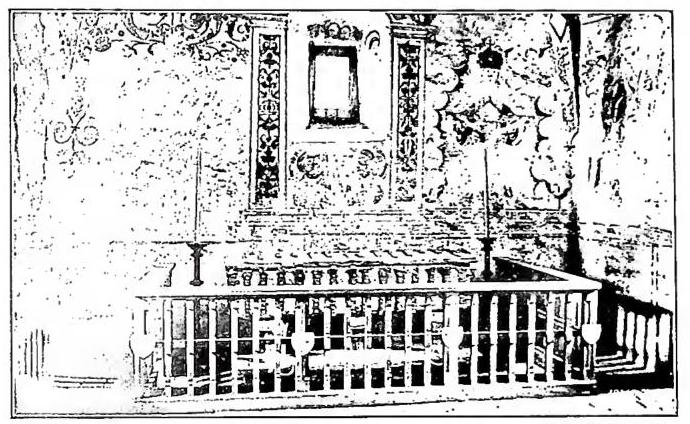
BRIGIDA, saint. – The chest in which the body of the Saint was carried from Rome to Vadstena – Chapel of St. Brigida in the church of the monastery of Vadstena, now a Lutheran parish church.
politics of the Avignon curia. In 1370 she received from Pope Urban V, by means of a bull issued at Montefiascone, the sanction of her rule, with certain reservations. The new Order was to follow the Rule of St. Augustine, but in the convent of Vadstena and in the foundations dependent upon it, life was to follow the prescriptions given in the rule of St. B. Thus it took on a wholly distinctive development, characterized by the double monastery for monks and nuns, with a common church. Under the direction of Pietro di Skänninge, a special ritual was composed, the so-called Cantus sororum, with two rectriceschori, two versiculariae, and a lectrix. The rule was confirmed by Urban VI in 1378, and the Order—in its most fruitful and flourishing period—seems to have had some seventy monasteries scattered throughout Sweden, Finland, Denmark, Germany, the Netherlands, Italy, Spain, and England. After the Council of Basel (1436), which did not take a clear position regarding the revelations, and after the Reformation in the Scandinavian countries, the Order rapidly declined (concerning the modern restoration of the Order: V. ORDINE DELLA SANTA CROCE. SALVATORE e DI S. BRIGIDA).
Having attained the goal so ardently desired with the sanction of her rule, s. B. went on pilgrimage to the Holy Land at the beginning of 1372. Returning to Rome the following year, her health ruined, she died there on 23 July 1373. Her mortal remains were transported to her Vadstena. As early as 1379, with the support of Popes Gregory XI and Urban VI, the process for her canonization began; it was successfully concluded on 7 October 1391.
S. B. is without any doubt the most interesting and outstanding personality of the Nordic world in the late Middle Ages. Nor should one fail to note how, alongside her religious and political activities, her remarkable literary gifts also emerge. Indeed, her writings inaugurate Swedish literature and are marked
by a poetic force, a pregnant and narrative style, and a concrete vivacity that assign her not only a place of honor in the history of Swedish literature but also make her the source of a supreme influence upon the whole of the sacred literature of the late Middle Ages.
II. THE REVELATIONS
Because of this characteristic work, B. is called the “mystic of the North.” Her vocation is described in solemn, almost biblical terms, in Rev. Extr. 47: in B., the prophetic mission is inscribed within the charism of mystical union. Providence had already prepared her for this mission through her noble education, her contacts with all sectors of society, and her numerous readings, especially of Sacred Scripture, her “most precious treasure” (at her request, Magister Matthias had prepared a Swedish version of it: cf. G. Jörgensen, I, p. 55); after the death of her husband (12 February 1344), she was prepared for it still more directly through an abundance of supernatural communications in the solitude of Alvastra, where B., by exceptional concession, was allowed to take up residence as an “oblata” in an dependency of the monastery. Thus began the first cycle of Revelations, the Swedish one (1344–49), marked by prophetic missions to the court of Stockholm, among the great and the clergy: Marian revelations; ecclesiastical revelations concerning the Order of the Most Holy Savior then being founded; revelations to the seven “angels” (bishops) of her nation; concerning Swedish sovereignty; concerning the decline of Christian Chivalry; concerning the proclamation of the second jubilee in Rome; and the related message that the prior of Alvastra and the bishop of Abo brought to Clement VI in Avignon.With B.’s arrival in Rome, at divine command, on the occasion of the jubilee of 1350, a second cycle of Italo-Roman Revelations begins (cf. Rev. Extr. 8): at Milan, then in St. Peter’s during the opening of the Holy Door (24 December 1349), and on many other occasions, with warnings and threats from the Lord, exhortations to penance and the corresponding assurance of forgiveness, and above all appeals to the Pontiffs to return to the City. Rome and its basilicas recall the visionary, carried away in ecstasy near the Catacombs of the Appian Way, or near the tombs of the Apostles and the ancient martyrs. In the Basilica of St. Paul, a marble statue depicts her listening to Jesus, who speaks to her from the ancient image of the Crucified Christ, still venerated there.
Another cycle of Revelations is associated with her pilgrimages to the Sanctuaries of Italy (1364–70): Assisi (St. Francis), Ortona a Mare (St. Thomas the Apostle), Monte Gargano (St. Michael the Archangel), Bari (St. Nicholas), Benevento (St. Bartholomew), Naples, with various missions to the court of Queen Giovanna and the nobility, Salerno (St. Matthew), and Amalfi (St. Andrew).
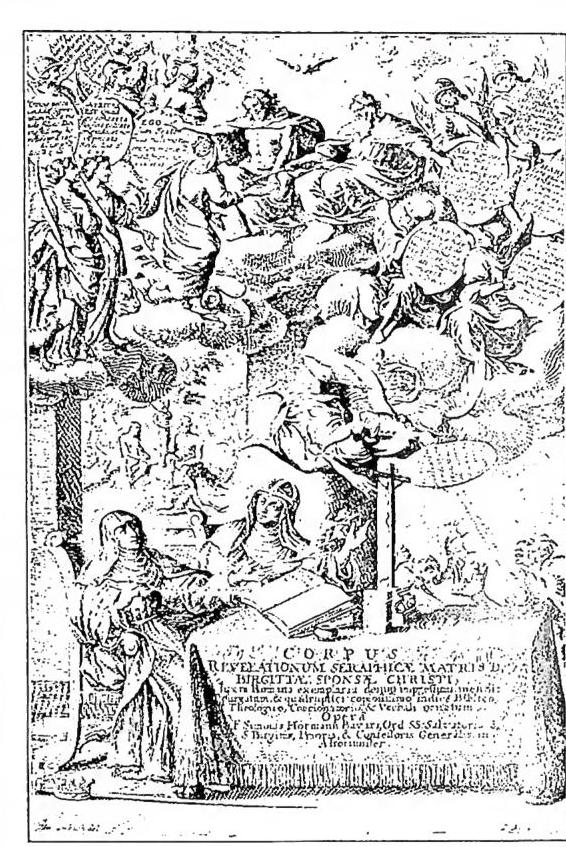
BRIGIDA, saint “Frontispiece of the Corpus Revelationum of St. B. Copper engraving by V. Humbach (Munich 1660).
return journeys, in Cyprus, with warnings and messages for the people, the court of Famagusta, and the Byzantine Empire itself.
B. received all these visions and revelations while awake and in ecstasy (Rev. IV, 77; cf. IV, 78; VI, 52). She often had bodily visions and sensible auditions, while at the same time being enlightened as to the meaning of these symbols, and her heart was inflamed. At other times she heard voices without seeing who was speaking, but recognized her interlocutors: the Lord, the Angels, and the Saints. Sometimes she had only intellectual illuminations, yet even then recognizing what was communicated to her through revelation. Often, however, B. experienced anguished doubt as to whether the phenomenon she had undergone was divine; in such cases a new revelation reassured her, sometimes also reminding her of the criteria for the divine authenticity of her revelations (“cognoscendi bonum vel malum spiritum”: cf. Rev. I, 4; III, 10; IV, 78).
Moreover, the Lord and the Virgin required her, as a matter of principle, to submit her visions to the judgment of her directors (cf. Rev. IV, 78; cf. I, 52). Magister Matthias (d. 1350), in the prologue to the Revelations of the Swedish period, enumerates the evident signs of their divine origin. He had such confidence in B. that he asked her to consult the Lord concerning the interpretation of the Apocalypse for his commentary (cf. Rev. VI, 89).
The words that B. heard in ecstasy remained distinctly impressed upon her memory until she had confided them to her secretaries, who translated them into Latin; afterward she remembered only their general meaning. Protesting their fidelity, they report that B., after learning Latin in Rome, checked the work to ensure the accuracy of their version.
1. The Collection. — At her death B. left a group of “friends of God” (often alluded to in the Revelations: cf. I, 55; IV, 11; VI, 76), whom she had maternally gathered around her, convinced of their particular divine election, imbued with her spirit, and animated by invincible hopes and zeal for the dissemination of her message. Among them were Petrus de Skinninge, Petrus of Alvastra, and, from 1368, the hermit Alfonso of Vadaterra, resigned bishop of Jaén in Spain. They undertook not only to translate the Revelations of the Roman and Palestinian periods into Latin as they appeared, but also to collect them, joining them to those of the Swedish period, so that at B.’s death they could refer to the books of the Revelations in the Life of the Saint that they had prepared for her canonization. This work of arrangement is due chiefly to Alfonso of Jaén (cf. Rev., VII, 31; Extr., 49). Returning to Sweden (1380), the two Petrus completed the Brigittine corpus, which the monks of Vadstena subsequently presented in definitive form in the editio princeps of Lübeck in 1492.
In this edition the Revelations are grouped into 8 books, together with a supplementary collection called, in juridical terminology, Revelationes Extravagantes. Two books have a special title: V is called Liber quaestionum, and VIII Liber caelestis Imperatoris ad reges. At the beginning of Book I is the Prologus of Magister Matthias of Sweden; at the beginning of VIII, Alfonso of Jaén’s Epistola solitarii ad reges.
To these Revelations properly so called are added, between VIII and the Extravagantes, the Regula 1. Salvatoris (revised in canonical style for Roman approval), and the Sermo Angelicus de excellentia B. Mariae Virginii, adapted and divided into 21 chapters for liturgical use (3 lessons for each day of the week), as well as 4 Orationes, each preceded by a prologue.
Each revelation (chapter) is preceded by a summarium; quite a few are also followed by several Declarations. If one sets aside I. V (or “of the Whys”), concerning a vision that B. had on the road to Vadstena, in dialogical form, between a proud monk and his divine judge; VIII (Ad reges: exhortations to rulers); and the final part of IV (that is, chapters 132–44: Tractatus ad sacerdotes et ad Summus Pontifices), the collection presents no logical or chronological order. Some revelations are repeated. In I. VII, the visions experienced in the Holy Land predominate. There is no critical edition. The best is that of Gonzalvo Durante, bishop of Montefeltro (Rome 1606), who enriched the editio princeps with explanatory Notae, a theological commentary on the individual Revelations. It is prefaced by part of the Defensorium of Cardinal Giovanni of Torquemada and Paul V’s brief of approval, Cum sicut accepinus (24 July 1606). In the even more authoritative reprint of 1628, he added a large Tractatus de Revelat. 1. Brigittae. It demonstrates B.’s submission to the Church in doctrinal matters, her agreement with the authorized doctors in free opinions, and her Thomistic tendencies. This edition, reprinted at Munich in 1680, was enriched with extensive indexes by Fra Simone Hörmann, prior of the Brigittine monastery of Altomünster (Bavaria).
2. Partial collections
These consist of excerpts made from the Birgittine corpus for ascetical purposes, e.g.: 1) Caeleste viridarium, compiled by Alfonso of Jaén; 2) Onus mundi, taken from I. IV, Rome 1485; 3) Opusculum Vitae et Passionis Christi eiusque Genitricis Mariae, Antwerp 1489; 4) Thesaurus animae fidelis, Cologne 1517.3. General characteristics
A literary and mystical masterpiece, the Revelations of B. are composed in a lively, imaginative, and at times dramatic style, wholly pervaded by a powerful and fascinating poetic breath. Although the Latin form in which they have been transmitted does not possess classical elegance, it is nevertheless dignified. The Saint’s soul is revealed therein in its «chivalrous» grandeur, trembling with indignation at injustices and at the unworthiness of the clergy and the great.The spirituality of B., because of its relations with the religious orders, belongs chiefly to the Cistercian school, and reflects the Franciscan school as well (she was a Franciscan tertiary). Its characteristic note is strength, not separated from admirable discretion. The great ideas of God’s sovereignty and justice, and at the same time of his infinite mercy, recur frequently in the Revelations; because of this the Lord can tell her never to «do justice without mercy» (Rev., I, 7), even toward the damned themselves (Rev., II, 12; cf. III, 28); as does the idea of Providence, particularly directed toward the souls of the just, who are called to cooperate in divine redemption (cf. Rev., I, 56; IV, 77); and that of the Rome of Christ, «most excellent and most holy», whose squares are «paved with the blood of the martyrs» (Rev., III, 27; VI, 63).
The Saint describes the kingdoms of the world beyond (cf. Rev., VI, 52), which, together with the present world, constitute the four cities (of trial, purification, sorrow, and glory), with four different loves (Rev., III, 28: a concept perhaps inspired by St. Augustine); and she seems to have foreseen, as Pius XI himself customarily admitted, the establishment of Vatican City (cf. Rev., VI, 74).
B. also expresses the great Catholic devotions to Christ’s Humanity, to the Most Blessed Virgin (whose glories she sings and whose Immaculate Conception she exalts: Rev., VI, 49 [«Ego concepta fui sine peccato originali»]; cf. I, 9; V, at the end; VI, 55; Sermo Angelicus, 10), especially as Mother of Sorrows, and to St. Joseph, whose cult was still kept in the shadow within the Church (cf. Rev., VI, 59); to the Angels, particularly the guardian angel (cf. Rev., I, 9); and she embraces the local devotions of the shrines that she visits. For this reason the Revelations also influenced medieval piety and art (cf. E. Mâle, L'Art religieux de la fin du M. A. en France, Paris 1908, pp. 80, 81, 118, 125, 128).
4. Theological value
These Revelations were not received with enthusiasm by everyone; alongside the apologists there were also critics and doubters: there was reluctance to grant credibility to «visionary» little women (mulierculae) (s. B. and s. Catherine of Siena), who assumed the role of advisers to the Head of the Church (cf. G. Gersone, De examinatione doctrinarum, II, 3, and De probatione spirit., 3, in Opera omnia, I, Antwerp 1706, cols. 16 and 38).The question, brought before the Council of Constance (cf. Hefele-Leclercq, VII, p. 184 ff.), was debated even more harshly at the Council of Basel (cf. Acta SS. Octobris, IV, Brussels 1780, pp. 409-12), where a request was made for the censure of the Revelations on the basis of a list of 123 articles drawn from them. But the Scandinavian bishops and the Dominicans defended them effectively, and Giovanni di Torquemada, Master of the Sacred Palace and later a cardinal, composed a Defensorium, correcting all 123 articles point by point (Mansi, XXX, 697-814).
Moreover, Gregory XI and Urban VI had already judged them favorably (cf. Acta SS. Octobris, IV, pp. 406-18), and Boniface IX had them rigorously examined for B.’s canonization, recognizing her as endowed with «prophetic spirit» (bull Ab origine mundi, 7 October 1391).
Ratification by the councils was sought so that, given the schism, the party dissenting from Boniface IX might also recognize the holiness and mission of the visionary; the canonization was confirmed by Giovanni XXIII at the Council of Constance (2 February 1415), and again at Florence by Martin V, the ecumenical pope (bull Excellentium principum, 1 July 1419). The Revelations were reexamined at the Council of Basel (1433-36), where, however, the claim of those who wished to assimilate the Revelations to the Gospel was rejected (cf. Rev. Extr., 49), and it was declared that many passages required clarification and revision.
Incidental defects are indeed not lacking, owing to the influence of the period’s environment (cf., for example, Rev., IV, 13, concerning Trajan’s liberation from Hell, also recalled by Dante, Purg., X, 76) and to the intermingling of human activity with God’s action.
Benedict XIV’s judgment therefore remains definitive. Asking what one must think of private revelations, even when approved by the Church (such as those of ss. Hildegard, B., and Catherine of Siena), he replies that one must neither can nor ought to grant them «assensum fidei catholicae, sed tantum fidei humanae, iuxta regulas prudentiae, iuxta quas praedictae revelationes sunt probabiles et pie credibiles» (De Serv. Dei Beatif., III, 53, 15; cf. II, 32, 11).
Catholics have always held B.’s writings in high esteem (cf. Pietro Canisio, De Maria Virgine, I, 7), since reading them elevates and strengthens the spirit.
Igino Cecchetti