
HOLY DOOR. - A walled-up door found in Rome, in the patriarchal basilicas of St. Peter's in the Vatican, St. John Lateran, St. Paul Outside the Walls and St. Mary Major on the Esquiline, beside the main entrance, and which is opened on the occasion of the celebration of universal Jubilees.
The Holy Door of the Vatican Basilica is opened by the Supreme Pontiff on Christmas Eve immediately preceding the Holy Year (v. GIUBILEO), with entirely special and characteristic ceremonies, during which the Supreme Pontiff strikes three blows with a golden hammer at the center of the door, intoning the verses: Aperite mihi portas institutae. Introibo in domum tuam, Domine. Aperite mihi portas, quoniam vobiscum Deus. At the same time three cardinals legates a latere proceed to the opening of the other Holy Doors. On the eve of the following Christmas the four Holy Doors are closed with the inverse ceremony.
Such doors are called holy, not only because with their opening and closing the year of the Jubilee, commonly called the Holy Year, begins and ends, but principally because, as Ricci observes, «by the Supreme Pontiff and by the cardinals his legates de latere, the stones, the lime and the cements with which they are sealed are blessed, invoking the Name of Our Most Holy Redeemer...» (O. Ricci,
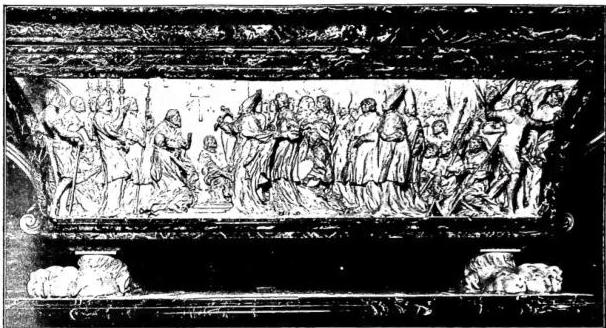
De' Giubilei universali celebrati negli Anni Santi, Rome 1675, p. 17). The opening of the P. S. in the celebration of the Holy Years has an undoubted reference to many events which according to the ancient law are said to have taken place before the doors of the temple and to the fact that, as St. Cyprian affirms, the doors of the churches were closed to sinners (Ep., 31). There is certain record of the opening of the P. S. and of the related rite on Christmas Eve of 1449 (jubilee year 1450), under the pontificate of Nicholas V (cf. Pastor, I, p. 429).
To obtain the indulgence of the Jubilee it is not necessary to enter or leave through the P. S. (S. Penitenz. Apost., Monito of 17 Sept. 1949, in AAS, 41 [1949], p. 516, XII, 4th).
Bibliography4 works
Serafino de Angelis