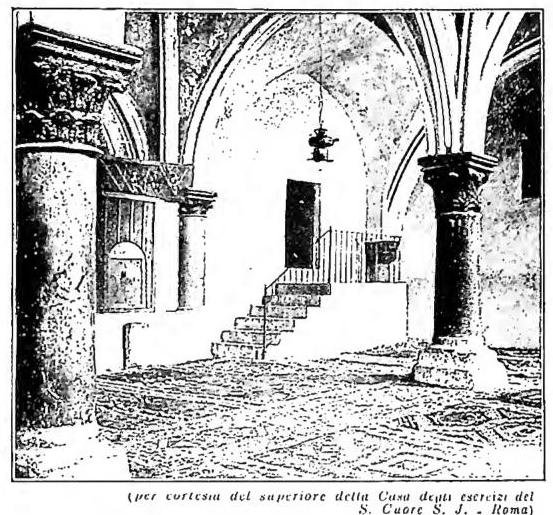
CENACOLO di GERUSALEMME. - A Gothic-style hall inside the Mohammedan mosque called Nebi Dâ'ûd ("prophet David"), southwest of Gerusalemme, outside the present walls, on the hill called Sion. This mosque has two floors; on the lower floor,
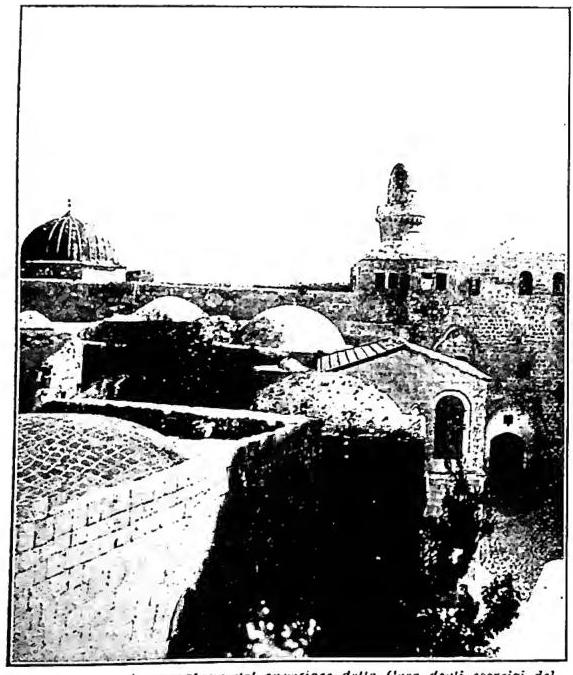
It is still controversial whether it is the same place where Jesus instituted the Eucharist, where the Risen Lord appeared several times, and where the outpouring of the Holy Spirit took place. From the first Christian centuries, on the hill Sion there was a little church called «of the Apostles»; writers of the 4th century attest that in it the descent of the Holy Spirit was venerated, while they are silent about the institution of the Eucharist. Thus s. Cirillo, bishop of Gerusalemme (Cateches., 16: D. Baldi, Enchiridiou Locorum Sanctorum, Gerusalemme 1935, n. 370, p. 602), the Peregrinatio Aetheriae (D. Baldi, op. cit., n. 732, pp. 603-605), and s. Epifanio (De mensuris et ponderibus, 14: D. Baldi, op. cit., n. 733, pp. 605-607). The texts of the New Testament are not decisive. Mc. 14, 15 and Lc. 22, 12 call the room of the institution of the Eucharist ἀνάγαιον (= upper part of the house, upper room). When the Apostles returned to Gerusalemme after the Ascension, they went up εἰς τὸ ὑπερῷον, which also means «upper room». The Vulgate has in both places coenaculum. In the same place the risen Jesus appeared to the Apostles, they elected s. Mattia, and received the Holy Spirit (Act. 1, 15-26; 2). If the identity of the room cannot be deduced from these texts, neither can it be deduced that different rooms are in question. On the other hand, witnesses of tradition since the 4th century affirm that in the said church the memory of the institution of the Eucharist was also celebrated: Didascalia di Addai (D. Baldi, op. cit., n. 733, p. 606, note 2), Epistola 53 of s. Girolamo (D. Baldi, op. cit., n. 734, p. 607). From the 5th century onward, testimonies in favor of the identification continually increase. Furthermore, pilgrims recount that in the church of Sion the house of Maria, mother of Giovanni Marco, was also venerated; others also see in it the house of Giacomo; the column of the flagellation was also venerated there, and from 415 the body of s. Stefano rested there. The house of the evangelist s. Giovanni and the place where the Madonna died were also located on Sion. Around the year 400, the primitive little church was transformed into a large basilica that was given various names by different writers: «house of God», «S. Sion», «mother of all churches». This basilica suffered greatly from the raid of the Persians (614) and in 966 was burned down by Jews and Muslims, but was rebuilt by the Crusaders as a double church. This was destroyed in 1219. Around 1335, King Roberto of Napoli obtained the C. for the Catholic Church from the sultan of Egypt; and his wife, the pious