
CUSTODIA DI TERRA SANTA. – An international institution composed of Franciscans chosen from all parts of the world, which, by the will of the supreme pontiffs, presides over the worship and honor of the Holy Places of Palestine. It arose with the end of the Latin Kingdom of Jerusalem, when the Holy Land was reoccupied by the Muslims and all the Christian sanctuaries remained in their hands. The Friars Minor then returned to the country where they had already been during the Crusading period and, gradually, with the favor of the sultans of Egypt and the assistance of the Catholic powers of Europe, took custody of the principal Holy Places. In the first half of the fourteenth century, through the intervention of the kings of Naples, they obtained possession of the Cenacle; then, through the intercession of the kings of Aragon, the Holy Sepulchre of Jerusalem, and first the Grotto and then the basilica of the Nativity at Bethlehem. Pope Clement VI, with his two bulls Gratias agimus and Nuper carissime of 21 November 1342, confirmed the happy results that had been achieved, assuring the Franciscans custody of those places. The dilapidated basilicas were promptly restored; possession and worship were then extended to the sanctuaries of St. John the Baptist at 'Ajn Kârim, St. Peter at Jaffa, the Annunciation at Nazareth, and St. Peter at Tiberias.
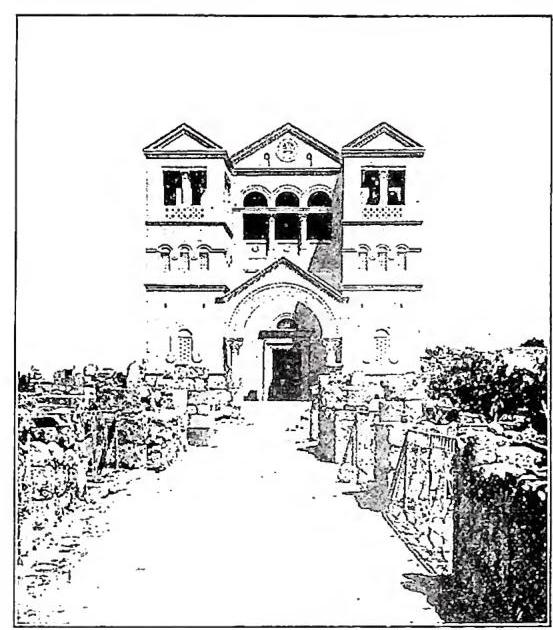
(photo: Custodia di Terra Santa)
CUSTODIA DI TERRA SANTA - Basilica of the Transfiguration on Mount Thabor, erected by the C. di T. S. Architect Antonio Barluzzi (1922).
in Saidâ, Beirut, Tripoli in Lebanon, Damascus, Aleppo, Alexandretta in Syria, Larnaca and Nicosia on the island of Cyprus, Cairo and Alexandria in Egypt, Constantinople and elsewhere. Meanwhile, however, the C. di T. S. was losing its principal convent because in 1551, by order of Sultan Suleiman, it was deprived of possession of the Holy Cenacle, which it had held for more than two hundred years, and had to transfer to the new convent of St. Saviour in Jerusalem. But it was to suffer other expropriations and abuses thereafter as well.
In 1565, during a naval raid carried out by Pietro di Lusignano in the port of Alexandria in Egypt, the religious of Jerusalem were massacred. In 1422, when the Catalans had seized the sultan’s ships, the Franciscans were deported to the prisons of Damascus, while the doors of the Holy Sepulchre, the Cenacle, and Bethlehem were walled up. In 1510, after the Knights of Rhodes had defeated the Muslim fleet in the waters off Jaffa, the friars were deported to the prisons of Cairo and the convents were plundered by the mob. The same occurred after the battles of Tunis (1534), Lepanto (1571), and others, when the Franciscans were killed, their houses and works attacked, and the sanctuaries profaned.
The supreme pontiffs, through more than 300 bulls, continually reaffirmed their confidence in the sons of St. Francis, conferring upon them those spiritual and ecclesiastical powers that were necessary for the government of the Catholic communities of the East. The Custodian of the Holy Land, in fact, throughout all those centuries and until 1848, possessed ordinary authority, as vicar and apostolic commissary, over the Latins of the countries of the Levant; and, as representative of the Church and of the Catholic powers, he was held in high esteem at the sultans’ courts, first in Cairo and later in Constantinople, and among all the Christian, Jewish, and Muslim peoples of the Islamic empire. The C., representing the Latin world, flew its flag of five crosses on a white field, which it had inherited from the fallen crusader kingdom of Jerusalem and which was requested as an honour by Latin ships sailing the Mediterranean, since it protected them from the frequent raids of pirates. In short, it was like a Christian state in the heart of the Islamic East.
The European powers, including the Republic of Venice, the kings of France and Aragon, Spain, and others, competed in supporting the C. of the Holy Places through diplomacy and offerings, enabling it to face the difficulties and expenses caused by the Muslim governments.
Indeed, during the first three centuries the life of the Franciscans unfolded almost entirely within the sanctuaries, in the celebration of worship and of the Christian mysteries. They always devoted special care to the pilgrims who flocked from every part to visit those places, welcoming them and guiding them in visits to the sanctuaries, and protecting them from the frequent abuses of the inhabitants.
Beginning in the sixteenth century, they began opening free schools within their convents and founding new ones near their religious houses, thereby providing Christian and literary education to boys. They also devoted themselves at all times to the evangelization of Muslims, although with meagre results and at the risk of their lives, since Islamic laws were hostile to every conversion. More successful, however, were the results they achieved in their apostolic work among the ecclesiastical authorities and the faithful of the various Christian rites, in order to lead them to the unity of the Catholic Church, both in Lebanon and Syria and also in Palestine.
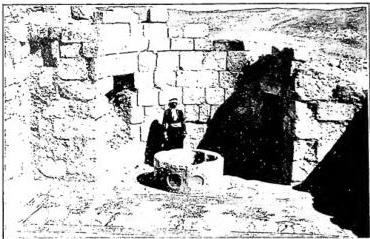
(phot. Custodia di Terra Santa)
CUSTODIA DI TERRA SANTA – Baptistery of the sixth-century Byzantine Basilica on Mount Nebo.
educational and sports youth organizations, excursions for Oriental studies, seaside hospices, and carries out many other religious and social activities throughout the East. – Vedi tav. LXXIII.
BIB.: G. Golubovich, Biblioteca bio-bibliografica della Terra Santa e dell'Oriente francescano, Quaracchi 1906 ff. (1st series: up to 1400; 2nd series: documents up to 1800). For a general overview: D. Baldi, La C. francescana di T. S., Torino 1918; for the sanctuaries, convents, and works: Status descriptiva Missio-nis Terrae Sanctae, Gerusalemme 1924. A rich bibliography is reviewed in A. Cirelli, Gli Annali di Terra Santa editi dal p. E. Mencherini e bibliografia di Terra Santa del medesimo editore, Quaracchi 1919, pp. 465–644. For a summary knowledge of the subject cf. [G. Zanella], Memoriale sui Luoghi Santi, Roma 1945. Giulio Zanella